
Fill out your information, and we'll do the calculations for you
Blog Details
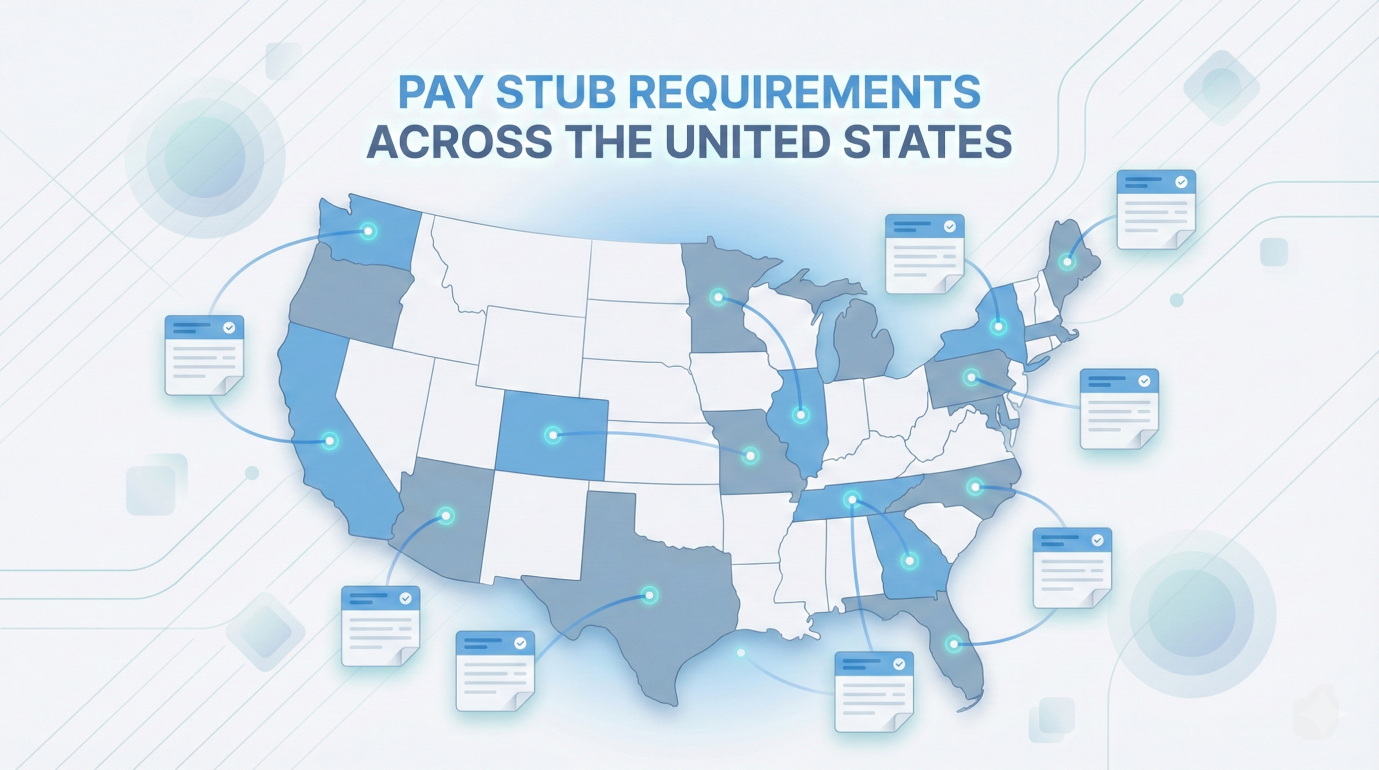
Pay Stub Requirements by State (2026) + Chart & Checklist
Most people think a pay stub is “just proof of pay.” In law, it is a wage statement (also called a pay statement), and states can require very specific details on it, especially around hours, rates, deductions, and leave balances. Some states are strict and penalty-heavy (California is the classic example).(Source Justia Law)
One important baseline: there is no single federal law that forces every employer to give a pay stub—but federal rules do require employers to keep accurate pay and time records. That is why state wage-statement rules matter so much in 2026, particularly for multi-state and remote teams. (Source:- DOL)
This guide gives you:
- A “universal” pay stub checklist that is safe in most states
- Clear state-by-state highlights (including special cases like farm labor and temp staffing)
- Practical rules for digital pay stubs in 2026
Compliance note This is informational, not legal advice. Always confirm edge cases (union CBAs, public works, agriculture, staffing agencies, hospitality tip credits, and local rules).
Quick Answer (2026 Pay Stub Rules)
In 2026, pay stub rules are mostly set by state law. Many states require employers to give a wage statement each payday, and even where a state does not list strict formatting rules, a clear pay stub is still the safest standard.
A compliant pay stub usually includes:
- Employee name and employer legal name + address
- Pay period start and end dates, plus the pay date
- Hours worked (regular + overtime, if applicable) and rate(s) of pay
- Gross wages, itemized deductions/withholdings, and net pay
- Paid leave balances (PTO/sick time) where your state requires it
Digital pay stubs are generally valid if employees can access them on payday and print or save a copy for their records.
Fast takeaway: If your pay stub shows the items above, you will meet the requirements in most states and avoid the most common compliance issues.
What a Pay Stub Should Show (Works in Nearly Every State)
If you want a pay stub format that is “hard to break,” include these every pay period:
Employee + employer
- Employee name + an identifier (employee ID; last 4 SSN only where allowed)
- Employer legal name + address (and phone when possible)
Pay timing
- Pay period start and end dates
- Pay date (date wages were issued)
Pay calculation
- Hours worked (regular + overtime; add double-time if you use it)
- Rate(s) of pay (hourly/salary/piece/commission; show each rate used)
- Gross wages
- Net pay
Deductions + withholdings (itemized)
- Federal, state, local taxes (as applicable)
- Social Security + Medicare
- Benefits, retirement, garnishments, other deductions (clearly labeled)
Balances where required
- Paid sick leave / paid leave accrual and usage (many states require disclosure)
This “full detail” approach is also what helps employees (and lenders/landlords) understand and trust the statement—reducing disputes.
Digital Pay Stubs vs Paper in 2026
A digital pay stub is generally acceptable when employees can access it on payday and retain it (view/print/save). Some states are explicit that employees must be able to print, and at least one state calls out access to an employer-provided computer if the employer goes fully electronic.
Best practice for electronic delivery
- Provide secure access (portal or email PDF)
- Make it printable and downloadable
- Keep a consistent archive employees can retrieve later
- Have a simple “paper copy on request” process (especially for employees without easy portal access)
At-a-glance: States with “No Specific Pay-Statement Details” Rule
A small group of states is commonly listed as not requiring specific information to appear on pay statements for most employers:
That does not mean “do nothing.” It means the state does not spell out exact fields the way strict states do. For consistency and risk reduction, most employers still issue detailed itemized stubs.
State-by-State Pay Stub Requirements (2026 Highlights)
Below are highlights in human language—what the state generally expects to see on (or with) the wage statement, and special cases worth noticing. The source basis for these summaries is a payroll compliance chart updated November 21, 2025 (still the most useful consolidated view heading into 2026).
Alabama
Alaska
- Include pay period dates, hours, rate(s), gross/net, and itemized deductions/withholdings.
- Paid sick leave usage and balance disclosures may be required.
Arizona
- Include earnings + withholdings.
- Provide earned paid sick time details (available, used to date, and pay received as sick time) on the statement or attachment.
Arkansas
California (Strict)
- Required fields are detailed (gross wages, hours worked for non-exempt, piece-rate details when applicable, deductions, net wages, pay period dates, employee ID/last 4 SSN, employer legal name/address, hourly rates and hours at each rate, etc.). (source :- Justia Law+1)
- California also has strong enforcement/penalty exposure when wage statements are incomplete or unclear. (source :- Justia Law )
Colorado
- Include gross/net, withholdings, deductions, pay period dates, employee identifier, employer name/address.
Connecticut
- Include hours, gross earnings (often separating straight time and overtime), itemized deductions, net earnings.
- Includes paid sick leave accrual/usage details when applicable.
Delaware
District of Columbia (Strict + Tips)
- Requires a detailed statement including pay date, gross/net, hours, rates, and more.
- Hospitality/tip reporting can be a key requirement area.
Florida (Special case)
- Pay-statement content rules apply to farm labor contractors and labor pool (labor hall) employers: provide an itemized statement showing each deduction. (Source:- adp )
Georgia (Special case)
- Rules apply to labor pool and work-site employers for temporary employees: show hours worked, rate of pay, and deductions. (Source:- adp )
Hawaii
Idaho
Illinois
- Requires hours, rate, gross/net, and deductions; written notice rules apply when changing pay rates.
Indiana
Iowa
Kansas
- Often tied to employee request: itemized earnings/deductions and how computed within a set timeframe.
Kentucky
Louisiana
Maine
Maryland
- Requires a statement each period with hours, rates, gross/net, and withholdings/employer identification.
Massachusetts
- Requires employee/employer identification, pay period timing, hours, rates, deductions, and gross/net.
Michigan
Minnesota
- Detailed earning statement requirements; also includes special handling for electronic delivery access expectations.
Mississippi
Missouri
Montana
Nebraska
Nevada
New Hampshire
New Jersey
New Mexico
New York (Strict)
- Workers must receive a wage statement each payday with key details like gross/net, deductions, hours, and pay rate. (source:- Department of Labor)
North Carolina
North Dakota
Ohio
Oklahoma
Oregon
- Requires pay date, dates covered, employee/employer identifiers, rates/basis of pay, gross/net, and itemized deductions.
- Paid sick leave accrual/usage disclosure may be required on the statement or attachment.
Pennsylvania
- Requires wage computation details and deductions (hours/rates often included).
Puerto Rico
- Requires wage statement details; pay frequency and deductions disclosures are important.
Rhode Island
- Requires key wage statement items and pay period coverage details.
South Carolina
- Has wage statement rules in certain contexts (including gross pay/deduction transparency).
South Dakota
- No state-law requirement to include specific details on the pay statement for most employers.
Tennessee
- No state-law requirement to include specific details on the pay statement for most employers.
Texas
- Requires a written earnings statement with core wage calculation details (name, rate, gross/net, etc.).
Utah
- Requires itemized deduction disclosures.
Vermont
- Requires wage statement details including hours/earnings and deductions clarity.
Virginia
- Requires wage statement disclosures and deductions transparency; employer/employee info may be required.
Washington (Strict)
- Washington requires an itemized statement showing pay basis (hours/days), rates, gross wages, deductions, pay period identification, and payment date. (Source:- Washington State Legislative Information)
- Paid sick leave disclosure can also apply.
West Virginia
- Requires wage calculation detail transparency (rates/earnings/deductions).
Wisconsin
- Requires wage details such as hours/rates and earnings disclosures.
Wyoming
- Requires itemized deduction disclosures and wage statement clarity.
2026 Pay Stub Compliance Checklist
Use this checklist before issuing any pay statement:
- Employee name + identifier (employee ID; last 4 SSN only where permitted)
- Employer legal name + address (add phone/FEIN when possible)
- Pay period start + end dates
- Pay date
- Regular hours + overtime hours (and any other hour types you track)
- Rate(s) of pay and basis (hourly/salary/piece/commission)
- Gross wages
- All taxes withheld (federal + state/local if applicable)
- Social Security + Medicare
- All deductions itemized (benefits, retirement, garnishments, etc.)
- Net pay
- Leave balances (paid sick leave / paid leave accrual and use where required)
- If electronic: employee can access, save, and print the stub
Common Reasons Pay Stubs Fail Compliance Checks
- Missing pay period dates (common issue in audits and disputes)
- No itemization of deductions (lumping everything together)
- Rates not shown when multiple rates are used in the same pay period
- Hours missing for non-exempt hourly workers
- Leave balances missing where required (paid sick leave disclosure states)
- Digital stubs that cannot be printed or saved (employees cannot retain their records)
Creating a “Safer-by-Default” Pay Stub
If your goal is to reduce risk across multiple states, the safest approach is simple: generate a pay stub that always includes the full set of “universal” fields plus any state-specific disclosures you need (leave balances, piece-rate, tips, etc.). A generator like ePayStubs can help because it forces consistent formatting, itemization, and clear totals.
Recent Posts
If the white whale be raised it must be...

The new rules of personal finance in...

Every business owner must be able...