


Wisconsin Paystub Generator - 4 Brackets to 7.65%, Manufacturing Credit Makes Factory Tax Near-Zero, SS Exempt, Free Preview
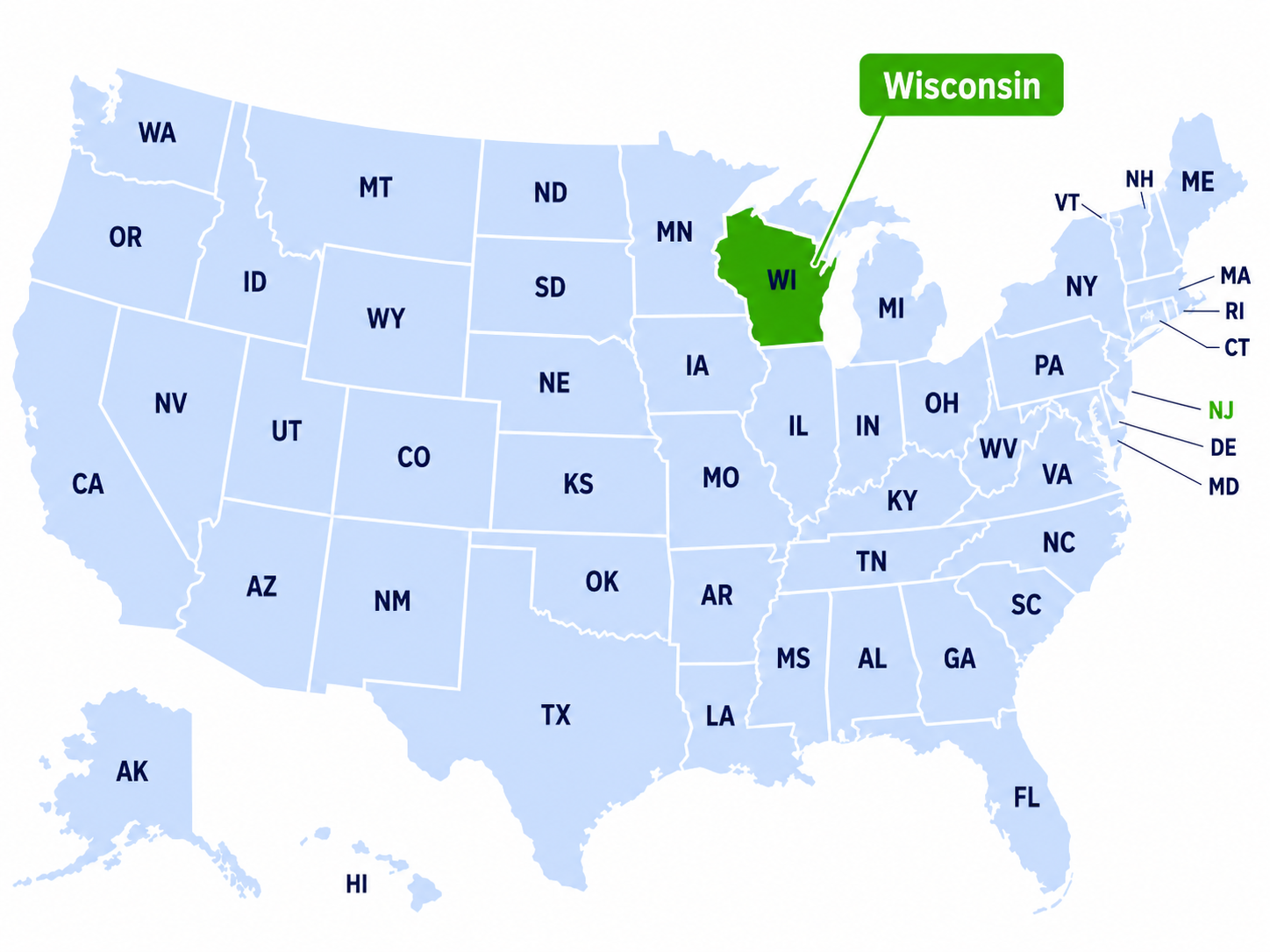
Wisconsin has a 7.65% top income tax rate. That's the number on the headline. But for the hundreds of thousands of people who work in manufacturing or agriculture, the actual rate is close to zero. The Wisconsin Manufacturing and Agriculture Credit (MAC) wipes out nearly all state income tax on qualifying factory and farm income. Per CountryTaxCalc (May 2026): "A manufacturing company earning $5 million in Wisconsin income would ordinarily face up to $382,500 in Wisconsin income tax, but with the MAC, the actual liability would be closer to $7,500 to $10,000."
The other Wisconsin story nobody tells: your standard deduction disappears if you earn more than $73,630. That's not a typo. Per the Wisconsin Department of Revenue withholding formula, the standard deduction phases out between $17,780 and $73,630 for single filers. At $74K, you get zero. A worker earning $40K gets a $4,038 deduction. A worker earning $75K gets nothing. This jump increases the effective rate substantially for middle earners and virtually nobody explains it.
Our Wisconsin paystub generator applies the correct 2026 brackets (3.50%-7.65% per WI DOR) and calculates all federal deductions. Four stub lines. No local tax. Two minutes. No signup. Free preview. For a take-home-pay estimate, use our Wisconsin paycheck calculator.
Works for employees, contractors, and small business owners across Milwaukee, Madison, Green Bay, Kenosha, Racine, Appleton, Eau Claire, Oshkosh, and all of Wisconsin.
- Free preview — see every line item before you pay anything
- No account or signup required
- Updated for Wisconsin 2026 payroll details, including 3.50% to 7.65% state brackets
- Covers W-2 employees and 1099 contractors
- No Wisconsin local income tax, SDI, PFML, or paid family leave deduction
- Useful for workers across Milwaukee, Madison, Green Bay, Kenosha, Racine, Appleton, Eau Claire, and Oshkosh
- Instant PDF delivered by email or direct download
| State Income Tax | Progressive, 4 brackets: 3.50%, 4.40%, 5.30%, 7.65% |
| Manufacturing Credit | MAC credit makes factory/farm income nearly tax-free |
| Standard Deduction | $6,702 (single) but PHASES OUT. $0 above ~$73,630. |
| Local Income Tax | None anywhere in Wisconsin |
| Stub Lines | 4: Federal, Social Security, Medicare, WI State |
| Social Security | Fully exempt (no threshold, no phase-out) |
| Military Retirement | Fully exempt (since 2022) |
| Property Tax | ~1.61-1.85% avg (3rd highest in US). Milwaukee County: 2.02%. |
| Sales Tax | 5% state + local. Most areas 5.5%. City of Milwaukee: 7.9%. |
| SDI / PFML | None |
| Minimum Wage | $7.25/hr (federal, since 2009). Tipped: $2.33. |
| Reciprocal Agreements | IL, IN, KY, MI (NOT Minnesota) |
"I work at a parts manufacturer outside Milwaukee. My paycheck shows the 5.3% bracket rate on the stub, but at tax time the Manufacturing and Agriculture Credit wipes out most of the state liability. Last year I got almost all of my WI income tax back. My buddy who works in financial services at Northwestern Mutual doesn't get that credit and pays the full rate. Same state, wildly different effective rates depending on your industry."
- Tom R., West Allis, WI
"I got a raise from $68K to $78K and my take-home barely changed. I couldn't figure out why until my accountant showed me that Wisconsin's standard deduction completely disappeared at $73K. The raise pushed me over the phase-out threshold, so I lost my entire deduction while moving into a higher effective bracket. Nobody warned me about that cliff."
- Sarah K., Madison, WI
Wisconsin's 4 Tax Brackets for 2026 (3.50% to 7.65%, Some Sources Show the Wrong First Rate)
Per the Wisconsin Department of Revenue (January 2026): "Wisconsin individual income tax rates vary from 3.50% to 7.65%, depending upon marital status and income."
| WI Taxable Income | Rate |
|---|---|
| $0 to ~$14,320 | 3.50% |
| ~$14,320 to ~$28,640 | 4.40% |
| ~$28,640 to ~$315,310 | 5.30% |
| Over ~$315,310 | 7.65% |
Married filing jointly thresholds are wider (top bracket at ~$420,420). The 5.30% bracket covers the vast majority of WI earners. Per CountryTaxCalc: "For most middle-income Wisconsin earners, the effective rate sits in the 5.30% bracket."
Some Sources Show the Wrong First-Bracket Rate
The WI DOR says 3.50%. CountryTaxCalc and AmericanTaxService show 3.54%. One source shows 4.65% as the second-bracket rate instead of the correct 4.40%. The WI Department of Revenue is the authoritative source: the correct first-bracket rate is 3.50%, not 3.54%.
The Standard Deduction Disappears Above $73K (And Nobody Tells You This)
Wisconsin doesn't use the federal standard deduction. Instead, it has its own state-specific deduction that shrinks as your income rises and eventually hits zero. Per the WI DOR withholding formula:
| Annual Gross Earnings | Standard Deduction |
|---|---|
| Under $17,780 | $6,702 (full amount) |
| $30,000 | ~$5,236 |
| $40,000 | ~$4,036 |
| $50,000 | ~$2,836 |
| $60,000 | ~$1,636 |
| $70,000 | ~$436 |
| $73,630+ | $0 |
The formula: $6,702 minus 12% of the amount over $17,780. At $73,630, it hits zero and stays there. A worker earning $40,000 gets a $4,036 deduction. A worker earning $75,000 gets nothing. The tax on that $75,000 is calculated on the full amount with no deduction at all. Per Wealthvieu (May 2026): "The standard deduction phase-out affects higher earners significantly."
Married filing jointly: the deduction starts at $9,461 and phases out using a 20% formula between $25,727 and $73,032. At $73,032+, married filers also get zero.
This is highly unusual. Most states either follow the federal standard deduction or have a fixed state deduction that doesn't change with income. Wisconsin's phase-out creates an effective rate cliff around $73K where a raise can actually result in less take-home per dollar because the deduction evaporates simultaneously.
What Gets Taken Out of a Wisconsin Paycheck: Two 2026 Examples
Milwaukee Manufacturing Worker, $26/hr, Biweekly
Setup: Tom works at a parts manufacturer in West Allis. He earns $26/hr, biweekly, 80 hours, files Single on federal W-4. Annual gross: $54,080. WI standard deduction at this income: ~$2,344 (partially phased out).
| Line Item | Amount |
|---|---|
| Gross Pay (80 hrs x $26.00) | $2,080.00 |
| 1. Federal Income Tax (per IRS Pub. 15) | - $210.00 |
| 2. Social Security, 6.2% | - $128.96 |
| 3. Medicare, 1.45% | - $30.16 |
| 4. WI State Tax (~4.3% effective, deduction partially phased out) | - $89.44 |
| Estimated Net Pay | About $1,621 |
Four lines. WI state tax of $89.44 per biweekly check ($2,325/year). But here's the twist: because Tom works in manufacturing, the MAC credit could eliminate most of that state tax liability at filing time. His net effective WI rate could drop from 4.3% to near zero. The credit doesn't change the withholding on each paycheck, but it comes back as a refund.
Madison Tech Worker (Epic Systems), $42/hr, Biweekly
Setup: Emily works at Epic Systems in Verona (Madison area). She earns $42/hr, biweekly, 80 hours, files Single. Annual gross: $87,360. WI standard deduction at this income: $0 (fully phased out).
| Line Item | Amount |
|---|---|
| Gross Pay (80 hrs x $42.00) | $3,360.00 |
| 1. Federal Income Tax | - $450.00 |
| 2. Social Security, 6.2% | - $208.32 |
| 3. Medicare, 1.45% | - $48.72 |
| 4. WI State Tax (~5.1% effective, NO standard deduction) | - $171.36 |
| Estimated Net Pay | About $2,482 |
Emily's $87,360 puts her well past the $73,630 threshold where the WI standard deduction hits zero. Her entire taxable income is subject to the progressive rates with no deduction cushion. Her effective WI rate is about 5.1%. If she earned $70,000 instead, she'd still have a small $436 deduction. The $17K raise from $70K to $87K didn't just push income into higher brackets; it also erased her deduction entirely.
Emily doesn't qualify for the MAC credit because Epic Systems is a healthcare IT company, not a manufacturer. She pays the full rate. Tom at the parts factory pays near-zero after the MAC credit. Same state, different industries, dramatically different effective tax rates.
Estimates based on 2026 WI DOR rates and standard withholding. Actual amounts depend on your federal W-4, WI WT-4, and voluntary deductions.
The Manufacturing and Agriculture Credit: How Factory Workers Pay Near-Zero State Tax
Wisconsin's headline rate of 7.65% is misleading for manufacturing workers. Per CountryTaxCalc (May 2026): "Wisconsin's Manufacturing and Agriculture Credit effectively creates a near-zero income tax rate on qualifying manufacturing and agricultural income."
The math is dramatic: "A manufacturing company earning $5 million in Wisconsin income would ordinarily face up to $382,500 in Wisconsin income tax, but with the MAC, the actual liability would be closer to $7,500 to $10,000." That's a 98% reduction. The credit applies to qualifying income from manufacturing, processing, fabrication, agricultural production, and qualifying supply chain activity.
Per CountryTaxCalc: "This makes Wisconsin significantly more competitive for manufacturing businesses than its headline 7.65% top rate suggests." Workers at Harley-Davidson (Milwaukee), Johnson Controls (Milwaukee), Oshkosh Corporation (Oshkosh), SC Johnson (Racine), John Deere (various locations), Rockwell Automation (Milwaukee), and hundreds of smaller factories across the state benefit from the MAC credit. The credit flows through to individual tax returns for workers at qualifying businesses.
Wisconsin's manufacturing sector remains the backbone of the state economy. Per CountryTaxCalc: this credit is "why Wisconsin's manufacturing sector remains strong despite other high-tax factors." If you work in a factory, food processing plant, or agricultural operation in Wisconsin, your effective state income tax rate is dramatically lower than the 5.30% or 7.65% shown on your pay stub. The difference shows up as a larger refund at filing time.
4 Reciprocal Agreements: IL, IN, KY, MI (Not Minnesota, Despite What Some Sources Say)
Per the Wisconsin Department of Revenue withholding guide (January 2026): Wisconsin has reciprocal tax agreements with Illinois, Indiana, Kentucky, and Michigan. Workers who live in Wisconsin but earn income in one of these four states only pay Wisconsin income tax (not the work state's). The reverse also applies: residents of those four states working in Wisconsin only pay their home state's tax and file Form W-220 with their Wisconsin employer.
One common error to watch for: at least one major online source (CountryTaxCalc) incorrectly lists Minnesota as a reciprocal state. Wisconsin and Minnesota DID have a reciprocal agreement, but it was terminated in 2010 by then-Governor Tim Pawlenty. It has not been reinstated. WI residents who work in MN must file both a WI resident return and an MN nonresident return, then claim credit on their WI return for taxes paid to Minnesota.
| State | Reciprocity? | Form Needed |
|---|---|---|
| Illinois | Yes | W-220 |
| Indiana | Yes | W-220 |
| Kentucky | Yes | W-220 |
| Michigan | Yes | W-220 |
| Minnesota | NO (terminated 2010) | Must file both states |
For Wisconsin residents commuting to Chicago: you only pay WI tax. WI's 5.30% bracket rate on most income is slightly above Illinois's flat 4.95%, so the reciprocity doesn't save you money vs. IL, but it simplifies filing. For Wisconsin residents commuting to Indianapolis or Detroit, the reciprocity avoids double-filing entirely.
Property Tax at 1.61-1.85% (3rd Highest in America)
Per CountryTaxCalc: "Property tax 1.85% avg, 3rd nationally." Per the Tax Foundation: the effective average is approximately 1.61%. Either way, Wisconsin is among the three or four highest property-tax states in the country.
| Area | Effective Rate | Annual Tax on $280K Home |
|---|---|---|
| Milwaukee County | ~2.02% | ~$5,656 |
| Dane County (Madison) | ~1.68% | ~$4,704 |
| Brown County (Green Bay) | ~1.60% | ~$4,480 |
| Rural counties | ~1.2-1.6% | ~$3,360-$4,480 |
| State average | ~1.61-1.85% | ~$4,508-$5,180 |
Combined with the 7.65% top income tax rate and the disappearing standard deduction, Wisconsin has a heavy total tax burden. Per CountryTaxCalc: the state ranks "bottom 10 on the Tax Foundation's 2026 State Tax Competitiveness Index" partly because of the property tax. Wisconsin does offer a Homestead Credit for lower-income homeowners and renters, but it's income-capped and doesn't help middle or upper earners.
Wisconsin vs. Minnesota vs. Illinois: The Full 2026 Midwest Comparison
| Factor | Wisconsin | Minnesota | Illinois |
|---|---|---|---|
| Income tax structure | 3.50%-7.65% (4 brackets) | 5.35%-9.85% (4 brackets) | 4.95% flat |
| State income tax at $100K | ~$5,470 | ~$6,395 | ~$4,950 |
| Property tax rate | ~1.85% | ~1.08% | ~2.08% |
| Property tax on $280K home | ~$5,180 | ~$3,024 | ~$5,824 |
| Sales tax (avg combined) | ~5.5% | ~7.49% | ~8.25% |
| Social Security taxed? | No (exempt) | Partially | No (exempt) |
| Groceries taxed? | Exempt | Exempt | 1% (reduced) |
| Total (income + property) | ~$10,650 | ~$9,419 | ~$10,774 |
Per CountryTaxCalc: "WI and MN have similar total burdens (~14%), IL is worse (14.9%)." The surprise is that Minnesota, despite its higher income tax (9.85% top), has a lower total burden than Wisconsin at these numbers because MN's property tax is about half of WI's. Illinois has the highest total because of its extreme 2.08% property tax, even though its flat 4.95% income rate is the lowest of the three.
For renters who skip the property tax comparison: WI $5,470 income tax vs. MN $6,395 vs. IL $4,950. Wisconsin beats Minnesota by $925/year but loses to Illinois by $520/year. WI's lower sales tax (5.5% vs IL 8.25%) makes up some of that gap at the cash register.
Wisconsin Payroll Requirements 2026: What Every Employer Needs to Know
| Requirement | What WI Requires | Official Source |
|---|---|---|
| State income tax | Progressive, 4 brackets: 3.50%-7.65% | WI DOR |
| Withholding form | WT-4 (separate WI form required) | WI DOR |
| Local income tax | None anywhere in WI | Paylocity |
| SDI / PFML / PSL | None | Paylocity |
| SUI (employer only) | Wage base $14,000. New employer: 3.05%. Experienced: 0.00%-12.00%. | WI Payroll Guide |
| Minimum wage | $7.25/hr (federal, since 2009). Tipped: $2.33. Opportunity (under 20): $5.90. | OnPay |
| Reciprocal agreements | IL, IN, KY, MI (Form W-220). NOT MN. | WI DOR Pub. 166 |
| Overtime | 1.5x after 40 hrs/week | Workyard |
| Pay frequency | At least monthly (max 31 days between) | Wis. Stat. § 109.03 |
| Sales tax | 5% state + local. Most areas 5.5%. Milwaukee city: 7.9%. | WI DOR |
| Property tax | ~1.61-1.85% avg (3rd highest). Milwaukee County: 2.02%. | Tax Foundation |
| Estate/inheritance tax | None | WI Legislature |
Who Uses the Wisconsin Paystub Generator?
Milwaukee Metro Workers
Harley-Davidson (motorcycles, Milwaukee HQ). Johnson Controls (building technology, Milwaukee). Rockwell Automation (industrial automation, Milwaukee). Northwestern Mutual (insurance/financial services, Milwaukee HQ). Kohl's (retail, Menomonee Falls). Fiserv (fintech, Brookfield). The Milwaukee metro is the state's largest employment center. Manufacturing workers benefit from the MAC credit; financial services workers pay the full rate.
Madison Metro Workers
Epic Systems (healthcare IT, Verona) is one of the largest employers in the Madison area, hiring thousands of software developers, project managers, and implementation consultants. The University of Wisconsin-Madison employs thousands. American Family Insurance and Exact Sciences (cancer screening) are major Madison employers. State government offices are in the capitol.
Manufacturing Workers Statewide
Oshkosh Corporation (military vehicles, Oshkosh). SC Johnson (consumer products, Racine). John Deere (agriculture equipment, various). Briggs & Stratton (engines). Mercury Marine (outboard motors, Fond du Lac). Snap-on (tools, Kenosha). Wisconsin's manufacturing heritage spans the entire state. Every factory worker benefits from the MAC credit at filing time.
Green Bay and Fox Valley Workers
Georgia-Pacific (paper products, Green Bay). Schneider National (trucking, Green Bay). Appleton Coated and other paper mills along the Fox River Valley. The Packers organization and Lambeau Field generate year-round employment. Healthcare systems like Bellin Health and ThedaCare employ thousands in the Fox Valley corridor.
Agriculture and Dairy Workers
Wisconsin produces over 25% of all cheese made in the United States. Dairy farming, cheesemaking, and food processing are major employers across rural Wisconsin. Sargento (Plymouth), Tillamook operations, and hundreds of independent creameries operate throughout the state. Agricultural workers benefit from the MAC credit.
Cross-Border Commuters (IL, IN, KY, MI)
Wisconsin residents commuting to jobs in Chicago, the Chicago suburbs, Indianapolis, Louisville, or Detroit only pay Wisconsin tax through the reciprocal agreements. They file Form W-220 with their out-of-state employer. Kenosha and Racine residents who commute to northern Illinois are the most common cross-border scenario.
Small Business Owners and Contractors
A supper club in Door County. A roofing company in Wausau. A fishing charter in Hayward. A cheese shop in Monroe. A brewery in La Crosse. Wisconsin small businesses manage four stub lines with the progressive rate structure. Self-employed workers carry the full 15.3% FICA self-employment tax per IRS rules.
How to Create a Wisconsin Pay Stub: 3 Steps
Wisconsin payroll has progressive rates, a phasing-out standard deduction, and no local taxes. Four deduction lines. Enter your info and the tool handles the bracket math.
- Enter company and employee info
Business name, address, employee name, address, pay period dates. Wisconsin requires Form WT-4 for state withholding, separate from the federal W-4. Cross-border workers from IL, IN, KY, or MI file Form W-220 instead. - Enter earnings and deductions
Hourly rate or salary (at least $7.25/hr, or $2.33 for tipped employees), hours worked, any overtime. Add voluntary deductions. The tool applies the 2026 progressive brackets (3.50%-7.65%) and calculates all federal taxes. - Free preview, then download
Check every line. Gross pay, four mandatory deductions (federal, SS, Medicare, WI state), voluntary deductions, net pay, YTD totals. Download when satisfied.
When You Need a Wisconsin Pay Stub as Proof of Income
Renting in Milwaukee, Madison, or Anywhere in WI
Milwaukee's Third Ward, East Side, and Bay View have competitive rental markets. Madison's Isthmus, Willy Street, and Hilldale areas are popular. Landlords want two to three recent stubs showing gross monthly income of at least 2.5 times the rent.
WI DCF Programs (FoodShare, BadgerCare Plus)
The Wisconsin Department of Children and Families requires current income documentation for FoodShare (SNAP) and BadgerCare Plus (Medicaid) applications through the ACCESS portal. Pay stubs are the standard accepted document.
Why Choose ePaystubs for Your Wisconsin Pay Stub?
| Feature | ePaystubs | Basic Pay Stub Tools |
|---|---|---|
| Free full preview before paying | Yes, review every line first | Many charge before showing the final stub |
| No account or signup required | Yes | Often requires registration |
| Wisconsin 2026 state tax details | Includes 3.50% to 7.65% bracket structure | Often uses generic or outdated state settings |
| Wisconsin-specific withholding context | Built around WI state withholding, no local income tax, no SDI, and no PFML deduction | Often treats every state the same |
| W-2 employees and 1099 contractors | Both supported | Varies by provider |
| Instant PDF | Direct download or email delivery | Usually available, but not always with preview |
| Related tax forms | Connects with W-2 forms and other ePaystubs form tools | Often limited to pay stubs only |
Common Questions About Wisconsin Pay Stubs
What is WI income tax rate for 2026?
4 brackets: 3.50%, 4.40%, 5.30%, 7.65%. Per WI DOR (official). Some sources incorrectly show 3.54% for the first bracket. The 5.30% bracket covers most earners.
What is the Manufacturing and Agriculture Credit?
The MAC credit makes factory and farm income nearly tax-free. $5M in qualifying income: ~$7,500-$10,000 actual tax (vs $382,500 without credit). Benefits Harley, Johnson Controls, Oshkosh Corp, John Deere, dairy operations, and more.
Does WI tax Social Security?
No. Fully exempt, no threshold, no phase-out. Military retirement also fully exempt since 2022. But 401(k)/IRA withdrawals are fully taxable.
Why does the WI standard deduction disappear above $73K?
WI uses a state-specific deduction ($6,702 single) that phases out: $6,702 minus 12% of income over $17,780. At $73,630+, it's $0. A $75K earner gets no deduction. Highly unusual among states.
Which states does WI have reciprocal agreements with?
Illinois, Indiana, Kentucky, Michigan. NOT Minnesota (terminated 2010, not reinstated). Form W-220. WI residents working in these 4 states only pay WI tax.
What deductions are on a WI pay stub?
Four lines: federal, SS (6.2%), Medicare (1.45%), WI state (3.50%-7.65%). No local tax. No SDI. No PFML. Form WT-4 required.
What is WI minimum wage?
$7.25/hr (federal, since 2009). Tipped: $2.33. Opportunity wage (under 20): $5.90 for first 90 days. Cities can't set higher (2015 Act 55). Living wage: ~$21.88/hr per OnPay.
Official Sources Referenced on This Page
Wisconsin Department of Revenue (January 2026) confirmed the 4-bracket structure (3.50%-7.65%), the 5% state sales tax, and the Milwaukee County/City of Milwaukee sales tax additions.
WI DOR Publication 166 (January 2026) confirmed the reciprocal agreements (IL, IN, KY, MI only), Form W-220 requirements, and withholding rules.
CountryTaxCalc WI Guide (May 2026) provided the MAC credit analysis ("near-zero tax on qualifying manufacturing income"), the property tax data (~1.61-1.85%), and the WI vs. MN vs. IL comparison. Note: incorrectly lists MN as reciprocal state and shows 3.54% first bracket.
CountryTaxCalc WI Calculator (March 2026) confirmed the MN-WI reciprocity termination year (2010) and provided the $100K income comparison across states.
Wealthvieu (May 2026) confirmed the brackets, SS full exemption, military retirement exemption, and standard deduction phase-out impact.
Wisconsin Payroll Guide (March 2026) and WI SUI Rates (February 2026) confirmed SUI wage base ($14,000), new employer rate (3.05%), experienced range (0%-12%), and minimum wage details.
OnPay (April 2026) confirmed $7.25 minimum wage, $2.33 tipped rate, $5.90 opportunity wage, and the ~$21.88 living wage figure.
Paylocity (January 2026) confirmed no SDI, no PFML, no PSL, and reciprocal states (IL, IN, KY, MI).
Workyard (June 2026) confirmed labor laws, overtime rules, the SB 36 overtime deduction veto (April 2026), and the 2015 Act 55 local wage preemption.
IRS Topic 751 covers FICA rates (6.2% SS, 1.45% Medicare). SSA confirms the 2026 wage base at $184,500. IRS Publication 15 provides federal withholding tables.
Ready to Create Your Wisconsin Pay Stub?
Wisconsin has four tax brackets from 3.50% to 7.65%, a Manufacturing and Agriculture Credit that makes factory income nearly tax-free, a standard deduction that disappears above $73K, and reciprocal agreements with IL, IN, KY, and MI. Four deduction lines. No local taxes. Our generator applies the correct 2026 rates per WI DOR and calculates all federal deductions.
Free preview. No signup. Rates from WI Department of Revenue. Federal calculations per IRS. Updated June 2026.
Create Your Wisconsin Pay Stub, Free Preview