


Illinois Paystub Generator for 2026
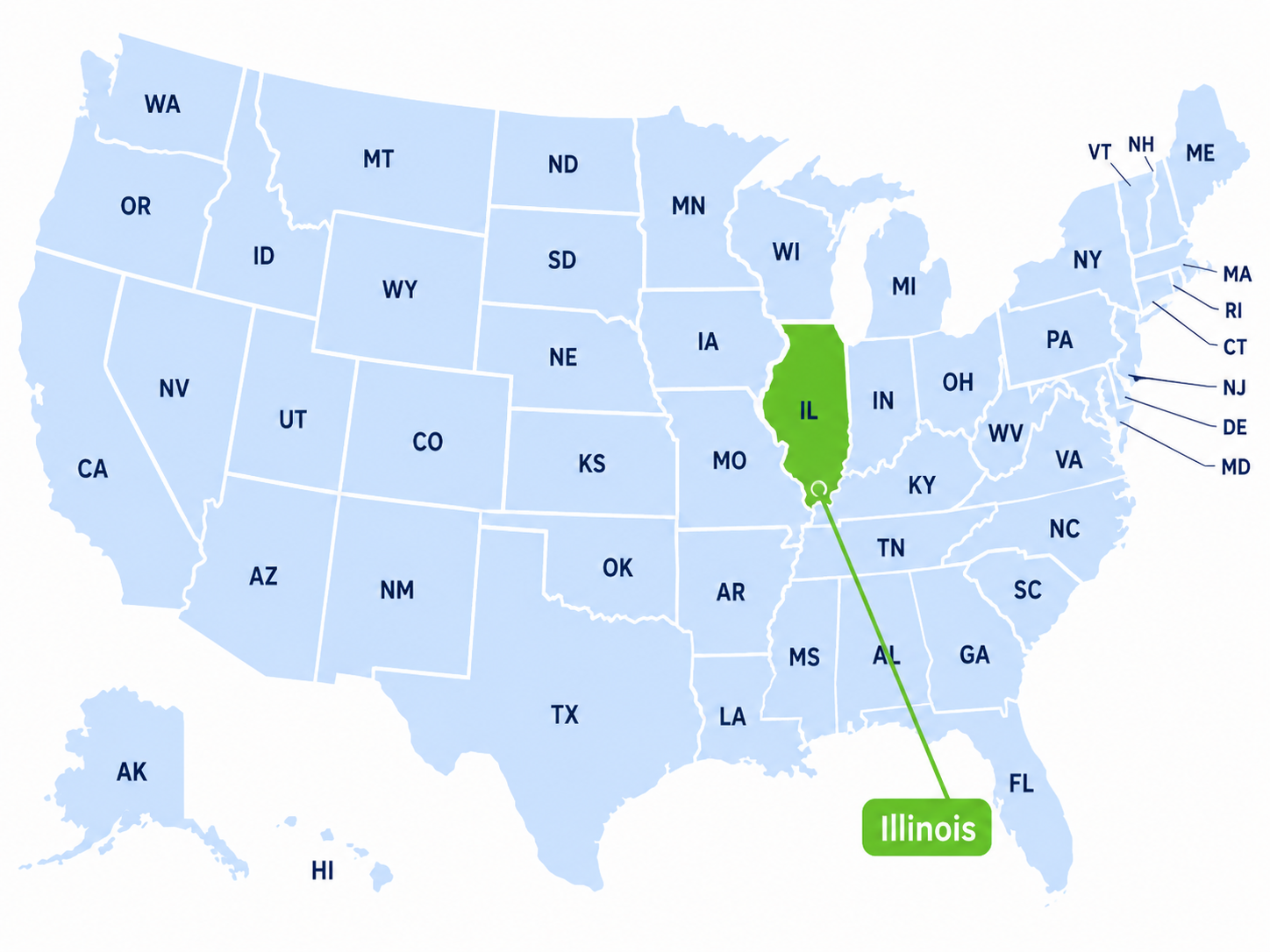
Create a professional Illinois pay stub with earnings, taxes, deductions, overtime, and year to date totals shown clearly. Enter the payroll details, review the complete preview, and download the finished PDF when everything looks right. For a take-home-pay estimate, use our Illinois paycheck calculator.
Illinois uses a flat state income tax rate, but payroll is not the same in every part of the state. Chicago and some Cook County workplaces have separate wage rules. The employee's work location, pay period, tax forms, hours, and deductions can all affect the final pay information.
Reviewed for 2026 payroll information
Last updated June 15, 2026. Information was checked against resources from the Illinois Department of Revenue, Illinois Department of Labor, Illinois General Assembly, Cook County, the IRS, and the Social Security Administration.
Create an Illinois Pay Stub Online Without Building Payroll by Hand
A pay stub brings several payroll details together in one place. It shows what an employee earned, what was deducted, and how much remained as net pay. Preparing those figures manually can take time, especially when overtime, reported tips, benefits, or year to date totals are involved.
The ePaystubs generator gives you a guided way to enter the information. You can review the document before downloading it, which makes it easier to catch a spelling mistake, an incorrect pay date, or a deduction entered in the wrong field.
Add the employer and employee details
Enter the business name, employee name, addresses, pay schedule, pay period, and payment date. The information should match the employer's actual payroll records.
Enter earnings and deductions
Add regular hours, overtime, salary, bonuses, commissions, reported tips, taxes, insurance, retirement contributions, or other valid payroll items.
Review the preview
Check gross wages, deductions, net pay, dates, and year to date amounts. Complete the order only after the information matches the real payment record.
Check the work location before entering wages
An employee working in Chicago may be covered by a different local minimum wage than someone working in Springfield. A Cook County workplace may also be covered by a county ordinance. Use the location where the work was performed when checking wage rules.
Illinois Payroll Facts for 2026
Illinois has a flat individual income tax rate, a statewide minimum wage, specific wage statement duties, and rules covering how often many employees must be paid. Local wage ordinances can add another layer for employers in Chicago and Cook County.
| Payroll item | 2026 information |
|---|---|
| Illinois income tax rate | 4.95 percent |
| Illinois withholding exemption allowance | $2,925 for 2026 withholding calculations |
| State minimum wage | $15.00 per hour for covered workers age 18 and older |
| State tipped cash wage | $9.00 per hour when the tip credit rules are satisfied |
| Qualifying youth wage | $13.00 per hour for workers under 18 who work fewer than 650 hours during the calendar year |
| General overtime rule | One and one half times the regular rate after 40 hours in a workweek for covered employees |
| Pay stub required | Yes, employers must furnish a pay stub for each pay period |
| Employer pay stub retention | At least three years after the payment date |
| Typical wage payment frequency | At least twice each month for most employees |
| Employee unemployment deduction | Illinois unemployment insurance is generally an employer responsibility rather than a normal employee deduction |
The figures above cover common payroll situations. Collective bargaining agreements, public contracts, prevailing wage projects, exempt employee classifications, local ordinances, and industry rules may require different treatment.
The Workplace Address Can Change the Wage Rate
The employee's home address does not always decide which minimum wage applies. Local wage coverage often depends on where the employee performs the work. That distinction matters for businesses with remote staff, delivery workers, temporary assignments, and employees who move between Illinois locations.
A Chicago employee may be covered by the Chicago minimum wage even when the employer's main office is outside the city. Cook County has its own ordinance, though some municipalities may use another local rule or may not follow the county ordinance. Work performed elsewhere in Illinois is generally subject to the statewide wage floor unless another law requires a higher rate.
Chicago
Check the Chicago wage in effect on the date the work was performed. Chicago rates normally change on July 1 rather than January 1.
Cook County outside Chicago
Confirm whether the county ordinance applies in the municipality where the employee worked. Chicago follows its own city ordinance.
Other Illinois locations
Use the Illinois statewide minimum unless a city ordinance, prevailing wage requirement, employment agreement, or another rule provides a higher amount.
When one employee works in more than one location during the same pay period, keep records that show the dates, hours, and applicable wage rate for each location.
How Illinois Income Tax Is Taken From a Paycheck
Illinois uses a flat income tax rate of 4.95 percent. That does not always mean an employer simply multiplies every gross paycheck by 4.95 percent. The withholding calculation can also reflect the employee's Illinois withholding certificate, pay frequency, exemption allowances, taxable wages, and any extra amount requested by the employee.
Employees generally provide Form IL W 4 to tell the employer how many Illinois allowances to use. The 2026 Illinois withholding exemption allowance is $2,925. The annual allowance is divided by the number of payroll periods when the employer calculates withholding for each paycheck.
A simple view of the process
Start with wages that are subject to Illinois withholding. Reduce that amount by the applicable allowance values for the pay period. Apply the 4.95 percent rate, then add any extra Illinois withholding requested by the employee.
An employee claiming no Illinois allowances may see an amount close to 4.95 percent of Illinois taxable wages. An employee with valid allowances may have a lower withholding amount. Payroll records should follow the current IL W 4 and the official Illinois withholding tables rather than guessing the deduction.
Illinois does not have a general city income tax. Chicago and Cook County wage ordinances affect wage floors, but they do not create a normal local employee income tax deduction.
Employers can check the current method through the 2026 Illinois withholding tables .
What May Come Out of an Illinois Paycheck
A pay stub should make each deduction easy to identify. Combining unrelated amounts under a vague label can make the statement difficult to check. Clear labels also help an employee compare the current check with earlier payments.
| Deduction | How it works |
|---|---|
| Federal income tax | Based on taxable wages, pay frequency, and the employee's federal Form W 4 information |
| Illinois income tax | Calculated using the 4.95 percent rate, Illinois allowances, and any requested extra withholding |
| Social Security | Generally 6.2 percent of covered employee wages up to the annual Social Security wage base |
| Medicare | Generally 1.45 percent of covered wages, with no regular annual wage limit |
| Additional Medicare tax | Employers generally begin withholding an extra 0.9 percent after employee Medicare wages exceed $200,000 during the calendar year |
| Health coverage | The employee portion of medical, dental, or vision coverage when the employee has enrolled |
| Retirement contributions | Amounts the employee directs into an eligible retirement plan |
| Court ordered deductions | Valid garnishments, support orders, levies, or similar legally required deductions |
| Other authorized amounts | Deductions that are lawful and supported by the employee's authorization when authorization is required |
Illinois restricts deductions from wages and final compensation. A deduction generally needs to be required by law, benefit the employee, follow a valid order, or have the employee's proper consent. Employers should not treat the pay stub as permission to remove an unexplained amount from wages.
Federal payroll rates and wage limits can be checked through IRS Publication 15 and the Social Security wage base information.
Illinois, Cook County, and Chicago Wage Rates
The statewide wage remains $15.00 per hour in 2026 for covered workers age 18 and older. Chicago and Cook County change their local rates on July 1, so employers should check the work date before entering wages.
| Work location and employee type | Through June 30, 2026 | Beginning July 1, 2026 |
|---|---|---|
| Illinois statewide regular wage | $15.00 | $15.00 |
| Illinois statewide tipped cash wage | $9.00 | $9.00 |
| Illinois qualifying youth wage | $13.00 | $13.00 |
| Cook County regular wage where the ordinance applies | $15.00 | $15.40 |
| Cook County tipped cash wage where the ordinance applies | $9.00 | $9.25 |
| Chicago regular wage for covered employers | $16.60 | $17.05 |
| Chicago tipped cash wage for covered employers | $12.62 | $12.96 |
Local coverage can depend on the employer, municipality, employee classification, and work performed. Some Cook County municipalities do not follow the county ordinance. Employers should confirm the local rule rather than applying the county amount to every address within Cook County.
How the tip credit works
A tipped cash wage is not the employee's final guaranteed hourly wage. When a lawful tip credit is used, the employee's cash wage and qualifying tips must reach the full applicable minimum wage. The employer must make up a shortfall when the employee's tips do not bring total compensation to that wage floor.
Keep cash wages and reported tips separate on the pay stub. That makes it easier to see what the employer paid directly, what the employee reported as tips, and whether the full minimum wage requirement was met.
State wage details are available from the Illinois Department of Labor .
County information is available from the Cook County Minimum Wage Ordinance page .
Chicago employers can review the City of Chicago minimum wage information .
How Overtime Appears on an Illinois Pay Stub
Most covered hourly employees must receive overtime after working more than 40 hours in a workweek. The usual overtime rate is one and one half times the employee's regular rate. Daily overtime is not a general Illinois requirement, so working more than eight hours in one day does not automatically create overtime when the weekly total stays at 40 hours or less.
Example with six overtime hours
An employee earns $20.00 per hour and works 46 hours during one workweek.
| Regular earnings | 40 hours multiplied by $20.00 | $800.00 |
|---|---|---|
| Overtime rate | $20.00 multiplied by 1.5 | $30.00 |
| Overtime earnings | 6 hours multiplied by $30.00 | $180.00 |
| Gross wages | Regular earnings plus overtime earnings | $980.00 |
The pay stub should show the regular hours and overtime hours separately. It should also identify the regular rate, overtime rate, and earnings produced by each group of hours.
Bonuses, commissions, shift premiums, piece rate earnings, and other compensation may affect the employee's regular rate for overtime purposes. Employers with those pay arrangements should calculate overtime from the correct regular rate rather than using the base hourly rate without review.
What Illinois Requires on a Pay Stub
Illinois requires an employer to furnish a pay stub for each pay period. State law defines a pay stub as an itemized statement showing several parts of the employee's wage record.
| Pay stub field | What it should show |
|---|---|
| Hours worked | The hours connected with the payment when hours apply to the employee's pay record |
| Rate of pay | The hourly rate, salary basis, piece rate, or another applicable rate |
| Overtime hours | The hours paid at the overtime rate |
| Overtime pay | The earnings produced by overtime hours |
| Gross wages | Total wages earned before deductions |
| Deductions | Taxes and other amounts taken from the employee's wages |
| Year to date wages | Total wages recorded for the year through the current payment |
| Year to date deductions | Total deductions recorded for the year through the current payment |
Employers must keep pay stub copies
Illinois employers must retain a copy of an employee's pay stub for at least three years after the payment date. The duty applies whether the document was provided electronically or on paper. Ending the employment relationship does not remove the retention requirement.
Employees can request copies
Current and former employees may request copies of qualifying pay stubs. An employer may require the request to be submitted in writing. The employer generally has 21 calendar days to furnish the requested copies.
Former employee requests have limits under the statute, so employers should maintain a clear process for receiving, documenting, and answering requests.
Penalties may apply
Failing to furnish a required pay stub or violating the related requirements may expose an employer to a civil penalty of up to $500 for each violation payable to the Illinois Department of Labor.
The statutory wording can be reviewed through 820 ILCS 115 Section 2 and 820 ILCS 115 Section 10 .
When Illinois Employees Must Be Paid
Most Illinois employees must be paid at least twice each month. Executive, administrative, and professional employees covered by the statutory exception may be paid once each month.
Wages earned during a semimonthly or biweekly pay period generally must be paid no later than 13 days after that pay period ends. Weekly wages generally have a shorter payment window.
Final compensation
When employment ends, final compensation is generally due by the next regularly scheduled payday. Final compensation can include wages, earned commissions, bonuses, and the cash value of earned vacation when payment is required by the employer's policy or agreement.
Illinois does not provide a general rule allowing an employer to hold the last paycheck until equipment is returned. Any deduction from final compensation must comply with the wage deduction rules.
Employers can review timing rules through the Illinois Department of Labor Wage Payment FAQ .
Two Illinois Payroll Examples
These examples show how information can be organized on a pay stub. They are illustrations rather than a substitute for payroll software, tax advice, or a calculation based on the employee's actual tax forms.
Springfield salaried employee
Assume a Springfield employee earns $52,000 each year and receives 26 paychecks. The employee has no pretax benefits in this example and has not requested extra withholding.
| Payroll item | Illustrative amount |
|---|---|
| Gross pay | $2,000.00 |
| Estimated federal income tax | $156.18 |
| Illinois income tax with no allowances | $99.00 |
| Social Security | $124.00 |
| Medicare | $29.00 |
| Total illustrated deductions | $408.18 |
| Illustrated net pay | $1,591.82 |
The federal estimate assumes a 2026 Form W 4 for a single filer with no credits, extra income, deductions, or extra withholding. A different federal form or Illinois allowance count will change the result.
Chicago tipped employee after July 1, 2026
Assume a covered Chicago restaurant employee works 40 hours at a tipped cash wage of $12.96 per hour and reports $300.00 in tips for the pay period.
| Cash wages | 40 hours multiplied by $12.96 | $518.40 |
|---|---|---|
| Reported tips | Tips reported for payroll tax records | $300.00 |
| Total taxable compensation | Cash wages plus reported tips | $818.40 |
| Full Chicago wage floor | 40 hours multiplied by $17.05 | $682.00 |
The cash wages and reported tips total more than the $682.00 full wage floor for 40 hours, so no wage makeup is shown in this example. When wages and qualifying tips fall below the full minimum, the employer must cover the difference.
Reported tips may already have been received directly by the employee. A pay stub should distinguish taxable reported tips from the cash wages being paid through payroll so the document does not suggest the same money was paid twice.
Paid Leave Can Affect Payroll Records
The Illinois Paid Leave for All Workers Act generally allows covered employees to earn up to 40 hours of paid leave during a 12 month period. Under the usual accrual method, an employee earns one hour of leave for every 40 hours worked.
Paid leave wages should be recorded consistently with the employer's timekeeping and leave records. A pay stub can identify paid leave earnings separately when the employer wants the employee to see how much of the payment relates to leave.
Local rules may differ. Chicago and Cook County have their own paid leave requirements, so employers should check the rule covering the employee's work location.
State information is available through the Illinois Paid Leave for All Workers Act page .
A Practical Illinois Payroll Check Before Payday
A short payroll review can catch errors before the pay stub reaches the employee. This is especially useful when a pay period includes overtime, tips, more than one work location, or a midyear local wage change.
The employer and employee names match the payroll records.
The pay period and payment date are correct.
The work location and applicable wage floor have been checked.
Regular hours and overtime hours are separated.
Gross wages include bonuses, commissions, tips, and other taxable earnings when applicable.
Illinois withholding follows the employee's current IL W 4.
Every deduction has a lawful reason and a clear label.
Current and year to date totals agree with earlier payroll records.
A copy of the final pay stub will be stored for at least three years.
Who Can Use an Illinois Paycheck Stub Generator
Small business owners
Create clear wage records for hourly or salaried employees when the business needs a straightforward pay stub document.
Household employers
Prepare an itemized record for eligible household employees while keeping payroll details organized.
Contractors and freelancers
Keep legitimate payment records for business income. A contractor document should not falsely present the worker as an employee.
Restaurants and tipped workplaces
Separate hourly cash wages, reported tips, overtime, taxes, and employer wage makeup amounts when those items apply.
Payroll and bookkeeping professionals
Produce a readable supporting record after payroll figures have been calculated and approved.
Employees replacing personal records
Employees should first request official copies from the employer. A newly created document should not be presented as an original employer issued record.
Use Real Payroll Information
A pay stub should reflect a genuine payment, business relationship, or payroll record. Do not change earnings, employment dates, employer details, or deductions to qualify for housing, credit, a loan, public benefits, or another financial decision.
Creating or using a false income document may lead to financial, civil, or criminal consequences. ePaystubs does not verify that the information entered by a user is true. The person creating the document is responsible for using accurate information and following the laws that apply to the payment.
Related Payroll Forms and State Pages
A pay stub records an individual payment. A check stub generator can help create that individual pay record, but it does not replace annual wage forms, employee withholding certificates, contractor tax forms, or employer payroll returns.
Questions People Ask About Illinois Pay Stubs
What is the Illinois income tax rate in 2026?
Illinois uses a flat individual income tax rate of 4.95 percent. Payroll withholding can still vary because the calculation reflects taxable wages, pay frequency, IL W 4 allowances, and any extra amount requested by the employee.
Does Illinois require employers to provide pay stubs?
Yes. Illinois employers must furnish a pay stub for each pay period. The statement may be provided electronically or on paper when the employer follows the applicable requirements.
What details belong on an Illinois pay stub?
The Illinois definition covers hours worked, rate of pay, overtime hours, overtime pay, gross wages, deductions, year to date wages, and year to date deductions.
How long must an employer keep pay stub copies?
Employers must keep a copy for at least three years after the payment date. The rule applies to electronic and paper statements and continues after the employee leaves the business.
Can an employee request old Illinois pay stubs?
Current and former employees have rights to request qualifying pay stub copies. The employer may ask for a written request and generally must respond within 21 calendar days.
What is the Illinois minimum wage during 2026?
The statewide wage is $15.00 per hour for covered workers age 18 and older. Higher local rates may apply in Chicago and certain Cook County workplaces.
What changes in Chicago on July 1, 2026?
The standard Chicago minimum wage for covered employers increases to $17.05 per hour. The tipped cash wage increases to $12.96 per hour. Employers should confirm coverage and any special employee category before applying a rate.
Does Cook County use the same wage as Chicago?
No. Chicago has its own ordinance. Beginning July 1, 2026, the Cook County rate is $15.40 for non tipped employees and $9.25 for tipped employees where the county ordinance applies.
When does overtime begin in Illinois?
Covered employees generally earn overtime after working more than 40 hours in a workweek. Illinois does not have a broad daily overtime rule for every employee.
How often must Illinois employees receive wages?
Most employees must be paid at least twice each month. Certain executive, administrative, and professional employees may be paid monthly.
Are unemployment taxes taken from an Illinois employee's pay?
Illinois unemployment insurance is generally paid by employers. It is not normally shown as an employee deduction on a standard Illinois pay stub.
Can a contractor use an Illinois paystub generator?
A contractor may create a truthful payment record for legitimate business income, but the document should not falsely identify the contractor as an employee. Contractors should also keep invoices, bank records, contracts, and tax forms that support the income.
Is an online pay stub legally valid?
An electronically created pay stub can serve as a payroll record when it contains accurate information and the employer follows the laws that apply. The generator does not make false or incomplete information valid.
Can I preview the Illinois pay stub before downloading it?
Yes. The preview allows you to review names, dates, earnings, deductions, and totals before purchasing the completed PDF.
Official Payroll Sources Used for This Page
Wage and tax information can change. Check the effective date shown on an official source when preparing payroll for a future or earlier pay period.
| Source | Information covered |
|---|---|
| Illinois Department of Revenue | 2026 Illinois withholding rate, exemption allowance, tables, and calculation instructions |
| Illinois Department of Labor Minimum Wage Law | State minimum wage, tipped wage, youth wage, and overtime information |
| Illinois Wage Payment FAQ | Pay frequency, wage timing, final compensation, and employee payment questions |
| Illinois General Assembly | Pay stub delivery, retention, and employee copy request requirements |
| Cook County Government | Cook County minimum wage rates and ordinance coverage |
| City of Chicago | Chicago minimum wage and tipped employee rules |
| Internal Revenue Service | Federal employment taxes, Social Security, Medicare, and payroll duties |
| IRS Publication 15 T | Federal income tax withholding methods and percentage tables |
| Social Security Administration | Annual Social Security taxable wage base |
Prepare Your Illinois Pay Stub
Add the real payroll information, check the complete preview, and download a clear PDF record when every amount is correct.
Create Your Illinois Pay Stub PreviewUse only accurate earnings, employment, tax, and deduction information.