
1099 Proof of Income: How Freelancers and Contractors Verify Earnings
By ePaystubs Editorial Team | Updated June 22, 2026 | Tax details verified against the IRS Form 1099-K guidance
A 1099 form is accepted as proof of income for most rental applications, personal loans, and benefits enrollment, but it rarely satisfies a mortgage lender on its own. The reason is that a 1099 shows the gross payments a client or platform paid you, not your total income or net profit. The strongest approach pairs your 1099 with bank statements and, for larger applications, tax returns. This guide covers every 1099 type, the current 2026 thresholds, and how to build a complete income file.
If you freelance, contract, or work gig platforms, a 1099 is the closest thing you have to a W-2 when someone asks you to prove your income. It does the job for most applications, but there are two things worth understanding before you hand one over: what a 1099 actually proves, and what to pair it with so your application does not stall. This guide covers both, along with the current 2026 reporting rules, which changed recently and which a lot of outdated guides still get wrong.
- Is a 1099 proof of income
- Types of 1099
- The 2026 thresholds
- What to pair it with
- Build your income package
- Multiple 1099s
- How lenders verify it
- Formatted pay stub
Is a 1099 Proof of Income? (And Proof of Employment?)
Yes, a 1099 is proof of income. Landlords, personal-loan lenders, and government benefit programs widely accept it as evidence of what you earned. Where people get tripped up is the difference between proving income and proving employment.
Once you make that distinction clear, most reviewers are flexible. What they actually need to know is whether you earn enough, reliably enough, to cover the rent or the loan payment. The rest of this guide is about showing exactly that.
The Types of 1099 (and What Each One Proves)
"1099" is not a single form. It is a family of forms, each reporting a different kind of income. Knowing which ones you have helps you assemble a complete picture, especially if you earn from more than one source.
| Form | What it reports | Who typically gets it |
|---|---|---|
| 1099-NEC | Nonemployee compensation | Freelancers, contractors, most gig work |
| 1099-K | Payments via cards and platforms | Rideshare, online sellers, payment apps |
| 1099-MISC | Other income (rents, royalties, prizes) | Landlords, creators, miscellaneous payees |
| 1099-INT | Interest income | Anyone earning bank or bond interest |
| 1099-DIV | Dividends and distributions | Investors holding stocks or funds |
| 1099-R | Retirement and pension distributions | Retirees, account holders taking withdrawals |
| SSA-1099 | Social Security benefits | Social Security recipients |
If you have several income streams, you may receive several 1099s, and together they paint your full income picture. If your 1099 comes from a gig platform, the access process and tax details differ by app, so see our specific guides to DoorDash, Uber, and Instacart.
The 2026 1099 Thresholds (What Changed)
The reporting rules changed recently, and a lot of guides still quote outdated numbers. Here is what actually applies, straight from current IRS guidance.
A 1099 Alone Isn't Enough: What to Pair It With
A 1099 shows the gross payments from a specific client or platform, not your total income and not your net profit after expenses. That is why a 1099 on its own is usually fine for a rental but rarely enough for a mortgage. Pair it to the application.
| Application | Pair your 1099 with |
|---|---|
| Renting an apartment | About 3 months of bank statements (usually enough) |
| Personal loan | Your most recent tax return |
| Mortgage | 2 years of tax returns, your Schedule C, and bank statements |
| Benefits enrollment | The form itself, sometimes with a tax return |
For the full mortgage picture, where lenders look closely at net income after deductions, see our guide to self-employed mortgage income. For the broader set of documents self-employed workers use, including profit and loss statements, see our guide to proof of income when self-employed.
Build a Complete 1099 Income Package
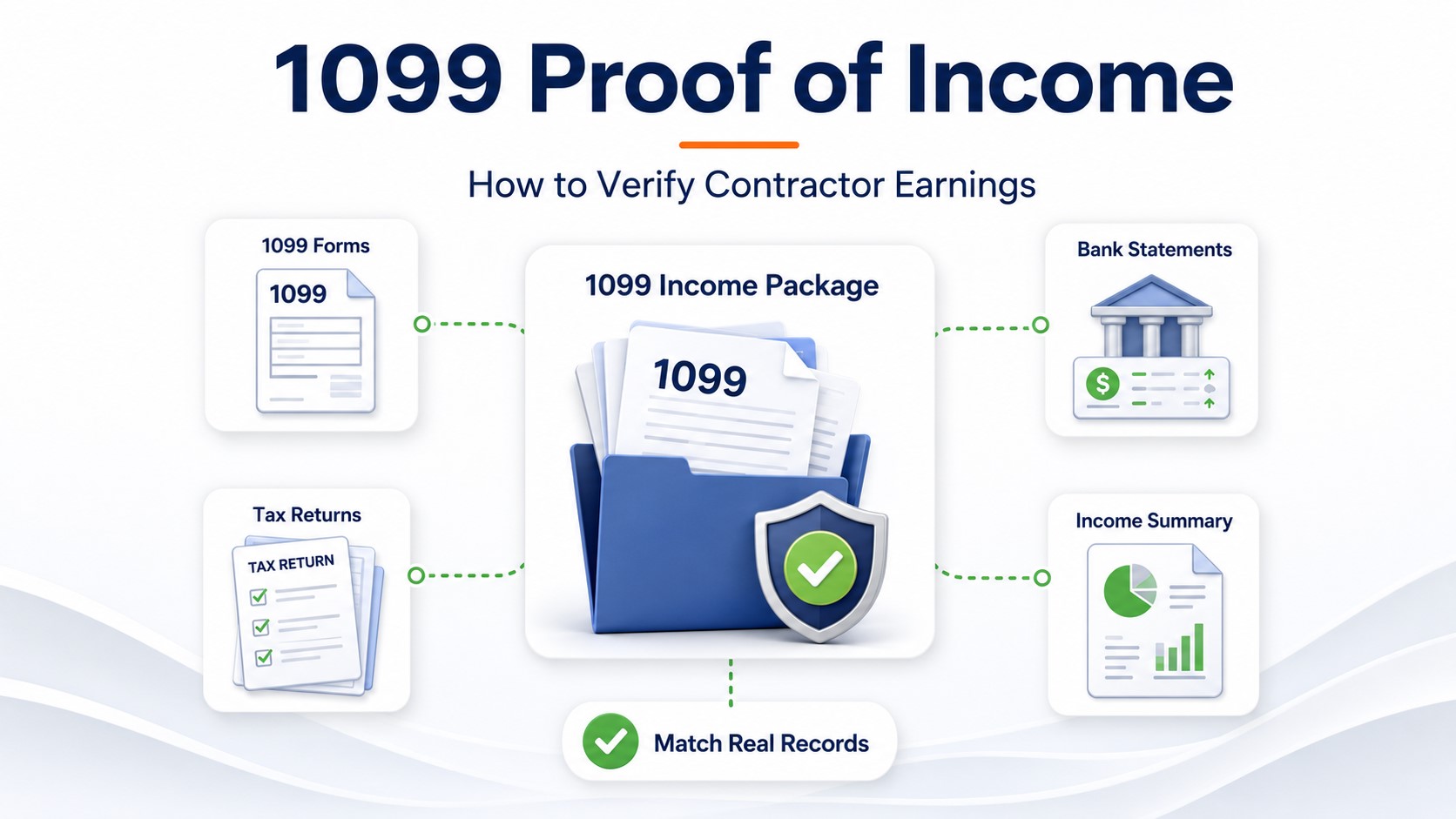
The single best thing you can do is make a reviewer's job easy. Rather than handing over a stack of raw forms, assemble a clean package that tells the whole story at a glance.
- Create a one-page income summary that lists each client or platform, the amount each paid, and the total.
- Attach the actual 1099 forms behind the summary.
- Add bank statements showing the deposits landed in your account.
- Optionally include reference letters or contracts from ongoing clients to show the income will continue.
Why Multiple 1099s Are a Strength
It is easy to assume that income spread across many clients looks less stable than a single salary. The opposite is often true. Several 1099s from different clients show a diverse, resilient income stream rather than dependence on one payer who could leave at any time. Five clients paying $10,000 each is stronger verification than one client paying $50,000, because losing any one of them would not wipe out your income.
When you present your 1099 income, lean into that. A summary showing multiple steady sources tells a reviewer your earnings are durable. Keep in mind that because a 1099 reports gross payments, your taxable income after Schedule C deductions will be lower, which is completely normal and is exactly what your tax return is there to show.
How Lenders Verify a 1099 (the IRS IVES Service)
For larger applications like a mortgage, a lender may not just take your documents at face value. The IRS runs a service called the Income Verification Express Service, or IVES, that lets a lender confirm your income directly with the IRS.
It works like this: with your consent, your lender requests a transcript of your tax return, which includes your 1099 data, using Form 4506-C. The IRS then provides that transcript to the lender. The practical takeaway is that your filed tax return is the ultimate backstop, so every figure you put on an application should match what you actually reported. Consistency between your documents and your filed return is what keeps an application moving.
When You Need a Formatted Pay Stub
Sometimes a landlord or lender wants a familiar pay-stub-style document, and a raw 1099 does not match that format. In that case, you can format your real 1099 income into a pay stub or summary and include it as part of your income package, alongside the actual forms and bank statements.
If a landlord or lender has asked you for a pay-stub-style document, you can use our paystub creator to format your 1099 income into a pay-stub-style record in a few minutes, and pair it with your actual forms.
Frequently Asked Questions
Yes. A 1099 is accepted as proof of income for most rental applications, personal loans, and benefits enrollment. It shows the gross payments a client or platform made to you. For mortgages, lenders usually want it alongside 2 years of tax returns and bank statements.
A 1099 proves income, not traditional employment, because a 1099 contractor is self-employed rather than an employee. If a leasing office or lender asks for employment verification, explain that you're an independent contractor and provide income documentation instead.
For 2026, a platform issues a 1099-K when your gross payments exceed $20,000 and you have more than 200 transactions. This is the restored federal threshold under the OBBBA. Some states use lower limits, payment-card transactions have no minimum, and you must report all income even without a form.
For 2025 income, clients issue a 1099-NEC at $600 or more. For payments made in 2026 and later, that threshold rises to $2,000. Either way, if no form is issued, you still must report the income on your tax return.
For rentals, pair your 1099 with about 3 months of bank statements. For personal loans, add your most recent tax return. For mortgages, include 2 years of tax returns, your Schedule C, and bank statements. A one-page income summary listing each payer helps tie it together.
A 1099 shows gross payments before expenses, not your net profit. Your taxable income after Schedule C deductions is lower, which is normal. For a complete picture, lenders look at your tax return, where net income appears.
Beyond the documents you provide, lenders can verify income directly with the IRS through the Income Verification Express Service, requesting a transcript of your tax return with your consent. This is why your submitted figures should match what you filed.