


DC Paystub Generator 2026
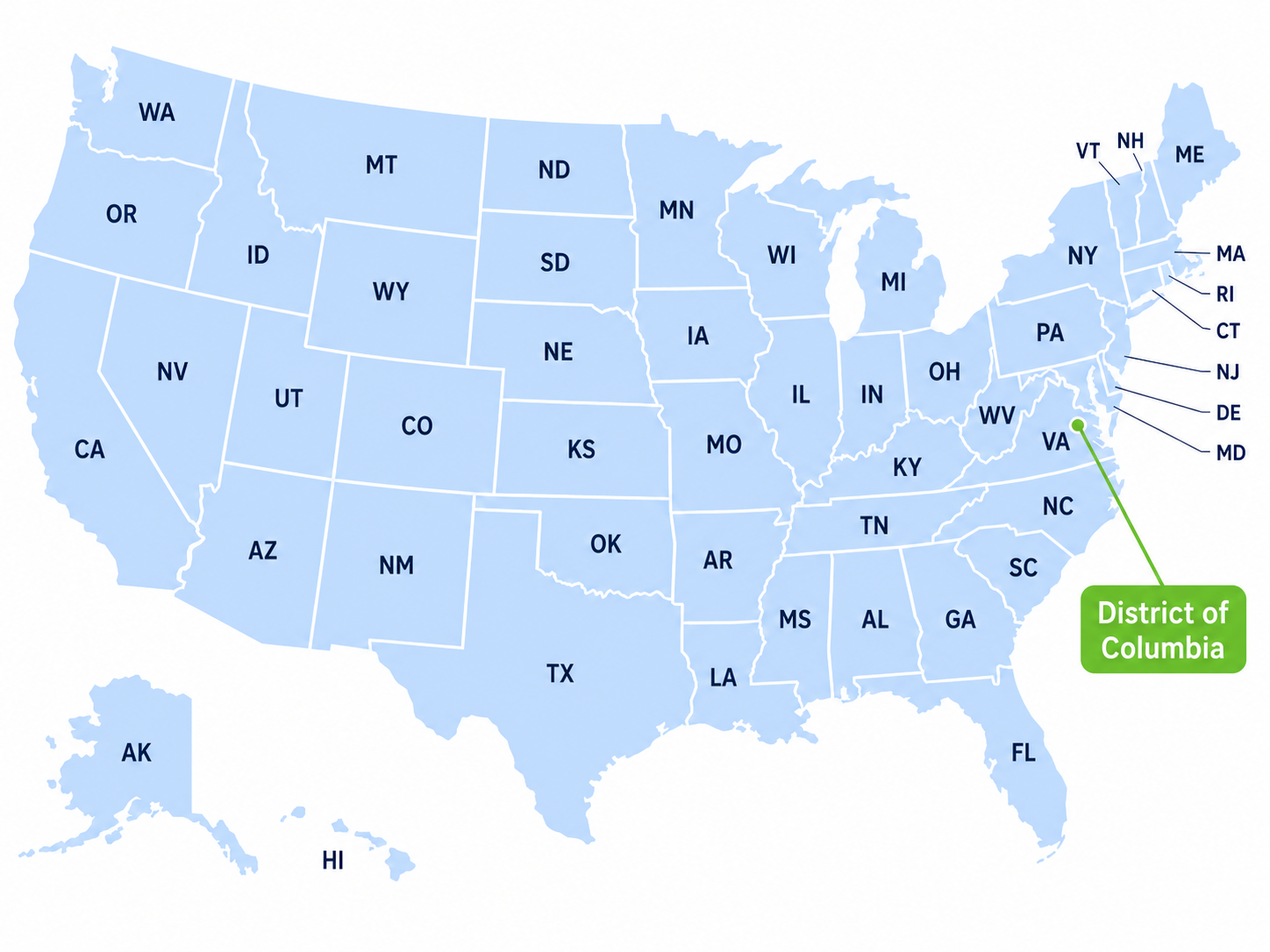
Washington DC does payroll differently from every state in the country, and not in ways most people expect. DC has seven income tax brackets topping out at 10.75%. Its paid family leave program is fully employer funded, so employees do not see a paid leave deduction on their pay stubs. Virginia and Maryland residents who commute into DC may also have their home state withholding shown instead of DC withholding.
Our DC paystub generator handles the District tax brackets, nonresident rules, federal deductions, earnings, and other payroll details. It works for DC residents, Virginia and Maryland commuters, federal employees, contractors, and small business owners.
| Income Tax | 7 progressive brackets, 4% to 10.75% (yes, DC does tax wages) |
| Paid Family Leave | 0.75% employer-paid. Employees pay $0. No deduction on your stub. |
| PFL Max Weekly Benefit | $1,153/week (up to 12 weeks parental, family, or medical) |
| Nonresident Tax | VA and MD commuters pay zero DC tax (federal law prohibits it) |
| Minimum Wage | $17.50/hr (adjusts July 1, not January 1) |
| Tipped Minimum | $10.00/hr cash wage |
| Pay Stub Required? | Yes. DC Wage Payment and Collection Law mandates itemized statements. |
| Withholding Forms | D-4 (residents) and D-4A (nonresidents/VA and MD commuters) |
| Inflation Indexing | None. Brackets unchanged since 2022 despite wage growth. |
"I moved from Arlington to Capitol Hill last year and my paycheck dropped noticeably. Turns out I went from Virginia's 5.75% top rate to DC's 8.5% bracket, and nobody told me. This tool was the first thing that showed me exactly where every dollar was going on my new DC stub."
"I'm a federal contractor in Foggy Bottom and needed stubs for an apartment application in Georgetown. Took about four minutes, the DC tax calculations were accurate, and my property manager accepted them that afternoon."
DC Has One of the Highest Income Tax Rates in America. Here Are All 7 Brackets.
Let's start by clearing something up. At least one online paystub tool states that "residents don't pay any District of Columbia state income tax." That claim is completely false. DC has a progressive income tax with seven brackets, and the top rate of 10.75% on income over $1 million is among the highest in the country. The 8.5% rate that hits income above $60,000 is what most mid-career DC workers actually pay on the bulk of their earnings.
Here's the full bracket schedule for 2026, sourced from the DC Office of Tax and Revenue (OTR). These brackets apply uniformly to all filing statuses. DC does not provide wider brackets for married filers the way most states do.
| DC Taxable Income | Rate |
|---|---|
| $0 to $10,000 | 4% |
| $10,001 to $40,000 | 6% |
| $40,001 to $60,000 | 6.5% |
| $60,001 to $250,000 | 8.5% |
| $250,001 to $500,000 | 9.25% |
| $500,001 to $1,000,000 | 9.75% |
| Over $1,000,000 | 10.75% |
DC conforms to the federal standard deduction ($16,100 single, $32,200 MFJ for 2026). Residents file Form D-4 to set their withholding allowances, similar to how a federal W-4 works but specific to DC.
Bracket Creep: Why Your DC Withholding Keeps Going Up
Here's something that affects nearly every DC worker and almost nobody talks about. These bracket thresholds haven't been adjusted for inflation since 2022. Not once. In a city where rents go up 4-5% a year and employers hand out cost-of-living raises to match, workers are being pushed into higher tax brackets without any actual improvement in what they can buy.
Say you earned $58,000 in 2022 and your employer gave you annual 4% raises. By 2026, you're earning roughly $67,800. In 2022, most of your income fell in the 6.5% bracket ($40,001-$60,000). In 2026, $7,800 of your income is now in the 8.5% bracket ($60,001+). Your purchasing power barely changed. Your tax bracket did. That's bracket creep, and it's a real thing in DC because the brackets just sit there frozen while wages climb.
If your DC withholding seems higher than you expected even though your real income hasn't grown much, this is probably why.
DC Paid Family Leave Is Employer-Paid. That's Why You Don't See It on Your Stub.
If you moved to DC from New York, you're used to seeing a "NY PFL" deduction on your pay stub (0.432% of your wages). If you came from California, you saw "CASDI" (1.3%). Connecticut shows "CT PFML" (0.5%). In DC? Nothing. There's no paid leave deduction line on your stub at all.
That doesn't mean DC lacks a paid leave program. It has one. A good one, actually. Under the Universal Paid Leave Act, DC workers can take up to 12 weeks of paid parental leave, 12 weeks of family care leave, 12 weeks of medical leave, and 2 weeks of prenatal leave. The maximum weekly benefit is $1,153.
The difference is who pays for it. In DC, the employer pays the entire premium at 0.75% of each employee's wages. Employees contribute zero. The employer reports and pays this quarterly alongside their unemployment insurance filing using Form UC-30. It never touches the employee's paycheck.
| Detail | 2026 |
|---|---|
| Who pays the premium? | Employer only (100%) |
| Employer contribution rate | 0.75% of employee wages |
| Employee contribution | $0. Nothing. Not on your stub. |
| Maximum weekly benefit | $1,153 |
| Parental leave | Up to 12 weeks |
| Family care leave | Up to 12 weeks |
| Medical leave (own health) | Up to 12 weeks |
| Prenatal leave | Up to 2 weeks |
| Administered by | DC Department of Employment Services (DOES) |
So if you're looking at a DC pay stub wondering where the paid leave deduction is, the answer is that it doesn't exist on the employee side. Your employer absorbs that cost entirely. You still get the benefits. You just don't fund them through your paycheck.
Live in Virginia or Maryland, Work in DC? Here's Why Your Stub Looks Different.
This is one of DC's most unusual features and it catches a lot of people off guard. Federal law specifically prohibits the District of Columbia from taxing the income of nonresidents who work there. This doesn't apply to any state. It's unique to DC.
What that means in practice: if you live in Arlington, VA and work at a consulting firm on K Street, your employer withholds Virginia income tax from your paycheck, not DC tax. If you live in Bethesda, MD and commute to a federal agency downtown, your stub shows Maryland withholding. In both cases, DC gets nothing from your paycheck. You're taxed by your home state, not your work state.
Your employer handles this through Form D-4A (Certificate of Nonresidence in the District of Columbia). When you start a DC job and you live in VA or MD, you file a D-4A instead of a D-4. That tells your employer to withhold for your home state. Without the D-4A on file, your employer might default to DC withholding, which would be wrong and create a mess at tax time.
For DC residents, the standard Form D-4 (Employee Withholding Allowance Certificate) is what you use. It works similarly to a federal W-4 but determines your DC tax withholding amount.
Source: DC Office of Tax and Revenue
What Gets Taken Out of a DC Paycheck: DC Resident vs. Virginia Commuter at the Same Job
Because of the nonresident exemption, two people sitting at the same desk in the same office can take home meaningfully different amounts depending on which side of the Potomac they sleep on. Here's what that actually looks like.
DC Resident, $30/hr, Biweekly
Setup: Angela lives in Adams Morgan and works at a nonprofit near Dupont Circle. She earns $30/hr, gets paid biweekly, works 80 hours per period, files Single on Form D-4.
| Line Item | Amount |
|---|---|
| Gross Pay (80 hrs x $30.00) | $2,400.00 |
| Federal Income Tax (per IRS Pub. 15) | - $276.00 |
| Social Security, 6.2% (per IRS Topic 751) | - $148.80 |
| Medicare, 1.45% | - $34.80 |
| DC Income Tax (roughly 7.2% effective at this income) | - $172.80 |
| DC Paid Family Leave | $0 (employer-paid, doesn't appear on stub) |
| Estimated Net Pay | About $1,767 |
Virginia Commuter at the Same DC Job, $30/hr, Biweekly
Setup: Marcus lives in Arlington, VA and commutes to the same Dupont Circle office. Same pay, same hours, same filing status. But he filed Form D-4A, so his employer withholds Virginia tax instead of DC tax.
| Line Item | Amount |
|---|---|
| Gross Pay (80 hrs x $30.00) | $2,400.00 |
| Federal Income Tax | - $276.00 |
| Social Security, 6.2% | - $148.80 |
| Medicare, 1.45% | - $34.80 |
| DC Income Tax | $0 (nonresident, exempt by federal law) |
| Virginia Income Tax (roughly 4.8% effective) | - $115.20 |
| Estimated Net Pay | About $1,825 |
Bottom line: $58 per biweekly check. That's $1,508 per year more take-home for the Virginia commuter. Same job, same office, same salary. The only difference is where they go home at night. For a Maryland commuter (top rate 5.75%), the savings compared to DC residency would be smaller but still significant.
Estimates based on 2026 rates. Actual withholding depends on filing status, allowances, and voluntary deductions. Use the generator for your exact numbers.
DC's $17.50 Minimum Wage and Why It Changes in July, Not January
Most states adjust their minimum wage on January 1. DC does it on July 1. That means if a new CPI-based increase is coming, it hits mid-year rather than at the start. For the period from July 1, 2025 through June 30, 2026, the DC minimum wage is $17.50 per hour. The rate for the next cycle (starting July 1, 2026) gets announced by the DC Department of Employment Services (DOES) typically in the spring.
At $17.50, DC has one of the highest minimum wages of any jurisdiction in the country. It's above New York City ($17.00), California statewide ($16.90), and Connecticut ($16.94). Only a handful of individual cities (Emeryville, CA at $19.36; West Hollywood at $19.08) are higher.
Tipped employees in DC receive a cash minimum of $10.00 per hour. Tips must bring total compensation to at least $17.50. If they fall short in any pay period, the employer covers the gap. This structure was established after voters passed Initiative 82 in 2022, which the DC Council subsequently modified to maintain a sub-minimum wage for tipped workers rather than eliminating it entirely.
Federal Government Workers: What Makes Your DC Pay Stub Different
About 30% of DC's workforce is employed by the federal government. That's a higher concentration than anywhere else in the country, obviously, and federal pay stubs have some characteristics that don't show up on private sector stubs.
If you're a federal employee working in DC, your stub probably includes some of these lines that confuse people who haven't worked for the government before:
GS Pay with DC Locality Adjustment: Federal employees on the General Schedule receive a locality pay adjustment on top of their base GS salary. For the DC metro area in 2026, that adjustment is +33.26%. So a GS-12 Step 1 with a base salary of $79,835 actually earns $106,389 in DC. That locality-adjusted number is what shows up on the pay stub as gross pay, and it's what DC income tax is calculated on for DC residents. Source: OPM Pay Tables.
FERS Retirement: Federal Employees Retirement System contributions range from 0.8% to 4.4% of your salary depending on when you were hired. FERS-FRAE employees (hired 2014 or later) pay 4.4%. This shows up as a separate deduction line on your stub labeled "Retirement" or "FERS."
TSP (Thrift Savings Plan): The federal government's version of a 401(k). Contributions are pre-tax (traditional) or post-tax (Roth) and show up as a separate line. The government matches up to 5% for FERS employees.
FEHB (Federal Employee Health Benefits): Government health insurance premiums. Usually pre-tax. Varies widely depending on which plan you choose during open season.
FEGLI (Federal Employee Group Life Insurance): Basic life insurance is automatic. Optional coverage shows as additional deduction lines.
A federal employee's DC pay stub can easily have 8-10 deduction lines before voluntary stuff like dental, vision, or FSA contributions. If you just transitioned from private sector work, the stub looks busier than what you're used to. Our paystub creator handles the standard tax calculations. For the federal-specific lines (FERS, TSP, FEHB), you add those as custom deductions.
DC Payroll Requirements 2026: What Every Employer Needs to Know
DC has a solid set of employer obligations. Mandatory pay stubs. An employer-funded paid leave program. A high minimum wage with mid-year adjustments. Here's the complete reference.
| Requirement | What DC Requires | Official Source |
|---|---|---|
| Pay stub mandate | Yes. Itemized wage statements required. | DC DOES / DC Code Title 32 |
| Required stub content | Hours worked, gross pay, all deductions itemized, net pay | DC Wage Payment and Collection Law |
| Minimum wage | $17.50/hr (adjusts July 1 by CPI) | DC DOES |
| Tipped minimum | $10.00/hr cash wage | DC DOES |
| Income tax | 7 brackets, 4% to 10.75% progressive | DC OTR |
| Paid Family Leave | 0.75% employer-paid. Employees pay $0. | DC Paid Leave |
| Nonresident exemption | Federal law prohibits DC from taxing VA/MD commuters | DC OTR |
| Withholding forms | D-4 (residents), D-4A (nonresidents) | DC OTR |
| Overtime | 1.5x after 40 hrs/week (FLSA) | U.S. DOL FLSA |
| New hire reporting | Within 20 days of hire | DC DOES |
| Local income tax | N/A (DC is the local government) | DC OTR |
DC SUI (Unemployment Insurance), 2026
Employer-paid only. Never deducted from employee paychecks. Per Keka's DC payroll guide, the taxable wage base is $9,000 per employee. New employers start at 2.7%. Experienced employers range from 1.9% to 7.4% under Table VI, which remains in effect for 2026. Rates between 1.9% and 4.4% apply to positive-rated employers, and 6.2% to 7.4% apply to negative-rated employers.
Who Uses a DC Paycheck Stub Generator?
Federal Government Employees and Contractors
Federal agencies, congressional offices, the Executive Office of the President, and hundreds of government contractors operate across DC. GS employees with DC locality pay, contractors on project-based assignments, and civilian workers at federal facilities all need pay documentation for housing applications, security clearances, and loan processing. DC's expensive housing market means landlords are thorough about income verification.
Nonprofit and Association Workers
DC has the highest concentration of nonprofits and trade associations per capita of any US city. Think tanks, advocacy organizations, professional societies, and international development groups all cluster here. Many are small organizations with 10-30 employees and limited payroll infrastructure. A clean, accurate pay stub for each pay period saves them from subscribing to expensive HR platforms.
Law Firm and Lobbying Firm Staff
K Street. Capitol Hill. Foggy Bottom. DC's legal and lobbying industry employs tens of thousands of lawyers, paralegals, policy analysts, and support staff. Salaries in this sector run high, which means workers are frequently in the 8.5% DC bracket. For VA and MD commuters at these firms, the nonresident exemption means their stubs look fundamentally different from their DC-resident colleagues. Our generator handles both scenarios correctly.
Hospitality and Service Workers
Hotels near the National Mall, restaurants in Georgetown and U Street, event staff at the Convention Center. DC's tourism and hospitality sector employs thousands of tipped workers at the $10.00/hr cash minimum. These workers need stubs that correctly show their cash wages plus reported tips, and that reflect DC's $17.50 total minimum when verifying income for housing applications.
VA and MD Commuters
Hundreds of thousands of people commute into DC from Virginia and Maryland every day. Metro riders from Silver Spring, drivers from Fairfax, commuters from Alexandria and Bethesda. All of them are exempt from DC income tax under federal law. When they need a pay stub for a Virginia mortgage application or a Maryland landlord, the stub needs to show their home state's withholding, not DC's. The generator asks for your work state and residence state and applies the right rules automatically.
Independent Contractors and Freelancers
Political consultants, freelance writers covering Capitol Hill, independent policy analysts, graphic designers serving the association community. DC's freelance economy is substantial. When it's time for a lease renewal in Columbia Heights or a car loan application, documented income is what gets you through the door. Self-employed workers carry the full 15.3% FICA self-employment tax per IRS rules.
How to Create a DC Pay Stub: 3 Steps
DC payroll has some details other jurisdictions don't (the nonresident exemption, the employer-paid PFL, the July minimum wage cycle), but you don't have to sort through any of it. Enter your info, specify whether you're a DC resident or a VA/MD commuter, and the tool handles the rest.
-
Enter company and employee info
Business name, address, employee name, address, pay period dates, pay date. Indicate whether the employee is a DC resident (Form D-4) or a nonresident from VA or MD (Form D-4A). This determines which tax jurisdiction applies. -
Enter earnings and deductions
Hourly rate or salary, hours worked, any overtime. Tips if applicable ($10.00/hr tipped minimum). Add voluntary deductions like health insurance, 401(k)/TSP, or other withholdings. The tool calculates DC's 7-bracket tax for residents, or the applicable VA/MD rate for nonresidents, plus all federal deductions. -
Preview, then download
Review every line. Gross pay, each deduction, net pay, YTD totals. Verify that the correct state/district tax is showing based on residency. When everything looks right, pay and download the PDF or have it emailed.
When You Need a DC Pay Stub as Proof of Income
Renting in DC
DC has one of the most expensive rental markets in the country. Landlords and property managers in neighborhoods like Dupont Circle, Logan Circle, Capitol Hill, and Navy Yard typically want two to three recent pay stubs showing gross monthly income of at least 2.5 to 3 times the rent. For a $2,400/month apartment, that means documenting at least $6,000 to $7,200 per month. A clean stub with all DC tax lines properly labeled helps avoid delays.
Mortgage Applications
DC home prices are among the highest in the nation. Lenders want your two most recent stubs plus W-2s and bank statements. For VA and MD commuters buying a home in their state but working in DC, the stub needs to show the correct state withholding (VA or MD, not DC) to match their tax returns. Mismatched stubs and returns slow down underwriting.
DC DHS Programs (SNAP, Medicaid)
The DC Department of Human Services (DHS) requires current income verification for SNAP, DC Medicaid, TANF, and other assistance programs through the DC Access System. Pay stubs are the standard accepted income document.
Security Clearances
Many DC jobs, especially in government contracting and federal agencies, require security clearances. The background investigation process includes financial reviews where pay documentation helps establish stable, documented income. Having clean, accurate pay stubs is part of demonstrating financial responsibility during the clearance process.
DC vs. Virginia vs. Maryland: The Full 2026 Tax Comparison
| Jurisdiction | Income Tax | Local Tax | Paid Family Leave | Minimum Wage |
|---|---|---|---|---|
| Washington DC | 4% to 10.75% (7 brackets) | N/A (DC is local govt) | Employer-paid 0.75% | $17.50/hr |
| Virginia | 2% to 5.75% (4 brackets) | None | No state program | $12.41/hr |
| Maryland | 2% to 5.75% (8 brackets) | Yes, all counties (2.25%-3.2%) | Employee+employer funded (starting 2026) | $15.00/hr |
DC has the highest income tax rates of the three by a wide margin. The 8.5% bracket that hits at $60,000 is nearly 3 percentage points above Virginia's top rate of 5.75% on the same income. Maryland sits between the two on income tax but adds county-level local taxes (2.25% to 3.2%) that DC and Virginia don't have.
On the flip side, DC's minimum wage ($17.50) is the highest, and DC's paid family leave program is the only one that costs employees nothing. Virginia has no state-level paid family leave program at all. Maryland is launching its own program in 2026 with both employer and employee contributions.
For workers deciding where to live in the DC metro area, the tax math matters. A $90,000 earner pays roughly $6,400 in DC income tax, $4,600 in Virginia income tax, or $4,500 in Maryland income tax plus $2,000-$2,800 in county taxes. The cheapest option for income tax alone is usually Virginia, but DC's higher minimum wage and employer-paid leave change the picture for lower-income workers.
One More Thing: Taxation Without Representation
This isn't a payroll rule. It's a DC reality. Residents of Washington DC pay more federal income tax per capita than residents of any state. They pay DC income tax on top of that. And they have no voting representation in Congress. No senators. One non-voting delegate in the House. It's printed right there on the license plates: "End Taxation Without Representation."
We're not taking a political position here. But if you live and work in DC and you're looking at your pay stub wondering why so much comes out, the answer includes a historical irony that's been unresolved since 1790. You pay full federal taxes. You pay full DC taxes. You don't get a vote on either one.
Common Questions About DC Pay Stubs
Does DC have income tax?
Yes. Seven brackets, 4% to 10.75%. The 10.75% top rate applies to income over $1 million. At least one online paystub tool claims DC has no income tax. That's incorrect. DC has taxed income for decades. The brackets haven't been adjusted for inflation since 2022, which means bracket creep is gradually increasing effective rates. Source: DC Office of Tax and Revenue.
Is DC paid family leave employer or employee paid?
100% employer-paid. The employer contributes 0.75% of each employee's wages to the Universal Paid Leave fund. Employees pay nothing and see no deduction on their stubs. But they can take up to 12 weeks of paid parental, family, or medical leave with a max benefit of $1,153/week. This makes DC unique among jurisdictions with paid leave programs.
Do Virginia or Maryland residents pay DC income tax?
No. Federal law prohibits DC from taxing nonresidents. VA and MD commuters who work in DC pay zero DC income tax. Their employers file Form D-4A to exempt them from DC withholding. These workers pay tax to their home state instead. A DC resident and a VA resident sitting at the same desk can have take-home pay that differs by $1,500+ per year purely because of this exemption.
What is DC minimum wage in 2026?
$17.50 per hour. DC adjusts its minimum wage on July 1 each year based on CPI, not January 1 like most jurisdictions. Tipped workers receive $10.00/hr cash minimum. Tips must bring total compensation to $17.50.
How much gets taken out of a DC paycheck?
For a DC resident earning $30/hr biweekly (80 hours, $2,400 gross), filing Single: federal tax takes about $276, Social Security 6.2% takes $148.80, Medicare 1.45% takes $34.80, and DC income tax at roughly 7.2% effective takes about $172.80. That's roughly $633 total, leaving about $1,767 net. No paid leave deduction because DC's program is employer-funded. A Virginia commuter at the same job takes home about $1,825 because VA's effective rate is lower.
Does DC require pay stubs?
Yes. The DC Wage Payment and Collection Law requires employers to provide itemized statements with hours, gross pay, deductions, and net pay. This applies to all DC employers.
What is Form D-4A?
It's the Certificate of Nonresidence for people who work in DC but live in Maryland, Virginia, or any other state. Filing it with your DC employer ensures they withhold your home state's tax instead of DC tax. Without it on file, your employer may default to DC withholding, which means you'd overpay DC and underpay your home state. DC residents use the standard Form D-4 instead.
Official Sources Referenced on This Page
Every tax rate, minimum wage, and compliance rule cited here comes from official DC and federal government sources.
- DC Office of Tax and Revenue (OTR) covers 2026 income tax brackets from 4% to 10.75%, Form D-4 for residents, Form D-4A for nonresidents, filing requirements, and the nonresident tax prohibition.
- DC Department of Employment Services (DOES) covers the $17.50 minimum wage, tipped employee rates, unemployment insurance, new hire reporting, and employer obligations.
- DC Paid Leave covers the 0.75% employer premium, $1,153 maximum weekly benefit, leave duration, and eligibility requirements.
- Patriot Software DC PFL Guide explains the employer contribution structure, quarterly reporting through Form UC-30, and benefit calculations.
- Keka DC Paycheck Calculator provides bracket verification, SUI rate ranges, and Form D-4 and Form D-4A withholding details.
- OPM Pay and Leave Tables covers the federal GS Pay Scale and the DC locality pay adjustment.
- CountryTaxCalc DC Tax Calculator provides Washington DC tax calculation information.
- NovaTaxServices DC Individual Income Tax 2026 provides bracket creep analysis and information about nonresident tax rules.
- DC Department of Human Services (DHS) covers income verification for SNAP, Medicaid, and public assistance programs.
- IRS Topic 751 covers Social Security and Medicare withholding rates.
- Social Security Administration confirms the 2026 Social Security wage base.
- IRS Publication 15 provides federal employer withholding tables and payroll guidance.
- United States Department of Labor FLSA covers federal overtime requirements and payroll recordkeeping.
Ready to Create Your DC Pay Stub Online?
DC payroll has layers that most jurisdictions don't. Seven tax brackets that haven't budged since 2022. An employer-paid family leave program that never shows up on your stub. A nonresident exemption that makes your pay stub look completely different depending on whether you live in DC or commute from Virginia. And about a third of the workforce carries federal-specific deduction lines most payroll tools don't handle well.
You don't have to figure out any of it. Enter your details, specify your residency, and the generator does the math. Preview your pay stub before checkout. No signup. Tax calculations sourced from the DC Office of Tax and Revenue and IRS. Updated June 2026.