
Proof of Income for a Personal Loan: Documents Lenders Accept
Home › Blog › Proof of Income for a Personal Loan
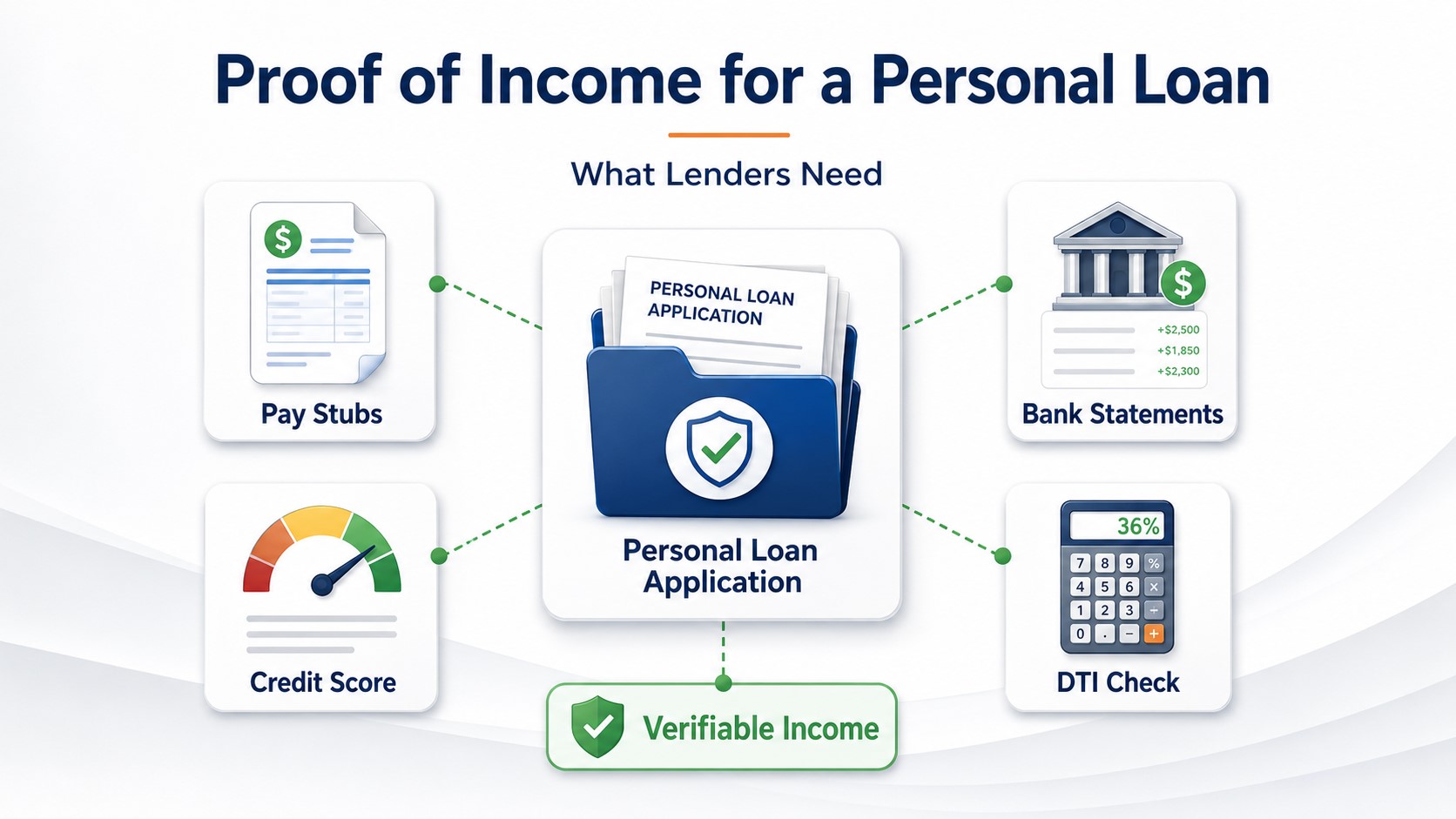
Personal-loan lenders may ask for proof that your income is real, current, and sufficient for their underwriting process. Common documents include employer-issued pay stubs, W-2s, tax returns, 1099 forms, bank statements, employment letters, and official benefit or retirement records. The best document depends on how you earn your income and what the lender specifically requests. There is no single proof-of-income document or fixed number of pay stubs that every personal-loan lender accepts.
Which Proof of Income Should You Use?
| Your Income Situation | Start With | Add If the Lender Requests It |
|---|---|---|
| W-2 employee | Recent employer-issued pay stub | W-2 or bank statement showing payroll deposits |
| New employee | Signed offer or employment letter | First pay stub when available |
| Self-employed | Filed tax return and recent bank statements | Profit-and-loss statement or 1099 records |
| 1099 contractor / freelancer | 1099 and tax return | Bank statements or current contracts if requested |
| Gig worker | Platform earnings records and bank deposits | 1099 or tax return |
| Retirement income | Pension, retirement or 1099-R documentation | Bank deposits or other account records |
| Social Security / disability | Official benefit or award documentation | Bank statement showing deposits |
| Rental income | Tax or lease documentation as requested | Bank deposit history or other supporting records |
| Cash income | Filed tax records and documented deposit history | Business records, invoices or ledger if accepted |
| No pay stubs | Ask the lender which alternative it accepts | Bank, tax, employer or benefit records |
Submitting more documents does not automatically improve an application. Start with the records the lender requests, then provide supporting documentation if clarification or additional verification is needed.
Personal Loan Proof of Income Finder
Choose the option that best describes how you earn money. This planning tool shows which documents may be useful to prepare before applying. The lender's own requirements always control.
This tool does not determine loan eligibility or guarantee that a lender will accept a particular document.
What Documents Can Prove Income for a Personal Loan?
The exact requirements vary by lender, but commonly used income records include:
What Does Each Proof-of-Income Document Actually Prove?
| Document | Strongest For | Main Limitation |
|---|---|---|
| Pay stub | Current wages, employer, pay dates, YTD earnings | Only covers a recent payroll period |
| W-2 | Prior-year employer wages and tax reporting | Historical and may not prove that income is still current |
| Tax return | Reported annual income | Historical and may not reflect recent changes |
| Bank statement | Deposits, payment consistency and cash flow | A deposit may not show gross earnings, taxes or exact income source |
| 1099 | Gross payments reported for nonemployee work | Does not necessarily show net income after business expenses |
| P&L statement | Current business revenue and expenses | May need bank or tax records to support the figures |
| Offer letter | New employment and stated compensation | Income may not have started yet |
| Benefit letter | Official recurring benefit amount | Only proves that specific source of income |
Best Proof-of-Income Package by Situation
A lender may need only one record, several records, or electronic verification. These combinations are practical starting points, not universal requirements.
Traditional employee
Start with a recent employer-issued pay stub. If the lender needs more history or verification, it may ask for a W-2, another recent pay statement, bank deposit history, or employer confirmation.
Self-employed borrower
Tax returns and bank statements are commonly useful because there may be no employer-issued pay stub. A lender may also request current business financial records such as a profit-and-loss statement.
1099 contractor or freelancer
A 1099 can show reported gross payments, while a tax return and bank statements can provide more context about total income and cash flow.
New employee
An employment or offer letter may help document expected compensation before a normal pay history exists. The lender may later request your first employer-issued pay stub or verify the job directly.
Benefits or retirement income
Use official records showing the recurring benefit, pension, or retirement amount. A lender may also request bank statements showing recent deposits.
Use records that are authentic, complete, current enough for the lender's request, and consistent with the income stated on your application.
Can You Use Pay Stubs as Proof of Income for a Personal Loan?
Yes, an employer-issued pay stub is one of the most direct ways for a traditional employee to document current income.
A complete pay statement may show:
- Employee name
- Employer information
- Pay-period dates
- Official pay date
- Hourly rate or salary earnings
- Gross pay
- Taxes and deductions
- Net pay
- Year-to-date earnings
The lender may compare those details with the income entered on your application, another pay stub, your bank deposits, or employer information.
A manually recreated document is not the same as an employer-issued statement from the employer's payroll system. Always provide the document type the lender requests.
How Many Pay Stubs Do You Need for a Personal Loan?
There is no universal number of pay stubs required for every personal loan. A lender may ask for one or more recent statements, use electronic verification, or request another type of income document.
Instead of guessing, check the lender's requested date range. What usually matters is that the records are:
- Recent enough for the lender's requirements
- Complete rather than cropped
- Readable
- Employer-issued when that is what the lender requests
- Consistent with the income listed on the application
Can Bank Statements Prove Income for a Personal Loan?
Some lenders may accept bank statements or use secure bank-account verification, especially when traditional payroll documents are unavailable or when they need to confirm recurring deposits.
| Bank Statements Can Help Show | Bank Statements May Not Show Clearly |
|---|---|
| Recurring deposits | Gross earnings before taxes and deductions |
| Deposit dates | Exact pay-period dates |
| Cash-flow consistency | Hours worked or pay rate |
| Account ownership | Whether every deposit represents earned income |
| Money actually received | Employer payroll calculations |
That is why a lender may request bank statements together with a pay stub, tax return, 1099, employment verification, or another supporting document.
Can You Use a W-2 or Tax Return for a Personal Loan?
W-2
A W-2 can document wages reported by an employer for a completed tax year. It is useful for historical income verification, but it may not prove that you still work for the same employer or earn the same amount today.
Tax return
A filed tax return can provide a broader view of reported annual income. It is especially useful for applicants whose income does not come from one traditional employer.
Self-employed applicants may need supporting tax schedules or other business-income documentation depending on the lender.
Can a Job Offer Letter Prove Income for a Personal Loan?
Some lenders may consider a signed offer letter or employment letter when you recently started a job or have not yet developed a normal pay-stub history.
A useful employment letter may identify:
- Employer
- Job title
- Start date
- Salary or hourly rate
- Employment status
The lender may still request your first pay stub, contact the employer, or require another form of verification before approving the loan.
Proof of Income for Self-Employed, 1099 and Gig Workers
Applicants do not need a traditional W-2 job for income to be documented, but self-employed and variable income often requires different records.
| Income Type | Documents That May Help |
|---|---|
| Self-employed | Tax returns, bank statements, P&L, business records |
| 1099 contractor | 1099s, tax return, bank statements |
| Freelancer | Tax records, deposits, 1099s, contracts/invoices if requested |
| Gig worker | Platform earnings, bank deposits, 1099/tax records |
For deeper documentation guidance, see proof of income when self-employed and 1099 proof of income .
Can Benefits, Retirement or Other Income Count?
A lender may consider other stable income sources according to its underwriting rules. The key is being able to document the income with reliable records.
| Income Source | Possible Supporting Record |
|---|---|
| Social Security | Official benefit verification or SSA documentation |
| Disability benefits | Benefit or award documentation |
| Pension | Pension statement |
| Retirement distribution | 1099-R or retirement-account documentation |
| Rental income | Tax records, lease or deposit records as requested |
| Investment income | Relevant account or tax records |
What If You Do Not Have Pay Stubs?
Not having traditional pay stubs does not automatically mean you cannot document income. The correct alternative depends on why the pay stubs are unavailable and how you earn money.
Possible alternatives include:
- Bank statements
- Tax returns
- W-2 or 1099 forms
- Employment verification
- Offer letter
- Benefit or pension statements
- Self-employment financial records
The lender decides which alternatives are acceptable, so ask for the exact documentation list before submitting substitutes.
How Do Personal-Loan Lenders Verify Income?
Income verification can happen in several ways. The lender may use one method or combine several.
| Verification Method | What It Means |
|---|---|
| Document review | The lender reviews pay stubs, tax records, W-2s, 1099s or bank statements. |
| Employer verification | The employer may be contacted to confirm employment or compensation information. |
| Payroll verification | Income or employment information may be confirmed electronically when available. |
| Bank verification | The borrower may authorize secure read-only access to verify deposits or cash flow. |
| Cross-checking | The lender compares application data against submitted or verified information. |
A lender may still request a PDF, tax record, employment letter, or another document when automated information is incomplete or inconsistent.
Why Might a Lender Ask for Another Income Document?
| Problem | Why It May Need Review |
|---|---|
| Document is too old | It may not reflect current earnings. |
| Pay stub is cropped or incomplete | Employer, pay period or YTD details may be missing. |
| Application income does not match records | The lender may need an explanation or additional verification. |
| Bank deposits differ from claimed income | The amount or source may require clarification. |
| W-2 is from an old job | Prior-year income may no longer be current. |
| 1099 shows gross payments only | Business expenses may affect actual self-employed income. |
| Screenshot instead of complete statement | The lender may need the full original PDF or record. |
| Document appears altered or recreated | The lender may not be able to verify its authenticity. |
Does Proof of Income Guarantee Personal-Loan Approval?
No. Income verification is only one part of underwriting. A lender may also evaluate:
- Credit history
- Existing debts
- Debt-to-income ratio
- Requested loan amount
- Housing costs
- Employment or income stability
- Other lender-specific factors
Is There a Minimum Income for a Personal Loan?
There is no universal minimum income that applies to every personal loan. Some lenders publish minimum-income criteria, while others evaluate income together with existing debts, credit history, loan amount, and other underwriting information.
Check the specific lender's current eligibility requirements instead of relying on a generic salary threshold.
Can You Get a Personal Loan Without Traditional Proof of Income?
Sometimes a lender can verify ability to repay without traditional documents such as employer-issued pay stubs. That does not necessarily mean the lender ignores income.
Alternative verification may involve:
- Bank-account information
- Tax records
- Self-employment records
- Benefits or retirement income
- Employment verification
- Other lender-approved income sources
If you do not have standard pay stubs, ask the lender which alternative documents it accepts before applying.
Do not inflate, alter, invent, or misrepresent income on a loan application. The information you provide may be cross-checked against payroll, bank, tax, employment, or other verification records.
Need to Organize Accurate Current Pay Information?
If you are an employer, self-employed user, or someone responsible for legitimate current payroll records, ePaystubs can help organize accurate pay information. Always use the exact type of document a lender requests, and never create or alter a document to impersonate an employer-issued historical record or misrepresent income.
Create a Pay StubFrequently Asked Questions
Common options include employer-issued pay stubs, W-2s, tax returns, 1099s, bank statements, employment letters, and official benefit or retirement records. The lender decides which documents it accepts.
Some do, but there is no universal rule. A lender may accept another form of income verification or use electronic verification instead.
There is no fixed number for every lender. Follow the lender's requested date range and provide complete, recent, employer-issued statements when those are required.
Some lenders may use bank statements or secure bank-account verification to review recurring deposits and cash flow. A lender may still request another document because bank deposits do not always show gross income, employment status, or payroll details.
A W-2 can document prior-year employer wages, but because it is historical, the lender may also request evidence of current income such as a recent pay stub or employment verification.
Self-employed applicants can document income with records such as tax returns, bank statements, 1099s, and current business financial records according to the lender's requirements.
Some lenders may accept an offer or employment letter as supporting evidence for a new job. They may still request a first pay stub, employer verification, or another income record.
Possibly. Depending on the lender and your income source, alternatives may include bank statements, tax returns, W-2 or 1099 forms, employment verification, benefit records, or self-employment documentation.
Some lenders may verify employment or income directly, while others rely on uploaded documents, digital payroll verification, bank data, or another approved verification method.
No. A lender may also consider credit history, existing debts, debt-to-income ratio, loan amount, and other underwriting factors.