
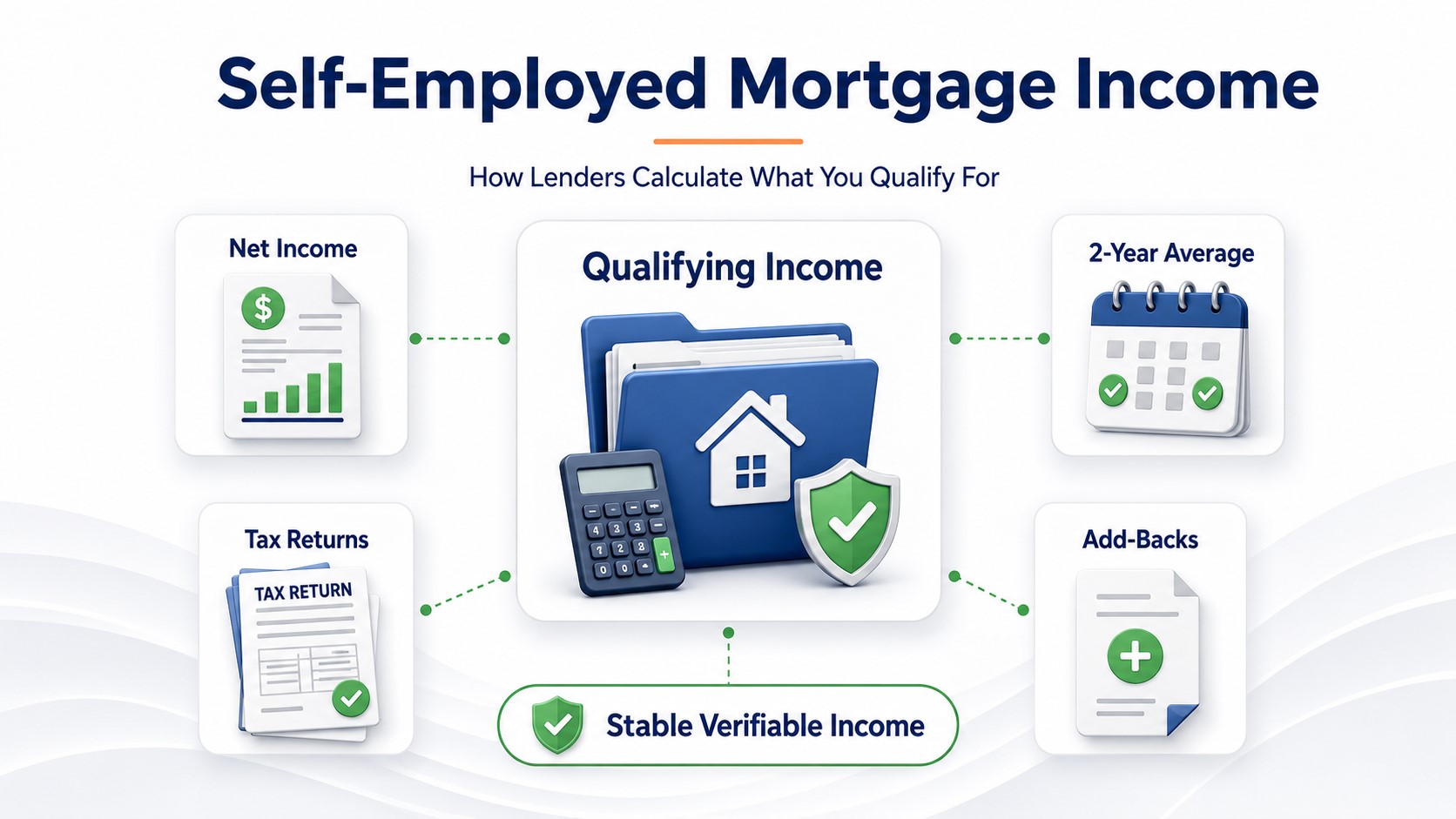
Self-Employed Mortgage Income: How Lenders Count Net Profit
By ePaystubs Editorial Team | Updated June 22, 2026 | Reviewed against Fannie Mae self-employed guidelines
When you're self-employed, mortgage lenders qualify you on your net income after business expenses, averaged over your last two years of tax returns, not your gross revenue. That single rule explains why a freelancer earning $200,000 can qualify for less house than a salaried neighbor earning half as much: the write-offs that lower your taxes also lower your qualifying income. This guide explains how the calculation works, the deductions lenders add back, and what to plan before you apply.
The math is not unfair, it is just different from what most self-employed borrowers expect. Lenders do not look at what your business brings in; they look at what is left after expenses on your tax return, averaged over two years. The good news is that the calculation is rule-based and predictable, so once you understand it, you can plan around it. This guide walks through how lenders calculate your income, the deductions that work in your favor, how much house the result qualifies you for, and the single best thing you can do before you apply. We are a pay-stub resource, not a lender, so think of this as the orientation that helps you walk into a lender conversation informed.
- Why you qualify for less
- Who counts as self-employed
- How income is calculated
- How much house
- The add-backs
- The declining-income rule
- Documents you'll need
- Loan alternatives
- Plan ahead
Why Self-Employed Borrowers Often Qualify for Less
Here is the tension at the heart of every self-employed mortgage application: the smarter you are about taxes, the harder it can be to qualify. Spend years training yourself to deduct every legitimate expense, which is exactly what your accountant wants, and you may find a lender sees a fraction of what your business actually earns.
A freelance consultant who grosses $180,000 a year and claims $80,000 in legitimate deductions shows about $100,000 in net income on the tax return. That lower number, not the gross, is typically what a lender uses. Push the deductions harder, say $200,000 in revenue against $150,000 in write-offs, and the lender may qualify you on just $50,000, even though your cash flow is far healthier than that.
This is not lenders distrusting you. It is a mechanical rule: they qualify you on the taxable income reported on your return, and write-offs reduce it. The good news is that the calculation is rule-based and predictable. Once you know which line becomes your qualifying income, what gets added back, and what trips up the average, you can plan the year or two before you apply around the loan you actually want.
Who Counts as "Self-Employed" for a Mortgage
For mortgage purposes, you are considered self-employed if any of these apply: you own 25 percent or more of a business, you receive 1099 income for services, or your income is reported on Schedule C of your tax return. That covers sole proprietors, freelancers, independent contractors, and partnership, S-corporation, or C-corporation owners.
Gross vs Net, and the Two-Year Average
The mechanic is simpler than it sounds. Lenders start with your net profit, the figure after business expenses, on your tax return. For sole proprietors that is the net profit on Schedule C. For S-corporation and partnership owners, it is your share of the business income on your K-1, combined with any W-2 salary the business pays you. Then they average your two most recent years.
So the rough formula is the sum of your last two years of net income, divided by 24, which gives your monthly qualifying income. That figure then drives your debt-to-income ratio, the percentage of your monthly income that goes toward debts including the new mortgage. This is the mechanism behind the qualifying struggle: heavy write-offs lower the income on paper, which raises your debt-to-income ratio, which is exactly the number lenders use to decide how much you can borrow.
How Much House Will That Qualify You For?
Once you know your qualifying income, the natural next question is how much you can actually borrow. A common rule of thumb lenders and borrowers use is that your loan amount lands somewhere around four to four and a half times your annual qualifying income, though the real number depends on your other debts, your down payment, your credit score, and current rates.
The reason debt-to-income, not income alone, sets the ceiling is that two borrowers with identical income can qualify for very different loan amounts depending on their existing debts. A $100,000 earner with no car payment or credit-card balance qualifies for far more than one carrying $1,500 a month in other debt. So the two most effective things you can do to raise the number, beyond the income side, are paying down existing debt and bringing a larger down payment. Treat the multiple above as a back-of-envelope starting point, not a promise, only a lender running your full file produces a real figure.
The Deductions Lenders Add Back (the Good News)
Not every deduction counts against you. Some are paper losses, not real money leaving your account, and lenders add those back to your qualifying income. This is the part of the calculation that works in your favor.
The most common add-backs are depreciation, depletion, amortization, casualty losses, and the depreciation portion of the home-office deduction. Depreciation is the big one: the IRS lets you deduct a portion of the cost of business assets over time even though no cash leaves your account, so lenders add it back. If your Schedule C shows $12,000 of depreciation, that is about $1,000 a month added back to your qualifying income.
The home-office deduction is worth understanding because it splits two ways. The depreciation portion is a paper loss and gets added back, while the cash portions, your share of utilities, repairs, and insurance, are real expenses and do not. Most underwriters work from the figures on IRS Form 8829 when they are itemized cleanly on the return, which is one more reason a tidy, well-prepared return helps your qualifying income.
The Declining-Income Rule (the Asymmetry to Know)
Here is a rule that catches a lot of borrowers off guard. If your most recent year is higher than the year before, lenders average the two years. But if your most recent year is lower, they generally use the lower, more recent year alone, not the average. In other words, you do not get the benefit of the average when you are on a downward trend, and a strong earlier year will not rescue a soft recent one.
Underwriters do not stop at last year's return either. They also pull a year-to-date profit and loss statement, usually dated within the last 60 to 90 days of your application, to confirm the business is still tracking close to the two-year average. A soft quarter right before you apply can drag the qualifying number down even when your two-year history is strong, so the months leading up to your application matter almost as much as your filed returns.
The Documents You'll Need
Self-employed files require more paperwork than a W-2 borrower's, and organized, complete documents speed underwriting and prevent last-minute surprises. Here is the typical set.
- Two years of personal tax returns (Form 1040), with all schedules including Schedule SE
- Two years of business tax returns if you own 25 percent or more (Form 1065 for partnerships, 1120-S for S-corps, 1120 for C-corps), plus K-1s
- A year-to-date profit and loss statement, ideally prepared or reviewed by your accountant
- A balance sheet for your business
- 12 to 24 months of personal and business bank statements
- Proof your business exists and has for two years: a business license, a CPA letter, or proof of insurance
- W-2s if you also have income from traditional employment
To understand how your income builds across the year, which matters for that year-to-date statement, see our guide on how to track your year-to-date earnings.
When Tax Returns Don't Reflect Your Income: Loan Alternatives
When your write-offs make your taxable income too low to qualify conventionally despite healthy cash flow, specialized programs exist that calculate income differently. These are lender products, so a loan officer determines which one fits, but here is what they are.
| Program | How income is calculated |
|---|---|
| Bank statement loan | 12 to 24 months of bank deposits instead of tax returns |
| P&L loan | A CPA-prepared profit and loss statement |
| DSCR loan | An investment property's rental income, not your personal income |
The bank statement loan is the most common. The lender adds up your deposits, subtracts an expense factor, and divides by the months reviewed. The expense factor is either a fixed rate of around 50 percent when you have no third-party documentation, or a lower rate from a CPA-prepared expense letter, which works in your favor. Deposits into a personal account are often counted in full, while business-account deposits get the factor applied. The illustration that shows why this product exists: a borrower grossing $1,000,000 a year but showing only $50,000 in net profit would qualify on about $50,000 conventionally, but a bank statement loan based on actual deposits could qualify them on far more.
Plan Ahead: the Single Best Thing You Can Do
If you take one thing from this guide, take this: talk to a loan officer 12 to 18 months before you apply, not two weeks before. The decisions you make at tax time, how aggressively you write off, how you pay yourself from an S-corp, the timing of large equipment purchases, all affect your qualifying income. Once a return is filed, those choices are locked in for two years of averaging.
You do not have to overpay your taxes. The middle ground is to know which deductions get added back and which simply lower your qualifying income, and to keep your write-offs moderate in the years before you apply if a mortgage is on the horizon. Some advisors suggest keeping write-offs under roughly 40 percent of your income in that window. A short pre-application checklist helps: pull your last two years of complete federal returns including all K-1s, have a year-to-date profit and loss statement ready, and identify your depreciation and non-recurring expenses in advance so you can flag them rather than letting them get missed.
A Note on Documentation and Honesty
One reality worth keeping in mind throughout: lenders verify your income directly with the IRS. With your consent, they pull a transcript of your tax return, so every figure on your application has to match what you actually filed. You cannot present income you did not report, and a mortgage file is built on your tax returns, not on pay stubs.
If you need a pay-stub-style document for your real income, you can use our paystub creator to prepare one in a few minutes. For the bigger picture of proving self-employment income across all situations, not just mortgages, see our guides to proof of income when self-employed and proving income when paid in cash.
Frequently Asked Questions
Net income, after business expenses, not gross revenue. Lenders take the net profit from your tax returns, add back certain non-cash deductions like depreciation, and average the result over your two most recent years.
They add your net income from the last two years and divide by 24 to get a monthly figure. So $70,000 one year and $135,000 the next averages to about $8,540 a month. If your recent year is lower, they often use that lower year alone.
Most lenders want two years, documented with two years of tax returns. Some accept one year if your most recent return shows a full 12 months of self-employment and you have prior income at a similar level in a related field.
Write-offs lower your taxable income, and lenders qualify you on taxable income, so heavy deductions can reduce your qualifying income even when your cash flow is strong. Non-cash deductions like depreciation are added back, but cash expenses are not.
It's a loan that qualifies you on 12 to 24 months of bank deposits instead of tax returns, useful when write-offs make your taxable income too low. The lender averages your deposits and subtracts an expense factor. These are non-QM loans with higher rates.
Non-cash deductions, primarily depreciation, plus depletion, amortization, casualty losses, and the depreciation portion of the home-office and standard-mileage deductions. Real cash expenses are not added back.
It's harder. Lenders usually use the lower recent year and may ask for a written explanation. If the drop is small and tied to a documented one-time event, you may still qualify on the recent-year figure; a large or trending decline may mean waiting or a non-QM option.