
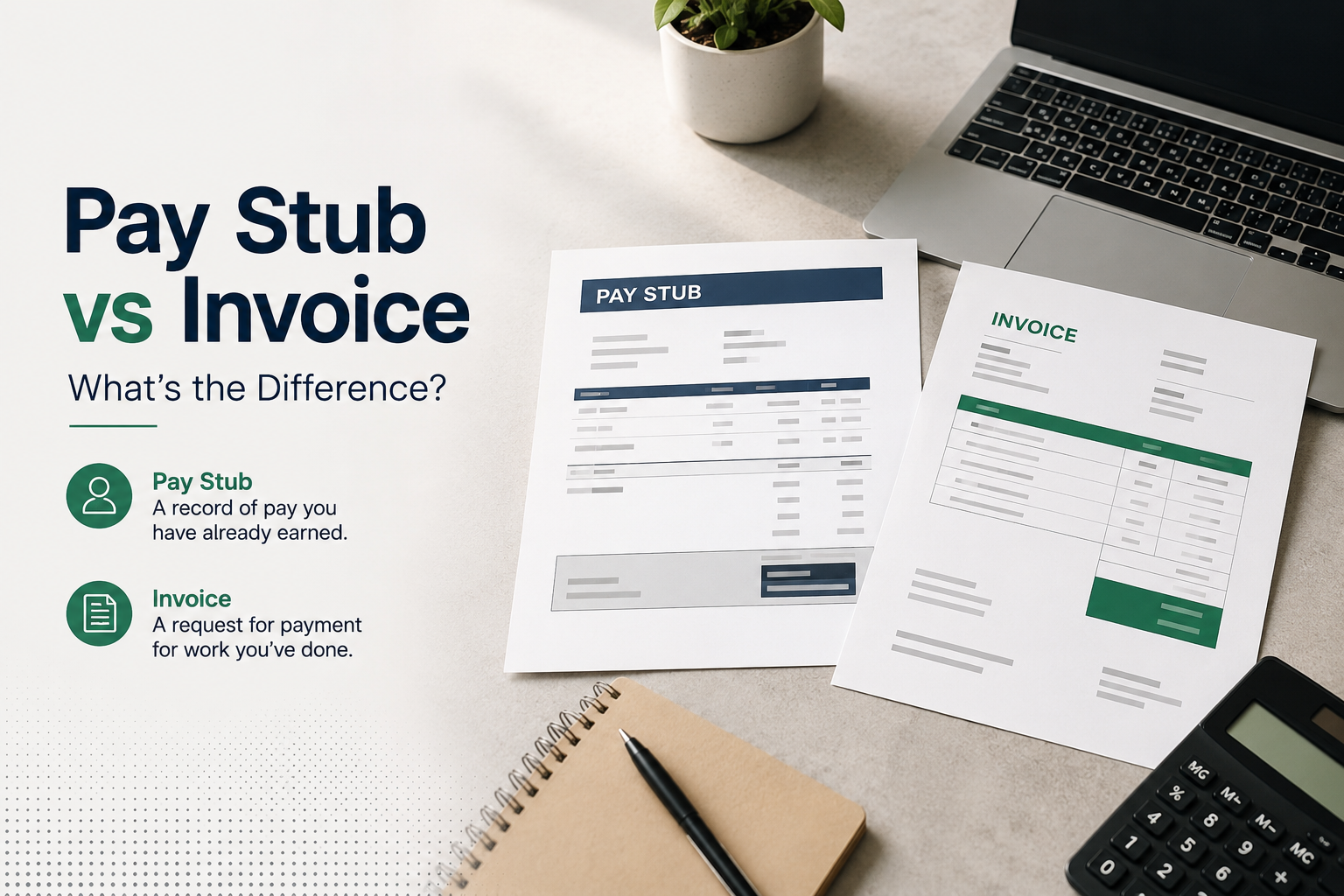
Pay Stub vs Invoice: Key Differences for Employees and Contractors
Payroll record vs billing request
The easiest way to understand pay stub vs invoice is to ask what stage of the payment process you are looking at. An invoice usually comes before a client pays. A pay stub belongs to an employee payroll process and explains how wages were calculated. A bank record, receipt or payment confirmation helps show that money actually moved.
What is a pay stub?
A pay stub, pay statement or wage statement is a payroll record tied to an employee's pay period. It commonly shows gross earnings, hours or salary information, taxes, other deductions, net pay and year-to-date totals. The employer or payroll provider produces the record as part of payroll. If you need the individual fields explained, see what is on a pay stub.
A pay stub explains the payroll calculation. It is not the same thing as the paycheck or direct deposit that delivers wages. For that distinction, see pay stub vs paycheck.
What is an invoice?
An invoice is a request for payment from a seller, freelancer, contractor or business to a customer or client. It normally identifies the parties, invoice number, description of work or goods, quantity or rate, amount due, issue date, payment terms, due date and payment instructions.
An invoice can be unpaid, partially paid or fully paid. That is the key difference: an invoice documents what was billed, not necessarily what was received. After payment, contractors should preserve records that let them reconcile the invoice with the amount actually paid.
Pay stub vs invoice: side-by-side comparison
| Question | Pay stub | Invoice |
|---|---|---|
| Primary purpose | Explains an employee payroll calculation. | Requests payment for goods or services. |
| Who creates it? | Employer or payroll provider. | Contractor, freelancer, vendor or business. |
| Who receives it? | Employee. | Customer or client. |
| When used? | During/after payroll for a pay period. | According to billing terms, often before payment. |
| Gross earnings | Typically shown. | Not an employee gross-wage calculation. |
| Payroll taxes/deductions | Commonly itemized. | Generally not employee withholding; tax treatment depends on the transaction. |
| Net pay | Typically shown for payroll. | Shows an amount due/balance, not employee take-home pay. |
| Proves payment arrived? | Not always by itself. | No. An unpaid invoice is only a billing request. |
| Typical worker | Employee. | Independent contractor/freelancer/vendor. |
| Useful for income verification? | Often useful for employee wage income, subject to the verifier's rules. | Can support contractor income records, but reviewers may require deposits, tax records, P&L statements or other evidence. |
The easiest way to remember it: 4 documents, 4 jobs
Many “pay stub vs invoice” questions are really about confusing four different records. This timeline separates them.
Example: employee pay stub vs contractor invoice
Employee example
Jordan is an employee earning $2,400 for a biweekly pay period.
- Gross earnings: $2,400
- Taxes and employee deductions: $520
- Net pay: $1,880
The pay stub explains how $2,400 became $1,880. The direct deposit or paycheck delivers the $1,880.
Independent contractor example
Casey completes design work for a client and bills $2,400.
- Invoice issued: $2,400
- Client initially pays: $1,500
- Remaining invoice balance: $900
- Final payment later: $900
The invoice shows the $2,400 billed. It does not prove the full $2,400 was received on the invoice date. Casey's payment records can show the two payments and reconcile them to the invoice.
Employee or independent contractor? The document does not decide the classification
Do not decide worker status only by whether someone receives a pay stub or sends an invoice. For federal tax purposes, the IRS says the full relationship must be examined. Relevant evidence falls into three broad categories: behavioral control, financial control and the type of relationship.
A contract label alone does not settle the issue. The IRS notes that the actual working relationship matters. If classification is uncertain, review the IRS employee vs independent contractor guidance.
For a broader tax comparison, see W-2 vs 1099.
Which one is better proof of income?
There is no universal proof-of-income document accepted in every situation. The landlord, lender, agency or other verifier decides what records it will accept and for what period.
For a deeper breakdown, see proof of income when self-employed and what counts as proof of income.
Which document do you actually need?
| What are you trying to do? | Best starting record | Why |
|---|---|---|
| Bill a client | Invoice | States what is owed and the payment terms. |
| Check employee gross/net pay | Pay stub | Shows the payroll calculation. |
| Confirm wages actually arrived | Pay stub + bank/payment record | One shows the calculation; the other helps confirm delivery. |
| Show an invoice was paid | Invoice + payment record/receipt | Connects the billed amount with payment. |
| Verify current employee income | Recent pay stubs plus whatever the verifier requests | Shows current wage data with employer/pay-period context. |
| Verify self-employed income | Tax/business records + current payment evidence | Shows both reported income and recent business activity. |
| Confirm annual employee tax wages | W-2 | Annual tax reporting, not one pay period. |
| Confirm nonemployee compensation reporting | 1099-NEC when required | Reports qualifying nonemployee compensation for the year. |
2026 contractor reporting: the $600 rule changed
For payments made in 2026, the IRS states that the general information-reporting threshold for certain nonemployee-compensation payments increased from $600 to $2,000. For payments made before 2026, the threshold was $600. The rules contain exceptions, including backup withholding, and not every payment to every contractor is reportable in the same way.
For the current rule and exceptions, use the IRS information-return guidance and the 2026 Forms 1099-MISC and 1099-NEC instructions.
Can an independent contractor use a “pay stub”?
A genuine independent contractor is not paid as an employee through the client's payroll. The cleaner terminology is usually contractor payment statement, earnings statement, remittance record or income summary, depending on what the document actually represents.
A self-prepared summary can help organize legitimate payment records, but it should not be presented as an employer-issued wage statement if no employer payroll relationship exists. For proof-of-income purposes, self-prepared documents are generally stronger when they reconcile to third-party evidence such as bank deposits, platform statements and filed tax records.
If you legitimately need an employee-style pay record for actual payroll, ePaystubs provides an online pay stub generator. Use accurate information and only create documents that reflect real compensation and the actual employment/payment relationship.
What should be on each document?
Typical pay stub fields
- Employer and employee identification
- Pay-period and payment dates
- Hours/rate or salary earnings information
- Gross earnings
- Taxes and other deductions
- Net pay
- Year-to-date figures where applicable
Typical invoice fields
- Seller/contractor and customer/client details
- Unique invoice number
- Invoice and due dates
- Description of goods or services
- Quantity, hours, rate or unit price
- Subtotal, applicable taxes/fees and total due
- Payment terms and payment instructions
Pay stub vs invoice vs receipt vs paycheck vs 1099
| Document | Core job | Typical timing |
|---|---|---|
| Pay stub | Explains employee payroll. | Each pay period. |
| Invoice | Requests payment. | Based on billing terms. |
| Receipt/payment confirmation | Helps document that a transaction/payment occurred. | After payment. |
| Paycheck/direct deposit | Delivers employee wages. | Payday. |
| 1099-NEC | Annual information return for qualifying nonemployee compensation. | After the calendar year, when filing rules apply. |
Frequently asked questions
Is a pay stub the same as an invoice?
No. A pay stub is tied to employee payroll. An invoice is a billing request sent to a customer or client.
Do independent contractors get pay stubs?
Independent contractors are not paid as employees through a client's payroll. They typically send invoices and keep payment/business records. A contractor may use an earnings or payment statement for recordkeeping, but that is different from an employer-issued employee wage statement.
Can an invoice be used as proof of income?
It can support an income-verification package, but an invoice alone only shows what was billed. The verifier may also want bank deposits, tax returns/transcripts, 1099s, P&L statements or other independently verifiable records.
Does a pay stub prove that wages reached my bank account?
It shows what payroll calculated and recorded for the pay period. If actual receipt matters, compare the stub's net pay with the complete payment record, accounting for split deposits or other payment destinations.
Can I use an invoice instead of a pay stub?
Not for an employee payroll record. An invoice and a pay stub serve different purposes. Use an invoice to bill a client; use the appropriate payroll record for employee wages.
What is the 1099-NEC threshold for 2026?
For qualifying payments made in 2026, the general threshold for certain Form 1099-NEC reporting is $2,000, subject to exceptions and the specific IRS rules. The general threshold was $600 for payments made before 2026.
Need a pay stub for legitimate payroll or income records?
Use accurate earnings, tax and deduction information that reflects the real payment relationship. ePaystubs can help you create a clear pay stub when a pay-stub format is appropriate.
Create a Pay StubGeneral educational information only. Payroll, worker-classification, wage-statement and tax rules can vary by facts, jurisdiction and year. Check current federal and state requirements or consult a qualified professional for a specific situation.