
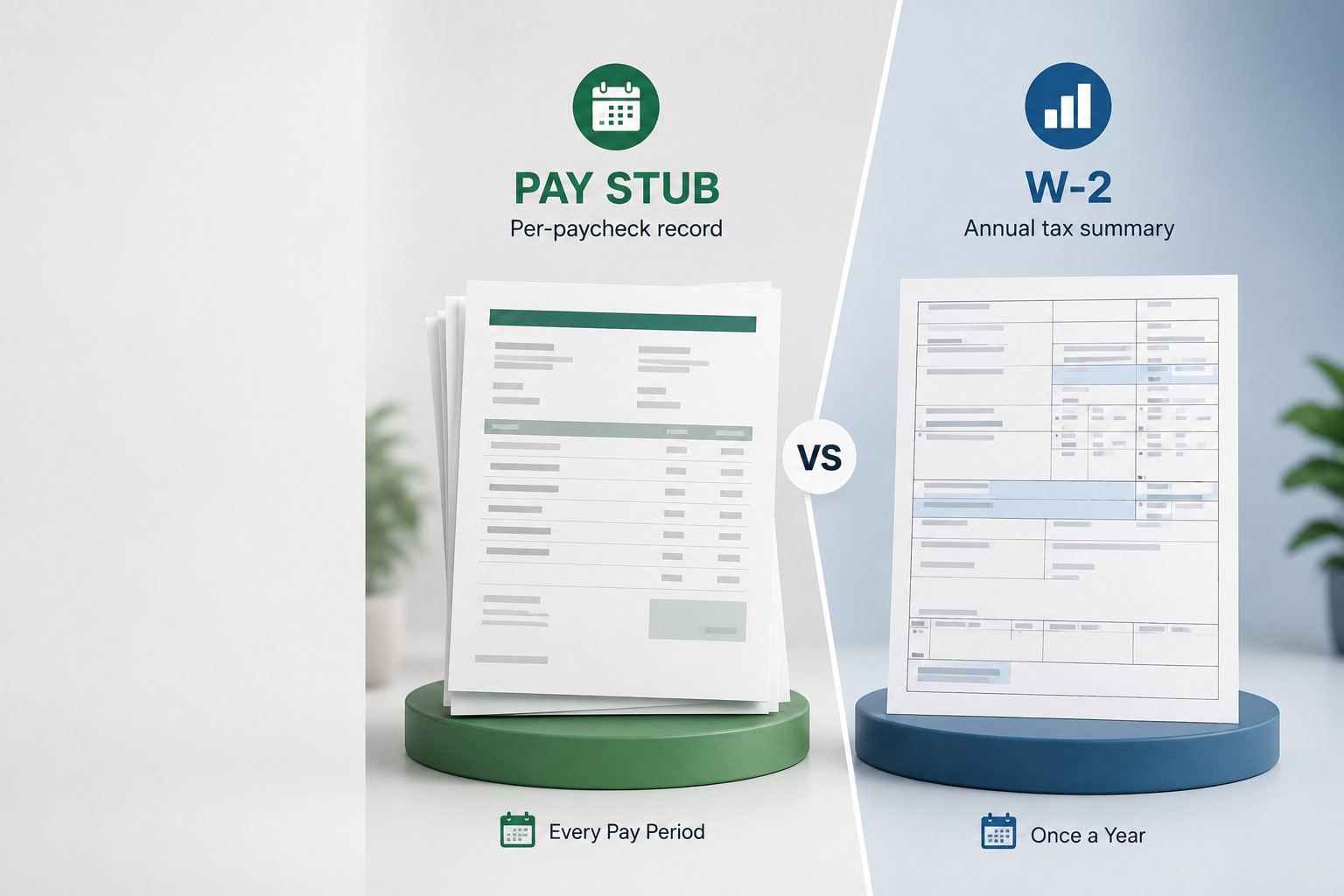
Pay Stub vs W-2: Differences, Tax Use, and Why They Do Not Match
Written by the ePaystubs Editorial Team · Last updated: June 2026
A pay stub and a W-2 are two different documents. A pay stub is the per-paycheck record of what you earned and what was taken out for one pay period. A W-2 is the annual tax form your employer sends once a year that reports your taxable wages and the taxes withheld. You file your taxes with the W-2, not a pay stub. And the two often do not match, because pre-tax deductions lower the wages shown on your W-2.
The short answer: the pay stub tracks a single paycheck, the W-2 sums up your year for taxes. File with the W-2, and expect the numbers to differ because of pre-tax deductions.
Below is what each document is, a side-by-side comparison, why your final pay stub rarely matches your W-2, which one to use and when, and what a pay stub generator can and cannot create.
What each document is
They sound related, and they are, but they do different jobs. One is a running record of each payday. The other is a once-a-year tax summary.
Pay stub
A pay stub is the breakdown that comes with each paycheck. It shows your gross pay for the pay period, the taxes and deductions taken out, and your net pay, plus year-to-date totals. You may also see it called a paycheck stub, check stub, or pay statement; they all mean the same thing. For a closer look at the lines on it, see our guide to what a pay stub shows.
W-2, the annual tax form
A W-2, officially the Wage and Tax Statement, is the annual tax form your employer prepares after the year ends. It reports your taxable wages and the federal, state, Social Security, and Medicare taxes withheld, and it is what you use to file your return. According to the IRS Form W-2 rules, an employer must file a W-2 for any employee paid $600 or more during the year, or anyone from whom income, Social Security, or Medicare tax was withheld. So when people compare a pay stub to a tax form, the W-2 is the tax form they mean.
Pay stub vs W-2, side by side
Here is the difference at a glance.
| Pay stub | W-2 | |
|---|---|---|
| How often | Every pay period | Once a year |
| Who issues it | Your employer or payroll system | Your employer, also filed with the SSA |
| Main purpose | Show how one paycheck was calculated | Report your year for tax filing |
| What it reports | Gross pay, deductions, net pay, year to date | Annual taxable wages and taxes withheld |
| You use it for | Proof of current income, checking your pay | Filing your tax return |
Why your W-2 does not match your last pay stub
This is the question that comes up every tax season. You look at the gross pay on your final pay stub, then look at your W-2, and the numbers are different. That is normal, and usually correct.
The reason is that your pay stub shows gross pay, while your W-2 shows taxable wages. Pre-tax deductions sit between the two. Money you put into a 401(k), traditional health insurance premiums, an HSA, and similar pre-tax items lower the wages reported in Box 1 of your W-2. A state payroll office puts it plainly: Box 1 reports taxable wages, not gross pay.
A quick example
One detail trips a lot of people up: not every pre-tax deduction affects every box. A traditional 401(k) lowers your federal taxable wages in Box 1, but it does not lower your Social Security and Medicare wages in Boxes 3 and 5, because you still pay those taxes on the money you set aside. Pre-tax health insurance and HSA contributions are different; they usually lower all three. That is why Box 1 is often the smallest wage figure on your W-2.
Non-taxable items can also create a gap. Things like mileage reimbursements or certain allowances may appear on your pay stub but are left out of your taxable wages, which makes the stub look higher than the W-2.
How to reconcile your pay stub and W-2
If you want to check the math yourself, work from your final pay stub of the year:
- Start with your year-to-date gross pay from your last pay stub
- Subtract your pre-tax deductions, such as 401(k), traditional health insurance, and HSA contributions
- The result should be close to Box 1 on your W-2
- Small rounding differences are normal; a large gap is worth a question to payroll
Roth 401(k) contributions are an exception, since they are made after tax and do not lower Box 1. If the numbers still do not line up after accounting for pre-tax items, ask your payroll department to walk through it with you.
Which one do you use, and when
Most of the confusion clears up once you match the document to the task.
| What you need to do | Use |
|---|---|
| File your tax return | Your W-2, always. Do not file from your last pay stub. |
| Show your current income for a rental or loan | Recent pay stubs |
| Show last year's total income | Your W-2 |
It is worth being clear about the tax point. You cannot reliably file your taxes from your final pay stub, because it may not reflect your taxable wages or carry all the information your return needs. Filing from a stub can lead to errors and an amended return later. Wait for the W-2.
For proof of income, the two documents answer different questions. A pay stub shows what you are earning right now, which is what most landlords and lenders want to see. A W-2 shows what you earned last year. If you are self-employed and do not receive either from an employer, our guide to proof of income covers the alternatives that get accepted.
What employers provide, and by when
If you run payroll, the two documents have different rules. You provide pay stubs according to your state's wage statement rules, which vary by state, so check what your state requires. The W-2 is set at the federal level. Employers must furnish each employee's W-2 by January 31 (the next business day if it falls on a weekend), and a W-2 is required for any employee paid $600 or more during the year, or anyone from whom tax was withheld.
Can a pay stub generator create a W-2?
No. A pay stub generator creates pay stubs. It is useful when you need a clear record of earnings or proof of income, for example if you are self-employed or your employer does not provide stubs, and you can create online pay stubs or start from a pay stub template. It does not produce an official W-2. Your W-2 is prepared and issued by your employer. If yours is missing or late, see how to get a copy of your W-2 rather than trying to recreate one.
So the simple takeaway: two different documents, two different jobs. File your taxes with the W-2. When you need to prove what you earn, reach for a recent pay stub for current income or your W-2 for last year's total. And when the year-end numbers do not match, that is usually your pre-tax deductions doing exactly what they are supposed to do, not a mistake.
Frequently asked questions
Is a pay stub the same as a W-2?
No. A pay stub is a per-paycheck record of your earnings and deductions. A W-2 is the annual tax form that reports your taxable wages for the whole year.
What is the difference between a pay stub and a W-2?
A pay stub covers one pay period and shows gross pay, deductions, and net pay. A W-2 covers the full year and reports your taxable wages and taxes withheld for filing your return.
What is the difference between a paycheck stub and a W-2?
A paycheck stub is just another name for a pay stub, so the comparison is the same: a per-paycheck earnings record versus the annual W-2 tax form used for filing.
Can I use a pay stub instead of a W-2?
For proof of current income, yes, a recent pay stub works. For filing your taxes, no. Use the official W-2.
Can I use my final pay stub to file taxes?
It is not recommended. A last pay stub may not match your taxable wages or include everything your return needs, which can lead to errors and an amended return. Wait for your W-2.
Why does my final pay stub not match my W-2?
Because the stub shows gross pay and the W-2 shows taxable wages. Pre-tax deductions like 401(k) and health insurance lower the amount in Box 1, so the W-2 is usually lower than your gross pay.
Is a pay stub or W-2 better for proof of income?
It depends on what is being asked. A pay stub shows your current income, which most landlords and lenders want. A W-2 shows last year's total. Sometimes both are requested.
What information appears on a pay stub?
Gross pay, tax withholdings, other deductions, net pay, and year-to-date totals, along with your name, your employer's details, and the pay period dates.
What information appears on a W-2?
Your annual taxable wages, the federal and state taxes withheld, Social Security and Medicare amounts, and employer and employee identifying details.
Does a pay stub generator create W-2 forms?
No. It creates pay stubs. An official W-2 comes from your employer. If yours is missing, request a copy from the employer or follow the IRS process to obtain it.
Do employers have to provide pay stubs and W-2s?
Employers must furnish a W-2 to each employee by January 31. Pay stub requirements are set by each state and vary, so the rules depend on where you work.
This article is for general information and is not legal or tax advice. Pay stub rules vary by state, and tax rules and deadlines can change, so confirm the current details with the IRS or your state labor department, or speak with a tax professional.