
What Is CASDI on My Paycheck? SDI Meaning, 2026 Rate and Rules
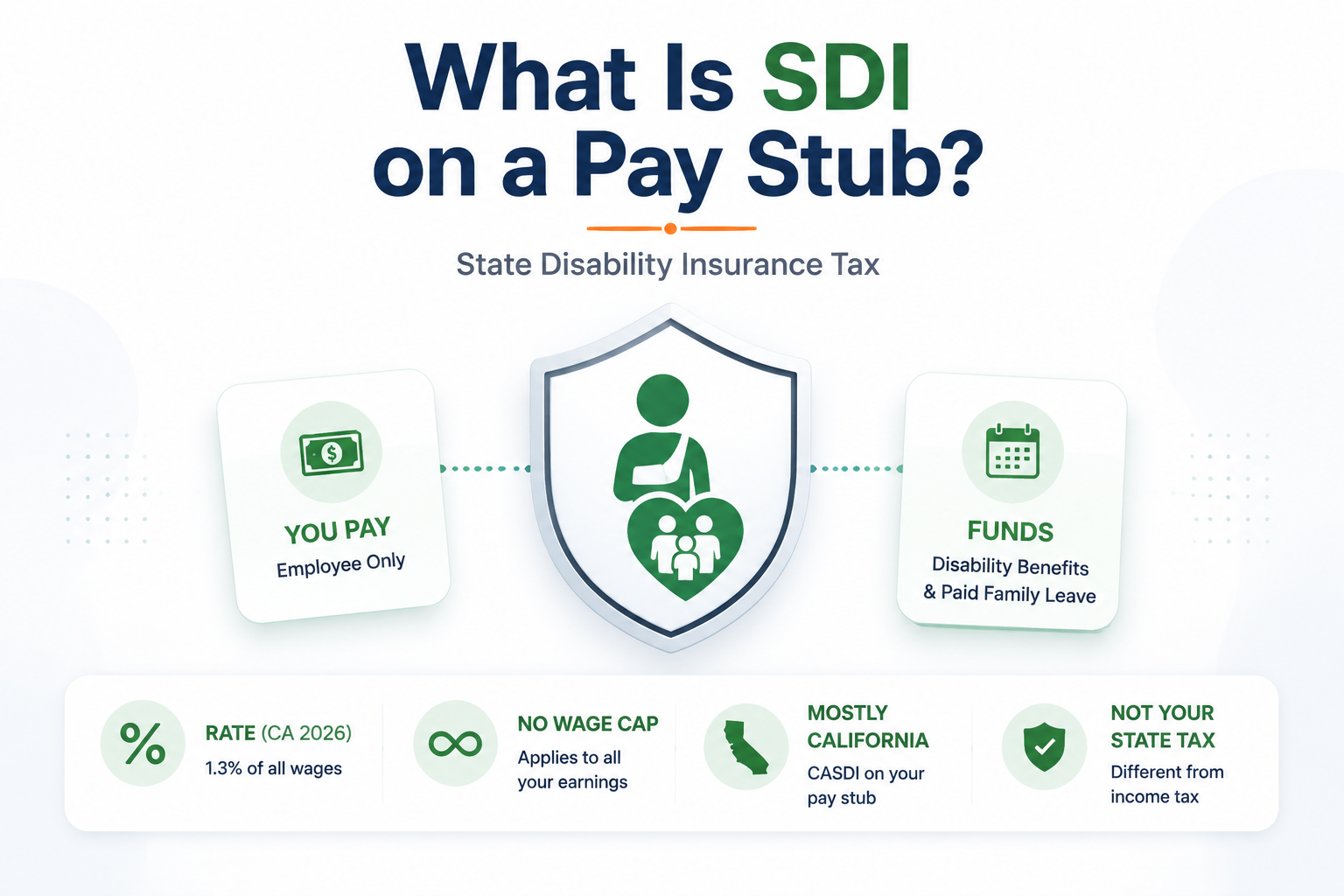
CASDI on a paycheck means California State Disability Insurance. It is generally a mandatory employee payroll deduction used to fund California Disability Insurance and Paid Family Leave. On a pay stub, the same type of withholding may be labeled CASDI-E, CA SDI, SDI, or SDI EE; “E” or “EE” usually means employee.
In 2026, regular California SDI withholding is 1.3% of wages subject to SDI, with no annual taxable-wage ceiling. If your SDI-taxable wages for a paycheck are $2,000, the standard calculation is $2,000 × 0.013 = $26.00. Check the official EDD rate, or check the deduction on your own pay stub below.
What is CASDI tax on your paycheck?
California generally requires employees in jobs covered by State Disability Insurance to contribute through payroll withholding. Your employer withholds the amount and remits it to the California Employment Development Department (EDD). CASDI is separate from California personal income tax, Social Security (OASDI), Medicare, and unemployment insurance. It is not an extra tax charged simply because you requested a pay stub.
The deduction helps fund potential wage-replacement benefits. Paying CASDI does not, by itself, guarantee that a particular benefit claim will be approved: the program has its own eligibility rules. See California EDD's Disability Insurance information.
What does CASDI-E mean on a pay stub?
CASDI-E meaning: In common payroll shorthand, CASDI-E identifies the employee contribution to California State Disability Insurance. CASDI and CASDI-E usually refer to the same California program, not two separate state taxes. The abbreviations are payroll-provider labels rather than one mandatory nationwide labeling standard.
| Label | What it usually means |
|---|---|
| CASDI | California State Disability Insurance employee deduction. |
| CASDI-E / CASDI EE | California SDI employee withholding; E or EE generally means employee. |
| CA SDI / SDI / SDI EE | State Disability Insurance withholding; confirm the state when the label omits CA. |
| VPDI / VSDI / VDI | May indicate disability coverage under an employer's approved Voluntary Plan. Confirm with payroll; labels vary. |
| RES SDI / WORK SDI | Possible residence- or work-state payroll-system labels. Do not assume they are California SDI without checking the state and payroll legend. |
If your pay stub simply says SDI, it stands for State Disability Insurance; it does not always mean California because some other jurisdictions have their own disability programs. If it says CASDI, the CA prefix identifies California. An OASDI/EE line, however, is the separate federal Social Security deduction, not CASDI. Read our OASDI pay-stub guide for that line.
California SDI tax rate 2026: how much is CASDI?
The 2026 California SDI employee rate is 1.3% (0.013) of wages subject to SDI. The state removed the annual SDI taxable-wage ceiling on January 1, 2024, so covered employees do not stop contributing solely because their year-to-date wages exceed an older annual limit. EDD shows the calculation with 2026 examples.
| Year | Employee rate | Annual SDI wage ceiling |
|---|---|---|
| 2024 | 1.1% | None |
| 2025 | 1.2% | None |
| 2026 | 1.3% | None |
Does CASDI have a maximum contribution in 2026? No fixed annual maximum applies to regular California SDI withholding because there is no annual SDI wage cap. This is a contribution rule, not an unlimited weekly benefit: EDD publishes separate limits on how much benefit an eligible claimant may receive.
2026 CASDI paycheck audit: calculation and reverse wage-base check
Use the pay-period wages payroll classifies as subject to California SDI. The first check calculates regular SDI at 1.3% and compares it with a deduction you enter. If your stub does not show an SDI wage base, the reverse check estimates the implied wage base from the amount withheld. Neither result establishes coverage, the correct wage classification, or the amount a Voluntary Plan should charge.
Example: $2,000.00 of covered wages × 0.013 = $26.00. This tool rounds the result to cents. Some payroll systems may round at a different intermediate stage, and corrections or Voluntary Plans can change the displayed amount.
How is CASDI calculated on a paycheck?
Reverse wage-base example: If a standard 2026 CASDI deduction is $24.70, the implied SDI-taxable wages are approximately $24.70 ÷ 0.013 = $1,900.00. This is a mathematical clue, not evidence that $1,900 is the legally correct wage base. Small rounding differences can also affect the implied amount.
For a standard 2026 paycheck, multiply the SDI-taxable wage amount by 0.013. A hypothetical employee with $2,000 in SDI-taxable wages has a $26.00 SDI contribution. The CASDI line is one deduction among several; subtracting CASDI alone does not calculate net pay because other payroll taxes and benefit deductions may also apply.
Why is my CASDI not exactly 1.3% of gross pay?
First compare the deduction with the SDI-taxable wages field rather than assuming the largest gross-pay figure is always the relevant base. If the difference remains, follow this checklist before assuming an error.
- Check the date and rate: 1.3% applies to regular California SDI wages paid in 2026; older paychecks used different rates.
- Confirm the SDI wage base: Ask payroll which earnings and adjustments were treated as subject to SDI. The wage base can differ from wages reported for other taxes.
- Check the deduction code: A VPDI/VSDI entry may belong to an employer's Voluntary Plan rather than regular SDI. Ask HR which plan applies.
- Look for corrections or separate payments: Retroactive pay, voided and reissued checks, or prior-period adjustments may affect the current line.
- Confirm the state and coverage: SDI without a CA prefix may refer to a different state, and some employment or payment types receive special treatment.
“My pay stub dated [date] shows [label] of $[amount]. Could you confirm the SDI-taxable wage base, applicable rate or plan, and whether the amount includes any earlier-period adjustment?”
Why does California SDI keep coming out of my paycheck?
Under the old California rules, SDI withholding stopped once covered wages reached the annual ceiling. Beginning in 2024, the ceiling was removed. If you are still earning wages subject to regular SDI, withholding can continue across the full year. Do not confuse this with the wage limit that applies to the separate Social Security tax. EDD publishes the current contribution limits and benefit amounts.
What does the CASDI deduction pay for?
California SDI contributions finance two distinct wage-replacement programs: Disability Insurance (DI), for eligible workers who cannot perform regular work because of qualifying non-work-related illness, injury, pregnancy, or related disability; and Paid Family Leave (PFL), for eligible workers taking qualifying leave to bond with a new child, care for a seriously ill family member, or other eligible reasons. Benefits have additional requirements and do not automatically equal the amount deducted from your pay. See the EDD program guidance.
SDI is not workers' compensation for work-related injuries, and it is not the same as federal Social Security Disability Insurance (SSDI).
What is VPDI or VSDI on my pay stub?
Some California employers have EDD-approved Voluntary Plans instead of the state SDI plan. A qualifying plan generally must provide the state plan's covered benefit types, include at least one better benefit, and not cost covered employees more than regular SDI. If your pay stub shows VPDI, VSDI, or another plan-specific code, ask the employer which plan applies and where to file a claim. Read EDD's Voluntary Plan guidance.
Why is there no CASDI on my California pay stub?
Check for an alternate SDI label or a Voluntary Plan entry first. If you see neither, ask payroll whether your employment and this payment are covered by regular California SDI. An independent contractor or self-employed person ordinarily does not see employee SDI automatically withheld like a covered W-2 employee; eligible self-employed workers can review EDD's separate elective-coverage program. A missing line alone does not prove an error or establish that a worker is exempt.
Can I get a refund if too much CASDI was withheld in 2026?
If a current-period amount appears incorrect, ask your employer to reconcile the wage base, rate, plan and any prior-period adjustment. Reaching a former annual wage limit does not itself create excess withholding in 2026: there is no annual SDI wage ceiling. California removed the former excess-SDI/VPDI withheld line from its income-tax return beginning with tax year 2024. That does not prevent an actual payroll calculation or duplicate-withholding error from requiring review. Request correction of the employer's official records rather than altering a pay stub or W-2 yourself. See California FTB's explanation of the discontinued annual-limit credit.
Is CASDI taxable or deductible on your tax return?
CASDI withholding is not a pre-tax salary-reduction benefit. The question “is CASDI taxable?” can refer to three different things: whether the deduction reduces taxable wages, whether contributions can be itemized, or whether disability benefits received later are taxable. These have different answers. The fact that it appears in the deductions section does not mean it reduces wages for every other payroll tax. EDD explains that SDI deductions are not pre-tax.
A different question is whether you can claim SDI paid as an itemized tax deduction: the IRS's published Schedule A instructions include mandatory contributions to California's nonoccupational disability benefit fund among certain state and local income taxes eligible for consideration by federal itemizers. Whether this reduces your federal tax depends on your filing-year rules, itemization, election of income versus sales taxes, and applicable limits. Consult the IRS Schedule A instructions for the year you file. California does not allow SDI as a California itemized deduction; see the FTB's published Schedule CA instructions. The linked IRS and FTB return instructions currently describe the 2025 tax year; use the applicable 2026 instructions when filing a 2026 return.
What is CASDI on a W-2, and where does it appear in 2026?
For the 2026 tax-year Form W-2, the IRS says Box 14a (“Other”) may contain state disability insurance tax withheld. The former Box 14 has been divided into Box 14a and Box 14b on the 2026 form; Box 14b is for certain tipped-occupation codes, not CASDI. Employers may use labels such as CASDI, CA SDI, or SDI in Box 14a. The employer's reporting format and any applicable instructions control. See the IRS 2026 W-2/W-3 instructions.
How do I reconcile pay-stub SDI with my W-2?
- Find the year-to-date SDI or CASDI amount on your final paycheck for the same calendar year.
- Look for the corresponding state disability entry in Box 14a on the 2026 W-2, if the employer reports it there.
- Account for later payroll corrections, voids or reissued checks, and any other employer's separate W-2.
- If a material difference remains, ask payroll to reconcile and correct the official record where required.
Do not confuse SDI withholding with later disability benefits: the tax treatment of benefits can differ between DI and PFL and according to circumstances. Review the EDD's federal 1099-G guidance if you received benefits.
CASDI vs. other deductions on your pay stub
| Pay-stub item | What it is |
|---|---|
| CASDI / CA SDI | California employee disability and paid-family-leave program funding. |
| CA PIT / SIT / SWT | California personal income-tax withholding; separate from SDI. See SIT/SWT. |
| OASDI / Social Security | Separate federal Social Security payroll tax. See OASDI. |
| SUI / SUTA | Unemployment insurance; California UI generally is an employer tax, not another name for CASDI. See SUI/SUTA. |
Example: identifying CASDI on a fictional pay statement
Suppose your California statement has a line labeled CASDI-E: −$26.00, and the payroll detail lists SDI-taxable wages: $2,000.00. The employee-side deduction is consistent with the standard 2026 calculation of $2,000 × 1.3%. You would still need to review the remaining tax and deduction lines to determine take-home pay; this single line is not a complete pay-stub calculation.
CASDI paycheck FAQs
Is CASDI the same as SDI?
On a California paycheck, CASDI generally identifies California State Disability Insurance. A generic SDI line may refer to another state's program, so verify the jurisdiction when CA is not shown.
Is CASDI mandatory?
It is generally mandatory for employees whose jobs and wages are covered by California SDI. Certain employment categories and employer-approved Voluntary Plans have different treatment; ask payroll which coverage applies to you.
What if my pay stub says RES SDI?
Payroll systems sometimes use residence or work-state qualifiers. Check the legend, the state listed for withholding, and your employer's payroll department before treating RES SDI as California CASDI.
Create an accurate pay-stub record
If you need to prepare a pay stub using actual payroll information, review California's wage and deduction fields before entering them. This educational CASDI checker does not prepare official employer payroll records or determine legal withholding.
Explore the California pay-stub tool- California EDD: 2026 contribution rates
- California EDD: determine taxable wages and calculate SDI
- California EDD: employer Voluntary Plans
- IRS: 2026 W-2 reporting instructions
- IRS: federal Schedule A instructions (check filing year)
- California FTB: Schedule CA instructions (2025 tax year)
- California FTB: removal of excess-SDI withholding credit from 2024 onward
Educational information, not individualized tax, legal, payroll, or benefit-eligibility advice. For an actual paycheck discrepancy, ask the employer for the applicable SDI taxable-wage base, rate, and any adjustment details. All calculation examples are fictional.