
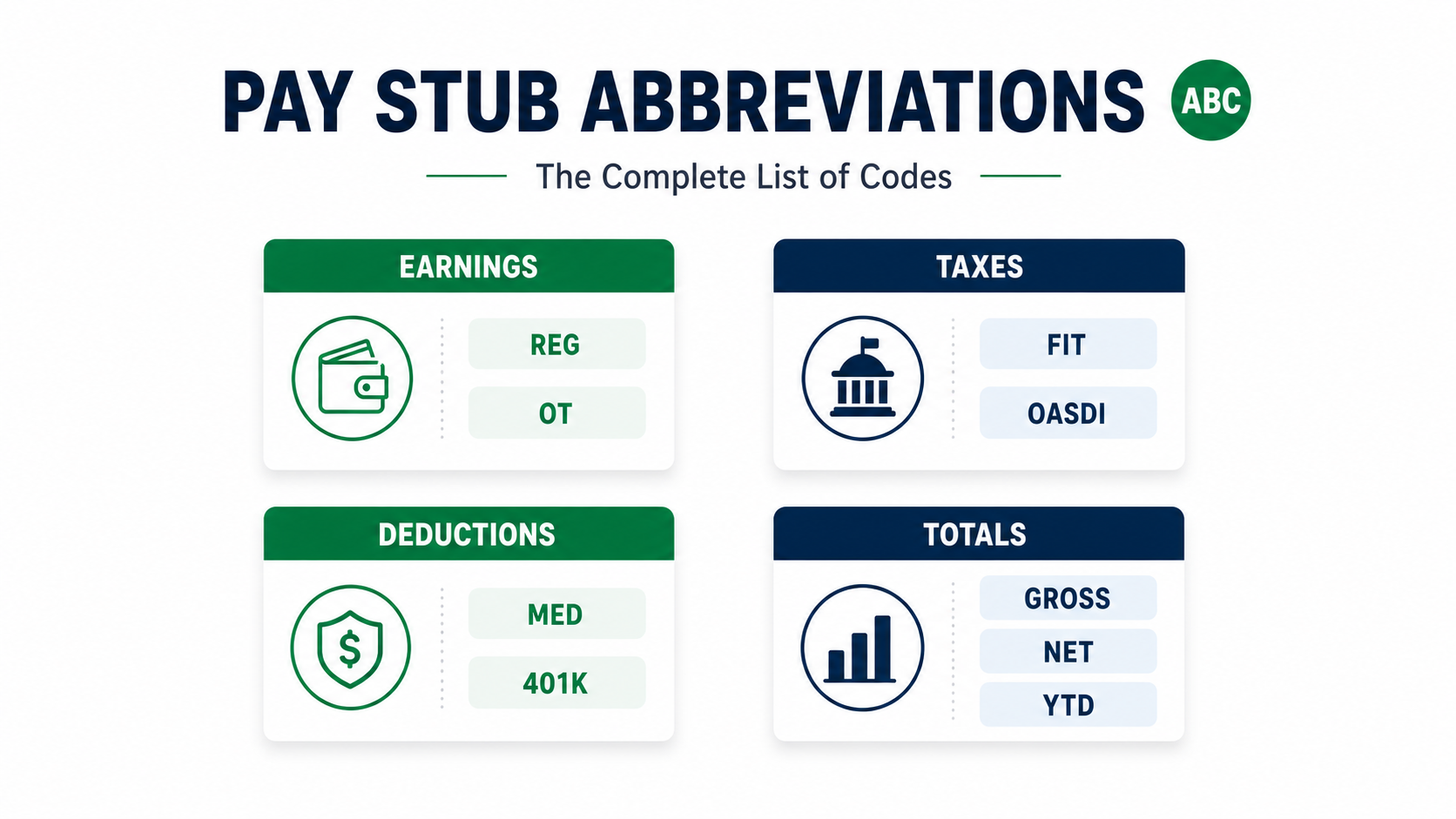
Pay Stub Abbreviations: Complete A-Z List of Paycheck Codes and Meanings
By ePaystubs Editorial Team | Updated June 22, 2026 | Verified against IRS Topic 751
Pay stub abbreviations are short codes that label every line on your paycheck, grouped into five sections: header and identifier codes, earnings codes, tax codes, deduction codes, and summary totals. REG is regular pay, OT is overtime, FIT is federal income tax, OASDI is Social Security, and YTD is your year-to-date total. Knowing which section a code belongs to tells you instantly whether it adds to your pay, gets withheld, or just identifies you.
A pay stub can hold dozens of cryptic codes crammed into a single page. The good news is that they follow a predictable structure. Once you know the five sections a stub is built from, every abbreviation falls into place. This guide decodes them section by section, in the same order they appear on your stub, and flags the handful of codes that confusingly mean two different things.
- The five sections
- Header codes
- Earnings codes
- Tax codes
- Codes with two meanings
- Deduction codes
- Summary totals
- Unrecognized codes
- A-Z index
Why Your Paycheck Is Smaller Than Your Salary (and Full of Codes)
Almost everyone remembers the surprise of their first paycheck: the take-home amount was far smaller than the salary they were promised. The gap is the stack of taxes and deductions sitting between your gross pay and your net pay, each one labeled with a short code.
For a typical worker, roughly 7.65% of gross goes to FICA (Social Security and Medicare), another 10% to 22% goes to federal income tax depending on income and filing status, 0% to 13% goes to state income tax, and another 5% to 15% goes to pre-tax benefits like health insurance and retirement. Added together, deductions commonly total 25% to 40% of gross pay before the money ever reaches you. The codes exist to fit all of that detail onto one page, and this guide explains each one.
How a Pay Stub Is Organized (The Five Sections)
Every pay stub, regardless of employer or payroll platform, is built from the same five sections. Learn the buckets and you can place any code instantly.
The stub reads top to bottom: it identifies you, lists what you earned, subtracts taxes, subtracts deductions, and shows what is left. The sections below follow that same order.
Header and Identifier Codes
The top of your stub identifies the people and the period involved. These codes do not affect your pay math, but they matter for recordkeeping and verifying the stub is yours.
| Code | Meaning |
|---|---|
| EIN FEIN | Employer Identification Number, the IRS-issued tax ID for your employer |
| SSN | Your Social Security Number, usually masked to the last four digits |
| Employee ID Emp No. | An internal number your employer uses to identify you in payroll |
| Check No. | Check or advice number, used to track each individual payment |
| Pay Period PP | The date range this paycheck covers |
| Pay Date | The date the paycheck is issued or deposited |
| LOC DEPT JOB | Location, department, or job title, used for internal cost tracking |
Earnings Codes (What You Earned)
The earnings section lists every form of pay you received this period. Together these lines add up to your gross pay, the figure at the top of the deduction math. This is the section with the widest range of codes, because pay comes in many forms.
| Code | Meaning |
|---|---|
| REG | Regular pay: hourly rate times hours, or salary divided by pay periods |
| OT | Overtime, paid at 1.5 times your hourly rate for hours over 40 in a week |
| OT2 DT | Double-time, paid at 2 times your hourly rate |
| HOL | Holiday pay, either paid time off or premium pay for working a holiday |
| VAC | Vacation pay |
| PTO | Paid time off, often combining vacation, sick, and personal leave |
| SICK | Sick pay |
| BONUS SignOn | Bonus pay, including a one-time sign-on bonus |
| COMM | Commission, common in sales roles |
| RETRO | Retroactive pay, correcting an underpayment from a previous period |
| SHIFT SHFT | Shift differential, premium pay for nights or weekends |
| TIPS | Reported tip income, subject to tax withholding |
| ONCALL | On-call pay for being available outside regular hours |
| SEV | Severance pay, given when employment ends |
| MIL | Military leave pay for active-duty service |
| REIMB EXP | Expense reimbursement for business costs, typically not taxable |
| TuiReimb | Tuition reimbursement, an education benefit |
| Move Rem | Moving expense reimbursement |
| MISC | Miscellaneous pay outside regular wages |
| RT HRS | Pay rate and hours worked for the period |
Tax Codes (What Is Withheld by Law)
The tax section shows the mandatory withholdings every employee is subject to. The amounts vary by income, filing status, and location, but the codes are consistent.
| Code | Meaning |
|---|---|
| FIT FED FWT FITW | Federal income tax withholding, based on your W-4 |
| OASDI SS SOCSEC | Social Security tax, 6.2% up to the wage base |
| MED HI | Medicare tax, 1.45% of all wages with no cap |
| SIT ST SWT SITW | State income tax withholding, where applicable |
| SDI CASDI | State Disability Insurance, in select states |
| SUI SUTA | State Unemployment Insurance, employee-paid in only a few states |
| PFL FAMLI FLI | Paid Family Leave premium, in select states |
| LOCAL CITY MUNC | Local or city income tax, in certain jurisdictions |
Nine states have no state income tax, so you will not see a SIT line if you work in Alaska, Florida, Nevada, New Hampshire, South Dakota, Tennessee, Texas, Washington, or Wyoming.
Why OASDI can disappear mid-year: Social Security tax only applies to the first $184,500 of wages in 2026. Once your year-to-date earnings cross that wage base, the OASDI line stops appearing and your take-home pay rises for the rest of the year. This is normal, not an error. For the full mechanics of Social Security and Medicare withholding, see what FICA means on a pay stub. For the state disability line specifically, see what SDI means on a pay stub.
The MED Collision and Other Codes That Mean Two Things
A few abbreviations are ambiguous, and they cause more confusion than any others. The single most important one to get right is MED.
Several other codes carry more than one possible meaning depending on the employer and payroll system:
| Code | Most Common Meaning | Could Also Mean |
|---|---|---|
| UD | Union Dues | Uniform deduction or Unpaid Deduction |
| INS | Insurance premium | May show $0 if you opted out of coverage |
| STD | Short-Term Disability | "Standard" rate in some systems |
| HCR | Healthcare reimbursement | Varies by employer plan |
| NC | Non-cash benefit (stock, car allowance) | Varies by employer |
| CLM | Claim or reimbursement from a benefit plan | Varies by employer |
Deduction Codes (Benefits and Withholdings)
The deduction section covers benefit contributions and other amounts withheld from your pay. This is the most nuanced group of codes, because each one is treated differently for tax purposes. Here is a quick reference to what the common ones stand for.
| Code | Meaning |
|---|---|
| 401K 403B 457 | Traditional retirement plan contributions |
| ROTH | Roth retirement contribution, made after tax |
| HSA | Health Savings Account contribution |
| FSA DEP CARE | Flexible Spending Account, medical or dependent care |
| INS MED INS DENTAL VISION | Insurance premiums for health, dental, or vision |
| LIFE LTD STD | Life and disability insurance premiums |
| GTL | Group-Term Life, imputed income on coverage over $50,000 |
| UNION | Union dues |
| GARN CHLD SUP TAX LEVY STDNLOAN | Court-ordered garnishments and levies |
If your employer uses ADP, many of these labels look different and more cryptic than the standard set. For the ADP-specific versions, see ADP pay stub abbreviations.
Summary and Total Codes
The bottom of your stub summarizes the math into a few key totals.
| Code | Meaning |
|---|---|
| GP GRS Gross | Gross pay, total earnings before anything is taken out |
| NP Net | Net pay, your take-home amount after all taxes and deductions |
| YTD | Year-to-date, the running total of a line since January 1 |
| CUR Current | The amount for this pay period only |
Every YTD column resets to zero on January 1 and tracks the cumulative total for the year. For how to read and verify your year-to-date figures, see what YTD means on a pay stub.
What to Do When You See a Code You Don't Recognize
No glossary covers every code, because employers can create custom ones. When you hit an abbreviation you cannot place, work through these steps:
First, check the legend or key printed on the stub itself, which many payroll systems include. Next, look at your onboarding paperwork and benefits enrollment confirmations, where custom deduction codes are usually defined. If it is still unclear, ask HR or payroll directly, and do it in writing so you have a record.
If you need a clean record with standard, recognizable codes, you can use our paycheck stub maker to lay out earnings, taxes, and deductions clearly.
Pay Stub Abbreviations: Full A-Z Index
Looking for one specific code? This alphabetical index lists every abbreviation covered above, with its meaning and the section of your stub where it appears. Jump to a letter or scan the full list.
C D E F G H I J L M N O P R S T U V Y
| Code | Meaning | Section |
|---|---|---|
| C | ||
| Check No. | Check or advice number for tracking each payment | Header |
| CHLD SUP | Child support garnishment | Deduction |
| CITY | Local or city income tax | Tax |
| CLM | Claim or reimbursement from a benefit plan (varies) | Ambiguous |
| COMM | Commission earnings | Earnings |
| CUR | Current period amount | Summary |
| D | ||
| DENTAL | Dental insurance premium | Deduction |
| DEP CARE | Dependent Care FSA contribution | Deduction |
| DEPT | Department, for internal cost tracking | Header |
| DT | Double-time pay (2x hourly rate) | Earnings |
| E | ||
| EIN | Employer Identification Number (employer tax ID) | Header |
| Employee ID | Internal employee identifier | Header |
| EXP | Expense reimbursement (typically not taxable) | Earnings |
| F | ||
| FAMLI | Paid Family and Medical Leave premium (select states) | Tax |
| FED | Federal income tax withholding | Tax |
| FEIN | Federal Employer Identification Number | Header |
| FICA | Umbrella term for Social Security and Medicare taxes | Tax |
| FIT FITW FWT | Federal income tax withholding | Tax |
| FLI | Family Leave Insurance (select states) | Tax |
| FSA | Flexible Spending Account contribution | Deduction |
| G | ||
| GARN | Wage garnishment | Deduction |
| GP GRS Gross | Gross pay, total earnings before deductions | Summary |
| GTL | Group-Term Life, imputed income on coverage over $50,000 | Deduction |
| H | ||
| HCR | Healthcare reimbursement (varies by plan) | Ambiguous |
| HI | Hospital Insurance, the Medicare tax | Tax |
| HOL | Holiday pay | Earnings |
| HRS | Hours worked for the period | Earnings |
| HSA | Health Savings Account contribution | Deduction |
| I | ||
| INS | Insurance premium (may show $0 if opted out) | Ambiguous |
| J | ||
| JOB | Job title or position, for internal tracking | Header |
| L | ||
| LIFE | Life insurance premium | Deduction |
| LOC | Location, for internal cost tracking | Header |
| LOCAL | Local income tax | Tax |
| LTD | Long-Term Disability insurance premium | Deduction |
| M | ||
| MED | Medicare tax (~1.45%) OR medical insurance premium | Tax / Ambiguous |
| MED INS | Medical insurance premium | Deduction |
| MIL | Military leave pay | Earnings |
| MISC | Miscellaneous pay outside regular wages | Earnings |
| Move Rem | Moving expense reimbursement (now FICA-taxable) | Earnings |
| MUNC | Municipal or city tax | Tax |
| N | ||
| NC | Non-cash benefit (stock, car allowance) | Ambiguous |
| NP Net | Net pay, take-home after all withholdings | Summary |
| O | ||
| OASDI | Old Age, Survivors, and Disability Insurance (Social Security tax) | Tax |
| ONCALL | On-call pay for availability outside hours | Earnings |
| OT | Overtime (1.5x hourly rate over 40 hrs/week) | Earnings |
| OT2 | Double-time (2x hourly rate) | Earnings |
| P | ||
| Pay Date | Date the paycheck is issued or deposited | Header |
| Pay Period PP | Date range the paycheck covers | Header |
| PFL | Paid Family Leave premium (select states) | Tax |
| PTO | Paid time off (vacation, sick, personal combined) | Earnings |
| R | ||
| REG | Regular pay | Earnings |
| REIMB | Expense reimbursement (typically not taxable) | Earnings |
| RETRO | Retroactive pay correcting a prior underpayment | Earnings |
| ROTH | Roth retirement contribution (after-tax) | Deduction |
| RT | Pay rate for the period | Earnings |
| S | ||
| SDI CASDI | State Disability Insurance (select states) | Tax |
| SEV | Severance pay | Earnings |
| SHIFT SHFT | Shift differential, premium for nights or weekends | Earnings |
| SICK | Sick pay | Earnings |
| SignOn | Sign-on bonus | Earnings |
| SIT SITW ST SWT | State income tax withholding | Tax |
| SOCSEC | Social Security tax | Tax |
| SS | Social Security tax | Tax |
| SSN | Social Security Number (usually masked) | Header |
| STD | Short-Term Disability OR "standard" in some systems | Ambiguous |
| STDNLOAN | Student loan garnishment | Deduction |
| SUI SUTA | State Unemployment Insurance (employee-paid in few states) | Tax |
| T | ||
| TAX LEVY | IRS or state tax levy | Deduction |
| TIPS | Reported tip income, subject to withholding | Earnings |
| TuiReimb | Tuition reimbursement | Earnings |
| U | ||
| UD | Union Dues OR uniform/unpaid deduction | Ambiguous |
| UNION | Union dues | Deduction |
| V | ||
| VAC | Vacation pay | Earnings |
| VISION | Vision insurance premium | Deduction |
| Y | ||
| YTD | Year-to-date running total since January 1 | Summary |
| 401K 403B 457 | Traditional retirement plan contributions | Deduction |
Frequently Asked Questions
The ones nearly everyone sees are REG (regular pay), OT (overtime), FIT or FED (federal income tax), OASDI or SS (Social Security), MED (Medicare), SIT (state income tax), and YTD (year-to-date). These cover earnings, the main taxes, and your running totals.
It depends on context. In the tax section, MED is Medicare tax, about 1.45% of your gross pay. In the deductions section, MED can mean your medical insurance premium. If it is a percentage of your gross, it is the tax; if it is a fixed benefit amount, it is insurance.
RETRO is retroactive pay, money added to correct an underpayment from a previous period, such as a raise that was approved late or a payroll error. It is real wages you already earned, and it is taxed like regular pay.
Different payroll platforms label the same items differently. ADP, Workday, Paychex, and Gusto each use their own conventions. If you switched jobs and the codes changed, the underlying earnings and deductions are almost always the same, just labeled differently.
Most often Union Dues. Some employers use UD for a uniform deduction or an unpaid deduction instead. Because it is ambiguous, check your pay stub legend or ask HR to confirm which one applies to you.
Gross pay (GP, GRS, or Gross) is your total earnings before anything is taken out. Net pay (NP or Net) is your take-home amount after all taxes and deductions. Every code between the two either is withheld or reduces what you take home.
Usually not. Expense reimbursements (REIMB or EXP) for legitimate business costs are not taxable income when documented under an accountable plan, which is why they appear as a separate line from your regular earnings.