
How to Void a Check for Direct Deposit: Safe Steps, Online Options, and Alternatives
To void a check for direct deposit, use an unused check and write VOID clearly across the front in permanent blue or black ink. Leave the routing number and account number readable, leave the date, payee, amount and signature blank, record the check number as voided, and submit the document through the secure method your employer provides.
You may not need a paper check at all. A bank-provided direct-deposit form, account-verification letter or secure payroll-portal entry can provide the same core banking details if your employer accepts it.
What Is a Voided Check?
A voided check is an unused paper check marked VOID so it is not used as a normal payment check while its printed bank details remain readable. For direct deposit, the useful details are usually the bank routing number and your account number. A voided check is different from a canceled check, which has already been paid, and from a stop-payment request, which asks a bank not to pay an eligible uncleared check.
Do You Need a Voided Check for Direct Deposit?
Not always. Employers historically used voided checks because the routing and account numbers were already printed on a bank document, reducing manual-entry errors. But the ACH network does not require every employee to hand HR a paper check. Nacha specifically notes that direct deposit can be set up without one when payroll collects the required banking information another approved way.
What matters is your employer's onboarding process. If payroll asks for a particular format, confirm which substitutes it accepts before uploading financial information.
| Your situation | Best next step | Avoid |
|---|---|---|
| You have paper checks | Void an unused check from the account you want payroll to use. | Do not hand over an unvoided blank check. |
| No checkbook | Ask for a bank direct-deposit form or account-verification letter. | Do not order checks solely because you assume they are mandatory. |
| Employer has a secure payroll portal | Enter bank-verified routing/account details if the employer permits direct entry. | Do not send the numbers through an unverified message or form. |
| Online-only bank | Look for Direct Deposit, Account Details or Account Verification in the bank app/site. | Do not create a fake bank document with a third-party check generator. |
How to Void a Check for Direct Deposit in 3 Steps
- Start with the correct unused check. Use a blank check tied to the account where you want the deposit sent. Leave the date, payee, dollar amount, written amount and signature blank.
- Write VOID clearly across the front. Use permanent blue or black ink. Make the word large enough that the paper cannot be mistaken for a usable payment check, but do not obscure the routing and account numbers along the bottom.
- Record and submit it securely. Mark the check number as voided in your own records and use your employer's approved portal, secure upload or other verified delivery method.
What Does a Voided Check Look Like?
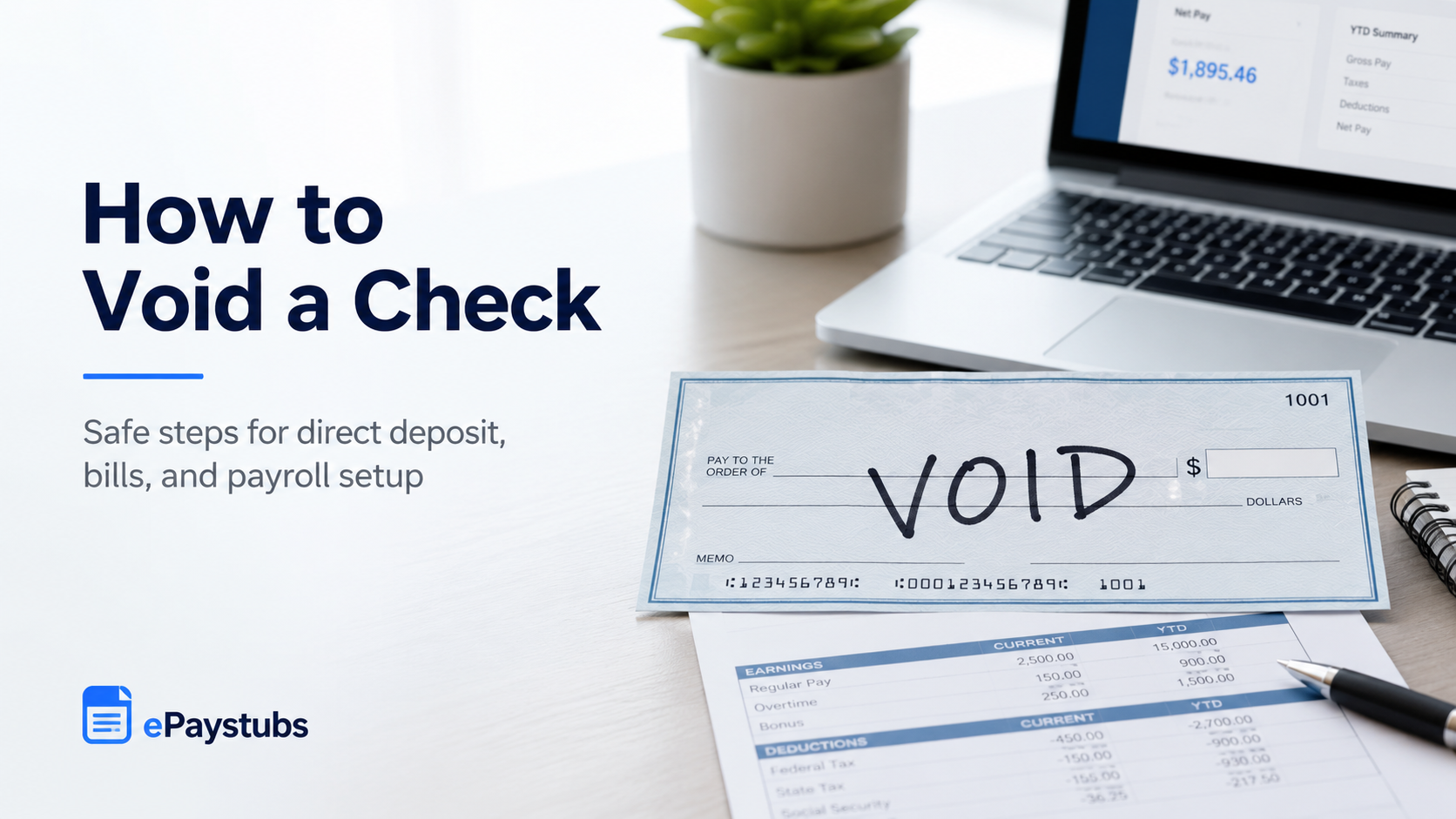
A useful voided check makes the word VOID unmistakable while leaving the bank-account details needed for direct deposit readable. The example below uses fictional numbers and is for layout education only.
Which Numbers Should Stay Visible on a Voided Check?
| Check detail | For direct deposit | What to know |
|---|---|---|
| Routing number | Keep readable | Identifies the routing path used by the bank. Verify the ACH/direct-deposit number with your bank. |
| Account number | Keep readable | Identifies the account that should receive the deposit. |
| Check number | Usually not needed by payroll | Keep it readable when practical so you can identify which paper check was voided. |
| Payee / amount / signature | Leave blank | These fields are not needed to provide direct-deposit banking information. |
No Checkbook? What Can You Use Instead of a Voided Check?
Do not assume you must order paper checks. Nacha notes that banks commonly make routing and account information available through online banking, and some provide prefilled direct-deposit forms. Bank of America, for example, offers a prefilled direct-deposit form through online/mobile banking.
How Do I Get a Voided Check From My Bank?
If you do not have paper checks, ask your bank whether it can provide a counter or starter check, an official direct-deposit form, or an account-verification letter. Some banks make these documents available through online banking; others provide them at a branch. Use the option your employer or payroll provider confirms it accepts.
| Alternative | How strong is it? | Important limitation |
|---|---|---|
| Bank direct-deposit form | Excellent | Use the bank-generated form and confirm payroll accepts it. |
| Bank account-verification letter | Strong | May need to be requested from the bank or downloaded through online banking. |
| Secure payroll-portal entry | Excellent when offered | Enter only bank-verified routing and account details. |
| Bank-issued counter/starter check | Possible | Some employers do not accept temporary checks. Ask first. |
| Official online-banking document | Often useful | It must show the fields payroll requires without exposing unrelated information. |
| Deposit slip | Last resort | Do not assume the printed routing information is appropriate for ACH direct deposit. |
Can You Get a Voided Check Online?
Sometimes. Some banks allow customers to download a digital voided-check image, while others provide a prefilled direct-deposit form or account-verification document instead. Citi says some banks provide an online voided check through their app or web portal; Bank of America provides a prefilled direct-deposit form that includes the account and routing information.
Log in through your bank's official website or app and look for terms such as Direct Deposit, Account & Routing Numbers, Account Verification or Direct Deposit Form. If you cannot find an approved document, ask the bank or payroll department what substitute they accept.
Which Routing Number Should You Use for Direct Deposit?
Use the ACH/direct-deposit routing number your bank provides for your account. Do not assume a wire-transfer routing number is interchangeable. Banks can publish different routing numbers for checks, ACH transactions and wires depending on the institution and account.
For example, Bank of America separately lists routing information by transaction type and provides a distinct domestic wire routing number. The safest approach is to copy the routing number from your bank's official direct-deposit screen or form rather than from an unrelated transfer page.
How to Send a Voided Check Safely
A voided check is still a sensitive financial document. Chase and other banks emphasize secure storage or disposal because it contains personal and bank-account information.
- Confirm the requester. Make sure the request came from your actual employer, payroll provider, bank or legitimate biller.
- Prefer a secure payroll portal or encrypted document process. Avoid sending banking documents through casual messaging channels.
- Use the minimum document required. A bank direct-deposit form may expose less unrelated information than a full statement.
- Be alert to payroll-change fraud. If you receive an unexpected message saying your direct-deposit information changed, contact payroll through a known channel.
- Store or destroy extra copies securely. Shred physical copies you no longer need.
Once direct deposit is active, the bank deposit is only the payment. Your itemized payroll record remains your pay stub. See what a pay stub shows about direct deposit or how to get your pay stub when you use direct deposit.
Already Sent the Check? Voiding Is Not a Stop Payment
Voiding works when the paper check is still under your control. Writing VOID on another copy does not cancel a check that has already been handed to someone or entered processing.
If an issued check is lost, stolen or should no longer be paid, contact your bank promptly and ask about its stop-payment process. Fees, deadlines, duration and eligibility vary by institution, and a stop-payment request cannot reverse a check that has already cleared.
| Term | Meaning |
|---|---|
| Voided check | A check intentionally marked so the paper is not used as a normal payment instrument. |
| Canceled check | A check that has already been processed and paid by the bank. |
| Stop payment | An instruction asking the bank not to pay an eligible check that has not yet cleared. |
Common Mistakes When Voiding a Check
- Covering the routing or account number with the VOID mark.
- Signing the blank check when no signature was requested.
- Using a check from the wrong or closed account.
- Assuming the wire-transfer routing number is the right direct-deposit number.
- Sending a bank document through an unverified email or messaging channel.
- Assuming a deposit slip or screenshot is accepted without asking payroll.
- Using a third-party check generator instead of a bank-issued document.
Frequently Asked Questions
How do I void a check for direct deposit?
Use an unused check, write VOID clearly across the front in permanent blue or black ink, keep the routing and account numbers readable, leave payment fields and the signature blank, record the check number as voided, and submit it using your employer's approved method.
Do I need a voided check for direct deposit?
Not always. A voided check is one way to provide bank information, but many employers also accept a bank direct-deposit form, verification letter or secure payroll-portal entry. Follow the employer's current process.
Do you sign a voided check?
Usually no. If the check is being used only to provide banking information, leave the signature line blank unless your employer or bank gives different instructions.
Can I get a voided check online?
Some banks provide downloadable voided-check images. Others provide a bank-generated direct-deposit form or account-verification document. Use the document produced by your financial institution rather than an unrelated generator.
What if I do not have checks?
Ask payroll whether it accepts a bank direct-deposit form, bank verification letter, secure portal entry, official online-banking document or bank-issued counter check.
Can a voided check still expose my bank information?
Yes. VOID prevents the paper from functioning as a normal payment check, but the routing number, account number, name and other printed information can remain visible. Treat the document as sensitive.
Can I email a picture of a voided check?
Ask your employer what secure submission method it supports. A payroll portal or protected upload is preferable to ordinary email when available because the image contains sensitive bank information.
Is a canceled check the same as a voided check?
No. A voided check is marked before use. A canceled check has already been processed and paid by the bank.
Need the Pay Stub After Direct Deposit Starts?
A voided check provides bank-account information. A pay stub is the separate payroll record showing earnings, taxes, deductions and net pay. If you are creating legitimate payroll records from accurate information, ePaystubs can help format them clearly.
Create a Pay StubFinancial-information note: Bank, employer, payroll-provider and document-acceptance procedures vary. Verify routing and account information directly with your financial institution and follow your employer's current instructions before submitting sensitive banking information.