
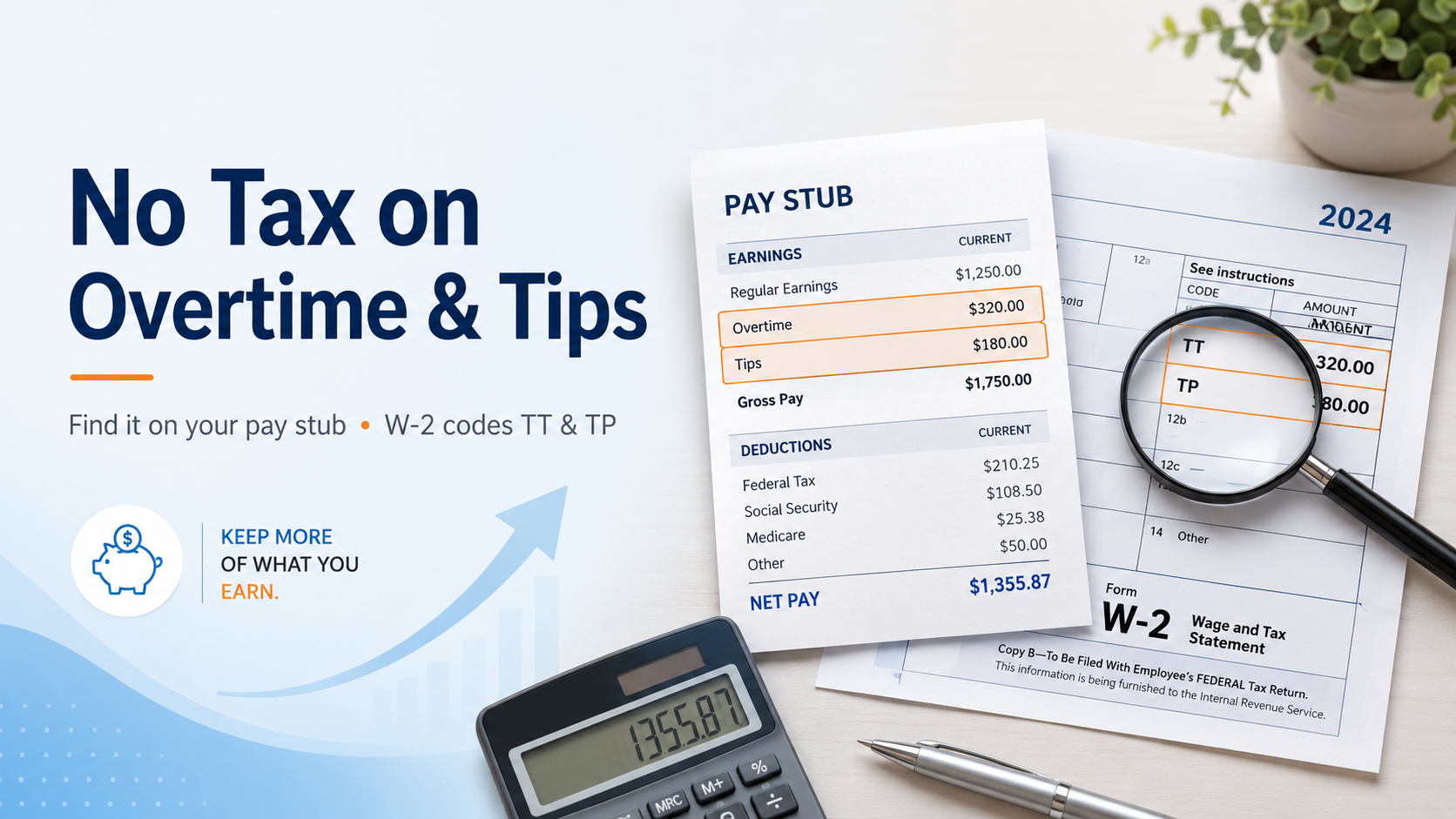
Where Is Overtime on a W-2? 2025 Box 14, 2026 Code TT, TP and TTOC Guide
Learn where qualified overtime appears for 2025 and 2026, what W-2 code TT means, how to read employer-specific Box 14 labels, and how codes TP and TTOC work for reported tips.
Where does overtime appear on a W-2?
The answer depends on the tax year. In 2025, the IRS did not require employers to place qualified overtime in a separate standardized W-2 field. The overtime wages were already included in Box 1, but the deductible premium might have appeared in Box 14 or in records supplied by the employer.
Beginning with wages paid in 2026, employers separately report qualified overtime compensation in Box 12 using code TT. The amount is not your entire overtime paycheck. It is generally the portion paid above your regular rate that the Fair Labor Standards Act required.
| Tax year or item | Where to look | What it means |
|---|---|---|
| 2025 overtime wages | W-2 Box 1 | Overtime is combined with other federal taxable wages. |
| 2025 qualified overtime premium | Optional Box 14 entry, payroll portal, employer statement, or pay stubs | Employers could provide the premium voluntarily, but no standardized 2025 W-2 code was required. |
| 2026 qualified overtime | W-2 Box 12, code TT | The FLSA-required overtime premium reported separately. |
| 2026 reported cash tips | W-2 Box 12, code TP | Total cash tips reported to the employer—not automatically the final deductible tip amount. |
| 2026 tipped occupation | W-2 Box 14b | The Treasury Tipped Occupation Code used with reported cash tips. |
Swipe sideways to view the complete table.
If no separate overtime amount appears, the wages are normally still inside Box 1. The missing item is the separate premium figure needed to calculate the deduction. Check the final pay stub, payroll portal, or a statement from the employer before assuming the W-2 is wrong.
What do 2025 overtime labels in W-2 Box 14 mean?
Box 14 is commonly used for employer-provided information that does not have another dedicated W-2 box. Its descriptions are not standardized. For the 2025 transition year, employers used several different labels for overtime-premium information.
| Label you may see | Likely meaning | What to do |
|---|---|---|
| FLSA OT Prem | FLSA overtime premium | Confirm that the amount is the premium portion, not the full overtime total. |
| OT OBBBA | Overtime amount supplied for the new federal deduction | Check the employer's W-2 explanation or payroll notice. |
| OBBBTT or 12TT | Employer-created label for qualified overtime | Treat it as a description, not as an official 2025 IRS Box 12 code. |
| OTBBB | Employer-specific overtime-premium description | Verify the definition with payroll before using the amount. |
| Qualified OT or Overtime Premium | Possibly the separately calculated premium | Compare it with year-to-date payroll records and the employer's explanation. |
Swipe sideways to view the complete table.
Do not assume every amount containing “OT” is deductible. A Box 14 label could describe full overtime pay, a state-only premium, union-contract pay, or another employer-defined amount. If the description is unclear, ask payroll what the amount includes.
What W-2 codes TT, TP and TTOC mean
The 2026 W-2 separates three related pieces of information. They answer different questions and should not be treated as interchangeable.
The FLSA-required premium above the regular rate, reported in W-2 Box 12.
The reported cash-tip total in Box 12. TP does not by itself prove that every dollar is deductible.
The occupation code in Box 14b that provides context for tips reported with code TP.
Code TT is the most useful starting point for an employee checking 2026 qualified overtime. Still compare it with payroll records, especially if the employee had several overtime rates, bonuses that affected the regular rate, or more than one payer.
How to find qualified overtime on a pay stub
Start with the final pay stub for the year because its year-to-date column should include all amounts paid during that calendar year. Then identify whether the earnings section separates the overtime premium or only shows a combined overtime total.
Swipe sideways to view the complete pay-stub example.
| What the pay statement shows | 2025 calculation method | Example |
|---|---|---|
| A separately listed FLSA overtime premium | Use the separate premium amount | $3,000 premium → $3,000 starting amount |
| Total overtime paid at 1.5×, including the regular-rate portion | Divide the total by 3 | $9,000 ÷ 3 = $3,000 |
| Only the premium above regular pay when overtime was paid at 2× | Divide that premium by 2 | $10,000 ÷ 2 = $5,000 |
| Total overtime paid at 2×, including the regular-rate portion | Divide the total by 4 | $20,000 ÷ 4 = $5,000 |
| Different rates, missing records, or bonuses affecting the regular rate | Use a reasonable regular-rate-and-hours method or request employer assistance | Calculation depends on the worker's records |
Swipe sideways to view the complete table.
Worked example: calculating the premium from a final pay stub
Maria is a fictional hourly nurse who earns $30 per hour and is covered by the FLSA overtime requirement. Her final 2025 pay stub shows $9,000 of year-to-date overtime paid at time-and-a-half. The stub does not separate the premium, so she uses the divide-by-three method.
The calculation identifies the premium; it does not prove eligibility by itself. Maria must also meet the FLSA, filing-status, SSN and income requirements.
Qualified overtime deduction calculator
Choose the option that matches the information on your pay statement. The tool estimates the qualified overtime premium, applies the annual cap and MAGI phaseout, and shows an approximate federal income-tax saving.
Estimate your qualified overtime amount
Estimate only. This calculator does not determine FLSA status, validate payroll records, or prepare a tax return. Social Security, Medicare, and potentially state tax still apply.
What counts as qualified overtime compensation?
Qualified overtime is not simply any pay labeled overtime. It is the compensation above the regular rate that is required under section 7 of the FLSA. Coverage and exemption are fact-specific, so hourly or salaried status alone does not settle the question.
Usually included
- The extra half of FLSA-required time-and-a-half pay
- Qualified premium paid to a covered, nonexempt worker
- Amounts computed under applicable special section 7 rules
- A premium recalculated when a nondiscretionary bonus raises the regular rate
Usually not included
- The regular-rate portion of overtime hours
- Extra pay above the FLSA-required premium
- Holiday, weekend or shift premium without qualifying FLSA overtime
- Overtime required only by state law, a union agreement or company policy
- Qualified tips already handled under the separate tip deduction
Five questions to check before using the amount
- Was the worker covered by the FLSA? Coverage depends on the employer, work and other facts.
- Was the worker nonexempt? Salaried nonexempt workers can qualify; hourly status does not automatically prove eligibility.
- Was the premium required under section 7? State-only and contract-only premiums do not become qualified federal overtime merely because payroll calls them OT.
- Does the figure contain only the eligible premium? Remove the regular-rate portion and any extra premium beyond what the FLSA required.
- Is the amount supported by reporting and records? Keep the W-2 or applicable statement plus the pay stubs, payroll summaries or employer explanation used.
What to do if code TT is missing or looks wrong
If it is a 2025 W-2
A missing TT code is normal because it was not a required 2025 W-2 code. Check Box 14, the payroll portal, a separate employer statement, and final year-to-date pay stubs. Use the calculation method that matches the records.
If it is a 2026 W-2
Ask payroll whether qualifying FLSA overtime was paid and how code TT was calculated. If payroll confirms that the W-2 is wrong, request the appropriate corrected W-2 or W-2c rather than entering a guessed figure.
When reviewing code TT, compare it with the full year's genuine payroll records—not with one pay period. If the employee changed jobs, collect records from every payer because each may report a separate amount.
If TT is blank, that does not make the complete time-and-a-half total deductible. The calculation still has to isolate the qualifying premium above the regular rate.
How code TP and TTOC work for reported tips
Code TP in 2026 W-2 Box 12 reports the total cash tips the employee reported to the employer. Cash tips include voluntary cash or charged tips and, for employees, tips received through a tip-sharing arrangement. Mandatory service charges are not qualified tips.
TP should not automatically be described as the employee's final deductible tip amount. The taxpayer must also consider the occupation, whether the payments meet the qualified-tip rules, the income limit, filing status, and any applicable business-income limitation.
What does TTOC mean?
TTOC stands for Treasury Tipped Occupation Code. When cash tips are reported with code TP, the employer reports up to two occupation codes in Box 14b. A code of 000 indicates that tips from a nonqualifying occupation are involved. In that situation, do not assume the entire TP total is deductible; review the occupation-specific records and current instructions.
You can compare the occupation code with the official IRS tipped-occupation list.
Deduction limits, income phaseouts and taxes that still apply
The phrase “no tax on overtime” can be misleading. This is a temporary federal income-tax deduction for qualified overtime compensation, not a rule that removes withholding or payroll taxes from every overtime dollar.
| Rule | Single, head of household, or qualifying surviving spouse | Married filing jointly |
|---|---|---|
| Maximum qualified overtime deduction | $12,500 | $25,000 per joint return |
| MAGI phaseout begins | Above $150,000 | Above $300,000 |
| Phaseout rate | $100 for each complete $1,000 of MAGI above the threshold | |
| Married filing separately | Not eligible; married taxpayers must file jointly | |
| Applicable years | Tax years 2025 through 2028, unless the law changes | |
Swipe sideways to view the complete table.
- Federal income-tax withholding still occurs. The deduction is generally claimed when the return is filed.
- Social Security and Medicare generally still apply. See the ePayStubs guide to FICA on a pay stub for those separate payroll-tax rules.
- State tax treatment can differ. A federal deduction does not automatically create an identical state deduction.
- A valid SSN is required. The individual receiving the qualified overtime needs a Social Security number valid for employment.
How to claim qualified overtime on Schedule 1-A
For the 2025 return, qualified overtime is calculated in Part III of Schedule 1-A. The schedule applies the cap and MAGI phaseout, then combines the permitted additional deductions. Its total flows to Form 1040 line 13b.
- Calculate Schedule 1-A MAGI. Use Part I rather than treating rough household income as the final MAGI figure.
- Enter qualified overtime in Part III. Use the amount supported by the W-2, applicable 1099, employer statement or payroll records.
- Apply the annual limit. The maximum is $12,500, or $25,000 on a joint return.
- Apply the MAGI phaseout. The 2025 form reduces the deduction by $100 for each complete $1,000 above the threshold.
- Keep the supporting records. Retain the forms, pay stubs, payroll summaries and calculations used.
Schedule 1-A additional deductions are available whether the taxpayer uses the standard deduction or itemizes. They reduce taxable income after AGI; they should not be described as “above-the-line” adjustments that lower adjusted gross income.
Use the official Schedule 1-A and the instructions for the applicable tax year. Form lines can change, so check the current version before filing.
Common overtime and W-2 mistakes to avoid
Deducting the full 1.5× amount
The regular-rate portion remains ordinary wages. Generally only the extra half required by the FLSA is qualified overtime.
Treating every Box 14 OT label the same
Employer descriptions are not standardized. Verify whether the number is a premium, combined overtime total, or a different payment.
Calling TP the final tip deduction
TP reports cash tips reported to the employer. Occupation and other qualification rules still matter.
Ignoring filing status
A married taxpayer must file jointly to claim the overtime deduction. Married filing separately does not qualify.
Using a fabricated pay stub
Tax calculations should be supported by genuine employer or payer records. A newly created document cannot replace missing historical payroll evidence.
Forgetting the final YTD total
One pay period does not show the annual amount. Use the final statement and confirm that it includes all wages paid during the year.
Frequently asked questions
Where is overtime on my 2025 W-2?
Overtime wages are included in Box 1 with other taxable wages. The qualified premium may also appear voluntarily in Box 14, a payroll portal, or a separate employer statement. If no separate amount was supplied, use the final payroll records and an IRS-approved 2025 calculation method.
What does code TT mean in W-2 Box 12?
For wages paid in 2026, code TT reports total qualified overtime compensation. It generally represents the FLSA-required premium above the regular rate, not the full time-and-a-half payment.
Is code TT supposed to appear on a 2025 W-2?
No standardized code TT was required for 2025 W-2s. Some employers used Box 14 or separate statements instead. Code TT becomes part of the 2026 W-2 reporting system.
What if code TT is missing from my 2026 W-2?
Contact the employer or payroll provider and ask whether FLSA-qualified overtime was paid and how it was reported. If payroll confirms a W-2 error, request the appropriate correction rather than entering the full overtime total or a guessed amount.
What does code TP mean?
Code TP reports total cash tips reported to the employer. It is not automatically the final qualified-tip deduction. The taxpayer must also check the tipped occupation, payment type, income limits, filing status and other rules.
What does TTOC mean in Box 14b?
TTOC means Treasury Tipped Occupation Code. It identifies the occupation connected with tips reported under code TP. Up to two codes may appear, and 000 indicates tips from a nonqualifying occupation are involved.
Does “no tax on overtime” mean no tax is withheld?
No. Qualified overtime remains part of gross income and is generally subject to federal income-tax withholding, Social Security and Medicare. The permitted deduction reduces taxable income when the return is filed.
Can salaried employees claim the overtime deduction?
Possibly. A salaried worker can be nonexempt and eligible for FLSA overtime. The controlling question is whether the worker was covered by and nonexempt from the FLSA overtime requirement—not whether the worker was simply labeled hourly or salaried.
Can a self-employed person claim the overtime deduction?
A genuinely self-employed person normally is not owed FLSA overtime. However, tax classification and FLSA classification are not always identical, and IRS guidance recognizes that a person treated as a nonemployee for tax purposes can, in uncommon cases, be covered as an employee under the FLSA. Review the facts with the payer or a qualified professional instead of relying only on the W-2-versus-1099 label.
Can married filing separately claim the overtime deduction?
No. A married taxpayer must file jointly with their spouse to claim the qualified overtime deduction.
Official sources
- IRS: 2026 General Instructions for Forms W-2 and W-3 — definitions and reporting rules for codes TT, TP and Box 14b.
- IRS: Questions and answers about qualified overtime compensation — eligibility, limits and 2025-versus-2026 reporting.
- IRS Notice 2025-69 — reasonable calculation methods and recordkeeping for tax year 2025.
- IRS: 2025 Schedule 1-A — Part III calculation, caps, phaseout and Form 1040 transfer.
- U.S. Department of Labor: Overtime Pay — FLSA coverage and overtime guidance.
- IRS: Treasury Tipped Occupation Codes — qualifying occupation list and TTOC definitions.
This article and calculator provide general educational information, not tax or legal advice. Tax forms and guidance can change, and individual FLSA and tax circumstances differ. Review the instructions for the applicable tax year or consult a qualified tax professional before filing.