
What Is FICA on a Pay Stub? 2026 Rates, Wage Limit and Calculation Examples
Payroll tax guide · United States · 2026
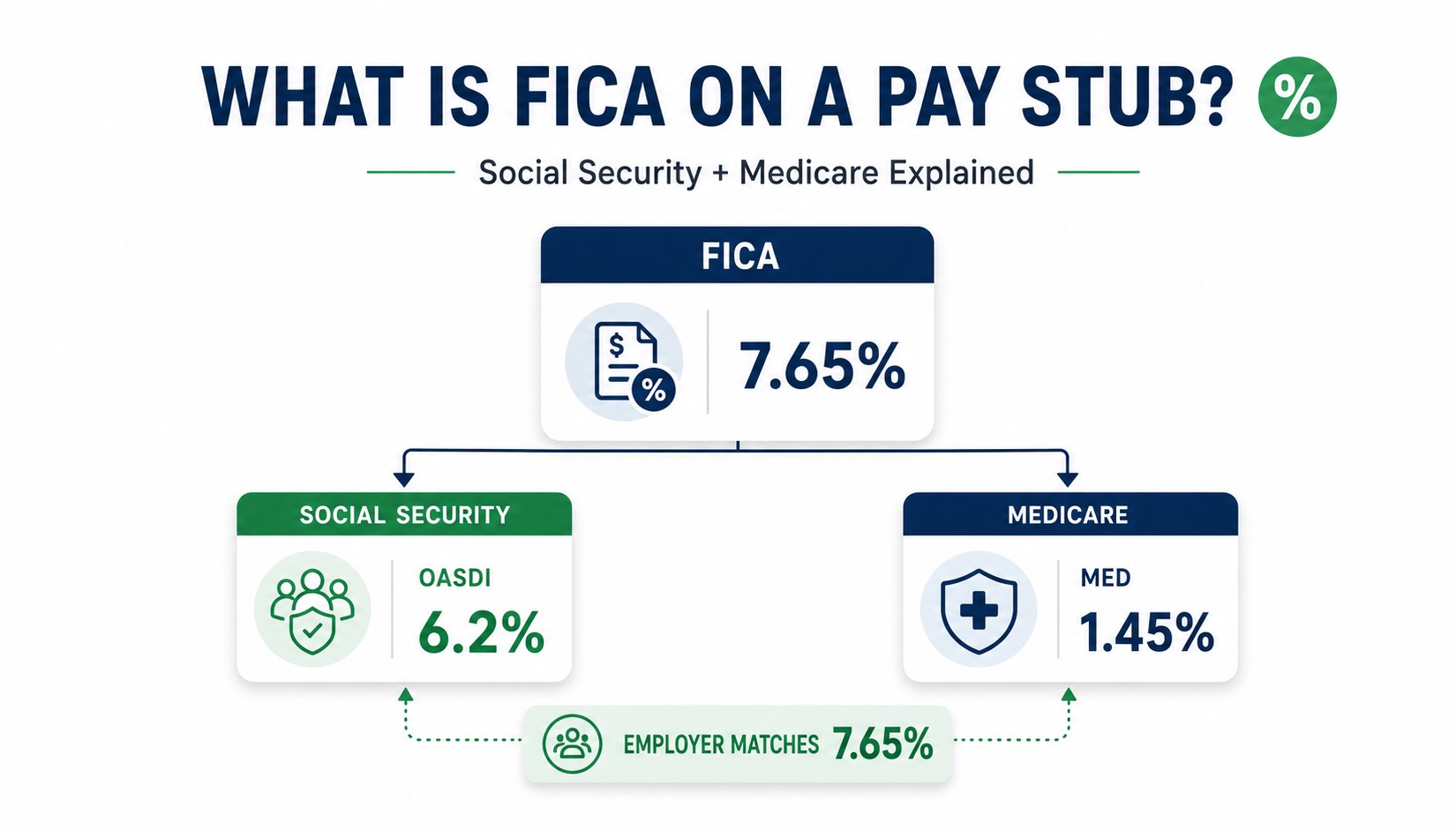
FICA stands for the Federal Insurance Contributions Act. On a US employee's pay stub, it refers to the federal payroll taxes that fund Social Security and Medicare. In 2026, the standard employee rates are 6.2% for Social Security on covered wages up to $184,500 and 1.45% for Medicare on covered wages without an annual cap. When both regular taxes apply to the same wages, the employee total is 7.65%. The employer generally pays a separate matching share; that employer amount does not reduce the employee's take-home pay. IRS: Publication 15
No. $11,439 is the maximum regular employee Social Security tax for 2026. Medicare tax has no annual wage cap, so total FICA withholding has no single fixed maximum. Some employees also owe Additional Medicare Tax. SSA: contribution and benefit base
2026 FICA Tax Rates and Wage Limits
FICA contains two separate taxes. Most covered W-2 employees pay a regular Social Security share and a regular Medicare share. Employers generally match those two regular amounts from their own funds. The additional 0.9% Medicare tax, when applicable, is withheld from the employee only and has no employer match.
| Tax | Employee rate | Employer rate | 2026 wage rule |
|---|---|---|---|
| Social Security / OASDI | 6.2% | 6.2% | First $184,500 of covered Social Security wages per employer |
| Regular Medicare | 1.45% | 1.45% | No annual wage cap |
| Additional Medicare Tax | 0.9% when applicable | No match | Employer starts withholding after it pays an employee more than $200,000 in Medicare wages during the calendar year; final individual liability may differ |
| Combined regular share | 7.65% | 7.65% | Only when both regular taxes apply to the same taxable wages without a wage-base adjustment |
Sources: IRS Publication 15 (2026) and IRS Topic 751. Special employment categories and exemptions have different rules.
What Is the Maximum FICA Tax in 2026?
The maximum regular employee Social Security tax is $11,439 for 2026: $184,500 of covered Social Security wages multiplied by 6.2%. That is not a cap on total FICA. Regular Medicare withholding continues on covered wages after the Social Security limit is reached, and Additional Medicare Tax can apply at higher earnings. SSA: official wage base
| Question | 2026 answer |
|---|---|
| Maximum covered Social Security wages | $184,500 for the year, applied separately by each employer under ordinary payroll rules |
| Maximum regular employee Social Security tax | $11,439 |
| Maximum regular employee Medicare tax | No fixed annual maximum |
| Maximum combined FICA tax | No single fixed annual maximum |
How does withholding change on the paycheck that crosses the Social Security limit?
Suppose an employee has $183,500 in Social Security-taxable wages from the same employer before a new paycheck with $3,000 in additional covered wages. Only $1,000 remains below the annual Social Security wage base. The regular employee Social Security tax on that check is therefore $62, rather than $186. Regular Medicare on $3,000 of Medicare-taxable wages is $43.50, assuming no Additional Medicare withholding applies. Total employee FICA for the check is $105.50.
The next ordinary paycheck from that employer would generally have zero regular Social Security withholding for the remainder of 2026, while Medicare continues on covered wages. A different unrelated employer generally applies its own wage-base tracking; qualified successor-employer arrangements can use a predecessor’s wages. See the multiple-employer discussion and IRS Publication 15 below.
2024–2026 Social Security wage bases
| Year | Taxable wage base | Maximum regular employee Social Security tax |
|---|---|---|
| 2024 | $168,600 | $10,453.20 |
| 2025 | $176,100 | $10,918.20 |
| 2026 | $184,500 | $11,439.00 |
Source: SSA contribution and benefit base. Apply the figure for the year of the wages you are checking.
How Does FICA Appear on a Pay Stub?
You may see a combined FICA line or separate Social Security and Medicare lines. Payroll providers do not use one universal set of abbreviations. Check the category, employee or employer column, and effect on net pay instead of interpreting a code in isolation.
| Common code | Usually identifies | Reduces employee net pay? |
|---|---|---|
| FICA EE | Employee Social Security and Medicare share, sometimes a combined label | Generally yes |
| FICA ER | Employer share of FICA | Normally no |
| OASDI / FICA SS / SS EE | Employee Social Security tax | Generally yes |
| MED / FICA MED / MED EE | Employee Medicare tax when shown under taxes | Generally yes |
| MED ER / OASDI ER | Employer-paid Medicare / Social Security | Normally no |
| ADDL MED / Additional Medicare | Additional Medicare withholding | Yes, when withheld from the employee |
FICA pay-stub code decoder
Choose the code closest to what you see. Payroll abbreviations vary, so confirm unfamiliar or ambiguous labels with your employer.
FICA generally refers to Social Security and Medicare payroll taxes. Check whether the amount is in the employee-deduction or employer-paid section.
Do not assume tax was withheld twice. FICA may be a heading or combined label, with OASDI and Medicare shown as components. Compare the actual employee deduction total and ask payroll whether a line is informational before subtracting it again.
For individual components, read OASDI on a pay stub and MED on a pay stub. For other abbreviations, see the pay-stub deduction code guide.
2026 FICA Paycheck Calculator: Check Your Deduction
This checker calculates ordinary employee Social Security and Medicare withholding for one paycheck using the taxable-wage figures you enter. It can also apply the annual Social Security limit and the employer's $200,000 Additional Medicare withholding trigger when you supply that employer's prior year-to-date wages.
Check your 2026 employee FICA
Enter taxable wages, not necessarily gross pay. Use only numbers from the same employer and calendar year. Nothing you type is sent to a server by this self-contained calculator.
Basic mode assumes current Social Security wages remain fully below the annual wage base and that Additional Medicare withholding has not begun; it cannot verify those assumptions without employer-specific YTD values. Advanced mode applies the specified thresholds to the entered wages only. It does not determine whether your pay is legally covered, incorporate every special payroll adjustment, calculate income-tax withholding, or determine final individual Additional Medicare Tax liability. Actual payroll rounding and corrections can cause small differences. The checker compares only employee FICA amounts; it does not calculate FIT, state taxes, employer payroll deposits, or W-2 liability. Employer match shown assumes the same ordinary wage bases. Very small differences may arise from payroll rounding across pay periods.
Worked Example: From Gross Pay to FICA and Net Pay
01 · Earnings & wage bases
- Gross earnings
- $3,000.00
- Qualifying health premium
- −$200.00
- Traditional 401(k) deferral
- −$300.00
- Federal income-tax wages
- $2,500.00
- Social Security wages
- $2,800.00
- Medicare wages
- $2,800.00
02 · Employee deductions · subtract from pay
- Employee Social Security (6.2%)
- −$173.60
- Employee Medicare (1.45%)
- −$40.60
- Employee FICA total
- −$214.20
- Assumed FIT withholding
- −$220.00
- Assumed state withholding
- −$75.00
03 · Employer share · NOT a deduction
- Employer Social Security
- $173.60
- Employer Medicare
- $40.60
- Employer FICA total
- $214.20
04 · Reconcile once
- Gross pay
- $3,000.00
- Health + 401(k)
- −$500.00
- Employee FICA
- −$214.20
- Assumed FIT + state
- −$295.00
- Net pay
- $1,990.80
Meet a fictional employee, Jordan, receiving a biweekly paycheck in 2026. This example assumes ordinary covered W-2 employment, no tip adjustments, no wage-base limit reached, and no Additional Medicare withholding. Jordan has a $200 qualifying cafeteria-plan health premium that is excluded from both regular FICA wage bases and federal income-tax wages, and a $300 traditional 401(k) elective deferral that generally reduces federal income-tax wages but remains included in FICA wages. Actual benefit treatment depends on the plan and payroll facts. IRS: 401(k) treatment
The $220 federal and $75 state income-tax amounts are illustrative assumed withholding figures, not an output of a tax-withholding calculation. They allow the paycheck arithmetic to reconcile without implying that every worker with these wages has the same income-tax deduction.
Why the two taxable-wage figures differ
Gross pay starts at $3,000. Under the stated qualifying-plan assumption, the $200 health premium reduces the illustrated FICA wage bases to $2,800. The traditional $300 401(k) deferral also lowers the illustrated federal income-tax wage amount to $2,500, but it does not lower the Social Security and Medicare wages in this ordinary case. This is why multiplying gross pay by 7.65% would overstate Jordan's regular FICA deduction.
For a deeper explanation of tax treatment by deduction type, read pre-tax versus post-tax deductions and taxable wages on a pay stub.
Same worker, later in the year: a threshold-crossing paycheck
Now assume Jordan has $183,500 of Social Security-taxable wages from the same employer before another paycheck with $3,000 of covered wages. Only the next $1,000 is subject to regular Social Security tax. Social Security withholding on that paycheck is $62. Regular Medicare is $43.50 on $3,000 of Medicare wages. If prior Medicare-taxable wages are also $183,500, the employer's $200,000 Additional Medicare withholding trigger has not been reached. Total employee FICA for this paycheck is $105.50.
These examples describe different pay periods and use different hypothetical current wage figures; they are not a second subtraction from the earlier $1,990.80 net-pay calculation.
Current paycheck versus year-to-date FICA: do not subtract twice
Consider a different fictional employee whose prior 2026 Social Security wages are $50,000 and whose current Social Security- and Medicare-taxable wages are $2,500, with Medicare wages also $50,000 before the check. The normal current employee Social Security deduction is $155.00 and Medicare is $36.25, for $191.25 current FICA. If their previous employee Social Security tax YTD was $3,100.00 and previous Medicare tax YTD was $725.00, the new YTD tax amounts would ordinarily be $3,255.00 and $761.25, respectively, assuming no corrections or special adjustments.
| Line | Before this check (YTD) | Current check | After this check (YTD) |
|---|---|---|---|
| Social Security wages | $50,000.00 | $2,500.00 | $52,500.00 |
| Social Security tax withheld | $3,100.00 | $155.00 | $3,255.00 |
| Medicare wages | $50,000.00 | $2,500.00 | $52,500.00 |
| Medicare tax withheld | $725.00 | $36.25 | $761.25 |
This example assumes consistent covered wages with one employer, no Additional Medicare Tax, and no adjustments. The YTD deduction is cumulative; it is not an additional amount taken out of the current paycheck.
Why Is My FICA Deduction Not Exactly 7.65% of Gross Pay?
The ordinary combined rate is 7.65% only when Social Security and Medicare apply to the same wage amount and no annual-limit or additional-tax adjustment changes the calculation. Compare the correct taxable-wage fields, not only gross earnings.
| What you notice | What to check |
|---|---|
| FICA is less than 7.65% of gross pay | Check whether qualifying benefits reduce FICA-taxable wages or Social Security has reached its annual limit. |
| Social Security stopped; Medicare remains | Check Social Security-taxable wages YTD against the $184,500 annual wage base for that employer. |
| Medicare withholding is higher than expected | Check whether the employer's $200,000 Additional Medicare withholding trigger was crossed and whether there were corrections. |
| Traditional 401(k) reduced federal taxable wages but not FICA | This is generally the ordinary treatment of a traditional employee elective deferral. |
| Both EE and ER tax amounts appear | Confirm which lines actually reduce net pay; ER may be informational employer expense. |
| Current and YTD figures do not appear to match | Compare current withholding with the preceding YTD amount, and review corrections, bonuses, and off-cycle payments. |
Does a 401(k) reduce FICA?
Traditional 401(k) elective deferrals generally remain subject to Social Security and Medicare taxes even when they reduce wages for federal income-tax purposes. Qualified employer matching contributions are different from employee elective deferrals. Do not assume every pre-tax deduction reduces every wage base. IRS Topic 424
Is FICA the same as federal income-tax withholding?
No. FICA covers Social Security and Medicare payroll taxes. FIT, FWT, or FITW usually identifies federal income-tax withholding, which is calculated under different rules and can depend on Form W-4 information. An employee normally sees both categories on a paycheck. See FIT/FWT on a pay stub.
What is Additional Medicare Tax?
Employers generally must withhold an additional 0.9% on Medicare wages they pay an employee above $200,000 during the calendar year, irrespective of filing status. Final individual Additional Medicare Tax liability uses filing-status-based thresholds: $200,000 for single and certain other filers, $250,000 for married filing jointly, and $125,000 for married filing separately. This can produce a difference between what payroll withholds and what the worker ultimately owes. Employers do not match the additional 0.9%. IRS Topic 751
Where Does FICA Appear on Form W-2?
Your W-2 normally does not use one combined field labeled “FICA.” Social Security and Medicare wages and employee withholding are reported separately. Use your final pay stub's year-to-date totals as a starting point for checking the W-2, allowing for year-end corrections, supplemental pay, and any differences in the payroll records.
| W-2 box | Reported information | Pay-stub comparison |
|---|---|---|
| Box 3 | Social Security wages, excluding separately reported Social Security tips | Relevant annual Social Security-taxable wage amounts; account for tip reporting if applicable |
| Box 4 | Employee Social Security tax withheld | Annual employee Social Security tax withheld; generally no more than $11,439 for 2026 from one employer |
| Box 5 | Medicare wages and tips | Annual Medicare-taxable wages and tips |
| Box 6 | Employee Medicare tax withheld, including Additional Medicare withholding | Annual employee Medicare withholding |
Official instructions: IRS General Instructions for Forms W-2 and W-3 (2026). Special treatment applies to some employers, tips, and corrections.
What If Your FICA Withholding Looks Wrong?
Start with the statement itself. A different-than-expected deduction is not automatically an error. Compare the applicable taxable wages, current withholding, year-to-date amounts, employer-paid columns, and any adjustment or reversal lines.
- Identify the line: is it a combined FICA figure, Social Security, Medicare, Additional Medicare, or an employer-paid item?
- Find the wage base: compare current Social Security-taxable and Medicare-taxable wages, not just gross earnings.
- Check prior YTD wages: confirm whether the Social Security maximum or the Additional Medicare withholding trigger has been reached for the same employer.
- Reconcile the paycheck: total employee deductions only once, separate current from YTD amounts, and compare the resulting net pay.
- Ask payroll for the calculation: provide the pay date, current and prior-YTD wages, deduction codes, actual withholding, and specific discrepancy. Do not send sensitive personal identifiers through an unsecured message.
| Situation | Appropriate next check |
|---|---|
| FICA does not appear as a label | Look for separate OASDI, Social Security, and Medicare lines; confirm your payroll provider's abbreviations. |
| Social Security withholding is zero | Check whether the $184,500 wage base has been reached, a specific exemption applies, or a payroll correction is involved. |
| One employer withheld excessive Social Security tax | Contact that employer to request correction; if it does not adjust the overcollection, follow the applicable IRS refund procedure. |
| Two different employers together withheld more than the annual employee maximum | Review the IRS rules for claiming excess Social Security withholding as a credit on your tax return; do not assume either employer calculated its own payroll incorrectly. |
| Medicare withheld after Social Security stopped | This is generally expected once the Social Security wage base is reached because Medicare has no annual wage cap. |
| Missing withholding due to worker classification or exemption | Ask payroll what classification or exemption was applied. Forms for misclassified workers are not universal fixes for every missing deduction. |
For overwithholding and employer-specific correction rules, consult IRS Topic 608. Employment-specific exemptions require individualized review under Publication 15.
Frequently Asked Questions
Does my employer pay FICA too?
Generally yes. For ordinary covered employment, the employer pays its own 6.2% Social Security and 1.45% Medicare shares. Those employer-paid amounts normally do not reduce employee net pay. There is no employer match for the employee's Additional Medicare Tax.
Does Form W-4 change my FICA rate?
A Form W-4 mainly affects federal income-tax withholding. It generally does not change the statutory 6.2% Social Security or 1.45% Medicare employee rates. FICA withholding can still vary with covered wages, the annual wage base, and special payroll rules.
Does FICA apply to bonuses and overtime?
Bonuses and overtime can be subject to Social Security and Medicare taxes when they are covered wages. The annual Social Security wage base and applicable Medicare rules still apply. A special federal income-tax deduction for qualifying compensation does not automatically make those wages exempt from FICA.
Why is there no FICA line on my paycheck?
Your payroll system may display Social Security and Medicare separately, or an applicable employment-specific rule may affect withholding. Do not assume that a missing label means an exemption applies; check the tax lines and ask payroll for its explanation.
Do self-employed people have FICA deducted from a paycheck?
Self-employed individuals generally calculate self-employment tax under separate rules rather than receiving an ordinary employer-issued W-2 paycheck with employee FICA withheld on business income. A person can also have W-2 employment and self-employment income in the same year, which requires considering both sets of rules.
Is FICA different in different US states?
The federal Social Security and Medicare rates do not change based solely on the employee's state. Separate state or local taxes and payroll deductions can vary by location.
Preparing a Pay Stub?
Use accurate payroll records and applicable tax information when preparing a legitimate pay statement. This guide can help you understand the FICA fields before entering them.
Go to the pay-stub creatorOfficial Sources and Editorial Notes
- IRS Publication 15 (2026): Employer's Tax Guide — regular FICA rates, wage base, and Additional Medicare withholding.
- SSA Contribution and Benefit Base — annual Social Security maximum and employee maximum tax.
- IRS Topic 751 — Social Security and Medicare withholding rates.
- IRS Topic 424 — ordinary 401(k) elective deferral tax treatment.
- IRS General Instructions for Forms W-2 and W-3 (2026) — year-end payroll reporting.
- IRS Topic 608 — excess Social Security withholding and corrections.
Prepared by the ePaystubs Editorial Team. The examples are fictional and the calculator provides educational estimates based on the assumptions shown. This page is general payroll information, not individualized tax or legal advice. For a disputed calculation or special employment situation, consult payroll or a qualified tax professional. Check official sources for subsequent rule changes.