
Pre-Tax vs Post-Tax Deductions: How They Affect Your Paycheck and Taxes
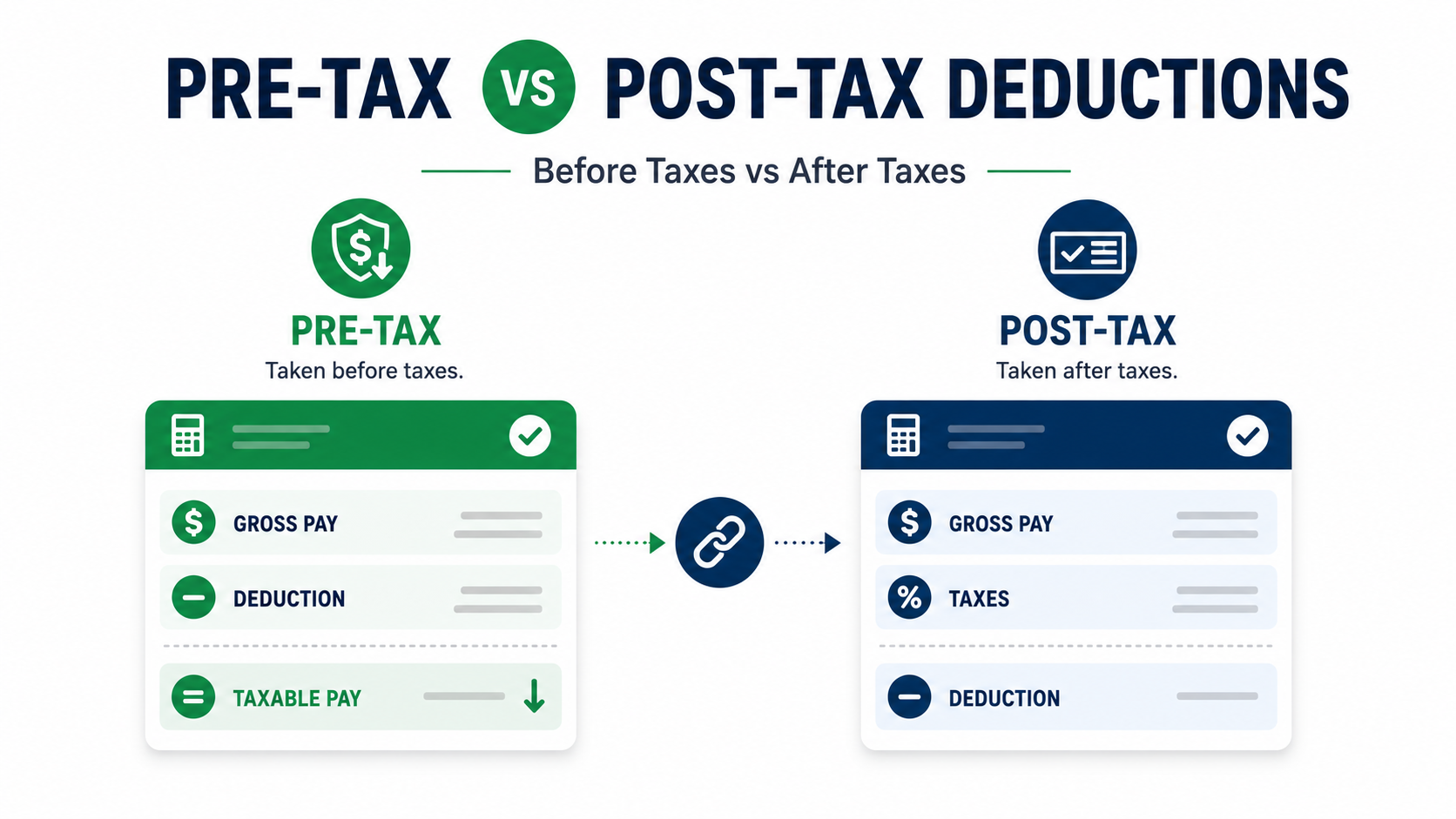
Pre-tax deductions are qualifying payroll amounts that reduce one or more taxable-wage bases before the corresponding tax is calculated. Post-tax deductions lower take-home pay without reducing current taxable wages. A traditional 401(k) generally reduces federal income-tax wages but not Social Security or Medicare wages; a designated Roth 401(k) reduces neither. A qualifying Section 125 health premium can reduce all three. The amount of tax saved depends on the deduction, employee circumstances, and applicable wage limits.
Two employees with identical gross pay can receive different net pay because their benefit deductions receive different tax treatment. But a $100 pre-tax deduction is not guaranteed to save exactly $25 in taxes: the result depends on your federal and state withholding, the benefit, your Social Security wage base, and other payroll details. This guide shows how to read your own deductions, compare real paycheck numbers, and spot the most common mistakes.
- The core difference
- Check a deduction with the interactive tool
- The payroll sequence
- Pre-tax and FICA
- Post-tax deductions
- When post-tax may make sense
- 2026 Roth catch-up rule
- Side-by-side comparison
- Worked paycheck example
- Check your own pay stub
- How deductions appear on a W-2
- Frequently asked questions
What is the difference between pre-tax and post-tax deductions?
Pre-tax deduction
A qualifying benefit reduces at least one type of taxable wages before the applicable tax is figured. For example, a traditional 401(k) contribution generally reduces federal income-tax wages, but not Social Security or Medicare wages.
Post-tax deduction
An amount comes out of your paycheck without excluding it from current taxable wages. A Roth 401(k) contribution generally does not reduce federal income-tax or FICA wages; qualified future withdrawals can be tax-free.
Both types reduce your cash take-home pay. The difference is whether the amount reduces the wages used to compute current taxes. Payroll tax withholding is also not always the same as your final income-tax liability when you file your return. For an overview of where each line appears, see how to read a pay stub.
Deduction treatment checker: what changes on your paycheck?
Select the employee-funded item and, where relevant, its plan arrangement. The checker separates federal income-tax wages from Social Security and Medicare wages. It does not calculate your actual federal or state withholding, final tax return, or future retirement benefit.
Source and scope: IRS Publication 15 (2026) and IRS Publication 15-B (2026). The 2026 Social Security wage base is $184,500. Ordinary employee Social Security and Medicare rates are 6.2% and 1.45%; Additional Medicare Tax is not included in this tool. A qualifying health benefit, an HSA contribution, and a retirement deferral may have different applicable exclusions.
How are pre-tax and post-tax deductions calculated?
A typical employee-paycheck calculation has five conceptual steps. This is a way to understand the math, not a universal legal order of deduction priority; real payroll systems and garnishment rules may differ.
1. Identify gross earnings. Combine regular wages, overtime, bonuses, commissions, and other relevant earnings for the pay period.
2. Calculate each taxable-wage base separately. Subtract amounts that qualify for exclusion from federal income-tax wages; separately determine Social Security wages, Medicare wages, and any state/local taxable wages. Traditional 401(k) deferrals usually reduce the first, not the next two.
3. Calculate employee tax withholding. Federal income-tax withholding uses applicable IRS rules and Form W-4 information. Social Security, Medicare, and state/local withholding have their own rules.
4. Account for all employee-funded benefits and other deductions. Both pre-tax and post-tax benefit contributions are removed from cash wages once; post-tax items do not also reduce the taxable-wage base.
5. Reconcile net pay. Gross cash earnings minus employee taxes minus employee deductions, plus any applicable nontaxable reimbursements, yields the payment amount. Employer contributions displayed for information should not be subtracted again from employee net pay.
Important: Federal income tax and Social Security are taxes withheld from your wages, not employee benefits you can freely elect to make pre-tax or post-tax. A benefit deduction may reduce the wages subject to a tax, but it does not change the legal classification of that tax.
Which pre-tax deductions reduce income tax, FICA, or both?
There is no single “taxable income” figure that applies to every paycheck tax. A qualified traditional retirement deferral is generally excluded from federal income-tax wages while remaining subject to Social Security and Medicare. A properly administered Section 125 health benefit generally reduces both. A qualified commuter benefit uses separate Section 132 rules; it is not a Section 125 cafeteria-plan benefit.
| Deduction | Federal income-tax wages | Social Security and Medicare wages | Important condition |
|---|---|---|---|
| Traditional 401(k) employee deferral | Generally reduced | Generally not reduced | Subject to plan and annual deferral rules |
| Qualifying employee health, dental, or vision premium | Generally reduced | Generally reduced | Must qualify under employer's applicable benefit arrangement |
| HSA salary reduction through a Section 125 plan | Generally reduced | Generally reduced | HSA eligibility and contribution limits apply |
| HSA contribution outside a Section 125 arrangement | Not automatically reduced through payroll | Not automatically reduced | An eligible personal contribution may be deductible on the tax return; payroll treatment differs |
| Qualifying health FSA or dependent-care assistance | Generally reduced | Generally reduced | Exclusion limits and plan eligibility apply |
| Qualified transit or parking benefit | Generally reduced within limits | Generally reduced within limits | Section 132 transportation benefit; not a Section 125 benefit |
On a phone, swipe horizontally to view every column.
Are Social Security deductions pre-tax? No. Social Security tax itself is withheld as a tax. For 2026, the regular employee rate is 6.2% of covered Social Security wages up to the annual $184,500 wage base. Regular Medicare withholding is 1.45% of covered Medicare wages, with no annual wage-base cap; Additional Medicare Tax rules can apply at higher wages. An eligible health benefit may reduce the wages subject to these taxes, whereas a traditional 401(k) deferral generally does not. Read the complete FICA pay-stub guide for thresholds and exceptions.
Selected 2026 limits to check before making an election
| Benefit | 2026 federal limit | Do not overlook |
|---|---|---|
| 401(k) elective deferrals | $24,500 regular employee limit | Traditional and Roth 401(k) employee deferrals share the applicable combined limit; eligible catch-ups can increase it. |
| HSA | $4,400 self-only / $8,750 family | Employer and employee contributions count toward the applicable limit; eligibility, age-based catch-ups, and monthly limits can change the amount. |
| Health FSA salary reduction | $3,400 | The employer's plan may set a lower limit and eligibility/use restrictions apply. |
| Dependent-care assistance exclusion | Generally up to $7,500; $3,750 if married filing separately | May be limited further by eligible expenses, earned income, and plan conditions. |
| Qualified transit / parking | $340 per month for each category | These limits are separate; an ordinary commute mileage expense does not automatically qualify. |
These are general federal figures, not instructions to contribute the maximum. See the official source links near the end of this guide.
What are post-tax deductions? Common examples
A post-tax deduction is taken from compensation that remains included in current taxable wages. Post-tax does not mean that every later benefit, reimbursement, or withdrawal will be tax-free.
| Example | What happens now? | Possible later treatment or caveat |
|---|---|---|
| Designated Roth 401(k) | Employee contribution does not reduce current federal income-tax or FICA wages. | Qualified distributions, including eligible earnings, can be tax-free; a five-tax-year rule and other conditions apply. |
| Employee-funded disability premium paid after tax | Premium ordinarily does not reduce taxable wages. | Benefits attributable to premiums paid entirely with the employee's after-tax dollars generally are not income; mixed employer/employee funding can make part taxable. |
| Union dues | Generally withheld from after-tax pay. | Do not treat dues as a pre-tax employee benefit merely because they appear in a deductions column. |
| Charitable payroll donation | Generally does not lower payroll taxable wages. | Any separate income-tax deduction depends on the tax-year rules and eligibility; it is not a payroll wage exclusion. |
| Wage garnishment or child-support withholding | Reduces available net pay without generally lowering taxable wages. | Mandatory payment rules differ; do not treat the amount as an optional employee benefit. |
On a phone, swipe horizontally to view every column.
If your pay stub contains unfamiliar abbreviations such as 401K, ROTH, MED, HSA, or a garnishment line, review the employer's payroll legend first, then see the pay-stub deduction codes reference.
When might a post-tax deduction make sense?
The useful question is not whether pre-tax or post-tax is universally “better.” It is what the particular benefit provides and which tax rules apply now and later.
Traditional 401(k) versus Roth 401(k)
A traditional 401(k) generally reduces current federal income-tax wages, while a Roth 401(k) does not. Qualified Roth distributions can be tax-free, subject to the applicable rules; traditional distributions generally are taxable when withdrawn. Your current and anticipated retirement tax circumstances, plan options, contribution needs, and other considerations may affect the choice. The regular 2026 employee deferral limit is $24,500 combined across traditional and Roth 401(k) elective deferrals under the applicable rules, not $24,500 for each. For detailed plan-specific limits, use the 401(k) pay-stub guide.
Disability premiums and future benefits
After-tax employee funding can make the portion of disability benefits attributable to those employee-paid premiums nontaxable. However, benefits paid from an employer-funded portion may be taxable. If an employer and employee share premium costs, do not assume the entire benefit will be tax-free. Ask the benefits administrator how the premium is funded and how future payments would be reported.
2026 Roth catch-up rule: who must use post-tax contributions?
Starting in 2026, certain employees eligible to make retirement-plan catch-up contributions must make those catch-up amounts on a Roth basis if their 2025 Social Security wages from the employer sponsoring the plan exceeded $150,000. This does not convert all of the employee's regular 401(k) contributions to Roth. Plan features and specific IRS rules can affect implementation.
For 2026, the usual additional 401(k) catch-up amount for eligible participants age 50 or older is $8,000; a higher $11,250 catch-up may apply at ages 60 through 63. These are additional limits rather than a second regular $24,500 allowance. Confirm your plan's implementation and eligibility before making an election.
Pre-tax vs post-tax: side-by-side checklist
| Question | Pre-tax example | Post-tax example |
|---|---|---|
| What happens to current cash pay? | Contribution reduces net pay; a corresponding tax reduction may offset some of it. | Contribution generally reduces net pay by its full amount compared with no contribution, before other changes. |
| Do federal income-tax wages decline? | Generally yes for qualifying traditional 401(k) or Section 125 benefit. | Generally no for Roth 401(k) or ordinary union dues. |
| Do FICA wages decline? | Depends on the benefit: generally yes for qualifying Section 125 health benefits; no for traditional 401(k). | Generally no. |
| Does the benefit create a future tax advantage? | Depends on the benefit; HSA qualified medical distributions can be tax-free, while traditional 401(k) distributions generally are taxable. | Depends on the benefit and eligibility: qualified Roth distributions can be tax-free; many ordinary post-tax deductions provide no future tax exclusion. |
| What should I check? | Benefit eligibility, plan elections, income-tax wages, FICA wages, limits. | Contribution type, benefit funding, tax treatment of withdrawals or payments. |
On a phone, swipe horizontally to view every column.
Worked paycheck comparison: the same $100, three different treatments
Assume an employee has $2,000 of otherwise taxable cash wages in one pay period, no other wage adjustments, and elects a $100 employee-funded benefit. Each column shows a different scenario, not three simultaneous deductions. For this example, the employee is below the annual Social Security wage base and the selected health premium satisfies Section 125 requirements.
| Per-paycheck item | Traditional 401(k) | Roth 401(k) | Qualifying Section 125 health premium |
|---|---|---|---|
| Gross covered cash wages | $2,000.00 | $2,000.00 | $2,000.00 |
| Employee-funded deduction | −$100.00 | −$100.00 | −$100.00 |
| Federal income-tax wages | $1,900.00 | $2,000.00 | $1,900.00 |
| Social Security and Medicare wages | $2,000.00 | $2,000.00 | $1,900.00 |
| Ordinary employee Social Security withholding at 6.2% | $124.00 | $124.00 | $117.80 |
| Ordinary employee Medicare withholding at 1.45% | $29.00 | $29.00 | $27.55 |
| Ordinary employee FICA withholding (combined) | $153.00 | $153.00 | $145.35 |
Each tax line is calculated separately and rounded to cents. This table does not estimate actual net pay or federal/state income-tax withholding.
Near or above the Social Security wage base: the Social Security portion of the difference can be smaller or zero. The interactive checker accepts year-to-date Social Security wages to handle the ordinary annual cap in a simplified single-employer scenario; it does not compute Additional Medicare Tax, state tax, or complicated payroll adjustments.
How to check whether your own pay-stub deductions are pre-tax or post-tax
This short pay-stub audit is the main practical test. You need your current stub, the prior comparable stub if available, and the employer's benefit or payroll legend.
- Find gross cash earnings and employee deductions. Note each line's label, amount, and year-to-date total. Do not mistake the employer match or an employer tax expense for a second employee deduction.
- Identify the benefit arrangement. “HSA” alone is insufficient: ask whether it is a qualifying Section 125 payroll contribution or a different employee contribution. Likewise, check traditional versus Roth on retirement lines.
- Locate taxable wages by tax. Look for FIT/federal taxable wages, Social Security wages, Medicare wages, and state taxable wages. The absence of separate fields on your stub does not prove all four bases are identical.
- Compare the appropriate wage bases. A traditional 401(k) generally reduces federal income-tax wages but not FICA wages. An eligible Section 125 health premium generally reduces both. A post-tax Roth contribution generally reduces neither.
- Reconcile actual net pay. Start from gross cash earnings, subtract all employee-funded benefit deductions and employee tax withholding once, then account for other permitted adjustments. Compare matching pay periods; overtime, a changed W-4, taxable fringe benefits, and reaching a wage cap can all change the result.
- Escalate unexplained differences. Ask payroll for the deduction's tax code, benefit-plan classification, and a taxable-wage reconciliation. If the issue concerns your tax return, seek guidance from a qualified tax professional.
Mini example: Gross pay is $2,000, with a $100 traditional 401(k) contribution and a $75 eligible Section 125 health premium, and no other wage adjustments. Illustrative federal income-tax wages are $1,825; Social Security and Medicare wages are $1,925. A $40 Roth contribution would reduce cash net pay but would not lower those wage bases. This is a wage-base example, not a complete net-pay calculation.
How pre-tax and post-tax deductions show up on Form W-2
For a straightforward employee-payroll situation, W-2 Box 1 reports federal taxable wages, Box 3 Social Security wages (subject to its annual cap), and Box 5 Medicare wages. A traditional 401(k) elective deferral normally reduces Box 1 but does not reduce Boxes 3 and 5. Eligible Section 125 health benefits generally reduce all three wage bases. A Roth 401(k) contribution generally does not reduce any of the three. Other compensation, employer benefits, tips, and special reporting rules can also affect the totals.
W-2 Box 12 can report traditional 401(k) elective deferrals under code D, designated Roth 401(k) contributions under code AA, and HSA contributions made by the employer or through a cafeteria plan under code W. These codes describe reporting categories; they are not a formula for subtracting every Box 12 amount from Box 1. The employer's final W-2, not an estimate from a sample stub, is the official wage statement. For a deeper reconciliation, see taxable wages and W-2 box differences.
Need to prepare a pay stub with clearly itemized earnings, taxes, and employee deductions?
Create a pay stub on ePaystubsUse accurate underlying payroll records. A generated stub does not replace an employer-issued W-2 or professional payroll calculation.
Frequently asked questions
Are Social Security and Medicare deductions pre-tax or post-tax?
They are employee payroll taxes, not elective employee benefit deductions. Qualifying pre-tax benefits can reduce the wages used to calculate them, but a traditional 401(k) usually does not. Social Security and Medicare also have different wage-base rules.
Why did my net pay fall by less than my pre-tax contribution?
A qualifying pre-tax contribution can reduce current income-tax withholding and, for some benefits, FICA withholding. The difference is not a fixed percentage: actual withholding depends on your pay, Form W-4, benefit category, wage-base thresholds, and state or local tax rules.
Are HSA contributions always pre-tax?
No. Qualifying HSA salary reductions under an employer's Section 125 arrangement generally reduce federal income-tax and FICA wages. Other eligible HSA contributions can be deductible on a return without having reduced payroll FICA wages. Check your contribution method and HSA eligibility.
Can a 401(k) be both pre-tax and post-tax?
If the plan offers both traditional and designated Roth options, you can generally direct eligible employee contributions to either or split them, subject to plan terms and the combined applicable contribution limit. Certain catch-up contributions must be Roth for workers meeting the 2026 prior-year employer-wage threshold.
Does a post-tax deduction reduce taxable income when I file my return?
Not automatically. A payroll donation, for example, is not excluded from wages merely because it is donated; a separate income-tax deduction may be available under applicable rules. Some after-tax insurance premiums or Roth contributions have their own later tax benefits. Check the specific deduction rather than assuming the answer from its payroll label.
Why are Boxes 1, 3, and 5 on my W-2 different?
They measure different taxable-wage bases. Traditional retirement deferrals, qualifying benefit exclusions, the Social Security annual wage cap, and other reporting adjustments can produce different amounts. Your pay stub's year-to-date wage bases and official W-2 instructions provide the right comparison.
Official sources and verification
- IRS Publication 15 (2026): employment taxes and HSA payroll treatment
- IRS Publication 15-B (2026): fringe benefits and Section 125 exclusions
- IRS 2026 Form W-2/W-3 instructions: wage boxes and Box 12 codes
- IRS: 2026 catch-up contributions and Roth threshold
- IRS: 2026 FSA and transportation limits
- IRS Revenue Procedure 2025-19: 2026 HSA limits
- IRS: when disability benefits are taxable
How this article was prepared: The examples distinguish taxable-wage calculations from income-tax withholding. Calculations in the worked example use stated inputs and published 2026 ordinary employee FICA rates. The browser-only deduction checker does not collect or transmit pay information; amounts stay in the current page. The byline identifies the editorial team; no independent professional review is claimed.