
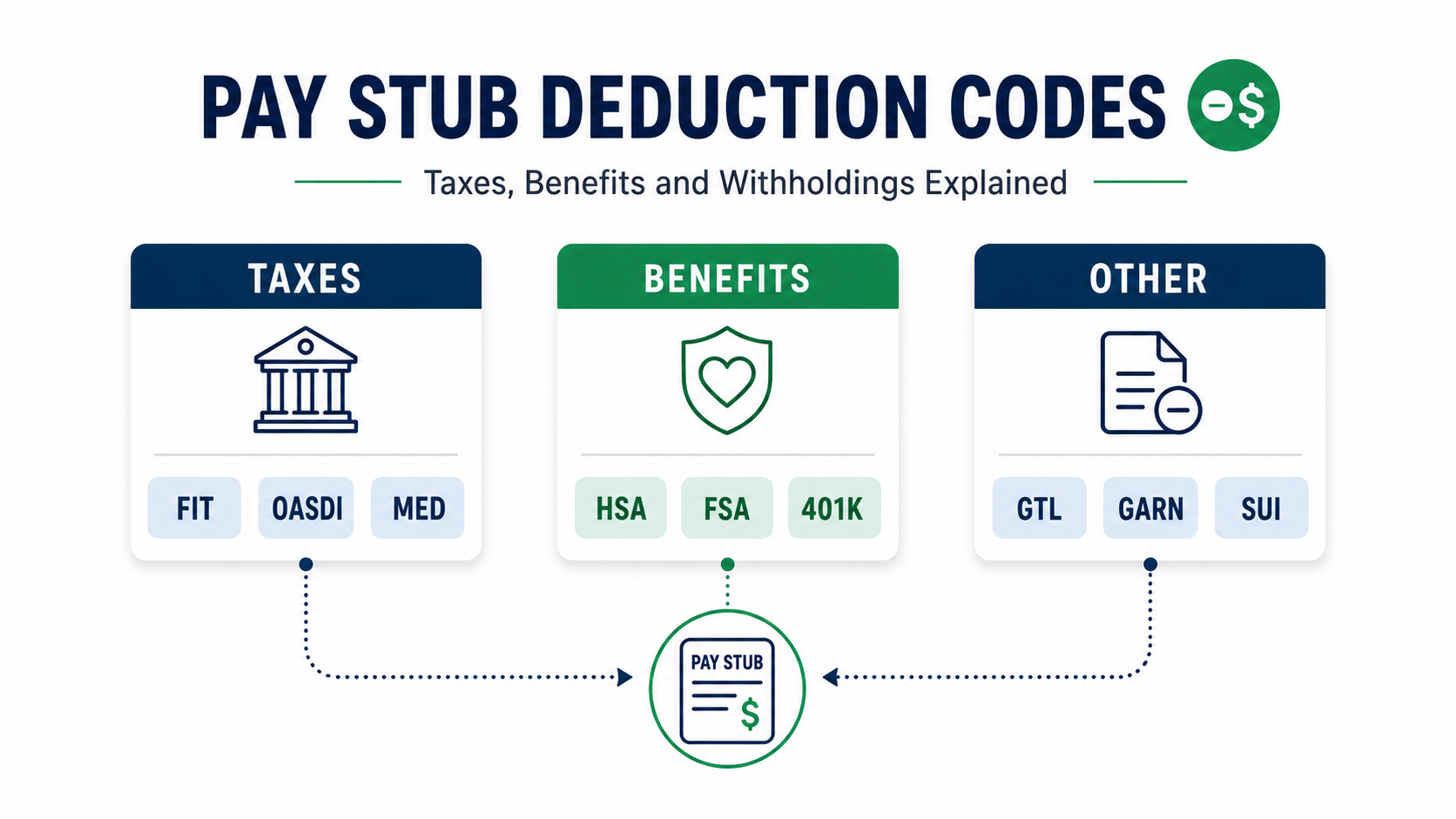
Pay Stub Deduction Codes Explained: Taxes, Benefits and Garnishments
Pay stub guide · United States · 2026
Pay stub deduction codes are short labels for amounts withheld from a paycheck, such as FIT for federal income-tax withholding, OASDI for Social Security, MED for Medicare, 401K for retirement contributions, HSA for health savings contributions, and GARN for garnishment.
Not every line next to deductions reduces take-home pay. Check the Current amount, the employee or employer marker, and the payroll section. Employers can use their own codes, so an unfamiliar label must be confirmed with the employer's code legend or payroll team.
Enter the letters printed on your pay stub, not a guessed expansion.
Compare the current deduction with your employee and employer sections.
Check whether it changes net pay or federal income-tax, Social Security, or Medicare wages.
Looking for REG, OT, PTO, YTD, or general payroll abbreviations? See our separate pay stub abbreviations guide. This page concentrates on deductions, benefits, employer-paid items, and their effects on your paycheck.
Find Your Pay Stub Deduction Code
Search a common abbreviation or filter the reference by category. The complete 40-entry table appears in the page's HTML even when JavaScript is unavailable. A match suggests a common interpretation; your employer's own description is the deciding source.
Optional context improves the explanation, but does not confirm an employer-specific code. Do not enter names, account numbers, or other personal information.
Showing all 40 common entries.
| Code or variant | Common meaning | Usually paid by | Reduces current net pay? | Typical tax or W-2 effect | What to verify |
|---|---|---|---|---|---|
| FIT, FWT, FED WH | Federal income tax withholding | Employee | Yes | Withholding appears in W-2 Box 2; it does not reduce wage boxes | W-4 settings; FED alone can be an ambiguous federal heading |
| OASDI, SS, SOC SEC | Employee Social Security tax | Employee | Yes | Withholding appears in W-2 Box 4; Social Security wages appear in Box 3 | 2026 rate and annual wage base |
| MED, MEDI, HI | Employee Medicare tax | Employee | Yes | Withholding appears in W-2 Box 6; Medicare wages appear in Box 5 | Regular versus Additional Medicare tax |
| FICA | Social Security and Medicare payroll taxes, sometimes shown as one heading | Employee and employer | Employee share: yes | Usually reconciles to W-2 Boxes 3–6 | Whether the stub breaks OASDI and Medicare into separate lines |
| SIT, SWT, STATE | State income tax withholding | Employee | Yes | Usually reported in W-2 Boxes 15–17 | Work state, resident state and state withholding form |
| LIT, LOCAL, CITY | Local, city, county or school-district income tax | Employee | Yes | Often reported in W-2 Boxes 18–20 | Local jurisdiction and work location |
| SDI, CASDI, TDI | State disability insurance or temporary disability program | Employee, employer or both | Sometimes | State-specific; may appear in W-2 Box 14 or another state field | State program, rate, wage base and payer |
| SUI, UI, SUTA | State unemployment insurance | Usually employer; employees contribute in some states | Sometimes | State-specific reporting | Whether the line is employee-paid or employer-only |
| 401K, 401K PRE | Traditional 401(k) elective deferral | Employee | Yes | Usually lowers W-2 Box 1, not Boxes 3 or 5; commonly Box 12 Code D | Traditional versus Roth election |
| ROTH 401K, 401K R | Designated Roth 401(k) contribution | Employee | Yes | After-tax; commonly reported in W-2 Box 12 Code AA | That the plan labels Roth separately |
| 403B, TSA | 403(b) retirement-plan contribution | Employee | Yes | Traditional deferrals commonly use Box 12 Code E; Roth 403(b) uses Code BB | Traditional, Roth or another contribution type |
| 457B, DEFERRED COMP | Eligible deferred-compensation plan contribution | Employee and sometimes employer | Employee share: yes | Reporting depends on plan type; governmental 457(b) deferrals commonly use Box 12 Code G | Governmental versus nongovernmental plan and Roth status |
| PENSION, RET | Pension or retirement contribution | Employee, employer or both | Sometimes | Tax treatment depends on the plan and whether the employee contribution is pre-tax | Plan document and employee/employer-paid marker |
| 401K ER, MATCH | Employer retirement match or contribution | Employer | No | Generally does not reduce the employee’s current net pay | Vesting rules and whether it is informational |
| HSA, HSA EE | Employee health savings account contribution through payroll | Employee | Yes | Cafeteria-plan contributions are generally pre-tax; salary-reduction amounts are included with employer HSA contributions in W-2 Box 12 Code W | HSA eligibility, contribution method and annual limit |
| HSA ER | Employer HSA contribution | Employer | No | Generally shown in W-2 Box 12 Code W together with qualifying payroll HSA amounts | Year-to-date total and eligibility |
| FSA MED, MED FSA | Health flexible spending arrangement contribution | Employee | Yes | Generally pre-tax under a qualifying cafeteria plan | Plan-year election, eligible expenses and carryover rules |
| DCFSA, DEP FSA, DCAP | Dependent care flexible spending or assistance contribution | Employee | Yes | Generally pre-tax up to the applicable exclusion; W-2 Box 10 may report dependent-care benefits | Eligibility, annual election and qualifying expenses |
| MED INS, HEALTH, S125 | Medical insurance premium, often through a Section 125 cafeteria plan | Employee | Yes | Often reduces federal income-tax and FICA wages when the benefit qualifies | Whether the premium is pre-tax or after-tax |
| DEN, DENTAL | Dental insurance premium | Employee, employer or both | Employee share: yes | May be pre-tax under the employer’s cafeteria plan | EE/ER share and plan tax treatment |
| VIS, VISION | Vision insurance premium | Employee, employer or both | Employee share: yes | May be pre-tax under the employer’s cafeteria plan | EE/ER share and plan tax treatment |
| LIFE, SUPP LIFE | Employee-paid life insurance premium | Employee | Yes | Often after-tax; plan treatment varies | Coverage amount, beneficiary and tax basis |
| STD | Short-term disability insurance premium | Employee, employer or both | Employee share: yes | Pre-tax versus after-tax premiums can affect taxation of future benefits | Who pays and the plan’s tax treatment |
| LTD | Long-term disability insurance premium | Employee, employer or both | Employee share: yes | Pre-tax versus after-tax premiums can affect taxation of future benefits | Who pays and the plan’s tax treatment |
| SUPP INS, AFLAC | Supplemental insurance premium | Employee | Yes | May be pre-tax or after-tax depending on product and plan setup | Specific policy and tax election |
| ER MED, ER HEALTH | Employer-paid medical coverage or contribution | Employer | No | Usually informational and does not reduce employee net pay | Whether any employee share is listed elsewhere |
| GTL, GTL IMP, IMPT INC | Taxable value of qualifying group-term life coverage over the excludable amount | Employer benefit; tax is borne through payroll | Not a cash deduction itself, but it can increase taxes | Taxable cost may enter W-2 Boxes 1, 3 and 5 and Box 12 Code C | Coverage, age-based cost and employee after-tax payment |
| GARN, GARNISH | Wage garnishment for a debt or legal order | Employee wages | Yes | Generally does not reduce taxable wages | Order type, case or agency, disposable earnings and applicable limits |
| CS, CHSUP, SUPPORT | Child or spousal support withholding | Employee wages | Yes | Generally does not reduce taxable wages | Issuing agency, arrears and priority rules |
| TAX LEVY, IRS LEVY | Federal, state or local tax levy | Employee wages | Yes | Generally does not reduce taxable wages; special levy rules apply | Agency notice, exempt amount and release status |
| SL GARN, STUDENT LN | Student-loan administrative wage garnishment | Employee wages | Yes | Generally does not reduce taxable wages | Debt holder, notice and applicable federal or state rule |
| BANKRUPTCY | Payment required by a bankruptcy order or plan | Employee wages | Yes | Taxable-wage treatment generally does not change | Trustee instructions and controlling court order |
| UNION, DUES | Union dues or assessments | Employee | Yes | Usually after-tax for payroll purposes; individual deductibility is limited and fact-specific | Authorization, amount and union agreement |
| TRANSIT, PARK, COMM | Qualified transit pass, commuter-vehicle or parking benefit | Employee, employer or both | Employee share: yes | Can receive favorable treatment under Internal Revenue Code Section 132 up to applicable limits | Benefit type, monthly election and limit |
| CHARITY, UW | Payroll charitable contribution | Employee | Yes | Usually after-tax; tax-return treatment depends on current deduction rules and records | Authorization, recipient and receipt |
| 401K LOAN, LOAN REPAY | Retirement-plan loan repayment | Employee | Yes | Repayment is not the same as a new pre-tax contribution | Loan balance, interest and repayment schedule |
| ADVANCE, PAY ADV | Repayment of a wage or payroll advance | Employee | Yes | Usually does not reduce current taxable wages because the advance was handled earlier | Original advance and repayment agreement |
| MEALS, CAF | Employee meal or cafeteria charge | Employee | Yes | Often after-tax; employer-provided meals can follow different rules | Dates, subsidy and authorization |
| UNIFORM, EQUIP | Uniform, equipment or tool charge | Employee | Yes | Usually after-tax; legality depends on federal and state wage rules | Authorization, state law and minimum-wage impact |
| MISC, OTHER | Custom payroll deduction | Varies | Varies | Cannot be determined from the abbreviation alone | Payroll code description, authorization and source document |
Read this before assuming an amount is missing: employer-paid items, imputed taxable benefits, and direct-deposit allocations can appear near deductions without being another subtraction from gross pay. Verify the actual current-period calculation.
What If Your Deduction Code Is Not Listed?
Some employers use proprietary labels such as KMTCHTR or PX401 EEPRE. A fragment such as 401 may suggest a retirement-related item, PRE may suggest a pre-tax designation, and EE may suggest an employee share. None of those fragments proves the full code's official meaning.
Check the payroll context
- Record the exact code and its Current amount.
- Identify the statement section: employee deduction, employer-paid benefit, earning, or payment allocation.
- Check EE/ER markers and compare your benefit elections or payroll documents.
- Recalculate gross pay minus actual employee-paid current deductions, allowing for noncash taxable benefits and adjustments.
Get the exact definition
- Open the employer's official payroll-code legend or benefits portal.
- Look for the code's full description and whether it is pre-tax for income tax, FICA, both, or neither.
- Ask for the enrollment, authorization, order, or payroll adjustment supporting the amount.
- If an unexpected amount persists, ask payroll for a line-by-line reconciliation.
Is a direct-deposit code a deduction?
Not necessarily. A line under payment distribution may show that net pay was sent to a bank account or split between accounts. It generally should not be subtracted again from gross pay. If the label appears under employee deductions instead, ask payroll which record it represents. See what pay stubs show about direct deposit.
Which Codes Reduce Your Take-Home Pay or Taxable Wages?
Two questions must be answered separately: Who pays the amount? and How is it treated for each tax? An employee-paid item typically reduces current net pay. An employer-only contribution generally does not. A pre-tax benefit may reduce some wage bases but not others.
| Common item | Effect on current net pay | Federal income-tax wages | Social Security / Medicare wages |
|---|---|---|---|
| FIT, OASDI or MED withholding | Reduces net pay | Does not reduce the taxable-wage base | Does not reduce the wage base |
| Traditional employee 401(k) | Reduces net pay | Generally reduces wages subject to federal income tax | Generally remains included |
| Roth 401(k) | Reduces net pay | Generally remains included | Generally remains included |
| Qualifying Section 125 health benefit | Employee share reduces net pay | Often reduces taxable wages | Often reduces taxable wages when the exclusion applies |
| Employer match | Usually no reduction | Plan-dependent, generally not current cash wages | Plan-dependent, generally not current cash wages |
| Garnishment or loan repayment | Reduces net pay | Generally does not reduce taxable wages | Generally does not reduce taxable wages |
| GTL imputed income | Not a cash deduction; related taxes can lower net pay | May increase taxable wages | May increase taxable wages |
For details about specific elections, see pre-tax versus post-tax deductions and taxable wages on a pay stub. Never assume every item labeled “pre-tax” is exempt from every payroll tax.
2026 Social Security and Medicare check
In 2026, covered employees generally pay 6.2% Social Security tax on Social Security-taxable wages up to the $184,500 wage base, and 1.45% regular Medicare tax on Medicare wages without a comparable annual cap. Additional Medicare Tax rules may apply at higher wages. Compare the correct wage bases, not gross pay alone. See the OASDI and MED guides for detailed examples.
Worked Example: Reconcile a Deduction to Net Pay
Suppose this fictional employee has $3,000 in gross pay, an eligible $150 Section 125 health premium, and a $180 traditional 401(k) deferral. The federal and state withholding amounts are illustrations only; actual payroll tax treatment depends on the employee's circumstances and employer's records.
Federal income-tax wages: $3,000 − $150 − $180 = $2,670. Social Security and Medicare wages: $3,000 − $150 = $2,850. The traditional 401(k) deferral generally remains subject to Social Security and Medicare taxes.
Current net pay: $3,000 − $918.03 = $2,081.97. Do not subtract the employer's matching contribution or the employee's YTD total again.
If your own numbers do not reconcile, check for bonuses, taxable benefits, corrections, retroactive deductions, employer-only information lines, and whether you are looking at the Current or YTD column. See gross pay versus net pay.
How Do Deduction Codes Connect to Form W-2?
A W-2 summarizes annual wage and tax information. Many voluntary or after-tax deduction codes do not appear as separate W-2 lines. Instead, compare the corresponding taxable-wage boxes, withheld-tax totals, and applicable Box 12 codes.
| Pay-stub item | Typical W-2 location | What to check |
|---|---|---|
| Federal income-tax wages / FIT | Boxes 1 and 2 | Annual federal taxable wages and income tax withheld |
| OASDI / Social Security | Boxes 3 and 4 | Social Security wages and employee tax withheld |
| Medicare / MED | Boxes 5 and 6 | Medicare wages and tax withheld, including Additional Medicare withholding if applicable |
| Traditional / Roth 401(k) | Box 12, Codes D / AA | Elective deferrals versus designated Roth contributions |
| HSA via cafeteria plan | Box 12, Code W | Employer and eligible employee salary-reduction contributions reported together |
| Dependent-care benefits | Box 10 | Applicable annual dependent-care benefit amount |
| Taxable group-term life cost (GTL) | Box 12, Code C; applicable wage boxes | Taxable cost of qualifying coverage above the excludable amount |
| State / local withholding | Boxes 15–20 when applicable | Jurisdiction, wages, and taxes withheld |
| Garnishment or employee loan repayment | Often no separate federal box | Reconcile pay-stub records, not a missing W-2 code |
Review the IRS 2026 Form W-2/W-3 instructions if you need the formal reporting rules. For a longer explanation, read our taxable-wages and W-2 guide.
What Should You Do If a Deduction Looks Wrong?
- Check the current amount. A year-to-date figure is a running total, not an extra current deduction.
- Identify the payer. Compare the EE/ER marker, statement section, and gross-to-net calculation.
- Match the source record. Review benefits enrollment, retirement elections, payroll authorizations, or any court or agency order.
- Compare earlier pay stubs. Look for a new code, changed contribution, correction, or retroactive amount.
- Request an explanation. Ask payroll for the official code definition, taxable-wage effect, calculation, and supporting document.
Message you can send to payroll
“Please explain the deduction code [CODE] on my pay stub dated [DATE]. The current amount is [$] and the YTD amount is [$]. Please confirm whether the amount is employee- or employer-paid, what document or order supports it, how it was calculated, and whether it affects federal income-tax, Social Security, or Medicare wages.”
Garnishment note: For ordinary consumer-debt garnishments, federal limits generally use the lesser of 25% of disposable earnings or the amount exceeding 30 times the applicable federal minimum hourly wage per workweek. Different rules can apply to support, tax levies, bankruptcy, and other debts; stricter state laws may apply. See the U.S. Department of Labor's garnishment fact sheet and our GARN guide.
Frequently Asked Questions
Are all pay stub deduction codes standardized?
No. Common labels exist, but payroll software and employers can use custom codes. An online guide can suggest a common meaning but cannot confirm every employer-specific label.
Is an employer match money deducted from my paycheck?
Usually no. An employer-paid retirement or benefit contribution generally should not reduce current employee net pay. If the statement also shows a separate EE contribution, that employee amount may reduce take-home pay.
What does EE PRE or PX401 EEPRE mean?
EE and PRE may suggest an employee pre-tax designation, and 401 may suggest a retirement plan. The full code is not standardized, however. Check the actual statement section and employer code legend before treating that interpretation as confirmed.
Does a pre-tax deduction always reduce Social Security wages?
No. A traditional employee 401(k) deferral generally reduces federal income-tax wages but remains included in Social Security and Medicare wages. A qualifying Section 125 benefit may reduce both types of taxable wages.
Why does a deduction code not appear on my W-2?
W-2 forms report particular annual wage, tax, and benefit information, not every pay-stub abbreviation. Garnishments and after-tax loan repayments generally do not get their own federal W-2 box.
Can a direct-deposit allocation look like a deduction?
Yes. Some statements display a payment split or deposit amount near deductions. Check whether the amount distributes existing net pay rather than reducing gross pay a second time.
What should I do about an unauthorized or unfamiliar deduction?
Ask payroll for the full code meaning, supporting authorization or order, amount calculation, and applicable state wage-deduction rule. If the matter remains unresolved, consider contacting your state labor agency or a qualified adviser.
Preparing an Accurate Pay Stub?
Employers and authorized payroll users can use ePaystubs to organize genuine current earnings, employee deductions, and employer-paid amounts. Employees should obtain official records and code definitions from their employer.
Create a pay stubOfficial Sources and Related Guides
Use official guidance for tax rules and the employer's payroll records for the meaning of proprietary codes.
Editorial note: This article is general educational payroll information, not individualized tax or legal advice. Codes, plan treatment, wage-deduction requirements, and employer records vary. Verify the official meaning and amounts with your employer or the relevant agency. Do not create or alter an employer-issued pay stub to resolve a disputed deduction.