
S-Corp Owner W-2: Reasonable Compensation and Health Insurance
W-2 series for
An S corporation owner who performs substantial services for the corporation generally cannot treat all compensation as distributions simply to avoid employment taxes. The corporation should evaluate reasonable wages for the work performed and report employee compensation through payroll. Special reporting rules can also apply to health insurance paid for a greater-than-2% shareholder-employee.
How reasonable compensation is determined
There is no universal percentage of profit or distribution that automatically establishes a reasonable salary. Consider the duties performed, time spent working, experience, comparable market pay, responsibilities and the extent to which revenue is generated by the owner's services rather than other employees or capital. Document your conclusion and revisit it when the business changes.
| Payment type | General treatment |
|---|---|
| Compensation for services | Wage reporting through payroll |
| Proper shareholder distribution | Separately accounted for as a distribution, not a W-2 wage by default |
| Qualifying shareholder health premiums | Special wage and benefit reporting rules |
A distribution is not automatically tax-free and does not replace reasonable compensation. The shareholder's basis and other tax facts matter.
Example: salary and shareholder health insurance
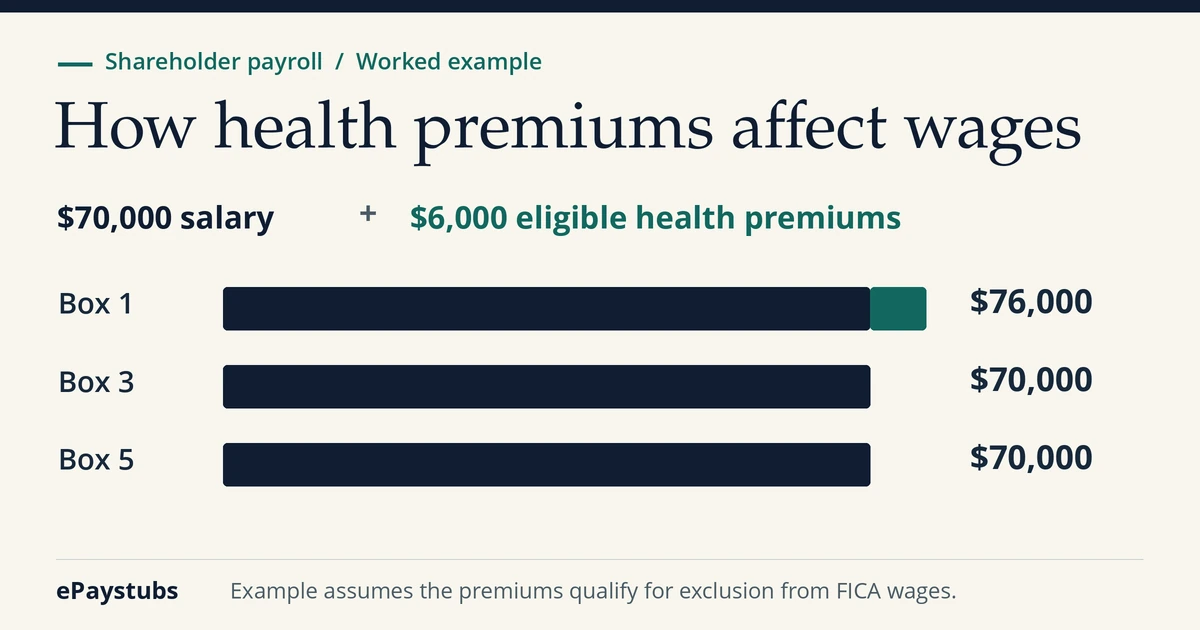
Assume a shareholder-employee earns $70,000 in salary and the S corporation pays $6,000 in health premiums under an arrangement that meets the applicable rules for exclusion from Social Security and Medicare wages. Assume no other payroll adjustments and wages below the Social Security cap.
| W-2 field | Illustrative amount |
|---|---|
| Box 1 federal wages | $76,000 |
| Box 3 Social Security wages | $70,000 |
| Box 5 Medicare wages | $70,000 |
The example assumes the premiums are included in federal income tax wages and qualify for exclusion from FICA wages. It is not a recommendation that $70,000 is a reasonable salary for every owner. Different insurance arrangements can produce different treatment. A potential self-employed health insurance deduction is a separate personal-return question and subject to eligibility requirements.
Year-end payroll review
Reconcile wages against the payroll register, confirm the shareholder's ownership status including relevant attribution rules, document insurance payments or reimbursements, and discuss any outstanding adjustments with your payroll provider and tax professional before filing. Use the small business W-2 checklist for general deadlines and the W-2 generator for authorized preparation after the figures are approved.
Frequently asked questions
Is a one-person S corporation exempt from payroll? No general exemption exists merely because there is one owner.
Can I use a fixed 60/40 salary-to-distribution ratio? No ratio guarantees compliance. Evaluate the actual services and business facts.
Are all owner health premiums exempt from FICA? Not automatically. Verify the arrangement and applicable requirements with a qualified adviser.