
What Does GARN Mean on a Pay Stub? Wage Garnishment Limits and Protections
Written by the ePaystubs Editorial Team · Last updated: June 2026
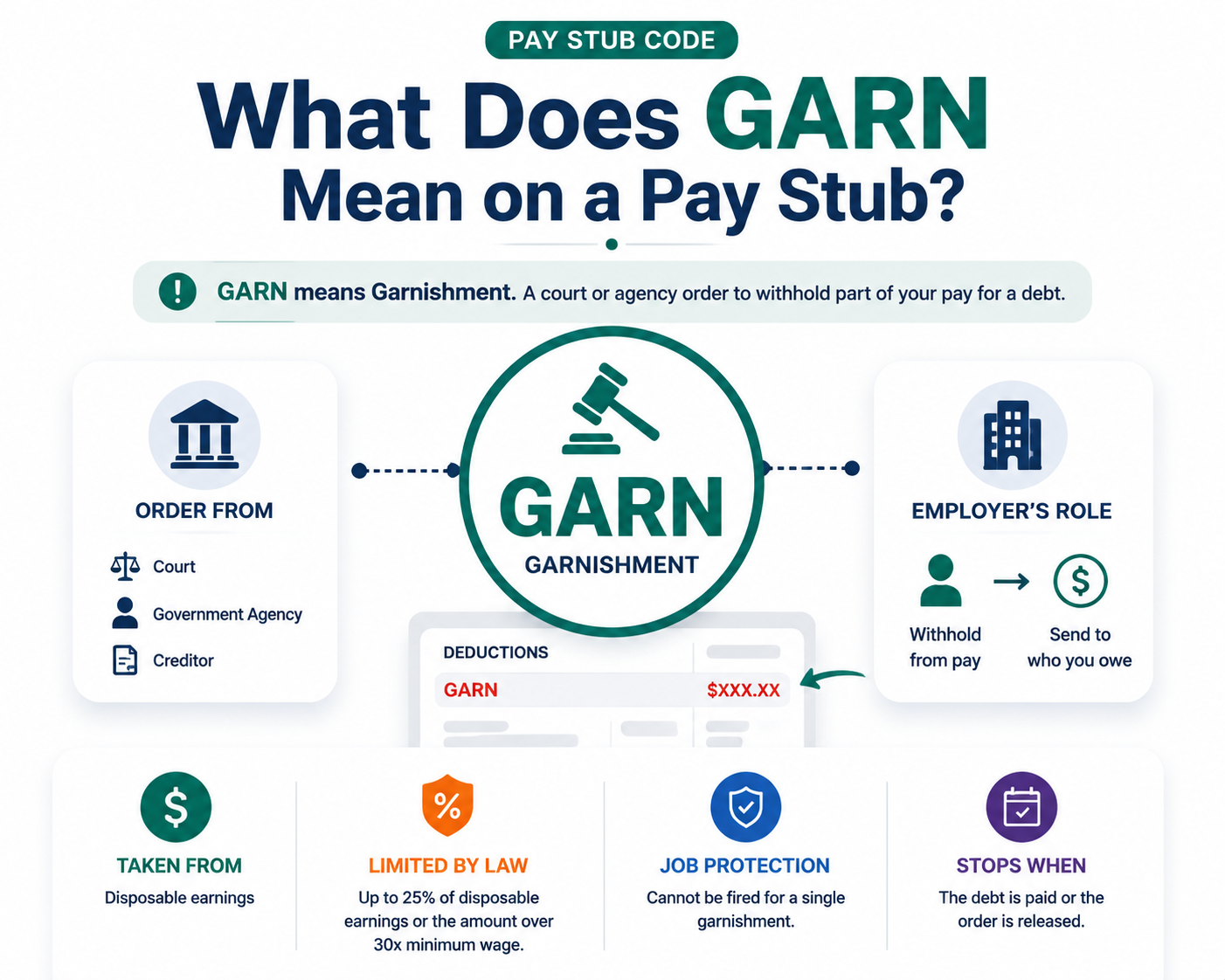
GARN on a pay stub stands for garnishment, which is money your employer is legally required to withhold from your pay because of a court order or a government order, then send to a creditor, court, or agency to pay a debt. It is taken from your disposable earnings, the pay left after required deductions. Federal law limits how much can be taken, and the limit depends on the type of debt. Your employer does not choose to do this; they have to follow a valid order.
The short version: GARN means garnishment. It is a court or agency order to withhold part of your pay for a debt. It comes from your disposable earnings, and federal law caps how much can be taken.
This is one of the codes you might find in the deductions area of a stub. For the full list of what each one means, see our guide on pay stub deduction codes. Here we focus on the garnishment line.
What it is: a court or agency order to withhold pay for a debt.
Who issues it: a court (after a judgment) or an agency (child support, tax, or student loan).
Taken from: your disposable earnings, the pay left after required deductions.
Federal limit (ordinary debt): the lesser of 25% of disposable earnings or the amount over 30 times the minimum wage.
What GARN (garnishment) means
A garnishment is an order that requires your employer to hold back part of your pay and send it to whoever you owe. On a stub it can read GARN, GARNISH, GARNISHMENT, CHILD SUP, or LEVY, depending on the debt and the payroll system. The important thing to understand is that your employer is not making a choice here. When a valid court or agency order arrives, the law requires them to follow it, the same way they are required to withhold taxes.
Why a garnishment is on your pay stub
A garnishment usually starts in one of two ways. A creditor, such as a credit card company or a medical provider, can take you to court, win a judgment, and then get an order to garnish your wages. Or a government agency can issue an order directly, which is common for child support, unpaid federal or state taxes, and defaulted federal student loans. Some agencies can act without going to court first. Seeing the line is not a judgment about you as an employee, and it does not affect your standing with your employer.
How much can be garnished?
Federal law, through the Consumer Credit Protection Act, sets limits on how much can be taken, and those limits are based on your disposable earnings rather than your gross pay. Your disposable earnings are what is left after legally required deductions like federal and state taxes, Social Security, and Medicare. Voluntary deductions, such as retirement contributions or health insurance, are not subtracted when this is calculated.
For ordinary debts like credit cards and medical bills, the most that can be taken each week is the lesser of two figures: 25% of your disposable earnings, or the amount by which your disposable earnings are more than 30 times the federal minimum wage. Different debts follow different rules, as shown below. You can read the federal limits from the U.S. Department of Labor.
| Debt type | Federal limit (of disposable earnings) |
|---|---|
| Ordinary debt (credit card, medical, most judgments) | The lesser of 25% or the amount over 30 times the minimum wage |
| Child support or alimony | 50% if you support another family, up to 60% if not, plus 5% if 12 or more weeks behind |
| Federal student loan | Up to 15% |
| Federal or state tax levy | Separate IRS or state rules and exemption tables |
These are federal baselines. Some states protect more of your pay, so the rule that leaves you with more money is the one that applies. For the rules where you work, check your state's labor or court agency.
Is garnishment taken before or after taxes?
After. A garnishment comes out of your disposable earnings, which is your pay after required taxes are taken out. So the order of operations on your stub is: your wages are figured, required taxes like the federal income tax line (FIT) come out, and the garnishment is then calculated on what is left.
What if you have more than one garnishment?
When more than one order applies, they are handled in a priority order rather than all at once. Child support and alimony generally come first, followed by federal tax levies, and then other debts like creditor judgments and student loans. Even with several orders, the total amount taken still cannot go past the limit that applies to your pay, so the cap protects you from having everything taken.
Can you be fired for a garnishment?
Federal law protects you here. The Consumer Credit Protection Act bars your employer from firing you because of a single garnishment, meaning one debt. That protection is narrower if a second garnishment arrives for a different debt, though some states extend the protection further. If you are worried about your job, your state labor agency can tell you what protections apply where you live.
A sample garnishment line on a pay stub
Here is a short fictional example showing where a garnishment sits on a stub. The numbers are made up to illustrate the order of the lines only. Notice that the garnishment comes after the required taxes, out of the disposable earnings.
Fictional example, for illustration only
Gross pay$1,200.00
Federal income tax-$120.00
Social Security and Medicare-$91.80
Disposable earnings$988.20
Garnishment (GARN)-$247.05
Net pay$741.15
In this example the garnishment is 25% of the $988.20 in disposable earnings, taken after taxes. If you want to produce a clean stub that lays out the lines clearly, you can use our paystub generator to show them in order. Any stub you create should reflect real, accurate pay.
A quick checklist
When you see a GARN line on a stub, a short scan covers the basics.
- The label is GARN, GARNISH, CHILD SUP, or LEVY
- It is a court or agency order your employer is required to follow
- It comes from your disposable earnings, after required taxes
- The cap depends on the debt type, and the total is always limited
- You cannot be fired over a single garnishment
- Questions about a specific order go to the court or agency listed on it
Once you know GARN is a court or agency order, the line is easier to understand: your employer is simply following the rules, federal law caps how much can be taken, and the order itself tells you who to contact with questions.
Frequently asked questions
What does GARN mean on a pay stub?
GARN means garnishment, money your employer withholds because of a court or agency order to pay a debt.
Why is there a garnishment on my paycheck?
A creditor won a court judgment, or an agency such as child support, a tax authority, or a student loan servicer issued an order. Your employer is required to comply.
How much of my paycheck can be garnished?
For ordinary debt, the most is the lesser of 25% of your disposable earnings or the amount over 30 times the federal minimum wage. Some debts, like child support, allow more.
What are disposable earnings?
Your pay after legally required deductions like taxes, Social Security, and Medicare. Voluntary deductions such as retirement or insurance are not subtracted.
Is a garnishment taken before or after taxes?
After. It comes out of your disposable earnings, which is your pay after required taxes are withheld.
Can my employer refuse to garnish my wages?
No. A valid court or agency order legally requires your employer to withhold the amount and send it on.
Can I be fired for having a garnishment?
Federal law bars your employer from firing you over a single garnishment for one debt. Some states extend that protection further.
How do I stop a wage garnishment?
Contact the court or agency listed on the order, or speak with a qualified attorney. This article is general information and does not provide legal advice.
Related Pay Stub Codes
This article is for general information only and is not legal advice. For questions about a specific garnishment, including how to respond to or challenge an order, contact the court or agency listed on the order or a qualified attorney. Rules and protections can vary by state.