
2026 W-2 Tips and Overtime Reporting: Codes TP, TT and Box 14b
W-2 series for
The 2026 W-2 introduces specific reporting for cash tips and qualifying overtime. Payroll teams should distinguish compensation amounts reported for these purposes from ordinary taxable wages. The deductions available to eligible workers are claimed on their individual federal returns, and the existence of the deductions does not make all tips or overtime exempt from payroll taxes.
New reporting fields
| Field | Reporting purpose |
|---|---|
| Box 12 TP | Total cash tips reported to the employer |
| Box 12 TT | Compensation above the regular rate required by federal FLSA overtime rules |
| Box 14b | Applicable Treasury tipped occupation identifiers |
These are reporting fields, not instructions to subtract amounts from wages or withholdings. Ordinary wage and tax reporting continues under the relevant rules. The employer must maintain payroll data sufficient to support the reported amounts.
Overtime example: separate the premium
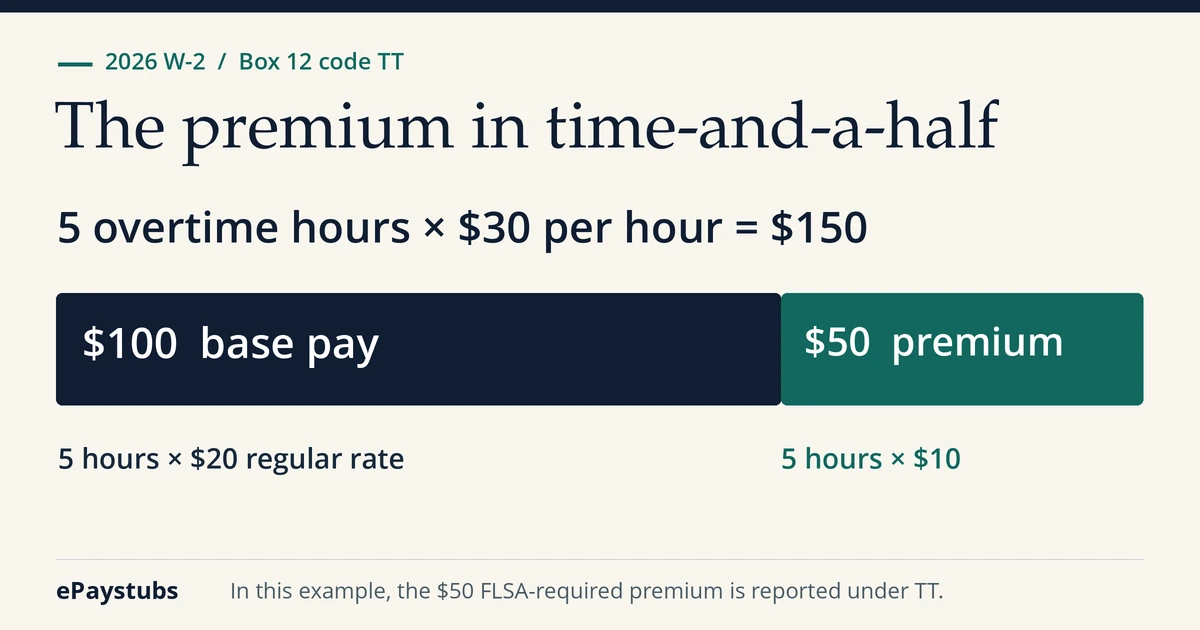
Assume a nonexempt employee receives $20 per hour and works 45 hours in one workweek, with a $30 overtime rate and no other regular-rate adjustments. The five overtime hours are required under the FLSA.
| Component | Calculation | Amount |
|---|---|---|
| First 40 hours | 40 × $20 | $800 |
| Straight-time portion of overtime | 5 × $20 | $100 |
| Overtime premium | 5 × $10 | $50 |
| Gross pay | $800 + $100 + $50 | $950 |
The $50 premium is the illustrative qualifying amount for TT, not the entire $150 paid for overtime hours. A holiday premium, state-only overtime or discretionary extra pay is not automatically qualified federal overtime. The actual regular rate can include nondiscretionary bonuses and other compensation, so complex cases need proper calculations.
Tips example: distinguish voluntary and mandatory payments
A restaurant employee reports $6,000 in voluntary cash and card tips. A separate $1,200 mandatory service-charge distribution is paid as wages. Assuming no other tips, TP reflects the $6,000 of reportable cash tips, not $7,200. The employer records the applicable occupation code in Box 14b and treats the service-charge wages according to the normal payroll rules. The employee's deductible amount depends on personal eligibility and other limitations.
Federal deduction limits and employer checks
For eligible individuals, the qualified tip deduction can be up to $25,000. Qualified overtime can be deductible up to $12,500, or $25,000 on a joint return. Income phaseouts and other eligibility restrictions apply. Neither is a universal exemption from federal withholding, Social Security or Medicare tax. Review state treatment separately.
Employers should identify applicable federal overtime hours and premium amounts, maintain tip records by occupation, reconcile year-end data to payroll, and check the latest IRS instructions before transmitting wage statements. See our W-2 box reference and W-2 preparation guide. The W-2 generator is a preparation resource, not a guarantee that your payroll calculations or filing are compliant.
Frequently asked questions
Does all overtime qualify? No. The federal required premium and other eligibility conditions determine qualification.
Does TP automatically equal the tax deduction? No. The individual must satisfy applicable requirements and limits.
Can employees change the codes themselves? No. Contact payroll about reporting errors and follow current IRS correction guidance, which has specific rules for tip and overtime amounts.