
How to Void a Check Safely for Direct Deposit and Bill Payments
Home › Blog › Voided Check for Direct Deposit
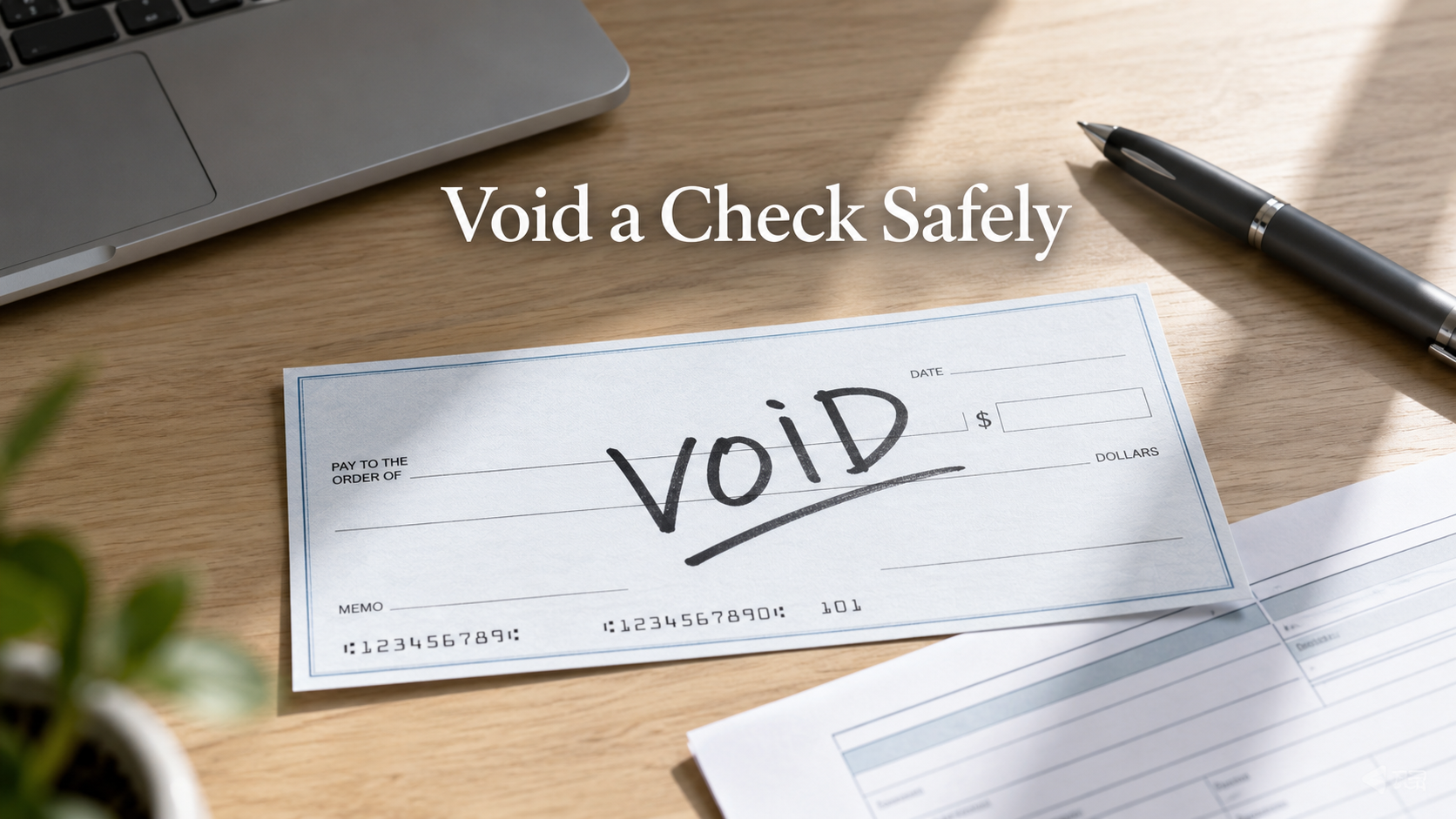
To void a check for direct deposit, take an unused check and write VOID clearly across the front using permanent blue or black ink. Leave the routing number and account number at the bottom readable, and do not fill in the payee, amount, or signature lines. Then submit the voided check through the secure method your employer provides.
You may not need a paper check at all. Many employers can also accept a bank-provided direct-deposit form, an account-verification document, or bank information entered directly through a secure payroll portal. Follow your employer's instructions.
Do You Need a Voided Check for Direct Deposit?
Not always. A voided check is one common way to give an employer the banking details needed for direct deposit, but it is not the only method.
The main purpose of the check is to provide accurate bank-account information, especially the routing number and account number. If payroll can collect and verify those details another approved way, a paper voided check may not be necessary.
A bank document that works for one employer may not satisfy another employer's onboarding procedure. If HR asks for a specific format, confirm which alternatives it accepts before sending financial information.
Direct Deposit Document Finder
Choose what you currently have. The tool shows a practical next step without requiring you to create a fake banking document.
This is a planning tool. Your employer and bank decide which documents they accept.
How to Void a Check for Direct Deposit in 3 Steps
Step 1: Use the Correct Checking Account
Use a check tied to the account where you actually want your paycheck deposited. Do not use a check from a closed account or a different account simply because it is available.
Leave these fields blank:
- Date
- Payee
- Dollar amount
- Written amount
- Signature
Step 2: Write VOID Clearly
Write VOID in large letters across the front of the check. The word should make it obvious that the check is not intended for payment.
Do not write through the routing number or account number along the bottom edge. Those are normally the details payroll needs.
Step 3: Record the Check Number
If you keep a check register or bookkeeping record, mark the check number as VOIDED so the missing number does not create confusion later.
If you voided a check because you made a writing mistake and do not need to submit it anywhere, destroy it securely rather than putting it intact in the trash.
What Does a Voided Check Look Like?
A properly voided check should make it impossible to mistake the paper for a normal payment check, while leaving the necessary bank information readable.
The numbers above are illustrative. Never copy account details from an example. Use the actual banking information provided by your financial institution.
What Numbers Should Stay Visible on a Voided Check?
| Check Detail | What It Does | Should It Stay Readable? |
|---|---|---|
| Routing number | Identifies the financial institution or routing path used for the transaction | Yes |
| Account number | Identifies your specific account | Yes |
| Check number | Identifies that individual paper check | Usually yes |
| Payee | Would identify who is being paid on a normal check | Leave blank |
| Dollar amount | Would state the payment amount | Leave blank |
| Signature | Would authorize an ordinary payment check | Leave blank unless specifically instructed otherwise |
A bank can use different routing numbers for different transaction types. Use the ACH/direct-deposit information your bank provides rather than assuming every routing number printed on another banking document is interchangeable.
Do You Sign a Voided Check for Direct Deposit?
Usually no. A check being supplied only for direct-deposit setup normally does not need to be signed like a payment check.
Start with a blank check, write VOID clearly across the front, and leave the signature line empty unless your employer or financial institution provides a different documented procedure.
Should You Give HR a Blank Check?
If payroll requested a voided check, do not hand over a normal usable blank check. Void it before submission.
A blank check still has your banking information and can potentially be filled out as a payment instrument. A properly voided check communicates that the document is being supplied for information rather than payment.
What If You Do Not Have a Checkbook?
You may still be able to set up direct deposit without ordering paper checks. The best alternative is usually an official record from your financial institution or secure entry through your employer's payroll system.
| Alternative | Good Option? | Important Note |
|---|---|---|
| Bank direct-deposit form | Excellent first choice | Use an official form generated by your bank when available. |
| Employer payroll portal | Excellent | You may be able to enter bank details without a paper document. |
| Bank account-verification letter | Strong option | Confirm that payroll accepts it. |
| Bank-issued starter or counter check | Possible | Availability, acceptance and fees vary. |
| Official online banking document | Often useful | It must contain the account information payroll requires. |
| Deposit slip | Maybe | Do not assume the routing details are appropriate for ACH direct deposit. Confirm with the bank and employer. |
| Bank statement | Last resort | It may not show all required banking details and can expose unnecessary balances or transaction information. |
How to Get a Voided Check Online
If you use online banking or do not have paper checks, look inside your bank or credit union's website or mobile app for options such as:
- Direct Deposit
- Set Up Direct Deposit
- Account Verification
- Account Details
- Routing & Account Numbers
- Direct Deposit Form
Some financial institutions can generate a PDF specifically for direct-deposit setup. Others show the account information you need to enter through your employer's secure portal.
Do not create a fake bank check with a random online check generator merely because an employer requested a voided check. If you do not have a paper check, ask your bank or employer for an approved alternative.
Voided Check vs. Direct Deposit Form vs. Bank Letter
| Document | Main Advantage | Possible Limitation |
|---|---|---|
| Voided check | Bank-printed routing and account information on a familiar document | Requires a check or bank-issued paper equivalent |
| Bank direct-deposit form | Designed specifically to communicate account details | Not every institution offers the same form |
| Bank verification letter | Bank-confirmed account information | Payroll must accept it |
| Payroll portal entry | No paper document required | Depends on employer and payroll platform |
| Starter/counter check | Bank-issued physical alternative | Some employers may have restrictions |
| Deposit slip | May contain account information | Do not assume its routing information is correct for direct deposit |
What Information Does Payroll Need for Direct Deposit?
The exact onboarding form varies, but payroll commonly needs information such as:
- Account holder name
- Bank or credit union name
- Routing number
- Account number
- Account type, such as checking or savings
- Deposit allocation if the employer allows split deposits
The routing and account numbers are the main reason employers historically asked for a voided check: they are already printed on the bank document, reducing the risk of copying a number incorrectly.
What Happens After You Submit a Voided Check?
Once payroll receives your banking details, the employer or payroll provider enters or verifies the account information in its payroll system.
The exact workflow can differ. A payroll system may:
- validate the routing information;
- verify account ownership or account details;
- use a prenotification entry;
- use another account-validation method;
- activate direct deposit according to the employer's payroll schedule.
Do not assume that every employer follows the same verification process.
What Is a Prenote, and Does Every Employer Use One?
A prenote, or prenotification, is a non-monetary ACH entry that can be used to check bank-account information before live payments begin.
Not every employer or payroll provider uses a prenote. Prenotification is one available validation method, not a universal requirement for every direct-deposit enrollment.
An employer may instead use another account-validation or verification process.
If HR tells you that direct deposit will begin immediately, that does not necessarily mean something is wrong because you did not see a prenote. Likewise, if payroll tells you a verification period is required, follow that employer's process.
How Long Does Direct Deposit Take to Start?
There is no universal activation time. Timing depends on:
- Your employer's payroll cutoff
- The payroll provider
- Whether account validation is required
- When you submitted the banking information
- Whether the account information was accepted correctly
Some employers advise allowing one or two payroll cycles for a new setup. Others may activate direct deposit sooner.
Ask payroll which payment method you should expect until the first electronic deposit successfully reaches your account.
Direct Deposit Setup Problems and What to Do
| Problem | Best Next Step |
|---|---|
| Routing number entered incorrectly | Contact payroll immediately and provide bank-verified information. |
| Account number entered incorrectly | Correct the information before the next payroll cutoff if possible. |
| Bank account verification fails | Ask payroll what information was rejected and verify the numbers with your bank. |
| You changed bank accounts | Keep the old account open until the employer confirms the change and the new deposit successfully arrives when practical. |
| Expected deposit is missing | Contact payroll first to confirm when and where the payment was sent. |
| Deposit went to an unexpected account | Contact the organization that originated the ACH payment as soon as possible and notify your bank as appropriate. |
How to Send a Voided Check Safely
A voided check is not meant to be used as a normal payment, but it still contains sensitive banking information. Treat it like a financial document.
- Confirm who requested it. Make sure the request actually came from your employer, payroll team, bank, or legitimate biller.
- Use the secure payroll portal when available. Avoid unnecessary copies and informal messaging channels.
- Be suspicious of unexpected bank-change emails. If someone claiming to be HR asks you to reconfirm banking information unexpectedly, contact HR through a known phone number or portal.
- Do not send a signed blank check.
- Store or destroy extra copies securely.
Criminals sometimes impersonate employees and ask payroll teams to redirect future paychecks to a different account. If you receive an unexpected confirmation of a direct-deposit change you did not request, contact payroll immediately.
Can You Use a Voided Check for Automatic Bill Payments?
Yes, some companies request a voided check when setting up recurring ACH withdrawals for expenses such as:
- Rent
- Mortgage payments
- Insurance
- Utilities
- Loan payments
- Other authorized recurring payments
The purpose is similar: the organization uses the banking information to set up electronic transactions.
Before providing a voided check for an automatic debit, confirm:
- which company is receiving authorization;
- the amount or payment rules;
- the payment frequency;
- how to cancel or change the authorization.
Can You Void a Check After It Has Been Sent or Deposited?
No. Voiding is something you do to the paper check before it is used as a payment. Writing VOID on another copy does not cancel a check that is already in someone else's hands or has already entered processing.
If you already sent a check and need to stop payment, contact your bank as soon as possible and ask about a stop-payment order. Fees, deadlines, and availability vary by financial institution.
| Term | Meaning |
|---|---|
| Voided check | A check intentionally marked so it is not used as an ordinary payment instrument. |
| Canceled check | A check that has already been processed and paid by the bank. |
| Stop payment | An instruction asking the bank to prevent an eligible check from being paid. |
Frequently Asked Questions
It is an unused paper check marked VOID so it is not intended for normal payment. The routing and account numbers remain readable so payroll can use the banking information to set up direct deposit.
Use an unused check, write VOID clearly across the front in permanent blue or black ink, keep the routing and account numbers readable, leave the payment fields and signature blank, and submit it through your employer's approved method.
Not always. Many employers also accept a bank direct-deposit form, account-verification document, or bank information entered directly through a secure payroll portal. Follow your employer's requirements.
Usually no. A check used only to supply banking information should generally remain unsigned unless the employer or bank gives different instructions.
Some banks and financial apps provide a downloadable direct-deposit form, account-verification document, or other bank-generated record. Use an official document from your financial institution rather than creating a fake bank check yourself.
Ask whether payroll accepts a bank-provided direct-deposit form, bank verification letter, secure payroll-portal entry, or another official bank document. Your bank may also offer a starter or counter check.
No. They are different documents, but both can communicate the banking information needed for direct deposit. An employer may accept either depending on its onboarding process.
The check provides bank-printed routing and account information that payroll can use to establish electronic payments. It also reduces the chance of an employee copying a number incorrectly by hand.
No. Prenotification is one optional ACH account-validation method. Employers and payroll providers can use other verification processes.
Timing varies by employer, payroll provider, payroll cutoff, and verification process. Some employers advise allowing one or two payroll cycles, while others may activate the account sooner.
No. Once a check has already been sent or processed, marking another copy VOID does not reverse it. Contact the bank about available stop-payment or transaction options as soon as possible.
Trusted Sources and Further Reading
Need to Understand Your Pay After Direct Deposit Starts?
A voided check communicates banking information. A pay stub serves a different purpose: it records earnings, taxes, deductions, and net pay. If you are responsible for legitimate payroll records and need to organize accurate pay information, ePaystubs can help.
Create a Pay Stub