
What Is OASDI on My Pay Stub? 2026 Rate & Limit
Payroll deductions · 2026 Social Security tax
By Rachel Brooks, Tax Forms and W-2 Content Specialist · Updated September 29, 2026 · Educational payroll guide
What Does FED OASDI/EE Mean on a Pay Stub?
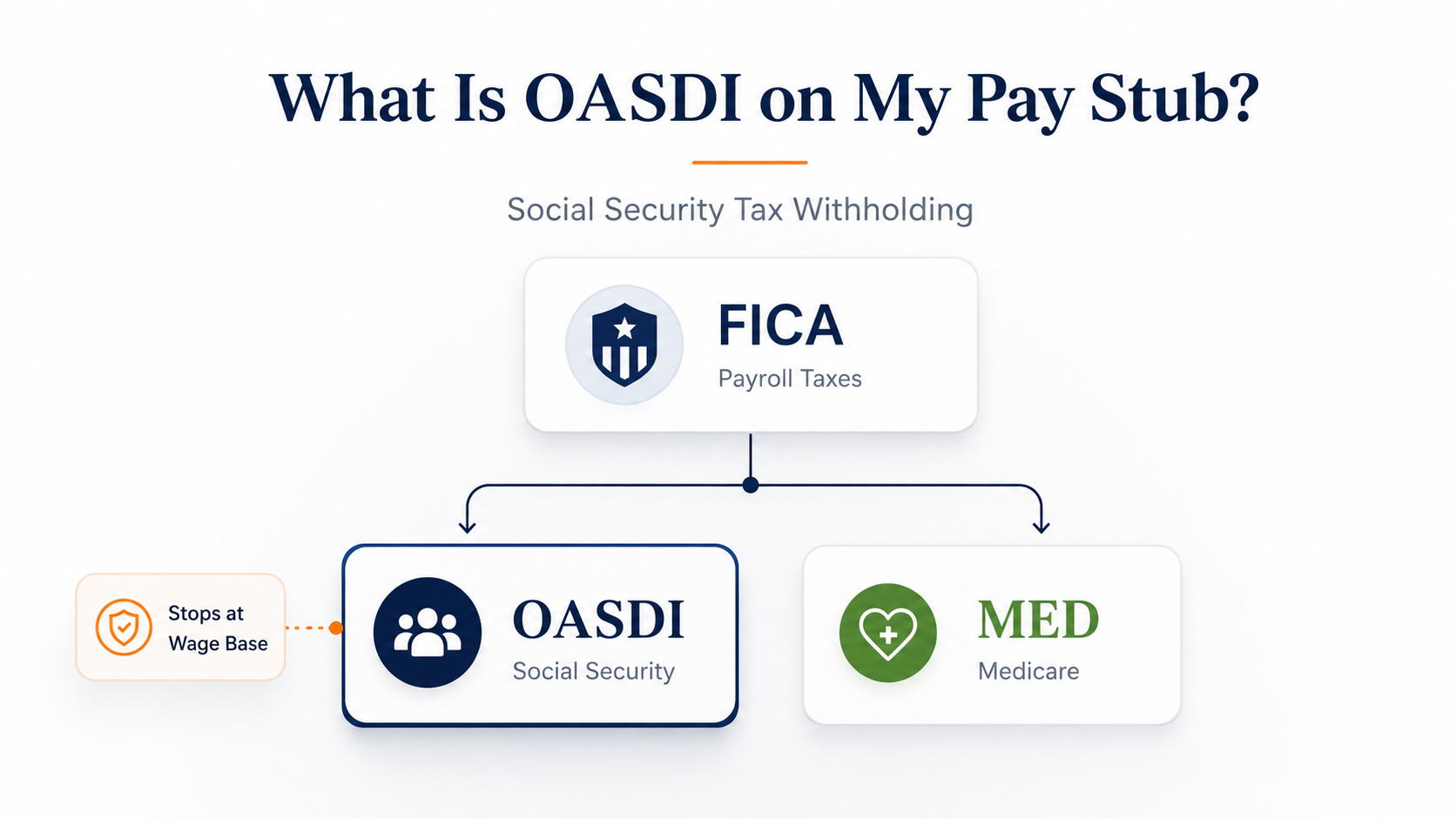
FED OASDI/EE usually means the federal Social Security tax deducted from the employee's paycheck. FED signals a federal payroll item; OASDI names the Social Security program; and EE commonly means employee. This OASDI payroll deduction is the employee Social Security tax withheld from covered wages. The separate employer-paid share may appear as OASDI/ER, but it should not be subtracted from the employee's net pay.
Employers use different abbreviations. You might see OASDI, FICA-SS, SS Tax, Social Security, Soc Sec, FED OASDI/EE or a similar label. When a code is unfamiliar, confirm how your employer uses it rather than assuming every payroll system follows one codebook.
Is FED OASDI/EE the same as federal withholding?
No. FED OASDI/EE is normally the employee Social Security tax. Federal income-tax withholding is a separate deduction, commonly labeled FIT, FWT, Federal Withholding or Federal Income Tax. Your W-4 affects federal income-tax withholding; it does not set the standard 6.2% OASDI rate on covered Social Security wages.
| Code on statement | Normally describes | Deducted from employee pay? |
|---|---|---|
| FED OASDI/EE / OASDI EE | Employee Social Security tax | Yes, for covered wages |
| OASDI ER | Employer Social Security contribution | No, normally informational |
| MED EE / Medicare | Employee Medicare tax | Yes, when applicable |
| FIT / FWT | Federal income-tax withholding | Yes, under separate rules |
For more payroll labels, use the pay-stub abbreviations guide. For combined Social Security and Medicare taxes, see the separate FICA guide.
What Is the OASDI Tax Rate and Maximum for 2026?
The employee and employer each generally contribute 6.2% of covered Social Security wages. The employee's regular withholding is limited by the $184,500 annual wage base; the separate employer contribution follows the same normal wage-base limit. The employee maximum is $184,500 × 0.062 = $11,439. SSA wage-base figures and IRS Publication 15 provide the primary rules.
| 2026 item | Amount | What it means for your pay stub |
|---|---|---|
| Employee Social Security rate | 6.2% | Calculated on wages subject to OASDI |
| Separate employer rate | 6.2% | Normally not deducted from your pay |
| Social Security wage base | $184,500 | Maximum eligible wages subject to regular OASDI per employer in the standard case |
| Maximum employee OASDI | $11,439 | Standard annual withholding maximum for one employer |
| Regular employee Medicare | 1.45% | Separate tax with no annual wage cap |
Where Does OASDI Appear on a Paycheck or Pay Stub?
The following example shows how the same pay period can have different gross, federal taxable, and Social Security wage amounts. These are fictional educational figures, not a real payroll record or proof of employment.
Assumptions: 11 equal pay periods; the $200 benefit qualifies for exclusion from Social Security, Medicare and federal income-tax wages. Federal and state withholding are illustrative amounts, not independently calculated tax estimates.
Check the highlighted line: $1,800 current Social Security wages × 6.2% = $111.60 current OASDI. Prior OASDI was $1,116.00, so the displayed inclusive YTD OASDI is $1,116.00 + $111.60 = $1,227.60. The gross-to-net check is $2,000 − $200 − $100 − $111.60 − $26.10 − $128 − $48 = $1,386.30.
2026 OASDI Paycheck Checker: Compare Actual and Expected Tax
Use this checker when you know the current wages eligible for Social Security tax before the annual cap is applied and your employer's year-to-date eligible wages before this paycheck. These amounts may differ from gross pay. If your pay stub shows a line such as Social Security wages, SS taxable wages, OASDI taxable wages or a similar wage base, use that figure rather than assuming gross pay is identical. If your current statement has only an inclusive YTD figure, consult the previous pay stub or payroll records before using the advanced comparison.
Check your OASDI withholding
Educational estimate for a standard employee and a single employer in calendar year 2026. This checker runs in your browser; its calculation script does not submit the values you enter.
Calculation: eligible current wages subject to the remaining annual wage base × 6.2%, rounded to the nearest cent. Payroll corrections, unusual wage treatment, exemptions and some employer arrangements can change the result.
Example 1: an ordinary paycheck
Example 2: a paycheck that reaches the 2026 wage limit
Suppose your previous pay stub shows $183,000 in this employer's Social Security-eligible wages before the current paycheck. Your next check includes $4,000 in current eligible wages. Only $1,500 remains below the $184,500 annual wage base.
After that check reaches the limit, this employer ordinarily stops withholding regular Social Security tax on additional covered wages for the rest of 2026. Regular Medicare withholding continues on covered wages because it has no corresponding annual wage cap. IRS Publication 15.
What Are OASDI Taxable Wages, and Why Is OASDI Not 6.2% of Gross Pay?
Social Security-taxable wages can differ from gross wages and federal income-tax wages. First identify the employer's Social Security wage base for the pay period. Then check whether the wage limit or a prior-period adjustment affected the current deduction.
| Payroll item | General OASDI treatment | Practical check |
|---|---|---|
| Qualifying Section 125 health benefit | May reduce Social Security wages when the relevant exclusion applies | Check the plan and the Social Security wage line, not just the phrase “pre-tax” |
| Traditional employee 401(k) elective deferral | Generally still subject to Social Security tax | Compare federal income-tax wages with Social Security wages |
| Employee Roth 401(k) deferral | Generally remains subject to Social Security tax | Check whether the amount appears in Social Security wages |
| Taxable fringe or imputed income | Can increase covered wages even without equivalent cash earnings | Find fringe-benefit and adjustment lines |
| Annual Social Security wage base reached | Current Social Security withholding decreases or stops | Compare previous and current YTD wages |
Two equal gross paychecks can have different OASDI deductions. For example, on a $2,000 paycheck, an eligible $200 benefit can reduce Social Security wages to $1,800 and the normal withholding to $111.60. A $200 traditional 401(k) deferral ordinarily does not reduce those Social Security wages; in that case the normal withholding remains $124. IRS retirement-plan contribution guidance.
For a full explanation of different wage bases, see taxable wages on a pay stub, and for retirement codes see 401(k) on a pay stub.
Why Did OASDI Change or Stop Coming Out of My Paycheck?
One common explanation is reaching the Social Security wage base. For standard covered wages paid by one employer in 2026, the tax generally stops once the employer has applied OASDI to $184,500 in eligible wages. That is not a rule that stops Medicare withholding. OASDI normally applies again to covered wages paid in the next calendar year.
Find the current Social Security wages and prior YTD wages, not just the gross-pay total.
See whether this paycheck crosses $184,500 in this employer's eligible wages.
Check for an adjustment, exempt wage, employer change or incorrect setup before assuming an error.
Missing OASDI can also reflect a legitimate employment-tax exemption, a type of payment that is not subject to Social Security tax, a correction, or an employer payroll problem. The correct explanation depends on the worker and payment. A missing OASDI line by itself does not establish that a tax exemption applies.
What Does OASDI YTD Mean, and How Does It Connect to a W-2?
OASDI YTD means the Social Security tax withheld so far in the employer's reporting year, usually including the current paycheck. If a paycheck shows $1,116.00 in employee OASDI before the current period and $111.60 for the current period, the new inclusive YTD is $1,227.60.
For ordinary wages under the annual cap, you can use OASDI ÷ 0.062 as a rough reverse check of the wages subject to Social Security tax. Do not rely on that reverse check for a threshold-crossing paycheck, rounding differences, corrections or special wage situations.
| Pay-stub figure | Year-end Form W-2 | What to check |
|---|---|---|
| Social Security wages | Box 3, plus any separately reported Social Security tips in Box 7 | 2026 combined Social Security wage base is generally $184,500 per employer |
| Employee OASDI tax withheld | Box 4 | Ordinarily no more than $11,439 for one employer in 2026 |
| Medicare wages and tax | Boxes 5 and 6 | Separate tax with no comparable annual wage cap |
Year-end corrections, tips, unusual employer arrangements and reporting adjustments can make a simple pay-stub-to-W-2 comparison incomplete. Use the final W-2 rather than an earlier pay stub when filing. See IRS Form W-2 instructions and the ePaystubs current-versus-YTD guide.
Can Two Employers Withhold More Than the OASDI Maximum?
Yes. Each employer ordinarily calculates withholding on the covered wages it pays. For example, if Employer A and Employer B each pay $100,000 in Social Security wages during 2026, each may correctly withhold $6,200. Together, that is $12,400, which is $961 more than the $11,439 regular employee maximum.
When two employers each withheld correctly, the excess employee Social Security tax may generally be claimed as a credit on the applicable federal income-tax return. If one employer withheld too much, the employer generally must correct the overcollection; the process is different. See IRS Topic 608 before claiming a credit or requesting a refund.
OASDI vs FICA, Medicare, and Federal Income Tax
OASDI is the Social Security component of FICA, not the entire federal payroll-tax deduction. The other regular FICA component is Medicare, generally 1.45% for employees on covered wages, without the Social Security wage cap. Federal income-tax withholding (FIT/FWT) is calculated under separate rules and may differ from either amount.
Read the related guides for FICA on a pay stub, MED/Medicare on a pay stub, and FIT and FWT withholding. This OASDI page focuses on identifying and checking the Social Security deduction.
OASDI Pay-Stub Questions
Is OASDI mandatory for everyone?
Most employees with covered U.S. wages pay Social Security tax, but certain employment, worker and payment-specific exceptions exist. Ask payroll for the rule applied to your particular wages if no OASDI appears.
Is OASDI the same as Social Security?
On a pay stub, OASDI ordinarily refers to Social Security tax. The acronym names the Old-Age, Survivors, and Disability Insurance program.
Is OASDI the same as federal income-tax withholding?
No. OASDI is Social Security payroll tax. Federal income-tax withholding is a separate deduction, usually shown as FIT, FWT, Federal Withholding or Federal Income Tax and calculated under different rules.
What does OASDI/ER mean?
ER commonly identifies the employer share of Social Security tax. It is normally paid separately by the employer and should not reduce your take-home pay.
Does a traditional 401(k) reduce OASDI withholding?
Generally no. A traditional employee 401(k) elective deferral typically reduces federal income-tax wages but remains included in Social Security wages. Other benefit types can follow different rules.
Why did Medicare continue after OASDI stopped?
Regular Social Security tax has the annual $184,500 wage base for 2026; regular Medicare tax does not have a similar annual wage limit.
Do self-employed workers see OASDI/EE on a paycheck?
Self-employed people generally pay the Social Security component through self-employment tax rather than the employee OASDI withholding line of an ordinary W-2 paycheck. The Social Security component of self-employment tax is generally 12.4% on applicable net earnings, subject to its wage-base rules. See IRS Topic 554.
Sources and how this guide was prepared
Reviewed September 29, 2026. The 2026 Social Security rate, wage base, employee maximum and wage-reporting rules above are based on the following primary references. Worked paychecks are fictional and use stated assumptions. Code meanings such as EE and ER are common payroll conventions rather than a mandatory nationwide pay-stub codebook.
Preparing an accurate pay stub?
Employers and authorized payroll users can prepare a clear wage statement using genuine earnings, withholding and deduction details. A formatted pay stub does not itself verify employment or make incorrect payroll information valid.
Create a pay stubEducational information only: This guide and checker describe ordinary 2026 U.S. employee Social Security withholding. Special employment arrangements, taxable benefits, tips, corrections, and exemptions can change the treatment. The checker is not a substitute for an employer's payroll records, tax instructions, or individual professional advice.