
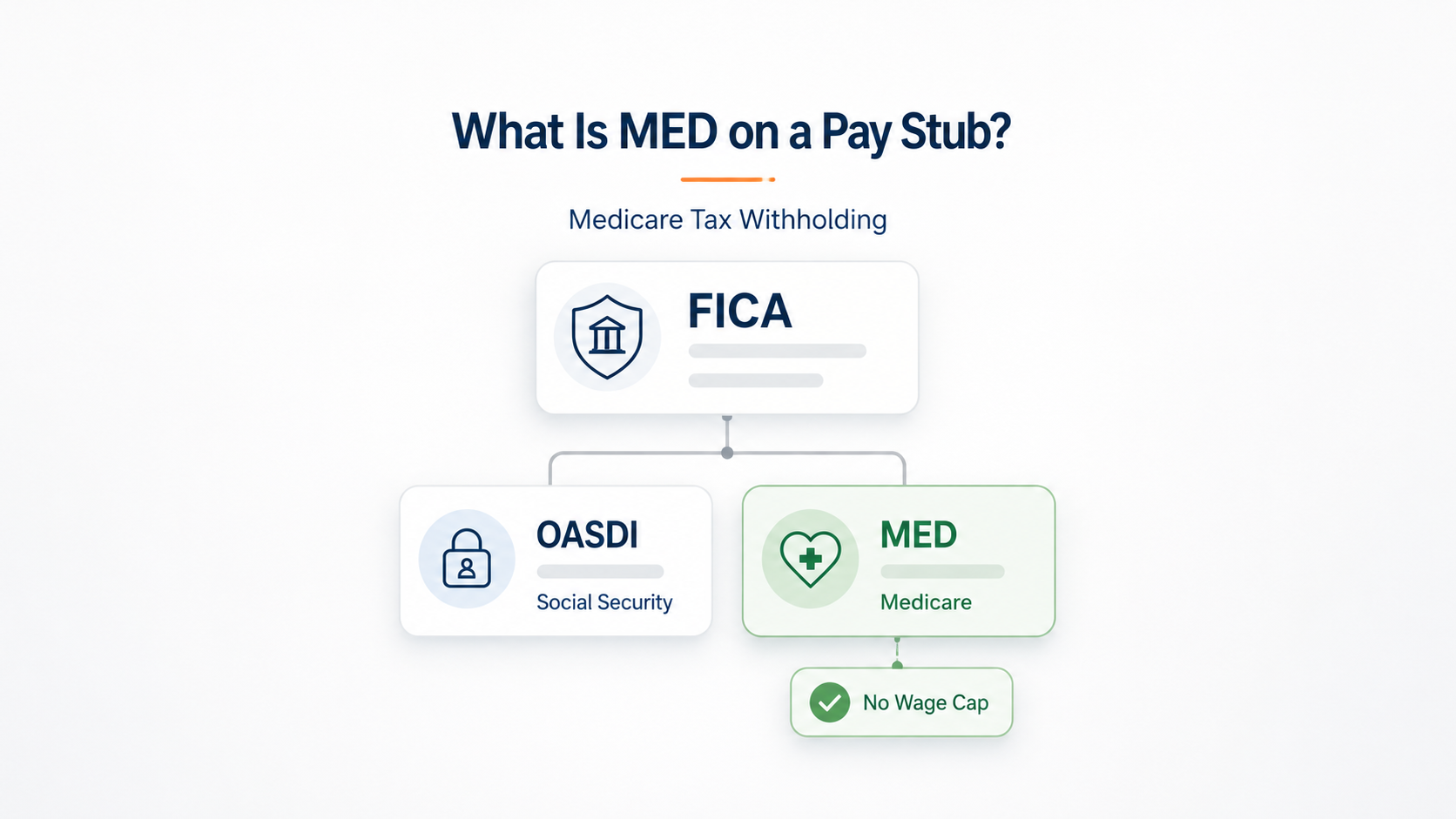
What Is MED on a Pay Stub? Medicare Tax Rate, FICA, and Wage Rules
MED on a pay stub usually means Medicare tax when it appears under Taxes or Withholding. MED EE, MEDI and Fed MED/EE normally identify the employee's Medicare tax. MED ER or MED-R can identify the employer contribution in certain payroll systems. If “Medical EE” appears under Benefits, it may instead be a health-insurance contribution.
In 2026, the regular employee Medicare rate is 1.45% of Medicare-taxable wages. The employer normally pays a separate 1.45% share, and regular Medicare tax has no annual wage cap.
MED Pay Stub Codes at a Glance
| Code on Pay Stub | Most Likely Meaning | Who Pays? | Reduces Net Pay? |
|---|---|---|---|
| MED | Medicare payroll tax when listed under Taxes | Employee | Usually yes |
| MEDI | Medicare payroll tax | Employee | Usually yes |
| MED EE / Fed MED/EE | Employee Medicare tax | Employee | Yes |
| MED ER / Fed MED/ER | Employer Medicare contribution | Employer | Normally no |
| MED-R | Employer Medicare in systems such as Checkwriters | Usually employer | Normally no |
| Fed MWT EE | Employee Medicare tax in Dayforce and systems using that convention | Employee | Usually yes |
| Medical EE | May be an employee medical-plan contribution | Employee | Usually yes |
| ADDL MED | Additional Medicare Tax withholding | Employee | Yes |
The section heading, the amount, the EE or ER designation, whether the line reduces net pay, and the employer's payroll-system legend are more reliable than the abbreviation alone.
Choose the exact code you see. The decoder gives the most likely meaning, who normally pays it, and what to verify before deciding whether the deduction is correct.
The exact same letters can mean different things in different payroll systems. The tax/benefit section, employee-versus-employer column, whether the amount reduces net pay, and the payroll system's legend are important clues.
What Does MED Mean on a Pay Stub?
In the tax or withholding section of a pay stub, MED usually identifies employee Medicare tax. It is the Medicare component of the federal FICA payroll-tax system.
Other common Medicare labels include:
- Medicare
- MEDI
- FICA MED
- Fed MED/EE
- MED/EE
- Fed MWT EE in some payroll systems
The amount is normally calculated from Medicare-taxable wages, not automatically from net pay and not necessarily from the gross-pay figure shown at the top of the statement.
What Does MEDI Mean on a Pay Stub?
MEDI commonly identifies Medicare payroll tax. Some payroll systems abbreviate Medicare as MEDI rather than MED, FICA MED, or Fed MED/EE.
The strongest clues that MEDI is Medicare tax are:
- it appears in the payroll-tax section;
- it appears near Social Security/OASDI or federal withholding;
- the current deduction is close to 1.45% of the Medicare-taxable wages;
- the line reduces employee net pay.
If a similar abbreviation appears under Benefits, Insurance, Medical, or Employee Benefits rather than Taxes, check the payroll legend before assuming it is Medicare tax.
What Does MED EE Mean on a Paycheck?
MED EE commonly means the employee portion of Medicare tax when it appears under Taxes or Withholding. EE normally means employee.
If the code is shown as:
- Fed MED/EE;
- FICA MED/EE;
- Medicare EE;
- MED/EE in the tax section;
the Medicare-tax interpretation is especially strong. The regular employee rate is 1.45% of Medicare-taxable wages. For example, if current Medicare wages are $2,000, regular MED EE should normally be $29.00.
MED EE vs Medical EE: Tax or Health Insurance?
This distinction is easy to miss. A code containing EE does not automatically mean Medicare tax. EE can simply mean employee.
| What You See | More Likely Meaning | Best Clue |
|---|---|---|
| Fed MED/EE | Employee Medicare tax | Federal tax code |
| FICA MED/EE | Employee Medicare tax | FICA/tax section |
| MED EE in Taxes | Likely employee Medicare tax | Tax section + amount near 1.45% |
| Medical EE in Benefits | Could be employee medical-plan premium | Benefits / insurance section |
| Health EE | Usually employee health-plan contribution | Benefits context |
If the line says Medical EE and appears beside Dental, Vision, HSA, FSA, or other benefits, it may represent an employee insurance premium rather than federal Medicare payroll tax.
What Does Fed MED/EE Mean on a Paycheck?
Fed MED/EE generally means Federal Medicare — Employee. It identifies the employee's Medicare payroll-tax withholding.
In 2026, the regular employee rate is:
Fed MED/EE is separate from federal income-tax withholding. It is a federal payroll tax, but it is the Medicare component of FICA, not the employee's FIT/FWT income-tax withholding line.
What Does Fed MWT EE Mean on a Paycheck?
Fed MWT EE means Federal Employee Medicare Tax in Dayforce and payroll systems using the same tax-code convention. Dayforce identifies Fed MWT EE as employee Medicare tax and Fed MWT ER as employer Medicare tax. However, the abbreviation is not universal across every employer or payroll platform.
- If the amount is approximately 1.45% of Medicare-taxable wages, it is probably Medicare tax.
- If Fed MWT ER appears beside it, the EE line is probably employee Medicare.
- If a separate MED, MEDI or FICA MED line appears, Fed MWT EE may mean something different in that system.
- If the amount changes according to W-4 elections, it may refer to federal income-tax withholding.
- The employer's payroll legend is the final source for that specific pay statement.
The corresponding employer code may appear as Fed MWT ER.
Payroll abbreviations are software-specific. ADP, Workday, Paychex, Dayforce and employer-created payroll systems may use different labels. Use the code location and calculation to verify the meaning.
What Does MED-R Mean on a Paycheck?
MED-R means the employer portion of Medicare tax in Checkwriters and some other payroll configurations. Checkwriters documents MED-R as its employer Medicare code. It is not a universally standardized abbreviation, so do not assume the R always means “regular.”
| MED-R Clue | What It Suggests |
|---|---|
| MED and MED-R appear together | MED may be employee Medicare while MED-R may represent the employer side in that payroll system |
| MED-R appears under Employer Taxes | Strong evidence it is employer Medicare |
| MED-R does not reduce employee net pay | Strong evidence it is employer-paid |
| MED-R appears in the employee-deduction column | Do not assume; check the payroll legend and calculation |
| Another website calls it “Medicare Regular” | Do not rely on that definition without confirming the payroll system |
Check the payroll system, section heading, EE/ER indicators, whether the amount reduces your net pay, and any payroll-code legend. Those clues are more reliable than assuming the letter R has one universal meaning.
What Do MED ER, Fed MED/ER and Fed MWT ER Mean?
ER commonly means employer. Therefore:
- MED ER / MED/ER commonly indicates employer Medicare;
- Fed MED/ER commonly indicates the employer Medicare contribution;
- Fed MWT ER can identify employer Medicare in payroll systems using that terminology.
The employer's regular Medicare rate is also 1.45% of covered Medicare wages.
Some pay statements show employer payroll taxes for information. If an ER Medicare amount is being subtracted from employee net pay, ask payroll for a line-by-line explanation.
Does Fed MED/EE Count as Federal Income-Tax Withholding?
No. Fed MED/EE is federal Medicare payroll tax, but it is not the same as federal income-tax withholding.
| Pay Stub Code | Usually Means |
|---|---|
| Fed MED/EE | Employee Medicare tax |
| FIT / FWT / Federal Withholding | Federal income-tax withholding |
| OASDI / Fed OASDI/EE | Employee Social Security tax |
For the income-tax line, see What Is FIT or FWT on a Pay Stub? .
MED vs FICA vs OASDI
MED is part of FICA, but it is not all of FICA.
| Feature | MED / Medicare | OASDI / Social Security |
|---|---|---|
| Part of FICA? | Yes | Yes |
| 2026 employee rate | 1.45% | 6.2% |
| 2026 employer rate | 1.45% | 6.2% |
| 2026 annual wage cap | None | $184,500 |
| Additional employee tax? | Additional 0.9% Medicare Tax when applicable | No comparable additional OASDI tax |
When both regular employee components apply to the same wages, the standard employee FICA rate is:
For the complete combined-tax explanation, see What Is FICA on a Pay Stub? .
What Is the Medicare Tax Rate in 2026?
For 2026:
| Medicare Tax | 2026 Rate / Rule |
|---|---|
| Regular employee Medicare | 1.45% |
| Regular employer Medicare | 1.45% |
| Combined regular employee + employer | 2.9% |
| Medicare wage limit | None |
| Additional employee Medicare Tax | 0.9% when applicable |
| Employer match on additional 0.9% | No |
Regular MED Formula
2026 Medicare Deduction Checker
Use this calculator to check the employee Medicare withholding on one paycheck. Enter the Medicare wage figures from the payroll record rather than assuming gross pay is the correct wage base.
The calculator checks regular Medicare payroll arithmetic and the employer's $200,000 Additional Medicare withholding trigger. It does not determine your final individual Additional Medicare Tax liability, which can depend on filing status, a spouse's wages, other employment, or self-employment income.
Example: Crossing $200,000 During One Paycheck
Assume:
- YTD Medicare wages before the paycheck: $198,500
- Current Medicare wages: $4,000
Medicare Wages vs Gross Pay
Medicare wages are not automatically the same as gross pay. A payroll record can contain several different wage figures.
| Payroll Figure | What It Means |
|---|---|
| Gross pay | Total gross payroll earnings recorded for the pay period |
| Federal taxable wages | Wages subject to federal income-tax withholding after applicable payroll adjustments |
| Social Security wages | Wages subject to Social Security tax, subject to the annual Social Security wage base |
| Medicare wages | Wages subject to Medicare tax; there is no annual Medicare wage cap |
| Net pay | Take-home amount after employee payroll deductions |
If payroll provides a Medicare wage amount, use that figure rather than multiplying total gross pay by 1.45%.
Do 401(k) Contributions Reduce Medicare Wages?
Traditional employee 401(k) elective deferrals generally remain subject to Social Security and Medicare tax even though they can reduce federal income-tax wages.
This is one reason a paycheck can show:
- gross pay of one amount;
- lower federal taxable wages;
- a different Social Security wage figure;
- a Medicare wage figure that remains closer to gross pay.
Payroll items can receive different treatment for federal income tax, Social Security, and Medicare. Use the applicable tax wage base rather than one generic “taxable pay” number.
What About Section 125 Benefits?
Some qualifying cafeteria-plan benefits can receive favorable payroll-tax treatment, which may reduce Medicare wages when federal rules permit. The treatment depends on the specific benefit and plan.
For the broader distinction, see Pre-Tax vs Post-Tax Deductions .
Is MED Medicare Tax or Medical Insurance?
MED in the payroll-tax section usually means Medicare tax. A medical-insurance deduction is a different payroll item.
| Clue | Medicare Tax | Medical Insurance |
|---|---|---|
| Section | Taxes / withholding | Benefits / insurance |
| Nearby codes | OASDI, FICA, FIT/FWT | Dental, Vision, HSA, FSA |
| Typical code | MED, MEDI, Fed MED/EE | Medical EE, Health EE, plan-specific code |
| Calculation | Generally tied to Medicare-taxable wages | Plan premium or contribution amount |
Why Is Medicare Taken Out of My Paycheck?
Employers generally withhold Medicare tax from wages covered by FICA. The tax helps finance Medicare Hospital Insurance.
It can apply even if:
- you are younger than Medicare eligibility age;
- you have private health insurance;
- you do not currently receive Medicare benefits.
MED is a payroll tax. It is not a voluntary employer medical-insurance premium.
Most covered employees cannot simply choose to remove Medicare withholding. Certain services or workers can qualify for specific federal exceptions, so ask payroll or a qualified professional if you believe a legal exception applies.
Does Medicare Tax Have a Wage Cap?
No. Regular Medicare tax has no annual wage ceiling.
That is different from Social Security. For 2026, Social Security uses a $184,500 wage base, while Medicare continues on covered Medicare wages above that amount.
Why Did OASDI Stop but MED Continue?
This can be normal for a higher-paid employee.
Once Social Security wages from one employer reach the 2026 Social Security wage base, regular Social Security withholding generally stops for the rest of that calendar year.
Medicare does not stop because Medicare has no comparable annual wage cap.
W-2 Box 5 Medicare wages can be higher than Box 3 Social Security wages because Medicare wages are not capped at the Social Security wage base.
What Is Additional Medicare Tax?
Additional Medicare Tax is an extra 0.9% employee tax that can apply above specified income thresholds. There is no employer match on the additional 0.9%.
Employer Payroll Withholding Trigger
An employer must begin withholding the additional 0.9% after Medicare wages it pays one employee exceed $200,000 during the calendar year, regardless of the employee's filing status.
Individual Additional Medicare Tax Thresholds
| Filing Status | Threshold |
|---|---|
| Married Filing Jointly | $250,000 |
| Married Filing Separately | $125,000 |
| Single | $200,000 |
| Head of Household | $200,000 |
| Qualifying Surviving Spouse | $200,000 |
Payroll begins additional withholding using the employer's $200,000 rule. Your final Additional Medicare Tax liability can differ after filing status, other jobs, a spouse's wages, or applicable self-employment income are considered.
Why Is My MED Deduction Not Exactly 1.45% of Gross Pay?
A mismatch does not automatically mean payroll is wrong. Check the actual situation first.
| What You See | What to Check |
|---|---|
| MED is below 1.45% of gross | Medicare-taxable wages may be lower than total gross pay |
| MED is above 1.45% | Check Additional Medicare withholding or a payroll adjustment |
| MED + MED-R | Determine whether MED-R is an employer-tax code in that payroll system |
| MED EE + Medical EE | One may be Medicare tax while the other is a medical-plan deduction |
| MED looks much too high | Make sure you did not compare a YTD tax amount with current wages |
| OASDI stopped but MED remained | Social Security wage limit may have been reached; Medicare continues |
| Two employee lines are both near 1.45% | Ask payroll whether one is duplicate, adjustment, or mislabeled |
| ER Medicare appears to reduce net pay | Ask payroll to confirm whether the line is truly employer-paid |
| W-2 Box 6 is more than Box 5 × 1.45% | Additional Medicare Tax withheld may be included in Box 6 |
Am I Being Charged Medicare Twice?
Seeing two Medicare-looking lines does not automatically mean you were charged twice.
Common reasons include:
- one line is employee Medicare and another is employer Medicare;
- one line is regular Medicare and another is Additional Medicare Tax;
- one code is Medicare tax while another is medical insurance;
- one figure is current and the other is YTD;
- a payroll adjustment was processed.
Fast Double-Charge Test
- Identify which lines actually reduce employee net pay.
- Separate EE from ER codes.
- Check whether one line is ADDL MED.
- Compare the regular employee line with Medicare wages × 1.45%.
- Check whether a similarly named “Medical” line sits in the benefits section.
Ask payroll for the Medicare wage base, rate, code definition, and any adjustment applied to each line.
Where Is MED / Medicare on Your W-2?
Medicare is reported separately from Social Security on Form W-2.
| W-2 Box | Meaning |
|---|---|
| Box 3 | Social Security wages |
| Box 4 | Social Security tax withheld |
| Box 5 | Medicare wages and tips |
| Box 6 | Medicare tax withheld, including Additional Medicare Tax withheld |
Pay Stub MED vs W-2 Boxes 5 and 6
| Final Pay Stub YTD Line | Compare With |
|---|---|
| Medicare wages YTD | W-2 Box 5 |
| MED / Fed MED/EE YTD | W-2 Box 6 |
| Additional Medicare YTD | Included in W-2 Box 6 |
Medicare has no annual wage cap, while Social Security does. A higher-paid employee can therefore have Medicare wages in Box 5 that exceed Social Security wages in Box 3.
How to Audit MED on a Pay Stub in About 60 Seconds
Frequently Asked Questions
MED usually means employee Medicare payroll tax when it appears in the tax or withholding section. The regular employee Medicare rate is 1.45% of Medicare-taxable wages in 2026.
MEDI commonly means Medicare payroll tax. Some payroll systems use MEDI rather than MED, Medicare, FICA MED, or Fed MED/EE.
In a payroll-tax section, MED EE commonly means the employee Medicare tax. If the wording is “Medical EE” and appears under benefits or insurance, it can instead mean the employee's medical-plan contribution.
Fed MED/EE generally means Federal Medicare — Employee, the employee Medicare payroll-tax withholding.
In payroll systems that use the code, Fed MWT EE can mean Federal Employee Medicare Tax. Confirm the payroll legend if your employer uses different terminology.
MED-R is not universally standardized. Some documented payroll systems use MED-R for the employer portion of Medicare tax. Check the Employer Taxes section, whether it reduces net pay, and the payroll system's code legend before assuming what R means.
MED ER usually means the employer's Medicare contribution. ER commonly means employer. It may appear informationally but should not normally reduce employee net pay.
Yes. Medicare is one part of FICA. The other regular component is Social Security/OASDI.
The standard employee Medicare rate is 1.45% of Medicare-taxable wages. Additional Medicare Tax can add another 0.9% when applicable, and payroll adjustments can also affect the amount shown.
No. Regular Medicare tax has no annual wage cap. It continues on covered Medicare wages even after Social Security withholding reaches its annual wage limit.
Social Security has an annual wage base, while Medicare does not. Once Social Security wages reach the applicable annual limit, regular OASDI can stop while Medicare continues.
Traditional employee 401(k) elective deferrals generally remain included in Social Security and Medicare wages even when they reduce federal income-tax wages.
W-2 Box 5 reports Medicare wages and tips. Box 6 reports Medicare tax withheld, including any Additional Medicare Tax withheld.
En una sección de impuestos, MED EE normalmente se refiere a la parte del empleado del impuesto de Medicare. La tasa regular del empleado es 1.45% de los salarios sujetos a Medicare. Si el texto dice “Medical EE” dentro de beneficios o seguro, puede significar la parte del empleado de un plan médico, por lo que conviene revisar la sección y la leyenda de nómina.
Sources & Payroll-Code References
- IRS Publication 15 — Employer's Tax Guide — Medicare rates, FICA rules, and Additional Medicare employer withholding.
- IRS Topic No. 751 — Social Security and Medicare Withholding Rates .
- IRS Topic No. 560 — Additional Medicare Tax .
- IRS Instructions for Forms W-2 and W-3 — Medicare wages in Box 5 and Medicare withholding in Box 6.
- Stanford Payroll — Tax Deduction Codes, Descriptions and Rates — real-world Fed MED/EE payroll-code context.
- Dayforce Payroll Documentation — Fed MWT EE / Fed MWT ER Medicare terminology.
- Checkwriters Payroll Documentation — documented MED and MED-R payroll-code usage.
Need a Clear Payroll Record With MED, FICA and YTD?
If you are responsible for legitimate payroll, ePaystubs can help organize real earnings, Medicare, Social Security, federal withholding, employee deductions, YTD totals, and net pay into a readable statement. Use only accurate and supportable payroll information.
Create a Pay Stub