
Is It Legal to Make Your Own Pay Stubs? Rules, Risks & Honest Uses
By ePaystubs Editorial Team | Updated June 22, 2026 | General information, not legal advice
Yes, making your own pay stub is legal, as long as every figure on it reflects income you actually earned. Self-employed people, freelancers, 1099 contractors, and cash-paid workers create their own pay stubs all the time, and it's completely lawful. What's illegal is falsifying or inflating a pay stub to deceive a lender, landlord, or agency, which is fraud under federal law. This guide explains exactly where the legal line sits, the penalties for crossing it, and the legitimate ways to use a pay stub.
It is one of the most common questions people ask before using a pay stub generator, and the answer online is muddled, some sites say it is fine, others say it is illegal. The truth is clear once you separate two different things: making the document, and lying on it. We are a pay-stub company, so this is squarely our area, and we will be straight with you about both sides of the line. This guide explains what is legal, what is not, what the law actually says, and the honest way to handle it if you need to prove your income. One note: this is general information, not legal advice.
- The line that matters
- When it's legal
- Federal vs state law
- When it's illegal
- The honest alternative
- The bottom line
The Short Answer (and the Line That Matters)
Creating a pay stub is legal. Falsifying one to deceive someone is fraud. The difference is not the document, it is your intent and how you use it.
Here is the precise hinge. A pay stub that records income you actually earned is a legitimate document, the same as the one an employer would issue. The moment a pay stub contains invented or inflated income and you present it as proof to gain something, a loan, an apartment, a benefit, it stops being a document and becomes an instrument of fraud. The numbers, and the deception, are what cross the line, not the act of making the stub.
When Making a Pay Stub Is Legal
There are many completely lawful reasons to make your own pay stub. This is the half of the question that often gets rushed past.
- You're self-employed or a sole proprietor documenting your real income, since no employer issues you a stub. See our guide to proof of income when self-employed.
- You're a 1099 contractor or freelancer creating a stub from real client payments to track and prove earnings. See 1099 proof of income.
- You're paid in cash and turning real, reported earnings into a documented stub. See proof of income when paid in cash.
- You're an employer issuing stubs to your employees, which is normal and often expected.
- You're using it for demonstration or learning a teacher explaining deductions, a writer giving a character a prop, or estimating your own taxes.
Federal Law Doesn't Even Require Pay Stubs
Here is a fact that surprises most people: federal law does not require employers to give employees pay stubs at all. Pay-stub requirements come from the states, and they vary. Some states mandate printed stubs, some require only that the information be accessible, and a few have no requirement.
This matters for the legality question. Because there is no federal stub mandate, generating your own stub to document real income fills a genuine gap, especially for the self-employed, who have no employer to issue one. The legality was never about who prints the stub. It has always been about whether the figures are true.
When Making a Pay Stub Is Illegal (and the Penalties)
The illegal cases all share one feature: fabricating or inflating income and presenting it as proof to deceive.
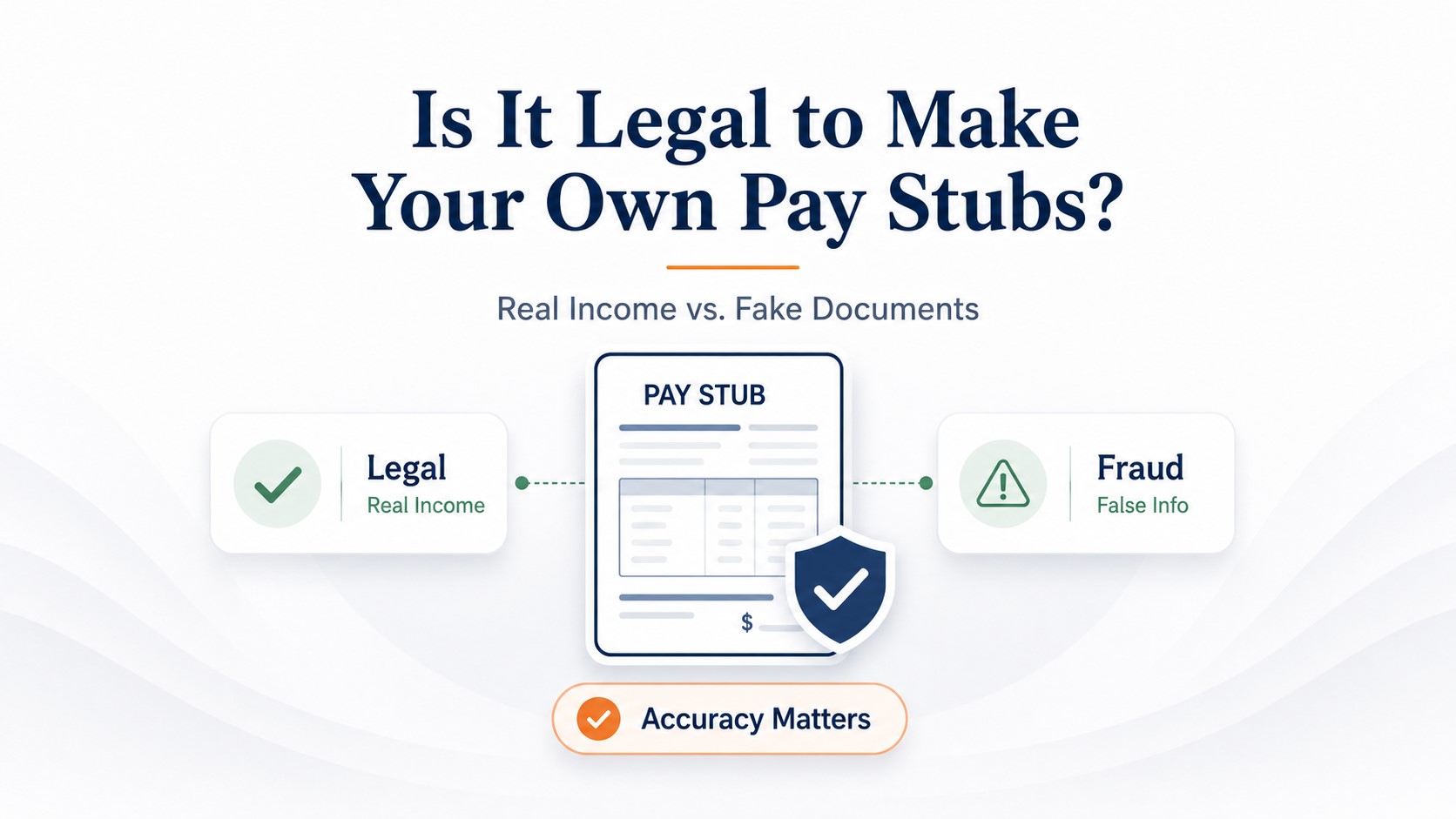
Legal
- A stub with your real income
- Documenting self-employment or contract pay
- An employer issuing stubs to staff
- Demonstration, teaching, or tax estimation
Illegal (fraud)
- Inflating income to qualify for a loan
- Inventing a job or employer to rent an apartment
- Faking income to claim benefits
- Misleading an employer or agency for gain
On penalties, here is the honest picture. For serious bank-fraud cases, federal law allows fines up to $1 million and imprisonment up to 30 years. Those figures are the statutory maximums the law permits for the most serious offenses, not what a typical case draws, but they signal how seriously fraud is treated.
Why People Are Tempted (and the Honest Alternative)
Most people who consider a fake stub are not trying to be criminals, they are in a tight spot. Unemployment, a gap in paperwork, or losing access to old stubs, all while really needing to prove income for a loan or an apartment. That pressure is real.
But if you have real income and just lack the standard paperwork, the answer is not to invent a stub, it is to document the income you actually have. Tax returns, bank statements showing your deposits, a benefit verification letter, or a pay stub built from your real earnings all prove income without any legal risk. For the full set of options, see our guide on proving income without pay stubs, and the specific guides for proof of income for a loan or proof of income for an apartment.
The Bottom Line
Making your own pay stub is legal when the numbers are true. It is fraud when they are not and you use them to deceive. The document is neutral; honesty is what keeps it lawful.
If you have real income to document, a pay stub generator is a legitimate and fast way to put it in a familiar format, whether that income is from self-employment, contract work, or cash you actually received. The only rule is the one that has run through this whole guide: use it to reflect what you truly earn, never to inflate it.
Frequently Asked Questions
Yes, as long as every figure reflects income you actually earned. Self-employed people, freelancers, and contractors create their own pay stubs legally and routinely. It only becomes illegal if you falsify or inflate the numbers and use the stub to deceive a lender, landlord, or agency.
Making a document isn't itself a crime, but using a falsified pay stub to deceive someone for gain is fraud. On a loan application it's bank fraud under federal law (18 U.S.C. § 1014), and using one for an apartment or benefits is similarly fraudulent. The lie and the deception are what's criminal.
Yes. Self-employed people, sole proprietors, and 1099 contractors have no employer to issue stubs, so creating their own from real income is both legal and common. The only rule is accuracy, the figures must match what you actually earned and your other records.
For serious bank-fraud cases, federal law allows fines up to $1 million and prison time up to 30 years. Those are the maximums for the most serious offenses, not typical outcomes, but they show how seriously fraud is treated. There's also the practical risk that fake stubs are increasingly caught through verification.
Yes. A pay stub generator is just a tool that formats the information you provide, like a calculator or a word processor. Using one to document real income is legal. Using one to fabricate income you didn't earn, and then deceiving someone with it, is what crosses into fraud. The tool is neutral; your inputs decide.
They cross-check against bank statements, verify employment directly with the listed employer, and look for telltale signs like inconsistent fonts, a missing or wrong EIN, an unusual SSN format, or pay-period dates that don't add up. Verification has gotten more thorough, which is part of why fake stubs are a poor bet.
Document the income you actually have. Tax returns, bank statements showing deposits, a benefit verification letter, or a pay stub built from your real earnings all prove income without any legal risk. The goal is to document real income, not invent it.