
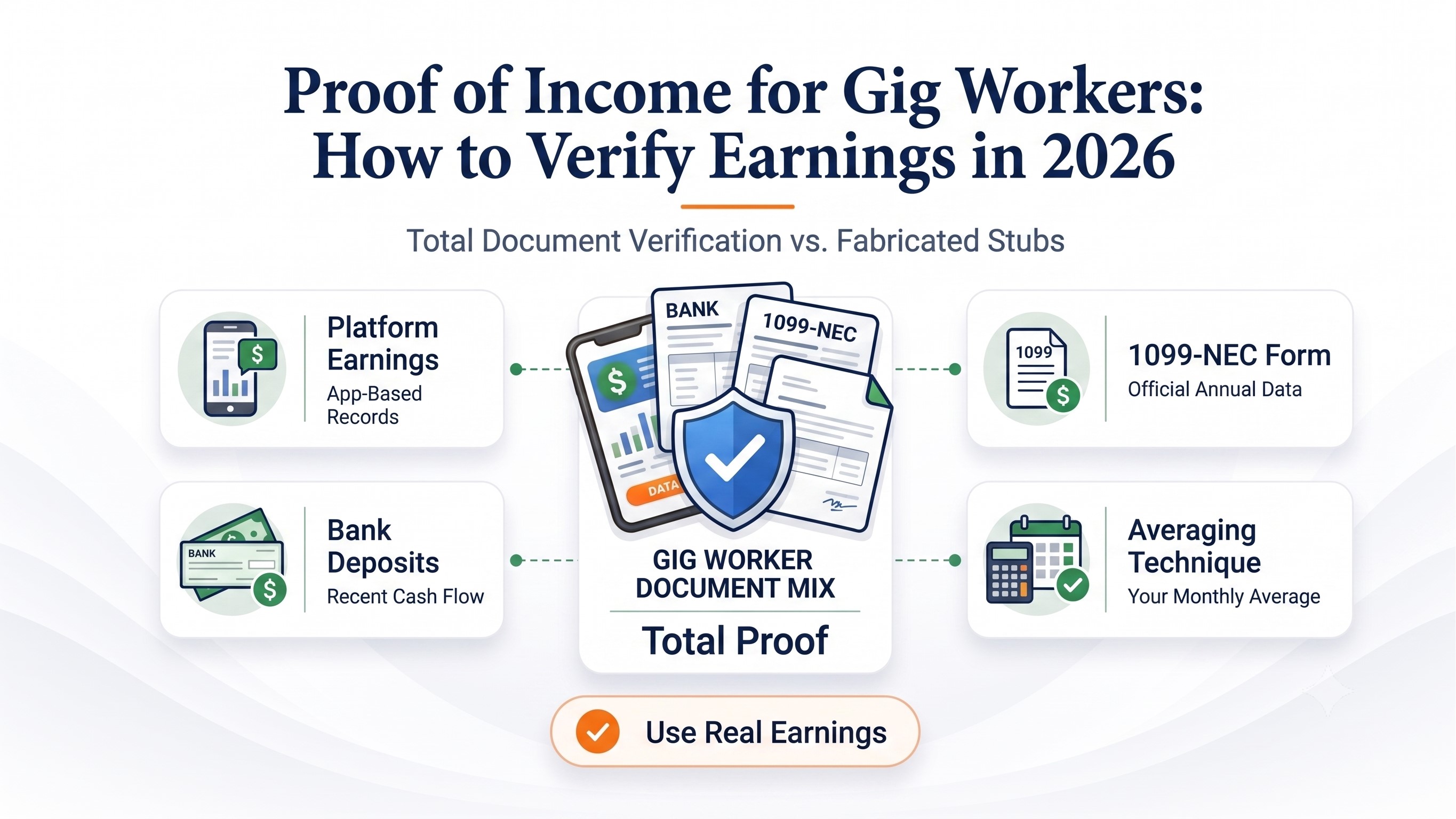
Proof of Income When Self-Employed: Tax Returns, 1099s & Bank Statements
To prove self-employed income, use records that show what the business earned, what money was actually received, and how the requested income figure is supported. A strong starting package is your latest filed tax return with the relevant business schedules, recent business bank statements, and a current profit and loss statement. Add 1099s, paid invoices, contracts, or platform records when they help connect payments to real work. The exact figure a reviewer uses varies: HealthCare.gov asks applicants to report net self-employment income, while mortgage lenders may perform a documented cash-flow analysis and make permitted adjustments rather than simply using raw deposits or one tax-return line.
Self-employed income verification rarely turns on one document. A tax return shows reported historical income. Bank statements show recent activity. A profit and loss statement summarizes current revenue and expenses. Used together they give a landlord, lender, or agency a clearer picture than any single record can — which is exactly why reviewers ask for combinations.
This guide covers what each document proves, the three numbers people confuse, how each type of reviewer actually verifies you, and two documents you can build yourself: a verification letter and a self-employment ledger.
- The three-record starting package
- What each document proves
- Requirements by situation
- Proof of self-employment vs. proof of income
- Revenue vs deposits vs net profit
- What a reviewer reads on your Schedule C
- How your income actually gets verified
- Benefits and government programs
- Self-employment ledger (template)
- Verification letter (template)
- Build your verification package
- Using a 1099 as proof
- No tax return yet
- Mistakes to avoid
- Self-generated pay stubs
Self-Employed Income Verification: Start With These Three Records
If the recipient has not given you a specific checklist, begin with three records that cover different parts of your income history.
1. Filed tax return and business schedules
A filed federal return shows the income you reported for a completed year. A sole proprietor typically uses Form 1040 with Schedule C; partnerships and corporations file different returns and schedules.
Include every page and schedule the reviewer requests. The first page of Form 1040 does not explain business revenue, expenses, or profit on its own.
2. Business bank statements
Bank statements show recent deposits and payment patterns. They are most useful when business and personal activity are separated and customer payments can be told apart from transfers, loans, and refunds.
The number required varies. A rental application may want two or three recent months; some lending programs review a full year or more.
3. Current profit and loss statement
A P&L summarizes revenue, business expenses, and net profit for a defined period. A year-to-date P&L covers the gap between your most recent tax return and today.
A self-prepared P&L is not independent verification on its own. Be ready to support its figures with invoices, receipts, accounting records, and bank activity.
What Documents Count as Self-Employed Proof of Income?
Each document answers a different verification question. Choosing records that complement one another beats submitting a large pile of repetitive paperwork.
| Document | What it can show | Main limitation |
|---|---|---|
| Filed tax return | Reported annual income and applicable business activity | Historical — may not reflect current performance |
| Schedule C | Gross receipts, deductible expenses, and net profit for a sole proprietorship | Does not apply to every business structure |
| Bank statements | Recent deposits, cash flow, and payment patterns | Deposits are not the same thing as business profit |
| Profit and loss statement | Revenue, expenses, and profit for a selected period | Self-prepared; figures usually need supporting records |
| Self-employment ledger | A detailed running record of income and expenses for programs or reviewers that accept it | No single universal format; keep source records behind each entry |
| 1099 forms | Payments reported by a client, business, or payment platform | May not include every payment, and shows gross rather than net |
| Paid invoices | The work billed and the customer connected to a payment | An unpaid invoice does not prove money was received |
| Contracts | Active work, agreed payment terms, or expected future projects | A contract does not prove payment occurred |
| CPA or tax-preparer letter | Business activity reviewed or prepared by a professional | Usually supplements source documents rather than replacing them |
| Self-generated pay stub | A structured record of genuine payroll wages when the business actually runs payroll | Self-created — supporting evidence only; owner draws should not be presented as wages |
The IRS advises choosing “any recordkeeping system suited to your business that clearly shows your income and expenses,” and lists supporting documents for gross receipts including “cash register tapes, deposit information (cash and credit sales), receipt books, invoices” and Forms 1099-MISC. The system matters less than whether the figures are supportable.
Which Documents Should You Use for Your Situation?
Renting an apartment
A landlord may request recent bank statements, a tax return, 1099s, or a P&L, and many apply an income multiple to monthly rent. Screening policies differ on whether they use gross revenue, net business income, or another monthly figure, so confirm the property manager's rule before presenting an average. For a rental-focused version of this process, see self-employed proof of income for apartment rentals.
Applying for a personal or car loan
A lender may compare current deposits against longer-term reported income, alongside credit, existing debts, collateral, and the amount requested. See the complete guide to proof of income for a loan.
Applying for a mortgage
The most demanding review of the group: personal and business tax returns, income trends, business stability, and the likelihood income continues. A 1099 or a few recent deposits will not be enough. The Fannie Mae guidance above is a useful starting point for conventional loans, though the lender and loan program set the final requirements. For the mortgage-specific calculation workflow, see how lenders calculate self-employed mortgage income.
Working through gig platforms
Combine platform earnings records with bank deposits, tax returns, 1099s, and a current earnings summary. If you work several apps, keep each platform's figures separate before calculating a combined total — a reviewer will want to see the components. See proof of income for gig workers.
Applying for benefits or health coverage
Report net income, not gross receipts, and use the program's official document list. A self-employment ledger is widely accepted where a return is unavailable or out of date. See the benefits section above for the specific HealthCare.gov and SSA guidance.
No pay stubs at all
If a form asks for pay stubs you cannot produce, the alternatives above may be accepted instead, depending on the recipient. See proof of income without pay stubs.
What Counts as Proof of Self-Employment vs. Proof of Income?
These answer two different questions, and applications often request both without saying so clearly.
| Question being asked | Proof of self-employment | Proof of income |
|---|---|---|
| What it establishes | That you operate a business or work independently | How much that work produces |
| Typical documents | Business registration or DBA, professional licence, client contracts, business invoices, business website or directory listing, business tax return, CPA or client letter | Tax returns, bank statements, 1099s, P&L statements, self-employment ledger, paid invoices |
| Common failure | Sending income figures when the reviewer asked whether the business exists | Sending a registration certificate with no financial figures |
If an application requests both, send at least one record establishing that the business exists and a separate set showing the income it generates. Sending only one is a frequent cause of a second document request.
Gross Revenue, Bank Deposits and Net Profit Are Three Different Numbers
The most common failure in self-employed income verification is treating three different figures as if they mean the same thing. They do not, and reviewers ask for different ones.
| Who is reviewing | The number they usually want | Where they read it |
|---|---|---|
| Mortgage underwriter | A documented qualifying-income calculation based on tax-return cash flow, stability, and applicable adjustments | Tax returns, schedules, and lender cash-flow analysis |
| Auto or personal lender | Varies by lender; often documented annual or monthly income with current support | Tax return, bank statements, and other requested records |
| Landlord or property manager | Varies by screening policy; ask whether gross, net, or an average is used | Tax return, P&L, bank statements, or other accepted records |
| Health coverage marketplace | Net self-employment income | Schedule C, or a self-employment ledger |
| Social Security Administration | Self-employment earnings as filed | Schedule C and Schedule SE |
Worked example: from deposits to qualifying income
This example shows how to separate business receipts from non-income deposits and arrive at a simple net-business-income figure. It is not a universal mortgage qualifying-income calculation; lenders and programs apply their own rules and permitted adjustments.
Notice the spread. Raw deposits work out to $7,200 a month, while the example produces $4,500 of monthly net business income — a $2,700 difference. A reviewer may calculate a different qualifying amount depending on the program, business structure, documented adjustments, and the period being analyzed. The practical point is to label transfers and loan proceeds so they are not mistaken for business revenue.
What a Reviewer Reads on Schedule C — and What Mortgage Lenders Adjust
People often send a full tax return and hope for the best. For a sole proprietor, Schedule C contains much of the business-income detail a reviewer needs, but the significance of each figure depends on the purpose of the review.
| Field on Schedule C | What the reviewer takes from it | Why it matters to you |
|---|---|---|
| Business name, address and activity code | That the business is identifiable and real | Should match your registration, invoices, and verification letter |
| Gross receipts or sales | Total money the business took in | Should be broadly consistent with customer deposits in your bank statements |
| Gross income | Receipts after returns and cost of goods sold | Where product businesses first diverge from service businesses |
| Individual expense categories | Whether deductions look proportionate and ordinary | Very large one-off deductions usually get questioned |
| Total expenses | The full deduction against revenue | Aggressive deductions lower the income you qualify on |
| Net profit or loss | A key starting figure for a sole proprietor's business income | Important, but not always the final qualifying-income number; lender or program rules may require adjustments |
For conventional mortgage underwriting, Fannie Mae requires a written analysis of self-employment income and permits tools such as Cash Flow Analysis (Form 1084) or another method that applies the same principles. Depending on the business structure and facts, qualifying cash flow may include documented adjustments rather than simply dividing Schedule C net profit by 12.
Line numbers on Schedule C shift between tax years, so work from the field labels above rather than memorised line numbers, and check the current form when you assemble your package. The IRS describes Schedule C as the form used to “report income or loss from a business you operated or a profession you practiced as a sole proprietor.”
How Landlords, Lenders and Agencies Actually Verify Self-Employed Income
Sending documents starts verification rather than finishing it. Knowing what happens next tells you which records to prepare.
- Internal consistency check. Does the P&L agree with the bank statements? Do gross receipts line up with customer deposits? Contradictions between your own documents are the most common reason a package comes back.
- Bank deposit analysis. The reviewer may separate customer payments from transfers, loans, refunds, and owner contributions. Unclear deposits can trigger follow-up questions or may not be treated as business income until their source is documented.
- IRS tax transcripts. With your signed Form 4506-C authorization, a lender can request transcripts through the IRS Income Verification Express Service. The IRS states it “only provides tax records to a third party with the consent of the taxpayer.” Your filed return and your application need to agree.
- Business existence check. Registration records, licensing databases, a business website, or a call to your CPA or a named client — confirming the business is real and operating.
- Continuity assessment. For lending especially, the reviewer asks whether the income is likely to continue, not just whether it existed.
Proof of Self-Employment for Benefits and Government Programs
Government programs can use different definitions and verification methods for self-employment income. Do not assume that a rule used by a landlord, lender, or the Marketplace applies to another program. Follow the specific agency's instructions for the application you are completing.
For Marketplace coverage, the important distinction is explicit: report net self-employment income, not gross receipts. Other benefit programs can use different methods, so verify the rule before converting revenue into an eligibility figure. When Marketplace documentation is requested and a filed return does not reflect the relevant period, a detailed self-employment ledger can be used to document income and expenses.
What Is a Self-Employment Ledger? Documentation and Template
A self-employment ledger is a running record of business income and expenses that you maintain yourself. The Marketplace and some other programs may request this type of record when a filed return is unavailable, out of date, or does not reflect the relevant period. The exact acceptance rules still depend on the program.
Because no format is prescribed, the useful thing is knowing which columns make a ledger easy to accept. Use these six, keep entries in date order, and total the period at the bottom.
| Date | Client or payer | Description | Income | Expense | Category / proof |
|---|---|---|---|---|---|
| Mar 3 | Northside Cafe | Logo design, final payment | $1,200 | — | Invoice #104, deposit 3/5 |
| Mar 8 | Adobe | Design software subscription | — | $60 | Software — card receipt |
| Mar 15 | Harbor Dental | Website build, milestone 1 | $2,400 | — | Invoice #105, deposit 3/17 |
| Mar 22 | J. Rivera | Subcontracted illustration | — | $500 | Contract labour — invoice |
| Mar 29 | Northside Cafe | Menu design revisions | $400 | — | Invoice #106, deposit 3/31 |
| Totals for March 2026 | $4,000 | $560 | Net: $3,440 | ||
Three details make the difference between a ledger that is accepted and one that generates follow-up questions. Put a proof reference in the final column for every line, so each entry points at an invoice, receipt, or deposit. Record expenses as you incur them rather than reconstructing them later. And state the exact period the ledger covers at the top, because the program is assessing a specific window.
The Self-Employment Income Verification Letter
Some applications ask for a written income statement alongside your documents — often called a self-employment income verification letter or proof of self-employment letter. It does not replace your tax return or bank statements. It explains them, which matters most when your income is variable or your business is young. For additional letter formats and recipient-specific wording, see the income verification letter templates.
A usable letter states seven things:
[Your full name] · [Address] · [Phone] · [Email]
[Date]
To whom it may concern,
I am writing to confirm my self-employment income for the purpose of [rental application / loan application / benefit application].
I have been self-employed as [job title, for example a freelance graphic designer] operating as [business name], a [sole proprietorship / LLC / other structure], since [month and year].
For the period [start date] through [end date], my business recorded gross revenue of [$ amount] and deductible business expenses of [$ amount], producing net business income of [$ amount]. That is an average net income of [$ amount] per month over the period stated.
These figures are supported by the documents attached to this letter: [list, for example: 2025 Form 1040 with Schedule C; business bank statements for January through June 2026; year-to-date profit and loss statement; self-employment ledger for the period].
I confirm the information above is accurate to the best of my knowledge. Please contact me at [phone or email] if you require anything further.
Sincerely,
[Signature]
[Printed name]
How to Build a Self-Employed Income Verification Package
- Request the accepted-document list. Ask what the recipient accepts and whether it provides a form or upload checklist.
- Confirm the required period. Recent monthly income, the latest tax year, or a multi-year history — the answer changes what you send.
- Ask which figure they want. Gross or net, and over what window. The required measure depends on the recipient: HealthCare.gov uses net self-employment income for Marketplace applications, while other programs may define and verify self-employment income differently.
- Select your primary record. The filed return, P&L, ledger, or whichever document was specifically requested.
- Add current evidence. Bank statements or payment-platform records covering the period since your last return.
- Run the reconciliation. Use the worked example above so the reviewer does not have to guess which number is your income.
- Connect payments to work. Match significant deposits to paid invoices, sales reports, contracts, or customer records.
- Explain unusual entries. Identify transfers, owner contributions, loans, and refunds so they are not mistaken for revenue — or silently excluded.
- Review for consistency. Names, business details, dates, and figures should agree across documents, or the differences should be explained.
- Protect private information. Follow the recipient's redaction instructions. Do not hide information the reviewer needs.
Can a 1099 Be Used as Proof of Income?
Yes — a 1099 can support proof of income, but it is rarely sufficient on its own. It carries real weight because a third party issued it: a client, business, or payment platform reporting what it paid you. That makes it stronger than a self-prepared document.
Two limits matter. A 1099 shows gross payments and does not establish net business income after expenses on its own. It also may not cover every payment you received because reporting thresholds and form rules vary by payment type. Pair it with bank statements, a filed tax return, a ledger, or a current P&L when the recipient needs a fuller income picture.
For form types, thresholds, multiple-client income, and document combinations, read the dedicated guide to using a 1099 as proof of income.
What If You Do Not Have a Filed Tax Return Yet?
A new business owner or first-year freelancer may have no completed return showing self-employment income. Ask the recipient whether it accepts alternative documentation, and expect the answer to vary a great deal.
- A self-employment ledger for the current period — HealthCare.gov explicitly recognizes this format, and other programs may accept it under their own rules
- Recent business bank statements
- A current profit and loss statement
- Paid invoices with matching deposits
- Signed client contracts
- Payment-platform earnings records
- Business registration or licence
- A signed verification letter explaining when the business began and how income is earned
Acceptance is never guaranteed. Some landlords and benefit programs allow several forms of alternative documentation, while conventional mortgage underwriting generally follows more prescriptive documentation and cash-flow rules. Do not create or alter records to make the business appear older or more profitable than it is.
Common Self-Employed Income Verification Mistakes
| Mistake | Why it costs you | The fix |
|---|---|---|
| Reporting gross revenue when a program asks for net income | Can overstate the income measure the program actually uses | Follow the program's definition; Marketplace coverage uses net self-employment income |
| Submitting only a 1099 | Shows gross payments with no expenses and no current activity | Add a tax return, ledger, or P&L showing net profit |
| Treating every deposit as revenue | Unidentified deposits are usually excluded, not counted | Label transfers, loans, refunds, and owner contributions |
| Counting unpaid invoices | An invoice is a request for payment, not evidence of one | Match invoices to deposits that actually landed |
| Cropped or partial bank statements | Incomplete pages are commonly rejected outright | Send complete statements for the full requested period |
| Presenting gross revenue as the final qualifying-income figure | Gross receipts ignore expenses and may not match the reviewer's required calculation | Show the requested income measure and explain the reconciliation |
| Mixing business and personal accounts | Makes the deposit analysis slow and unfavourable | Separate the accounts, or annotate every personal item |
| Reconstructing a ledger months later | Gaps and round numbers are obvious and undermine the whole document | Record entries as they happen, with a proof reference on each line |
| Unlabeled reporting periods | Figures appear contradictory when they simply cover different windows | Write explicit date ranges on every document |
| Figures that do not match real records | Cross-checks against banking and IRS data will expose it | No fix Use genuine figures only |
Can a Self-Generated Pay Stub Help When You Are Self-Employed?
Sometimes — but only as a supporting record. If your business actually runs payroll and pays you wages, such as an S-corporation salary processed through payroll, a pay stub can document those real wages. By contrast, a sole proprietor's owner draw is generally a distribution of business funds, not payroll wages, and should not be presented as salary. A pay-stub-style summary can organize genuine records, but it does not independently verify business profit.
| Situation | Is a self-generated stub useful? |
|---|---|
| You receive wages actually processed through payroll, such as an S-corp salary | Useful as wage documentation alongside the underlying payroll and business records |
| You take sole-proprietor owner draws | Do not present as wages — use tax returns, bank records, a P&L, or a ledger to document business income |
| An application form only has fields for employment income | Ask first — do not force business income into an employee-wage format the reviewer does not accept |
| A landlord who processes pay stubs routinely | Ask first — some accept it as a summary, some do not |
| Benefits or health coverage application | Check program rules — HealthCare.gov recognizes a self-employment ledger; other programs may request different records |
| Mortgage underwriting | Not sufficient — returns, transcripts, and business records govern |
| You have no payroll or draw records behind the figures | Do not use — there is nothing to support it |
A self-generated pay stub is never independent verification. The recipient may reject it or require tax returns, bank statements, and invoices regardless. Ask whether it is accepted before you rely on it.
If the recipient accepts a supporting pay stub and the figures reflect real payroll wages, you can use our pay stub generator with accurate payroll information. For owner draws or business profit, use the business records discussed above instead of labeling distributions as wages.
Frequently Asked Questions
Start with your latest filed tax return and business schedules, recent business bank statements, and a current profit and loss statement. Add 1099s, paid invoices, contracts, or platform records to connect deposits to work. Include a short reconciliation showing how deposits become net profit, and confirm the recipient's requirements before submitting.
Reviewers check your documents against each other first, then analyse bank deposits to separate customer payments from transfers and loans. With your signed Form 4506-C authorization, a lender can also request IRS tax transcripts through the Income Verification Express Service. Many will separately confirm the business exists through registration records, a licence, a website, or a call to your CPA or a named client.
A running record of your business income and expenses that you keep yourself. HealthCare.gov states there is no standard format — it “just needs to provide an accurate, detailed record of your self-employment income and expenses” — and accepts a spreadsheet, accounting software export, or even a handwritten ledger book. It can be requested when a tax return is unavailable or does not reflect your current income.
There is no single best document. A filed tax return shows reported historical income, bank statements show recent deposits, and a P&L or ledger summarizes current revenue and expenses. The strongest package is the specific combination the reviewer asked for, presented so the net figure is obvious.
Yes, and it carries real weight because a third party issued it. But it reports gross payments rather than profit after business expenses, and it may not cover every payment you received. Pair it with bank statements, a tax return, or a P&L whenever the recipient wants a fuller picture.
Yes. IRS instructions state that for tax years beginning after 2025 the minimum threshold for reporting certain payments on certain information returns increased to $2,000, with possible inflation adjustment from calendar year 2027. Form 1099-K follows separate rules. The threshold controls when a payer must issue a form — it does not change your obligation to report the income you earned.
Net income, not gross receipts. HealthCare.gov directs self-employed applicants to “report your net income from your self-employment” and notes that this is what you report on Schedule C. If expenses exceed income you report a net loss. Reporting gross revenue instead can push you out of an eligibility band you actually qualify for.
The SSA states that if you were self-employed last year it needs “a copy of Schedule C and SE from your tax return.” Photocopies are accepted. If you do not have every document, the agency advises submitting what you have and says it will help you obtain the rest.
They support it rather than prove it alone. Statements show deposits and cash-flow patterns, and work best when business activity is separated from personal and when transfers, loans, and refunds are identified. Most reviewers will also want a tax return, P&L, or ledger, because deposits are not profit.
There is no universal number. Rental applications often ask for two or three recent months; lending programs may review a year or more. Ask for the exact period and send complete statement pages for it rather than selected transactions.
Fannie Mae generally looks for a two-year history of prior earnings, but less than two years of self-employment may be considered when the most recent signed returns reflect a full 12 months from the current business and the file supports prior income at the same or greater level in a similar field or occupation. A separate one-year tax-return documentation option applies in certain cases with at least five years of qualifying business/ownership history. The lender and loan program set the final requirements.
They can affect documented taxable net profit, but the effect is not one-to-one for every application. Mortgage cash-flow analysis may allow documented adjustments for items such as depreciation or certain nonrecurring expenses. Follow tax rules first, keep support for legitimate deductions, and ask the lender how qualifying income will be calculated.
Use records covering enough time to show the pattern instead of presenting your strongest month. A year-to-date P&L, a ledger, bank statements, and prior tax records together explain seasonal or variable income. Always label the period behind any monthly average you quote.
Possibly, depending on who is asking. A self-employment ledger, bank statements, a current P&L, paid invoices, client contracts, platform records, business registration, and a signed verification letter may all be accepted. Mortgage applications are the least flexible and usually still require filed returns.
You can prepare supporting summaries such as a P&L, a ledger, a verification letter, or a pay-stub-style record using genuine figures. None of these independently verify the income, so submit them with source records and only where the recipient accepts them.