
Proof of Income for an Apartment: Documents Landlords Accept
Home › Blog › Proof of Income for an Apartment
Proof of income for an apartment can include recent employer-issued pay stubs, W-2s, tax records, bank statements, employment or offer letters, 1099 records, benefit-verification letters, pension records, or gig-platform earnings reports.
The strongest starting evidence depends on how you are paid. A good rental packet usually uses the smallest set of current, legitimate and verifiable records that shows where the income comes from, how much you receive, and whether it reflects your current situation.
What Should You Use as Proof of Income for an Apartment?
Use the row that best matches your real income source. The goal is not to submit every record you own. The goal is to provide evidence that directly answers the property's verification questions.
| Your Situation | Best Starting Evidence | Possible Supporting Evidence | What It Helps Prove | Ask the Property About |
|---|---|---|---|---|
| W-2 employee | Recent employer-issued pay stubs | W-2 or employment verification | Current gross pay, pay frequency and YTD earnings | Required number of recent pay periods |
| Starting a new job | Signed offer or employment letter | Employer verification and first new pay stub when available | Expected compensation and start date | Whether future income is accepted |
| Self-employed | Property-accepted tax record plus current business evidence | Current P&L and recent bank records | Historical income plus current business activity | Tax years and current lookback period |
| Freelancer / contractor | Contracts, invoices or client payment records | 1099 records and matching deposits | Client income and payment history | How variable income is averaged |
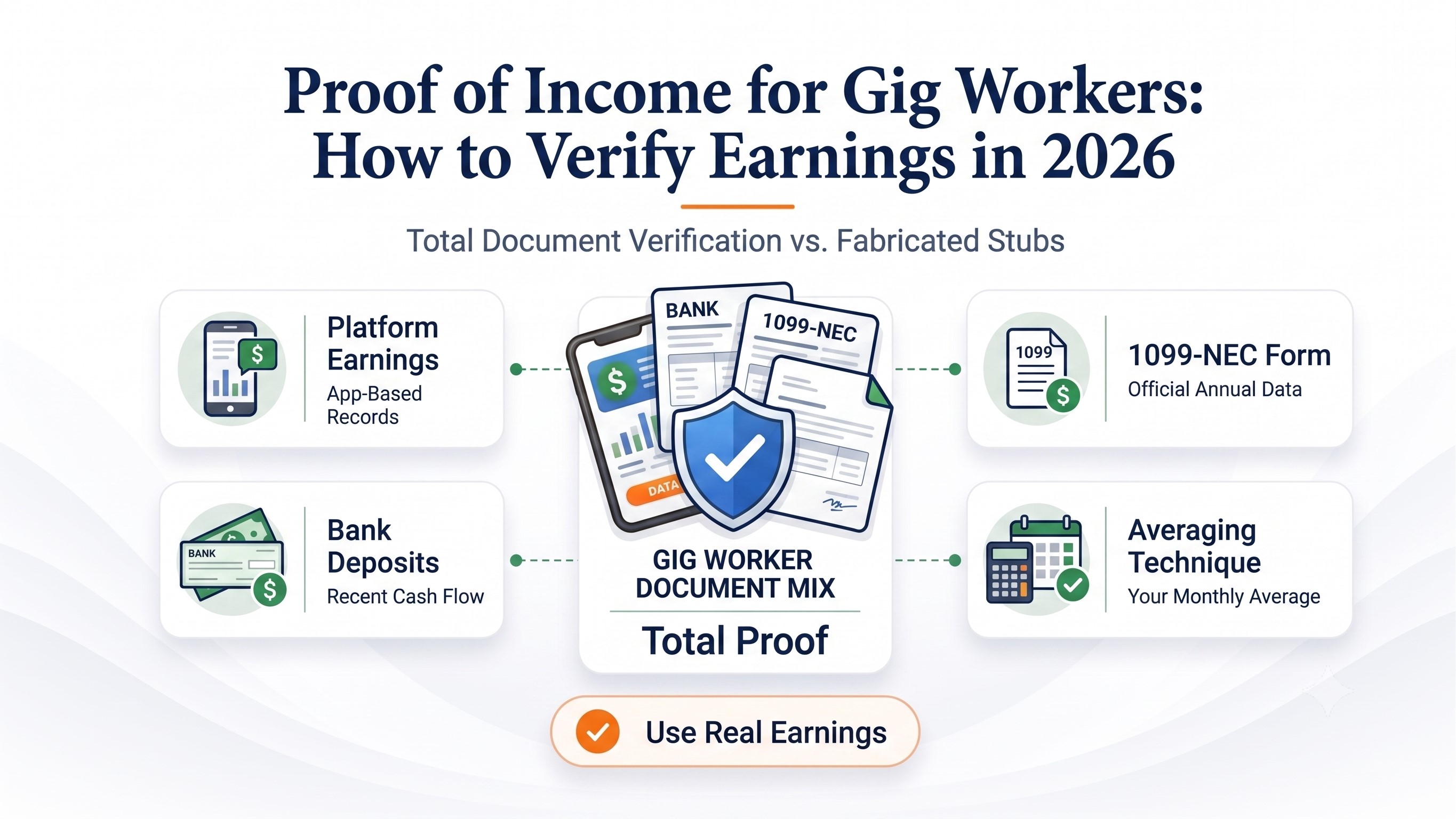
| Gig / app worker | Platform earnings or payout history | Matching deposits and tax records | Recent platform income and receipt of funds | Which earning period is evaluated |
| Paid mainly in cash | Legitimate deposit history or verifiable employer/client records | Tax records, invoices, receipts or contracts | Source and pattern of earnings | Which independently verifiable records are required |
| Social Security / SSI | Official Benefit Verification Letter | Matching deposit history if requested | Current benefit status and amount | Which benefit sources count |
| Retirement / pension | Pension or recurring distribution statement | Matching deposit history | Recurring retirement income | How distributions and assets are treated |
| Unemployment benefits | Official benefit or payment record | Deposit history if requested | Current documented benefits | Whether temporary income qualifies |
| Workers' compensation / disability | Official benefit or award record | Payment history if requested | Documented recurring or temporary benefits | Whether and how the property counts the income |
| Child support / alimony / court-ordered income | Property-accepted court or payment documentation | Recent payment history | Documented recurring payments | What evidence the property accepts and applicable local rules |
| Investment / dividend income | Statements showing recurring income or distributions | Tax records or deposit history | Recurring investment income | Whether the property counts income, assets, or both |
| Student / stipend | Property-approved funding or income evidence | Stipend, aid, guarantor or other accepted documentation | Available documented support | Alternative qualification or guarantor rules |
| Roommates / co-applicants | Each applicant's own income records | Combined household documentation if permitted | Individual and household income | Whether income can be combined |
Build a Starting Proof-of-Income Packet
What Does Each Proof-of-Income Document Actually Prove?
A pay stub, bank statement, W-2 and offer letter may all be legitimate records, but they answer different questions. This is why a second document can sometimes clarify the first.
| Document | Main Time Period | Shows Gross Income? | Shows Funds Received? | Main Strength | Main Limitation |
|---|---|---|---|---|---|
| Employer pay stub | Current / recent | Usually yes | Not by itself | Current wages, pay frequency, pay dates and YTD earnings | A new employee may not have one yet |
| Bank statement | Recent | Usually no | Yes | Shows deposits and receipt of funds | May not identify gross earnings or explain every deposit |
| W-2 | Historical | Annual wage information | No | Prior-year employer-reported wages | May not reflect a current raise, promotion or new job |
| Tax Return Transcript | Historical | Tax-return figures | No | Official IRS transcript of filed return information | Does not prove that income is unchanged today |
| Wage and Income Transcript | Historical / reporting-dependent | Shows W-2, 1099 and other information-return data reported to IRS | No | Independent information-return data | Current-year information may not yet be complete |
| Offer / employment letter | Future | Expected compensation | No | Documents salary or hourly pay and a start date before first payroll | Expected income is not income already received |
| Profit-and-loss statement | Current business period | Business income and expenses | No | Useful for current self-employment activity | Strength depends on source and corroborating evidence |
| Benefit Verification Letter | Current benefit status | Benefit amount | No | Official SSA documentation | The property may still request supporting evidence |
| Investment / pension statement | Current / recurring | Depends on statement | Sometimes | Can document recurring distributions or income | An account balance is not automatically recurring income |
How Many Months of Proof of Income Do Apartments Need?
The better question is: what period is this property trying to verify? A weekly employee can need more individual pay stubs than a monthly employee to document the same length of time.
| Income Pattern | Likely Verification Question | Useful Evidence |
|---|---|---|
| Stable employment | What are you earning now? | Recent consecutive employer-issued pay stubs |
| New job | What will you earn when employment starts? | Offer/employment letter plus later first pay stub if requested |
| Variable wages | What is your normal earning pattern? | Consecutive pay periods covering the property's requested window |
| Self-employment | What did you report historically, and what is the business doing now? | Tax records plus current P&L/bank/business evidence |
| Benefits / pension | Is the documented payment current and recurring? | Official benefit/distribution record plus supporting deposit evidence if requested |
For a dedicated pay-stub quantity guide, see How Many Pay Stubs Do You Need for an Apartment? .
What Public Rental Policies Show: There Is No Single Apartment Rule
For this update, we checked public rental qualification or verification information from several large apartment operators and programs. These examples are illustrations, not universal rules. A community's current application criteria control.
| Public Example | What the Public Criteria Say | What It Shows |
|---|---|---|
| UDR - Residences at the Domain | Publishes a minimum household gross monthly income of 2.5x monthly rent and 4x for guarantors. It says proof can be verified through Snappt using uploaded documents or connections to payroll and bank data. | A 3x rule is not universal, and verification may involve direct-source connections rather than only uploaded PDFs. |
| Essex - 500 Folsom | Publishes a minimum gross income of 2.4x monthly rent, while noting some communities can require more. Its listed proof examples include two months of pay stubs, three months of bank statements, prior-year tax returns and other verifiable documentation. | The required income multiple and document lookback can differ by operator and community. |
| Camden - current community quote pages | Current Camden quote pages state that Camden partners with Vero, a third-party screening company, to verify applicant identity and income. | Some apartment companies use specialized third-party verification systems. |
| Greystar - renter guidance | Greystar lists examples including recent pay stubs, bank statements, tax returns, benefit records, workers' compensation, investment income and pension distributions. Its renter guidance discusses three times rent as a common guideline while also telling applicants to check the specific property's requirements. | A common guideline is not the same as a universal rule, and accepted income sources can extend well beyond wages. |
| AvalonBay - Kanso Twinbrook affordable program | The public program page publishes both minimum-income requirements and maximum household-income limits tied to the affordable-housing program. | Program-specific housing can use qualification rules that are very different from a conventional market-rate screening formula. |
Public criteria can change. Re-check the property's current application instructions before relying on any example above.
Apartment Gross Monthly Income Calculator
Use the property's actual stated income multiple when you know it. The calculator below is mathematical only. It does not predict rental approval or determine whether a specific income source will be accepted.
Common gross-monthly conversions
| Income Type | Monthly Estimate |
|---|---|
| Weekly | Weekly gross x 52 / 12 |
| Biweekly | Biweekly gross x 26 / 12 |
| Semimonthly | Paycheck x 2 |
| Monthly | Monthly gross amount |
| Hourly | Hourly rate x average weekly hours x 52 / 12 |
| Annual salary | Annual salary / 12 |
Special Rental Situations
For deeper specialist guidance, see self-employed proof of income, gig-worker proof of income, cash income documentation, and proof of income from benefits.
Worked Examples: Which Documents Fit the Situation?
The examples below are hypothetical and are not records from real applicants.
The applicant's prior W-2 reflects the old salary, while the latest employer-issued pay stub shows the new rate. A short employer or raise confirmation can explain why the documents legitimately differ.
A signed offer or employment letter can document expected compensation and start date. If the property accepts future income, it may later request the first pay stub or direct employer verification.
Instead of selecting only the highest-income month, the applicant can provide the consecutive period the property requests, supported by contracts, invoices, 1099 records or matching deposits that show the source of the income.
What If Your Proof-of-Income Documents Do Not Match?
A legitimate difference between records is not automatically a problem. The useful question is: what caused the difference, and which source record explains it?
| Difference | Possible Legitimate Reason | Evidence That May Explain It |
|---|---|---|
| Current salary is higher than last year's W-2 | Raise, promotion or new employer | Recent pay stub plus employer/offer letter |
| Bank deposit is lower than pay-stub gross pay | Taxes, deductions and other withholdings | Matching employer pay stub and payroll deposit |
| Bank payer name differs from employer name | Payroll processor, parent entity or payroll company | Employer-issued pay stub or payroll record |
| Platform earnings exceed bank deposits | Fees, transfer timing or payout timing | Platform payout report plus matching deposits |
| No current pay stubs | New hire before first payroll | Signed offer/employment verification letter |
| Income changes every paycheck | Hours, tips, overtime, commission or seasonal work | Consecutive records for the requested lookback period |
| Prior tax income is lower than current business income | Business growth or new contracts | Current P&L, contracts and recent deposits |
How Do Apartments Verify Proof of Income?
| Verification Method | What May Be Checked | Applicant Takeaway |
|---|---|---|
| Uploaded source documents | Pay stubs, bank statements, tax records, letters or benefit documentation | Use clear records from the legitimate source requested by the property |
| Employer verification | Employment status, start date, role or compensation | Provide accurate employer details when requested and authorized |
| Deposit review | Recurring payroll, benefits, client or platform deposits | Be prepared to explain legitimate timing or payer-name differences |
| Tenant-screening report | Can include employment/income verification along with credit, rental and other screening information | Review your rights if inaccurate information affects the decision |
| Direct-source verification | Payroll or financial information obtained through an approved verification connection | Follow the property's secure workflow rather than assuming an uploaded PDF is always the only option |
For a deeper guide, see Do Apartments Check Pay Stubs? .
Which Official Records Can Help Verify Income?
IRS tax transcripts
The IRS offers several transcript types, and they are not interchangeable.
| IRS Record | What It Mainly Shows | Potential Use |
|---|---|---|
| Tax Return Transcript | Most line items from the originally filed tax return | Historical filed tax-return information |
| Wage and Income Transcript | Information-return data such as Forms W-2 and 1099 reported to the IRS | Historical employer/payer information reported to IRS |
| Tax Account Transcript | Basic return/account information and later changes | Account-status questions rather than a replacement for every income document |
| Verification of Non-Filing Letter | Shows no processed Form 1040-series return for the requested period as of the request date | Only when the recipient specifically asks for proof of non-filing |
Official IRS resources: Get Your Tax Records and Transcripts and Transcript Types for Individuals .
Social Security Benefit Verification Letter
The Social Security Administration states that a Benefit Verification Letter can show that someone receives benefits, has applied for benefits or does not receive benefits. SSA specifically notes that this documentation is often needed for housing assistance and other income-verification processes.
Official resource: SSA - Get a Benefit Verification Letter .
How to Protect Financial Information During a Rental Application
- Use the property's official or secure submission method.
- Download records directly from the payroll, bank, tax, benefit or platform source when possible.
- Ask before redacting information needed for verification.
- Do not send unrelated financial records simply because you have them.
- Keep a copy of exactly what you submitted.
- Use clear filenames and preserve the original files.
- Confirm that a request for sensitive information came from the property or its authorized screening provider.
Can you redact a bank statement or pay stub?
Ask the property before redacting. Some recipients may permit partial account-number redaction or removal of unrelated transactions while still requiring enough information to identify the applicant, payer, dates and relevant income.
What If a Tenant-Screening Report Is Wrong?
The CFPB explains that tenant-screening reports can include employment and income verification, along with credit, rental-history and other information. If a screening report contributes to an adverse rental decision, federal Fair Credit Reporting Act rights can apply.
- Read the adverse-action notice. Identify the screening company.
- Request the report. CFPB states that you can request a free copy from the company used if you act within the applicable 60-day period after an adverse action.
- Check for inaccurate or outdated information.
- Dispute errors with the screening company.
- Tell the property when relevant. Explain that the disputed information is under review.
Official CFPB guidance: Review Your Rental Background Check and What to Do After a Screening-Based Rental Denial .
FTC guidance: Tenant Background Checks and Your Rights .
Federal overview: HUD - Fair Housing Act Overview .
Apartment Proof-of-Income Checklist
- Get the property's current written proof-of-income requirements.
- Confirm whether it uses gross income or another calculation.
- Ask which income sources count.
- Confirm the required lookback period.
- Use records that match your actual income source.
- Use consecutive records when variable income is being evaluated.
- Check applicant names, dates, employer/payer information and amounts for consistency.
- Prepare a short explanation for legitimate document differences.
- Use secure submission methods.
- Keep copies of everything submitted.
- Do not change authentic records to alter income, dates or employer information.
Frequently Asked Questions
Depending on the property's policy, proof can include recent employer-issued pay stubs, W-2s, tax records, bank statements, employment or offer letters, 1099 records, benefit letters, pension statements and platform earnings records.
For a traditional employee, recent employer-issued pay stubs are often a strong starting point because they show current gross wages, pay frequency and year-to-date earnings. The best starting record changes for new hires, self-employed workers, benefit recipients and other income types.
There is no universal requirement. A property may request several recent pay periods, one or more months of bank records, prior tax years or a longer period for variable income. Use the property's written criteria.
Many rental-screening calculations use gross income, but properties can define qualifying income differently and may not treat every income source the same way. Confirm the property's method.
No. Three times rent is a commonly discussed guideline, not a universal U.S. rule. Public rental criteria show other multiples and program-specific approaches, so check the actual property.
Sometimes. An offer letter can document expected pay and a start date before the first paycheck exists. The property decides whether it accepts future income and whether employer verification or later pay stubs are required.
They may be accepted because they show deposits and receipt of funds, but bank statements may not show gross earnings or explain every deposit. A second source record can be required.
A property may request tax returns or transcripts, current profit-and-loss information, 1099 records, contracts, invoices and recent bank statements. Ask what period the property uses to evaluate variable income.
They may compare source documents, review earnings and deposits, contact employers when authorized, or use an income-verification or tenant-screening service. Some properties also use systems that connect to payroll or bank information.
Savings demonstrates assets, not automatically recurring monthly income. Some properties or programs may consider verified assets under an alternative qualification method, so ask how the property treats them.
Need to Organize Legitimate Current Earnings Information?
A clear earnings record can help employers and authorized users document genuine current pay information when the recipient accepts that kind of record.
It does not replace an employer-issued historical pay stub, IRS transcript, SSA benefit letter, bank record or other independent source when a property specifically requires independent verification.
Sources Used for This Update
Government and consumer-protection sources
- IRS - Get Your Tax Records and Transcripts
- IRS - Transcript Types for Individuals
- SSA - Benefit Verification Letter
- CFPB - Review Your Rental Background Check
- FTC - Tenant Background Checks and Your Rights
- HUD - Fair Housing Act Overview