
Proof of Income for a Loan: Documents Every Lender May Need
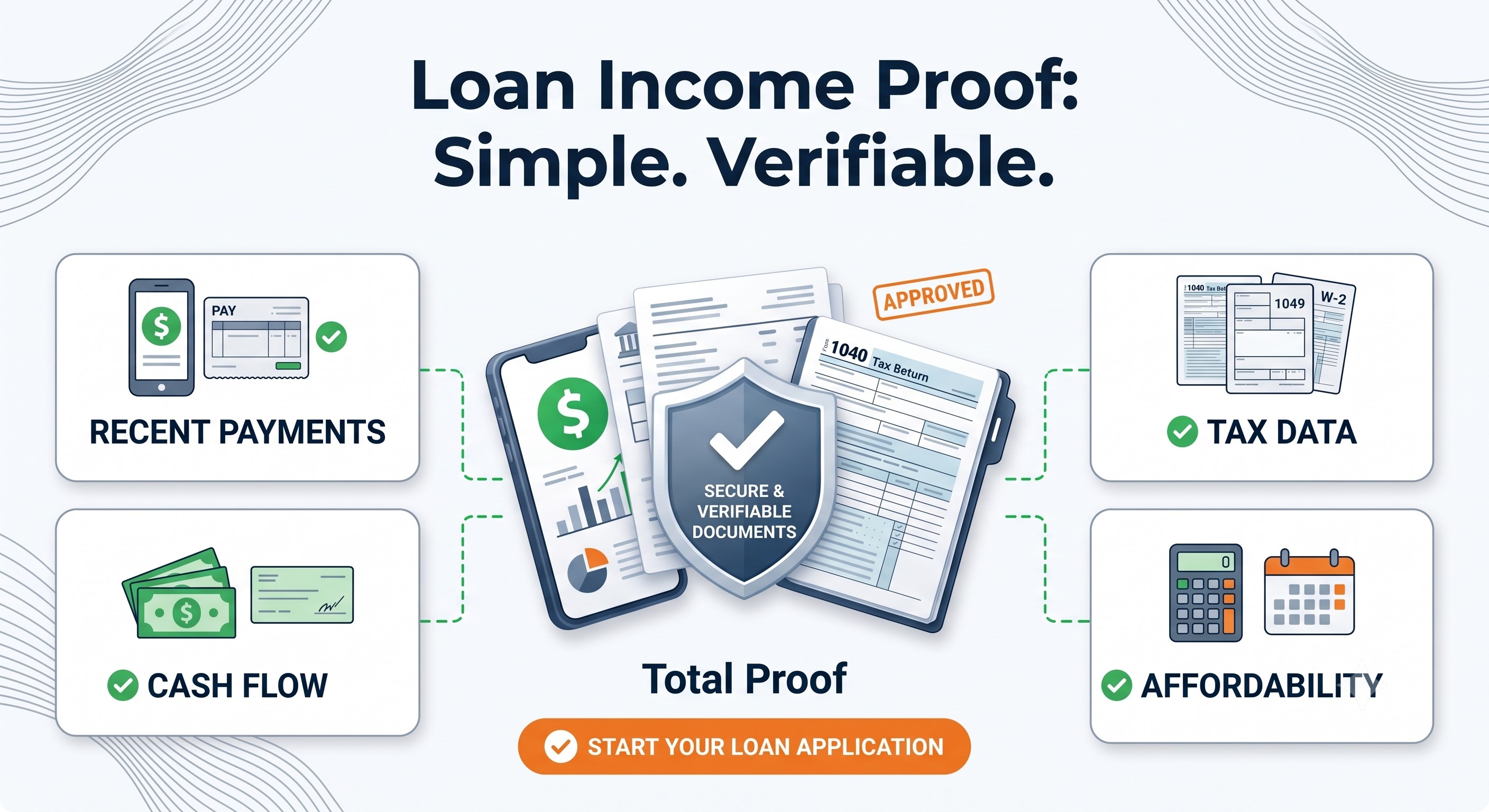
Lenders generally accept pay stubs, W-2s, tax returns, bank statements, 1099s, profit-and-loss statements, and benefit award letters as proof of income. How much you send matters as much as which document. Fannie Mae's consumer checklist for a conventional mortgage lists pay stubs from the most recent two months and W-2 forms for the last two years, plus two years of tax returns for self-employment, rental, or commission income. Auto and personal lenders usually work from current earnings and vary far more. Whatever you send, the figures have to reconcile — year-to-date pay, tax forms, and bank deposits are cross-checked against each other.
Proof of income is not one document. It is evidence that answers four separate questions for the lender: who paid you, how much, how recently, and whether the money is likely to keep arriving. A single record rarely answers all four. That is why lenders combine documents, why applications stall when one of the four is missing, and why a perfectly genuine pay stub can still trigger a follow-up request.
This guide covers what each document proves and fails to prove, how much history each loan type asks for, the exact fields a lender reads on a pay stub, how lenders confirm the document is real, and how to fix the eight problems that get proof of income rejected.
- What each document proves — and fails to prove
- How much income history lenders want
- Requirements by loan type
- What a lender checks on your pay stub
- How lenders confirm a pay stub is real
- The four income-verification methods
- Documents by how you are paid
- What lenders do with the income
- Before-you-apply checklist
- Why proof gets rejected and how to fix it
What Each Proof-of-Income Document Actually Proves
Most guides hand you a list of acceptable documents. That list is only half the answer. Underwriters treat each document as evidence of specific facts, and every one has a blind spot. Knowing the blind spot tells you which second document to send before the lender has to ask for it.
| Document | What it proves | What it does not prove | Pair it with |
|---|---|---|---|
| Recent pay stubs | Current gross pay, deductions, pay frequency, employer, and year-to-date earnings | That the job continues, or that year-to-date pay reflects a normal full year | W-2, employment verification, or bank statements |
| W-2 forms | Wages an employer actually reported to the IRS for a full calendar year | Anything about your current job, current pay rate, or this year's earnings | Recent pay stubs |
| Federal tax returns | Reported income across all sources, plus business expenses on Schedule C | What you earn right now — a return can be a year or more behind | Current bank statements or a year-to-date profit-and-loss statement |
| Bank statements | That money actually arrived, how regularly, and in what amounts | Where a deposit came from, or that it was income rather than a transfer or gift | Pay stubs, 1099s, invoices, or an award letter |
| 1099 forms | Gross amounts a client, platform, or payer reported paying you | Your business expenses, your net income, or whether that client still hires you | Tax return with Schedule C, plus current bank statements |
| Profit-and-loss statement | Current-year business revenue and expenses between tax filings | Independent confirmation — it is usually self-prepared | Business bank statements or the prior year's return |
| Award or benefit letter | Eligibility, payment amount, and often the payment schedule | That the benefit continues past any stated expiration date | Bank statements showing the deposits landing |
| Employment or offer letter | Job title, start date, and stated compensation for a new role | That you have actually been paid yet | Your first pay stub once it is issued |
How Much Income History Do Lenders Want?
“How many pay stubs do I need?” is one of the most common questions borrowers ask, and the honest answer is that it depends on the loan and on how steady your income is. No federal rule sets one number for every loan. The table below shows the pattern published guidance and lender checklists point to — not a promise of what any individual lender will request.
| Loan type | Current-income proof commonly requested | History commonly requested | Basis |
|---|---|---|---|
| Conventional mortgage | Pay stubs from the most recent two months | W-2 forms for the last two years; two years of tax returns for self-employment, rental, or commission income | Fannie Mae consumer document checklist |
| Auto loan | One or more recent pay stubs, or a bank statement | Varies widely; often nothing beyond current pay | Lender underwriting policy — no single published standard |
| Personal loan | Recent pay stubs, bank statements, or a permitted data connection | Varies widely; some lenders begin from self-reported income | Lender underwriting policy — no single published standard |
| Self-employed, any loan type | Year-to-date profit-and-loss statement plus current business bank statements | Typically two years of tax returns | Fannie Mae consumer document checklist |
Why variable pay needs a longer history
Salary projects forward easily. Overtime, bonuses, commissions, and tips do not, so lenders look for a track record before counting them. Fannie Mae's Selling Guide states the principle plainly: the lender must document that income “is stable, has a documented history of receipt, and is reasonably expected to continue.” Where income has a defined expiration date, the guide adds that “the lender must document that the income is expected to continue for at least three years from the note date.”
That is why one large commission check rarely unlocks a bigger loan on its own, and why a benefit letter with an end date can be discounted or excluded. If a meaningful share of your pay is variable, expect to be asked for enough history to show a pattern rather than a single strong month.
Proof of Income Requirements by Loan Type
Auto, mortgage, and personal loans do not use the same verification standard. Prepare for the loan in front of you rather than assembling every financial record you own. Each card links to the full guide for that loan type.
Usually starts with a recent pay stub or bank statement showing current earnings. Credit, down payment, and financing amount all affect what a dealer or lender asks for. See when auto lenders ask for proof and what works.
The deepest review of the three — current pay, multi-year history, assets, and employment — because federal ability-to-repay rules apply. See the full mortgage proof-of-income document list.
The most variable of the three. Some lenders verify with documents, some through a permitted bank or payroll connection, some prequalify on self-reported income first. See what personal-loan lenders accept.
Mortgage underwriting is document-heavy for a specific legal reason. Under the CFPB's Ability-to-Repay rule, a lender must “find out, consider, and document a borrower's income, assets, employment, credit history, and monthly expenses” before making a covered residential mortgage loan. Auto and personal lending is not governed by that same rule, which is why those checklists are shorter and differ more between companies.
What a Lender Actually Checks on Your Pay Stub
A pay stub is the most common proof-of-income document and the one most often sent back. Underwriters do not read it top to bottom — they check a specific set of fields against your application and against each other. Here is what each field is doing, and what makes it fail.
| Field | What the lender is confirming | Common failure |
|---|---|---|
| Employee name | The stub belongs to the applicant on the file | Nickname, maiden name, or middle initial that does not match the application or ID |
| Employer legal name and address | The employer can be identified and independently contacted | A trading name or abbreviation the lender cannot verify anywhere |
| Pay period start and end dates | The document covers a recent, complete period | Missing dates, or a period that ended months ago |
| Pay date | How current the document is, and whether year-to-date figures make sense | Pay date absent, or inconsistent with the stated period |
| Pay frequency | Converting per-period pay into monthly qualifying income | Not stated, forcing the underwriter to guess between biweekly and semi-monthly |
| Hours and rate (hourly pay) | Whether the hours are full-time and consistent | Hours that swing widely with no explanation |
| Gross pay for the period | The base figure for qualifying income | Overtime or a bonus blended into base pay with no breakout |
| Itemized deductions | That withholdings look like real payroll, and what net pay will be | No tax withholding shown on a stub that claims W-2 employment |
| Net pay | A figure that should match the deposits on your bank statement | Net pay that does not match any deposit in the account |
| Year-to-date totals | The strongest internal consistency check on the whole document | YTD that cannot be reconciled with the pay date and pay frequency |
Run the year-to-date check yourself first
Year-to-date reconciliation is the check that catches the most problems, and you can run it in under a minute before you apply. Multiply your gross pay per period by the number of pay periods completed this year, then compare that to the year-to-date gross on your stub.
If the stub instead showed $21,000, that is an $11,000 gap an underwriter will ask about. The gap is often completely legitimate — you started mid-year, took unpaid leave, changed from part-time to full-time, or had a pay rise. The point is to have that one-line explanation ready rather than discovering the question after your file is already in review.
How Lenders Confirm a Pay Stub Is Real
Lenders do not authenticate a pay stub by looking at it. They authenticate it by comparing it against records they can reach independently — which is why a document that looks convincing can still fail, and why an unpolished but genuine stub usually passes.
- Internal consistency. Gross minus deductions must equal net. Year-to-date must reconcile with the pay date and pay frequency. Most rejected documents fail right here, before anyone picks up a phone.
- Cross-document agreement. Net pay on the stub should appear as a deposit in your bank statement. Annual pay should be consistent with your W-2 or tax return.
- Employer confirmation. The lender contacts your employer directly, or queries an employment-and-income database your employer reports payroll data into.
- Third-party data. With your permission, a lender may review payroll or deposit records through a digital connection, or request IRS tax transcripts using your signed authorization.
How Do Loan Companies Verify Income?
Submitting a document starts verification rather than finishing it. Depending on the loan, the lender, and the permissions you grant, a lender may use any combination of four methods.
| Method | What the lender is doing | What it means for you |
|---|---|---|
| Document review | Reading your pay stubs, W-2s, returns, or statements and checking them against the application | Figures must reconcile — year-to-date pay should make sense for the pay date and frequency |
| Employment verification | Contacting your employer, or querying an employment-and-income database your employer reports to | Job title, status, and dates should match what you wrote on the application |
| IRS tax transcripts | Requesting transcripts through the IRS Income Verification Express Service using Form 4506-C | The IRS states it “only provides tax records to a third party with the consent of the taxpayer,” so this happens with your signed authorization. Filed returns and your application should agree |
| Bank or payroll data connection | Reviewing deposit history or payroll records through a permitted digital connection | Deposits should reasonably match the income you claimed |
These methods cross-check each other, which is why internal consistency matters more than any single document looking impressive. A different mailing address is easy to clarify. Unexplained differences in employer name, pay frequency, annual earnings, or deposit amounts are the ones that generate questions and slow a file down. A mismatch is not automatically treated as fraud — but you should be ready to explain it.
Which Documents Fit the Way You Are Paid?
Employee with regular wages
Start with your newest authentic pay stubs and run the year-to-date check above before sending them. Expect the lender to compare them against W-2s, bank deposits, or employment records. If any field is unclear, our guide on how to read a pay stub walks through a labeled example line by line.
New job, raise, or recent pay change
If you have not received a normal pay stub yet, ask whether the lender accepts a signed offer letter or written employment verification. Do not submit a previous employer's stub as proof of current earnings. If your salary, hours, or commission structure changed recently, prepare the explanation in advance — underwriters read that difference as a question that needs answering, and the year-to-date check will surface it immediately.
Self-employed, freelance, contract, or gig income
Tax returns show reported historical income; bank statements and a current profit-and-loss statement show what is happening now. A 1099 confirms what a payer reported, but it shows gross payments with no expenses and says nothing about whether that client is still sending work. Lenders generally qualify you on net business income rather than gross deposits, which is why a strong deposit total can still support a smaller loan than you expected.
Use the focused guides for self-employed proof of income, 1099 proof of income, and gig-worker app earnings.
Benefits, retirement, support, or rental income
Award letters, pension statements, court orders, signed leases, tax records, and bank statements can all document income earned outside employment. Whether a lender counts the full amount often turns on proof of receipt and expected continuation — which is where a stated expiration date on an award letter becomes relevant. Ask before submitting sensitive records the lender did not request.
What Lenders Do With Your Income After Verification
Verified income is an input, not a decision. The lender compares qualifying monthly income against recurring monthly debt payments to calculate a debt-to-income ratio, or DTI, then reads that alongside credit history, down payment, employment stability, and collateral.
Actual underwriting definitions and acceptable ratios vary by lender and loan program. Two points surprise borrowers most often: income that appears on a document can still be excluded if the lender cannot establish it is stable or likely to continue, and the new loan payment itself is added to the debt side of the calculation.
Before You Apply: Proof-of-Income Checklist
- Ask for the exact checklist and the date range. Accepted document types, required periods, and file formats — all three, in one question.
- Run the year-to-date check. Gross per period × periods completed, compared against the YTD figure on your stub.
- Send complete records. Every page, full statements, no cropped screenshots or partial PDFs.
- Check names and dates first. The applicant, the employer or payer, and the pay period all need to be identifiable without explanation.
- Reconcile across documents. Pay-stub earnings, YTD totals, tax forms, and bank deposits should tell the same story before an underwriter reads them.
- Pre-write the explanations. A new job, a raise, unpaid leave, variable hours, or a one-time bonus each need a one-line reason and a supporting record.
- Fill the pairing gap. Use the first table to send the second document before it is requested.
- Protect your data. Upload only through the lender's approved method, and only what was asked for.
- Keep newer records ready. A mortgage lender may request updated pay stubs or statements while the file is still open.
Why Proof of Income Gets Rejected — and How to Fix It
Most rejected documents fail for a small number of reasons, and nearly all of them are fixable before you apply.
| What the lender sees | Why it fails | The fix |
|---|---|---|
| Cropped, blurry, or partial document | Key fields are unverifiable, so the whole record is set aside | Resend the complete original file — all pages, unedited |
| Year-to-date pay does not fit the pay date | Suggests a math or authenticity problem | Run the YTD check above; explain mid-year starts, leave, or rate changes in one line |
| Deposits do not match the stated income | The source and amount cannot be confirmed | Supply the pay stub, 1099, invoice, or award letter behind each significant deposit |
| A one-time bonus presented as monthly income | Fails the stability and continuation test | Present it separately as non-recurring, and supply history if you want it counted |
| Gross revenue with no expenses | Lenders qualify self-employed borrowers on net income | Include Schedule C or a profit-and-loss statement showing expenses |
| Employer cannot be identified or reached | Verification cannot be completed independently | Provide the full legal employer name, an HR or payroll contact, and an employment letter |
| Current job differs from the records supplied | The application and the evidence disagree | Update the application, then supply current-employer documents |
| Figures appear altered or estimated | Cross-checks against payroll, banking, and tax data will expose it | No fix Use only real payroll or business records |
Can You Use a Pay Stub You Created Yourself?
A pay-stub generator can format a record of genuine wages or contractor payments. It cannot turn estimated or invented figures into verified income, because the four methods above compare your document against payroll, banking, and tax records the lender can reach independently. Before using any generated document for a loan, ask the lender whether it accepts the format and what supporting evidence it needs.
If you do prepare one from real payroll records, confirm it carries every field an underwriter reads — employee name, full legal employer name, pay period dates, pay date, pay frequency, hours and rate where hourly, gross pay, itemized deductions, net pay, and year-to-date totals that reconcile. A stub missing pay frequency or YTD totals will usually come back regardless of whether the figures are accurate.
If you need an organized pay record built from accurate income data, you can use our pay stub creator. Confirm acceptance with the lender and include the supporting records it requests.
Frequently Asked Questions
For an employee, recent authentic pay stubs are usually the clearest evidence of current earnings, because they show employer, pay period, gross pay, and year-to-date totals in one record. They do not prove the job will continue, so lenders often pair them with a W-2 or employment verification. Self-employed applicants typically lead with tax returns and add current bank statements or a profit-and-loss statement.
There is no universal number. Fannie Mae's consumer checklist for a conventional mortgage lists pay stubs from the most recent two months. Auto and personal lenders vary far more, and some ask for only one recent stub. Ask your lender for the exact date range rather than assuming a number.
It depends on the loan and how steady the income is. Mortgage files commonly include two years of W-2s and, for self-employment or commission income, two years of tax returns. Auto and personal lenders often focus on current earnings. Variable pay such as bonuses, overtime, commissions, and tips generally needs a longer history, because it must be shown to be stable and reasonably expected to continue.
Employee name, full legal employer name, pay period dates, pay date, pay frequency, hours and rate where applicable, gross pay, itemized deductions, net pay, and year-to-date totals. The year-to-date figure gets the closest attention because it is the strongest internal consistency check — it should reconcile with the pay date and pay frequency.
Not by inspecting the document itself. Banks check that the stub is internally consistent, that net pay matches deposits in your bank statement, and that annual figures agree with your W-2 or tax return. They may also contact your employer, query an employment-and-income database, or — with your signed authorization — request IRS tax transcripts. A genuine stub with a plain layout passes; a polished stub with figures that do not reconcile does not.
Sometimes, particularly for a straightforward employee application on a smaller loan, but approval is never based on the pay stub alone. Lenders also weigh credit, existing debts, identity, employment, and collateral. A pay stub proves current pay; it does not prove the income will continue, which is the gap a lender fills with a second document or an employment check.
Through some combination of four methods: reviewing the documents you submit, contacting your employer or querying an employment-and-income database, requesting IRS tax transcripts through the Income Verification Express Service with your signed Form 4506-C authorization, and reviewing deposit or payroll data through a permitted digital connection. Which methods apply depends on the loan type and the lender.
No. The CFPB states that a lender or mortgage broker cannot require you to provide documents as a condition for giving you a Loan Estimate. You supply six items: your name, your income, your Social Security number, the property address, an estimate of the property value, and the desired loan amount. Document requests come after you tell the lender you want to proceed.
Rarely on its own. A bank statement proves money arrived and how regularly, but not where it came from or whether it was income rather than a transfer, refund, or gift. Lenders usually want a pay stub, 1099, invoice, contract, or award letter to identify the source behind the deposits.
Borrowed money is generally not treated as earned income for the application, because it has to be repaid. The new monthly payment does count on the other side of the ledger as a debt obligation, which affects your debt-to-income ratio and therefore how much you can borrow. Tax treatment depends on the situation, so consult a qualified tax professional about a specific case.
Document the change rather than hoping it goes unnoticed — the year-to-date check and the lender's cross-checks will both surface it. A raise, a new employer, unpaid leave, reduced hours, or a shift from salary to commission each warrant a brief written explanation plus a supporting record such as an offer letter, revised pay stub, or employer confirmation.