
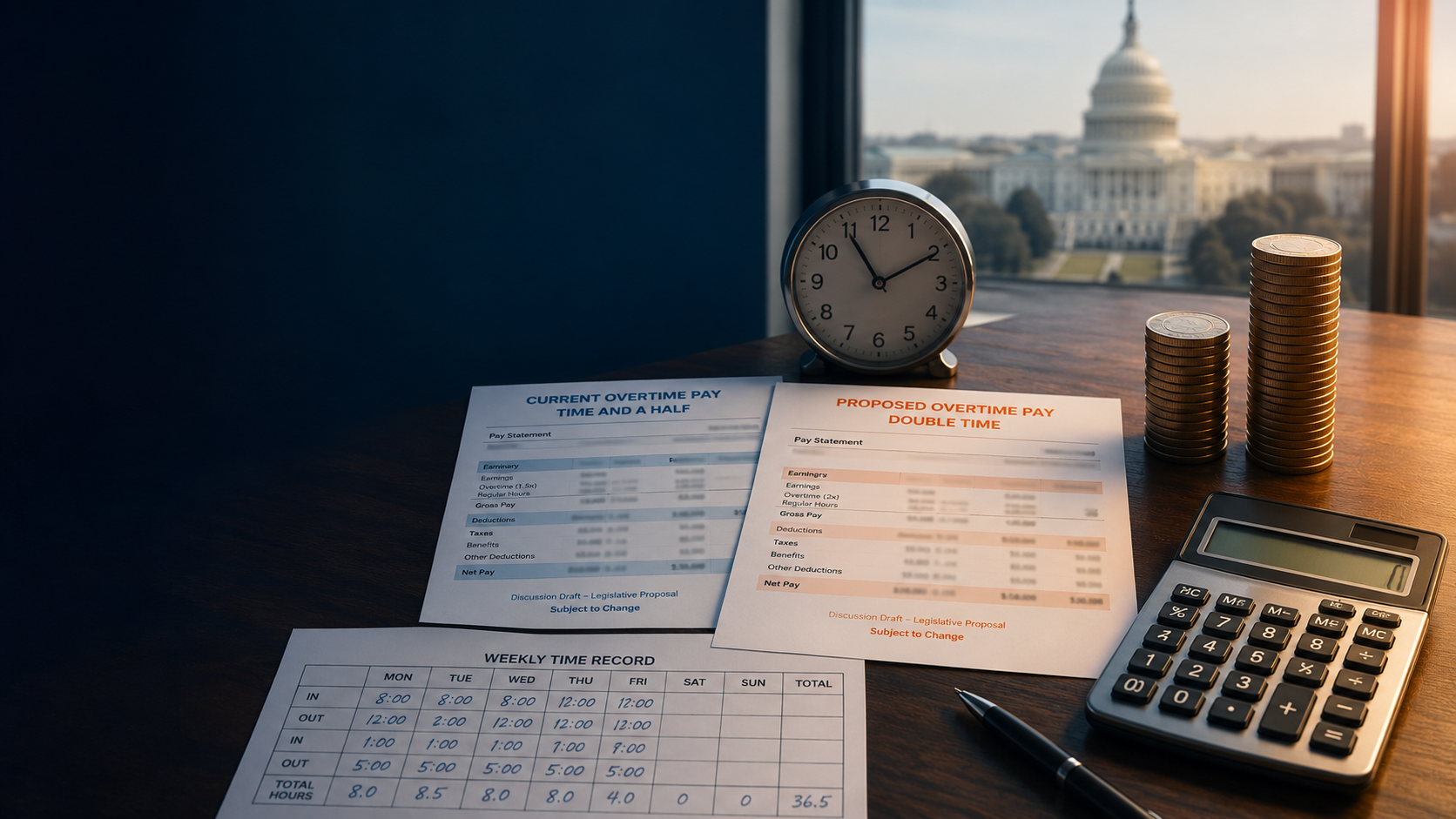
Is Overtime Double Time Now? 2026 Bill Status, Pay Examples and What Employees Should Know
No. Overtime is not automatically double time under current federal law. As of August 12, 2026, covered, nonexempt employees are still generally entitled to at least 1.5 times their regular rate for hours worked over 40 in a workweek.
The Double the Wage for Overtime Act of 2026, including Senate bill S. 5268, proposes changing the federal multiplier from 1.5 to 2. The proposal has been introduced, but it has not become law. Its text says the change would begin 180 days after enactment, not 180 days after introduction.
Federal overtime is still generally time-and-a-half, not double time. S. 5268 would raise the FLSA overtime rate to twice a covered worker's regular rate after 40 hours in a workweek. The bill is only a proposal as of August 12, 2026. Payroll should continue using the rate currently required by federal, state, local, contract or company rules.
A bill number, press release or social post does not create a new pay requirement. Employers should verify enacted law and its effective date before changing an overtime multiplier. Employees should check the rule that applies to their work location and employment status.
Did the Double the Wage for Overtime Act Pass?
No. The proposal is not federal law as of August 12, 2026. Senator Ruben Gallego announced the Senate version on August 5, 2026. The Senate bill is S. 5268, and the current recorded action is that it was read twice and referred to the Senate Committee on Health, Education, Labor, and Pensions. A House version was announced on June 9, 2026.
| Question | Status on August 12, 2026 | What it means for a paycheck |
|---|---|---|
| Has S. 5268 been introduced? | Yes | Congress can consider it, but introduction alone changes no pay rate. |
| Has it passed both chambers? | No | There is no new nationwide double-time requirement from this bill. |
| Has it been signed into law? | No | Current federal overtime rules remain in effect. |
| Would it start immediately if enacted? | No | The bill text provides a 180-day period after enactment. |
The decisive source is the two-page Senate bill text. It changes specified references to “one and one-half” in the Fair Labor Standards Act to “two” and gives the amendment an effective date 180 days after enactment.
How to Verify Whether the Overtime Bill Becomes Law
Search-result labels and social posts can be wrong or stale. Before changing a paycheck, verify all three items below in official records:
Status check completed: August 12, 2026. At that check, the bill was introduced and referred to committee; no public-law number or enacted effective date existed.
What Federal Overtime Law Requires Right Now
The current federal rule has not changed. The U.S. Department of Labor's FLSA overtime fact sheet says covered, nonexempt employees generally must receive at least one and one-half times their regular rate for hours worked beyond 40 in a workweek.
Federal law does not require double time merely because work occurs on a Saturday, Sunday, holiday or regular day off. It also does not permit an employer to average a 50-hour week and a 30-hour week to erase overtime. Each workweek stands on its own.
FLSA coverage and exemptions depend on the facts. A salaried worker can be overtime-eligible, and some hourly workers can fall under a specific exemption. Job title alone is not enough to settle the question.
What S. 5268 Would Change
The proposal is narrow but financially significant. It would replace the federal time-and-a-half multiplier with double time in the overtime provisions identified in the bill. For the common hourly calculation, the overtime rate would move from regular rate × 1.5 to regular rate × 2.
S. 5268 has reached this step.
Both chambers would need to approve matching legislation.
The proposal must become an enacted federal law.
The bill's effective-date clause starts after enactment.
The bill text changes the pay multiplier. It does not say every employee will become overtime-eligible. Existing FLSA coverage, exemption and regular-rate questions would still need to be resolved under the applicable rules unless later legislation or guidance changed them.
Time-and-a-Half vs Double Time: Pay Examples
For a simple hourly worker whose regular rate equals the base hourly rate, the comparison is direct:
Current overtime rate = regular rate × 1.5
Proposed overtime rate = regular rate × 2
| Regular hourly rate | Current 1.5x overtime rate | Proposed 2x overtime rate | Extra for 10 overtime hours | Extra across 52 such weeks |
|---|---|---|---|---|
| $15.00 | $22.50 | $30.00 | $75.00 | $3,900.00 |
| $20.00 | $30.00 | $40.00 | $100.00 | $5,200.00 |
| $25.00 | $37.50 | $50.00 | $125.00 | $6,500.00 |
| $30.00 | $45.00 | $60.00 | $150.00 | $7,800.00 |
| $40.00 | $60.00 | $80.00 | $200.00 | $10,400.00 |
The annual column assumes exactly 10 qualifying overtime hours in every one of 52 workweeks. It is an illustration, not a prediction. Actual hours, regular-rate adjustments, state rules, bonuses, shift differentials and exemptions can change the calculation.
Worked example: $25 an hour and 50 hours
Assume a covered, nonexempt employee has a $25 regular rate, works 40 regular hours plus 10 overtime hours in one workweek, and has no other earnings that change the regular rate.
| Pay component | Current 1.5x rule | Proposed 2x rule |
|---|---|---|
| Regular pay | 40 × $25 = $1,000 | 40 × $25 = $1,000 |
| Overtime rate | $25 × 1.5 = $37.50 | $25 × 2 = $50.00 |
| Overtime pay | 10 × $37.50 = $375 | 10 × $50 = $500 |
| Gross weekly pay | $1,375 | $1,500 |
| Difference before taxes and deductions | — | +$125 |
How 1.5x and 2x Would Look on a Pay Stub
A clear pay stub normally separates regular earnings from overtime earnings. The earnings section may label overtime as OT, OVT, overtime pay or another payroll code. Double time may appear as DT or 2X. Use the employer's legend when a code is unclear.
| Earnings line | Hours | Current rate | Current amount | Illustrative 2x rate | Illustrative 2x amount |
|---|---|---|---|---|---|
| REG | 40.00 | $25.00 | $1,000.00 | $25.00 | $1,000.00 |
| OT or DT | 10.00 | $37.50 | $375.00 | $50.00 | $500.00 |
| Gross pay | 50.00 | — | $1,375.00 | — | $1,500.00 |
Check the hours, multiplier and amount before reviewing taxes. Gross pay rises first. Federal income-tax withholding, Social Security, Medicare, state taxes and benefit deductions are then applied under their separate rules, so net pay will not rise by the full gross difference.
For unfamiliar labels, use the ePaystubs guide to pay-stub abbreviations and payroll codes. If your stub and timecard disagree, compare clocked hours, the employer's defined workweek and each earnings rate before requesting a correction.
When Double Time Can Already Apply
The lack of a general federal double-time rule does not mean no worker receives 2x pay today. A more protective state law, collective-bargaining agreement, employment contract or employer policy can already require it.
California is the clearest state example. The California Department of Industrial Relations says covered workers generally receive double time for hours worked beyond 12 in a workday and for hours beyond eight on the seventh consecutive day of work in a workweek, subject to exemptions and exceptions.
The Department of Labor explains that when federal and state wage laws both apply, the employee receives the higher benefit. Confirm the exact state rule, occupation and workweek instead of applying California's thresholds nationwide.
This Proposal Is Not the Same as “No Tax on Overtime”
The Double the Wage for Overtime Act concerns how much overtime wage must be paid. The existing qualified-overtime deduction concerns how a limited amount may be treated on a federal income-tax return. One is a wage-rate proposal. The other is an enacted tax provision.
Current IRS guidance on qualified overtime compensation says that when federal law requires time-and-a-half, the qualifying amount is generally the extra half above the regular rate. If an employer voluntarily pays double time, the current IRS example still limits qualified compensation to the half required by today's FLSA rule.
If Congress changes the FLSA-required premium, the interaction with the qualified-overtime deduction may need updated IRS guidance, forms and payroll reporting. Until then, use current law and current IRS instructions. Social Security, Medicare and potentially state taxes can still apply to overtime pay.
For the current tax provision and W-2 reporting, read where qualified overtime appears on a W-2 and pay stub. Do not treat the tax article as proof that S. 5268 has passed.
What Workers and Employers Should Do Now
For employees
- Continue checking overtime against the law, contract or policy that applies now.
- Find the employer's fixed workweek; it may not match the calendar week or pay period.
- Compare time records with the OT or DT hours, rate and current amount on the pay stub.
- Keep genuine timecards, schedules and pay statements if an amount appears wrong.
- Ask payroll for the calculation. Contact the appropriate labor agency or a qualified employment professional for a disputed legal entitlement.
For employers and payroll teams
- Do not replace a current 1.5x multiplier solely because the bill was introduced.
- Monitor official legislative status instead of relying on a social post or search snippet.
- Inventory every federal, state, local, union and company rule that can produce an OT or DT line.
- If legislation is enacted, use the stated 180-day lead time to update payroll configuration, testing, policies and employee communication.
- Preserve clear earnings lines so the hours, regular rate, multiplier, current amount and YTD amount can be reconciled.
When shift premiums are part of the worker's earnings, they can affect regular-rate math. See how shift differential pay can change overtime before assuming base hourly pay is always the complete regular rate.
Employers, household employers and payroll preparers can use our paystub maker with accurate wage, hour, tax and deduction information to create an itemized pay stub. Use the overtime rate legally or contractually in effect for that pay period. A generated document should never be used to replace or misrepresent a historical employer-issued record.
Frequently Asked Questions
No. Current federal law generally requires at least time-and-a-half for covered, nonexempt employees after 40 hours in a workweek. State law, a contract or employer policy may already provide double time in some situations.
No. As of August 12, 2026, S. 5268 has been introduced and referred to a Senate committee. It has not passed both chambers and has not been enacted.
The bill text says the amendments would take effect 180 days after enactment. That countdown has not started because the proposal has not become law.
Compared with time-and-a-half, double time adds another half of the regular rate for each qualifying overtime hour. At a $25 regular rate, 10 overtime hours would pay $500 at 2x instead of $375 at 1.5x, a $125 gross difference.
No. The bill concerns the wage multiplier, not a blanket removal of taxes. A separate federal income-tax deduction applies to qualified overtime compensation under its own limits and rules. Social Security, Medicare and potentially state taxes can still apply.
Yes, some salaried employees are nonexempt and entitled to overtime. Salary alone does not decide FLSA status. Duties, pay and any specific exemption must be reviewed under the applicable law.
Official Sources and References
- Senate legislative text: Double the Wage for Overtime Act of 2026
- Congress.gov: S. 5268 legislative status
- Senator Ruben Gallego: August 5, 2026 bill announcement
- U.S. House member release on the House proposal
- U.S. Department of Labor Fact Sheet #23: FLSA overtime pay
- U.S. Department of Labor FLSA Overtime Calculator Advisor
- IRS: qualified overtime compensation questions and answers
- California Department of Industrial Relations: overtime FAQ