
Pay Stub vs Paycheck: What’s the Difference and Which One Proves Income?
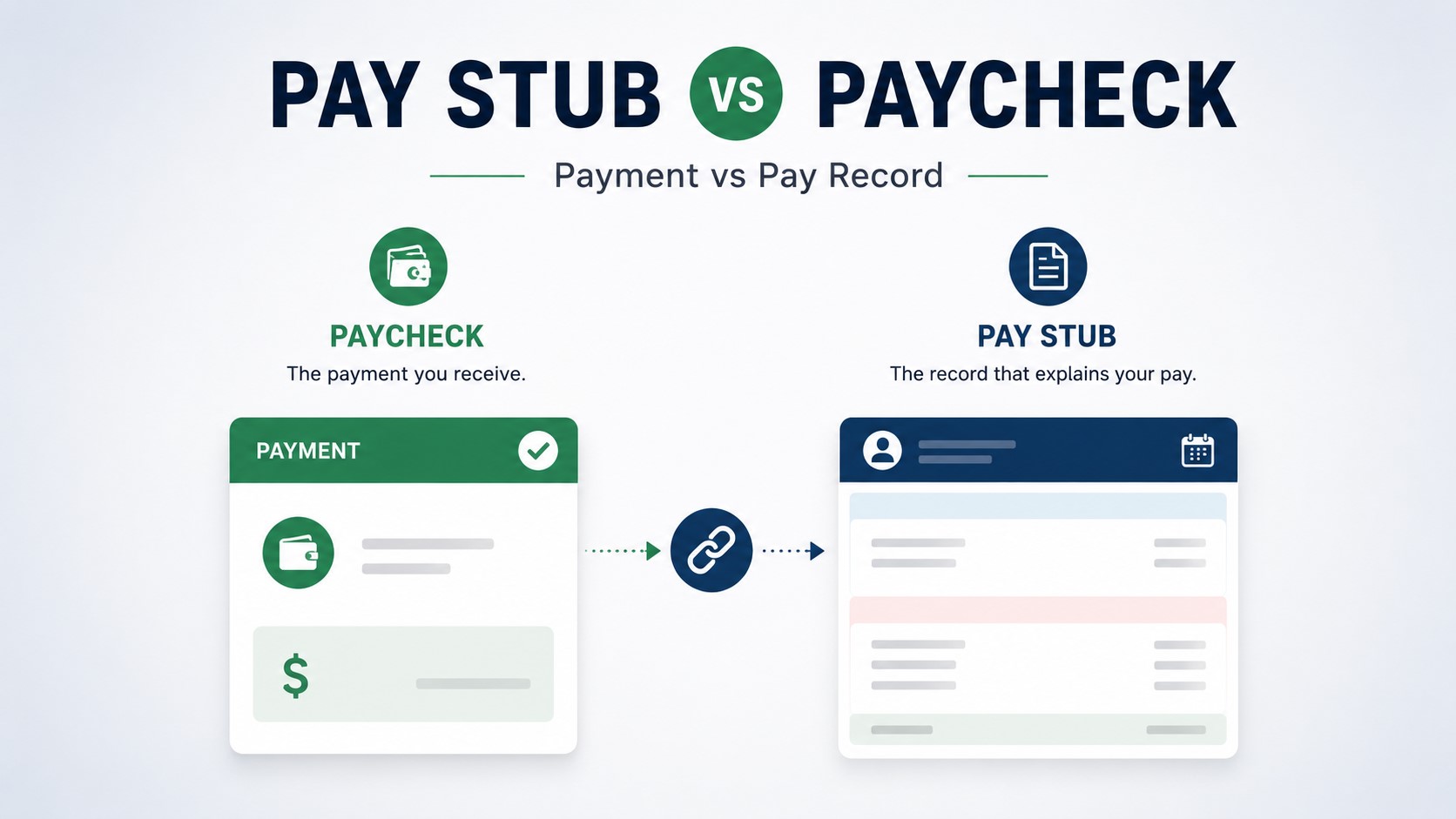
A paycheck is the wage payment. A pay stub is the record that explains how that payment was calculated. The paycheck, direct deposit or other payment method delivers net wages. The pay stub can show the gross earnings, taxes, other deductions and net pay behind that payment.
This is also how Consumer.gov explains the relationship: the paycheck is the money an employer pays, while the pay stub shows earnings and amounts taken out for taxes and benefits.
The difference becomes especially important when you need to verify income, investigate a smaller-than-expected deposit, check payroll deductions or determine whether the amount on a pay stub actually reached your account.
If you only need the general definition of the document, use What Is a Pay Stub?. This page focuses specifically on the difference between the pay stub and the paycheck.
Pay Stub vs Paycheck: What Is the Difference?
A paycheck is the payment. A pay stub is the explanation of the payment.
A paper paycheck has monetary value because it can be deposited or cashed. When wages are delivered electronically, people commonly use the word paycheck to mean the direct-deposit payment even though no physical check exists.
A pay stub is different. It is the payroll statement for the pay period. It explains how earnings, taxes and other deductions resulted in the employee's net pay.
| Feature | Pay stub | Paycheck or wage payment |
|---|---|---|
| What it is | An itemized payroll record | The money paid to the employee |
| Main purpose | Explain how payroll calculated the amount | Deliver wages |
| Gross earnings | Usually shown | Usually not itemized |
| Taxes and deductions | Usually itemized | Normally not itemized |
| Net pay | Shows the calculated take-home amount | Delivers that amount |
| Pay period | Usually identified | May not be obvious from the payment alone |
| YTD totals | Commonly shown | Normally not shown |
| Can it be cashed? | No | A paper paycheck can be deposited or cashed |
| Shows how pay was calculated | Yes | No |
| Confirms payment was delivered | Not by itself | The check, deposit or payment record can confirm delivery |
Easy way to remember it: the paycheck answers "What was paid?" The pay stub answers "How did payroll arrive at that amount?"
One Pay Period Can Create Five Different Records
The strongest way to understand pay stub vs paycheck is to put both inside the full payroll process.
Hours, salary, bonus, commission or other earnings information enters payroll.
Gross earnings are calculated and applicable taxes and deductions are applied.
The statement records earnings, deductions and the calculated net pay.
Net wages are delivered by paper check, direct deposit or another authorized method.
A bank transaction, check record or payroll-card history can show what actually arrived.
These records can contain related numbers without proving exactly the same thing.
| Record | What it helps show | What it does not necessarily prove by itself |
|---|---|---|
| Time or earnings record | Hours or other earnings inputs recorded for payroll | The final amount payroll calculated or paid |
| Pay stub | Earnings, deductions, net pay and often YTD information | That the money successfully reached the employee |
| Paper paycheck | The wage amount represented by the check | The full calculation behind the amount |
| Bank or payment record | The amount that reached a payment destination | Gross earnings and the deductions behind the payment |
| W-2 | Annual reported wage and tax information | The complete detail of one current pay period |
This is the key information gap in many pay stub vs paycheck explanations: the pay stub documents the payroll calculation, while the payment record helps confirm receipt. They are related evidence, but they answer different questions.
Paycheck vs Pay Stub Example
Suppose a fictional employee earns $2,000 during one pay period.
The pay stub records the $2,000 in gross earnings, the $500 in taxes and deductions, and the resulting $1,500 in net pay.
The paycheck or direct deposit delivers the $1,500.
What if that $1,500 goes to two bank accounts?
Suppose the employee has split direct deposit. Payroll sends $1,000 to checking and $500 to savings.
The pay stub can still show $1,500 net pay, while the bank shows two separate deposits. Looking at only the $1,000 transaction would create the false impression that the payment does not match the stub.
For the calculation itself, see gross pay vs net pay.
What Should Actually Match Between a Pay Stub and Paycheck?
Many payroll questions come from comparing numbers that are not supposed to match. Use the same type of figure and the same pay period before deciding something is wrong.
| Comparison | Should it match? | What to check |
|---|---|---|
| Gross pay vs one bank deposit | No | Gross pay is before employee taxes and deductions. A wage deposit generally reflects net pay. |
| Net pay vs total wage payment | Generally yes | Compare the stub's net pay with the full wage payment for that pay period. |
| Net pay vs one split deposit | Not necessarily | Add all payment destinations before comparing them with the stub. |
| Current pay vs YTD pay | No | Current covers one period. YTD is the accumulated total for the year. |
| Pay stub gross vs W-2 Box 1 | Not necessarily | A W-2 uses annual tax-reporting figures and may differ from total gross earnings. |
Before reporting a payroll mismatch: confirm the pay period, identify whether you are comparing gross or net pay, and add all payment destinations associated with that payday.
Which Record Should You Use?
| What you need to do | Best starting record | Why |
|---|---|---|
| Check hours or rate | Pay stub + time record | Lets you compare what was recorded with what payroll calculated |
| Check taxes or deductions | Pay stub | Shows the deductions that reduced earnings |
| Understand gross vs take-home pay | Pay stub | Shows how gross earnings became net pay |
| Confirm money reached an account | Bank or payment record | Shows the payment that actually posted |
| Understand a smaller paycheck | Current and previous pay stubs | Lets you identify the earnings, tax or deduction line that changed |
| Document current wage income | Recent pay stubs plus documents requested by the reviewer | Pay stubs contain more payroll detail than a deposit alone |
| Review annual wage and tax information | W-2 | A W-2 summarizes annual tax-reporting information |
| Investigate a payroll discrepancy | Time record + pay stub + payment record | Together they show what was recorded, calculated and delivered |
Does a Pay Stub Mean You Got Paid?
A pay stub shows what payroll recorded for the pay period, including the stated net pay. It does not independently prove that the funds successfully reached your bank account or other payment destination.
To confirm payment, compare the stub with the paper paycheck, direct-deposit transaction, payroll-card activity or other payment record.
This distinction matters if a pay stub exists but the expected deposit is missing, delayed or different from the amount you expected.
What Changes With Direct Deposit?
Direct deposit changes how wages are delivered. It does not change the role of the pay stub.
Payroll still calculates gross earnings, applies applicable taxes and deductions, and determines net pay. Instead of issuing a physical check, the wage payment is sent electronically.
The related pay stub may be available through a payroll portal, employee portal, application or downloadable document.
One pay stub can correspond to multiple payment transactions. Split direct deposit can send part of the same net pay to checking, savings or another authorized destination.
For a deeper explanation, read Do Pay Stubs Show Direct Deposit?
What If the Pay Stub and Deposit Do Not Match?
Do not start by assuming payroll made an error. First identify where the numbers stop lining up.
Compare the stub with your hours, salary, overtime, bonus, commission or other earnings records for the same pay period.
Review taxes, benefit deductions, retirement contributions, garnishments and other deductions shown on the stub.
Check for split direct deposits, payroll cards or another payment destination before comparing one transaction with total net pay.
Check separate reimbursements, adjustments, off-cycle payments, bank posting details or another transaction associated with the same payday. If you still cannot reconcile the amounts, contact payroll with the relevant records.
Fast payroll check: time or earnings record → pay stub → payment record. This helps separate an earnings-input problem from a payroll-calculation problem or a payment-delivery problem.
If the hours themselves are wrong, use Pay Stub Hours Do Not Match Your Timecard?
If your overall take-home pay suddenly dropped, use Why Is My Paycheck So Low?
Which Is Better for Proof of Income?
A recent pay stub is often more informative than a paycheck or bank transaction when someone needs details about current wage income. The stub can show the employer, employee, pay period, gross earnings, deductions, net pay and often year-to-date totals.
A bank or payment record can help show that money arrived, but it normally does not explain the full payroll calculation.
The requesting organization decides what it accepts. A landlord, lender, agency or other reviewer may request multiple recent pay stubs, bank statements, W-2 forms, tax returns or other supporting documentation.
For the broader document question, see What Is Proof of Income?
If you legitimately do not receive traditional pay stubs, see how to show proof of income without pay stubs.
Is a Pay Stub a Check? Can You Cash It?
No. A pay stub is an informational payroll record, not a negotiable check.
A traditional paper paycheck can have a detachable pay stub attached to it. That physical connection is one reason the terms are sometimes confused. The check is the payment instrument. The stub is the record explaining the payment.
With direct deposit, there may be no physical check at all, while the electronic pay stub still exists.
Does Federal Law Require Every Employee to Receive a Pay Stub?
Federal payroll recordkeeping requirements and employee pay-statement requirements are different issues.
The U.S. Department of Labor's FLSA recordkeeping guidance requires covered employers to maintain specified wage and hour information, including hours worked, wage basis, additions or deductions, total wages paid, payment date and the pay period covered. The guidance also states that the Act does not require employers to use one particular form for those records.
State and local laws can create separate wage-statement requirements, including rules about the information that must appear and how statements may be delivered.
Employers should therefore check the rules that apply where the employee works rather than assume that one national pay-stub format applies everywhere.
Paycheck Stub, Payslip and W-2 Are Different Search Intents
A paycheck stub or check stub generally refers to the pay stub itself, not the wage payment.
A payslip is another term for a payroll statement. For that terminology question, use Pay Stub vs Payslip vs Earnings Statement.
A W-2 is an annual wage and tax statement rather than a record for one pay period. See Pay Stub vs W-2.
Frequently Asked Questions
No. The paycheck or wage payment delivers the employee's net wages. The pay stub is the itemized payroll record explaining the earnings, taxes and other deductions behind that amount.
No. A pay stub and a paper paycheck may be physically attached, but they perform different functions. The check is the payment instrument. The stub is the payroll statement.
A pay stub shows the payroll calculation and stated net pay. To verify that the money actually arrived, also check the paycheck, bank transaction, payroll-card activity or other payment record.
A paper paycheck can have a detachable stub attached to it, but they are still separate records. With direct deposit, the stub is often electronic and no physical check exists.
The pay stub normally itemizes payroll taxes and other deductions. The payment itself generally shows the resulting amount paid rather than the full calculation.
One common reason is split direct deposit. Part of the same net pay may go to another account or payment destination. Compare the total wage payment for the pay period rather than only one transaction.
Create a Pay Stub From Accurate Payroll Information
ePaystubs helps legitimate users organize earnings, deductions, pay dates and year-to-date information into a professional pay stub. The information entered should accurately reflect the underlying payroll transaction.
Create a Pay Stub Online Pay Stub GeneratorSources and Review References
- Consumer.gov: Your Paycheck Explained
- Consumer Financial Protection Bureau: Calculating the Numbers in Your Paycheck
- U.S. Department of Labor: FLSA Recordkeeping Requirements
Source review date: September 11, 2026.