
Pay Stub vs Payslip vs Earnings Statement: Are They the Same Document?
Home › Blog › Pay Stub vs Payslip vs Earnings Statement
Written by the ePaystubs Editorial Team · Last updated: June 2026
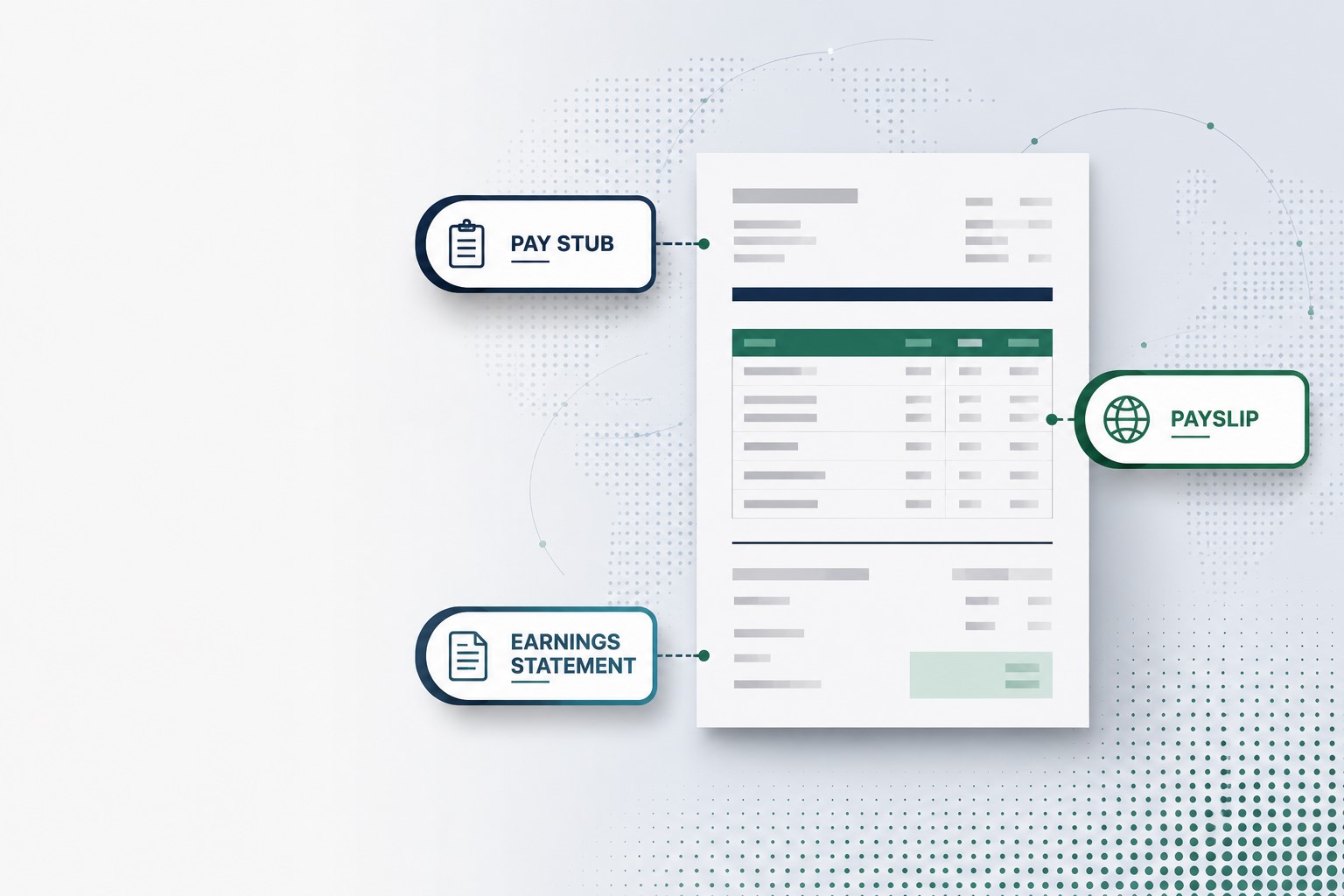
Pay stub, payslip, and earnings statement all describe the same thing: a record of what you earned in a pay period, what was taken out, and what you took home. The names differ by place and formality. "Pay stub" is the usual term in the United States. "Payslip" is more common in the UK and other countries. "Earnings statement," sometimes called a wage statement, is the formal term some employers and states use. The document behind all three is identical.
The short answer: these are different names for one document. If a landlord, lender, or employer asks for any of them, they are asking for the same earnings record.
Below is what each term means, a side-by-side comparison, where each one shows up in real life, and which term makes sense for you to use, whether you are an employee or running a small business.
What each term means
A pay statement or payroll statement is another common label for this type of payroll record. In most workplaces, a pay stub, payslip, pay statement, earnings statement, or wage statement shows the employee’s earnings, taxes, deductions, and net pay for a specific pay period.
The wording changes, but the purpose does not. Each one breaks down a single pay period and shows your gross pay, your deductions, and your net pay.
Pay stub
A pay stub is the standard US term, so when people ask what a pay stub means in the United States, this is it: the per-paycheck record of your earnings and deductions. You will also see it written as "paystub," or called a paycheck stub, check stub, or pay statement. They are all the same thing. The name goes back to the paper era, when you tore the stub off the bottom of a printed paycheck and kept it.
Payslip
A payslip is the same document, and it is the common term in the UK, Australia, India, and many other countries. For a US reader, "payslip" usually just signals that the employer or writer is following international habits, because the payslip means the same thing as a pay stub. The content lines up, though the specific deductions differ because the tax systems differ. A UK payslip, for example, shows National Insurance instead of Social Security and Medicare.
Earnings statement and wage statement
If you are asking whether a wage statement is the same as a pay stub, the answer is usually yes in a payroll context. Both generally summarize earnings and deductions for a specific pay period, although the exact label can vary by employer or payroll system.
Earnings statement is the formal label, and in payroll it means the same per-period record of pay and deductions. Some larger employers and government payroll systems prefer it, and several state labor codes use "earnings statement" or "wage statement" as the legal name for the document an employer must provide. If your employer's portal calls it an earnings statement, it holds the same information as any pay stub.
Pay stub vs payslip vs earnings statement, side by side
The difference between a pay stub and a pay statement is usually terminology rather than purpose. A pay statement normally contains the same core payroll details as a pay stub, including gross pay, taxes, deductions, and net pay. So, is a pay statement the same as a pay stub? In most payroll contexts, yes.
Here is how the three line up.
| Term | Where it is common | Who uses it | What it contains |
|---|---|---|---|
| Pay stub also paystub, paycheck stub, check stub, pay statement |
United States, Canada | Most US employers and workers | Gross pay, deductions, net pay, year to date |
| Payslip | UK, Australia, India, and other countries | Employers and workers outside the US | Same breakdown, with local taxes such as National Insurance |
| Earnings statement also wage statement |
United States (formal and legal use) | Some large employers, government payroll, and state labor codes | Same breakdown; the legal term in several states |
There is one small real difference. Some payslips, especially for hourly workers, put more emphasis on hours worked and pay rate. A pay stub shows the same details, but how prominent they are can vary by employer and payroll system. The categories of information stay the same across all three.
Which term is used where
If you keep running into different words for the same paper, geography explains most of it. In the United States, "pay stub" is what you will hear, and it is what shows up on payroll portals like ADP, Gusto, and Workday. Across the UK and Commonwealth countries, "payslip" is standard. And in formal or legal settings, the document becomes an "earnings statement" or "wage statement."
That legal usage is real, not just style. In Minnesota, for instance, the state Department of Labor and Industry calls the required document an earnings statement and spells out the exact fields it must include each pay period. Other states use "wage statement" the same way. Because these rules and the required fields vary by state, the name you see can depend on where you work.
Where you will actually see each term
- On a US payroll portal: the download is almost always labeled "pay stub" or "pay statement."
- On a UK or Australian payment record: the header reads "payslip."
- In a state wage law or a formal HR system: the document is named an "earnings statement" or "wage statement."
What the document includes
No matter the label, you will find the same core information. A complete record usually shows:
- Your name and your employer's name and address
- The pay period dates
- Gross pay, your earnings before anything is taken out
- Tax withholdings such as federal income tax, Social Security, and Medicare
- Other deductions like health insurance and retirement contributions
- Net pay, the amount you actually receive
- Year-to-date totals for each of these
For a closer look at how these lines appear and read, see our guide to what appears on a pay stub.
Which term should you use?
In the United States, pay stub is the most familiar everyday term, but employers and payroll portals may also use pay statement, earnings statement, wage statement, or payroll statement for the same type of record.
The honest answer is that it rarely matters, because the document is the same. Still, here is a simple way to decide.
| If you are | Do this |
|---|---|
| An employee | Use whatever term your landlord, lender, or agency asks for. A pay stub, payslip, or earnings statement will satisfy the request, since they are the same record. |
| An employer or small business owner | Pick one term and use it consistently across your payroll and your documents. Consistency keeps your team from second-guessing what they received. |
One point for employers on the legal side. There is no federal rule requiring you to hand out a stub, but the U.S. Department of Labor requires you to keep accurate payroll records. Most states go further and require you to give workers access to a wage statement, with the required fields set at the state level.
Can these documents prove your income?
Yes. A pay stub, payslip, or earnings statement is one of the most widely accepted forms of proof of income, and the label does not change that. Landlords, lenders, and agencies care about the numbers on the document, not the word in the header. A bank statement can back it up, and some verifiers ask for both.
Here is a practical example. If a landlord asks for your two most recent pay stubs, you can hand over the records your employer provides even if the portal calls them earnings statements, and a record labeled payslip from an overseas employer works the same way. What the reviewer checks is your income and that it is steady, not the title at the top. If you are self-employed and do not get one from an employer, our guide to proof of income covers the alternatives landlords accept.
One thing that is genuinely different is your W-2. A pay stub covers a single pay period, while a W-2 is a different document that reports your taxable wages for the whole year.
Creating your own pay stub, payslip, or earnings statement
Because all three are the same document, a single tool can produce whichever layout you need. If you are self-employed, freelance, or your employer does not provide one, you can create pay stubs online with the correct fields, or start from a pay stub template and fill in your own details. Whether you call the result a pay stub, a payslip, or an earnings statement, the document and the information on it are the same.
So if the wording ever throws you off, do not let it. Pay stub, payslip, and earnings statement are three labels for one earnings record, and the right one to use is simply the one the person in front of you is asking for.
Frequently asked questions
Is a pay stub the same as a payslip?
Yes. They are the same document. "Payslip" is the common term in the UK and many other countries, while "pay stub" is standard in the United States.
Is an earnings statement the same as a pay stub?
Yes. "Earnings statement" is a more formal name for the same document. Some employers and several state labor codes use it, along with "wage statement."
What is the difference between a pay stub and a payslip?
Mainly the name and the region. The content and purpose are the same. Local taxes differ, so a UK payslip shows National Insurance while a US pay stub shows Social Security and Medicare.
Which term is used in the United States?
"Pay stub," sometimes written "paystub," is the standard US term. You may also see "pay statement," "earnings statement," or "wage statement," especially in formal and legal settings.
What is the difference between a paycheck stub and a pay stub?
None. "Paycheck stub," "check stub," and "pay statement" are all alternate names for a pay stub.
Can a pay stub be used as proof of income?
Yes. It is one of the most accepted forms of proof of income for rentals and loans. The label on the document does not affect its validity.
What information appears on a pay stub?
Gross pay, tax withholdings, other deductions, net pay, and year-to-date totals, along with your name, your employer's details, and the pay period dates.
Do employers have to provide pay stubs?
No federal law requires it, but most states require employers to give workers access to a wage statement. The rules and required fields vary by state.
Can a pay stub generator create a payslip or earnings statement?
Yes. Since these are the same document, one tool can produce the layout you need, whatever you choose to call it.
Is a pay stub the same as a W-2?
No. A pay stub covers a single pay period. A W-2 is an annual tax form that reports your taxable wages and withholdings for the full year.