
Gross Pay vs Net Pay: What Is the Difference?
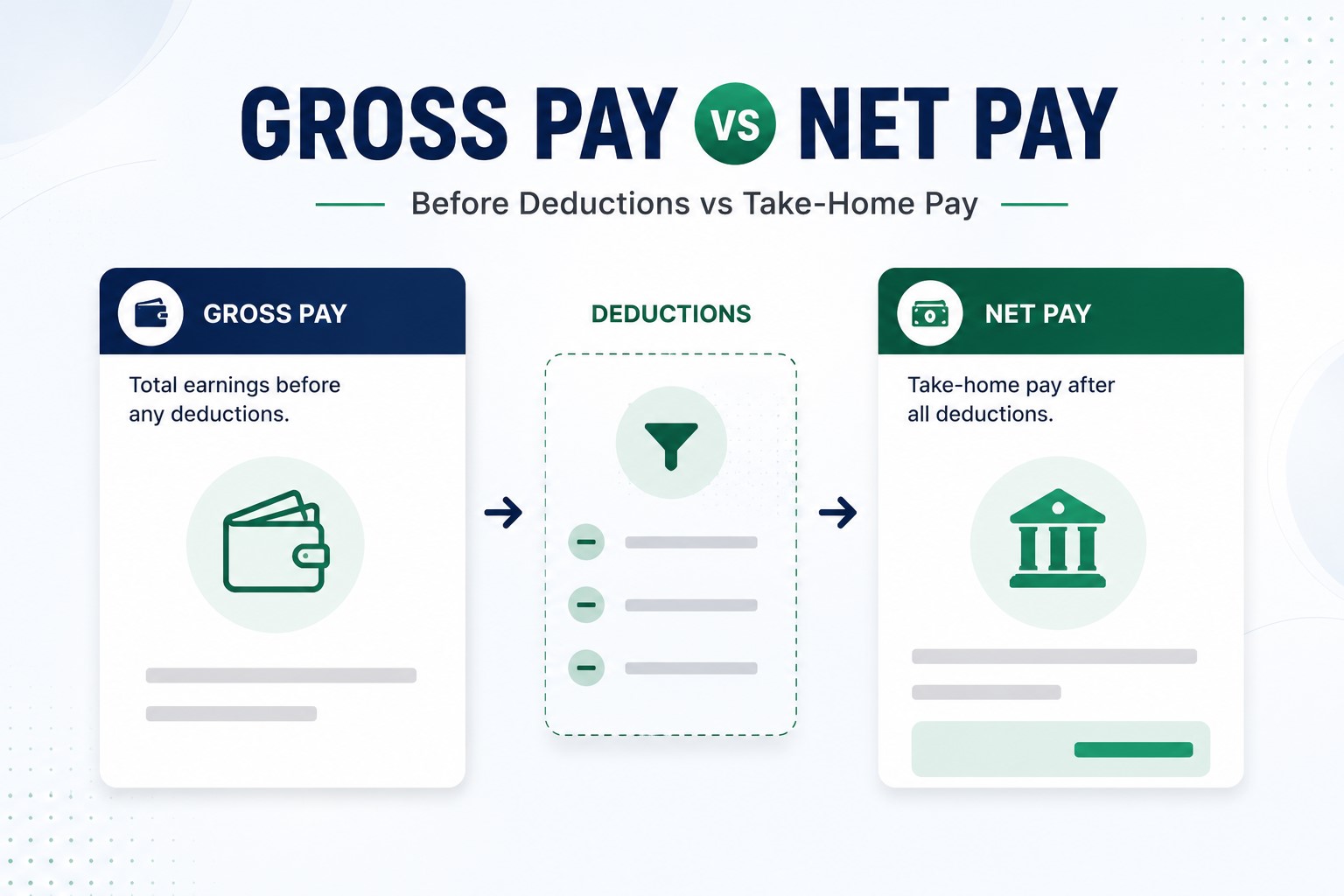
The difference between gross pay and net pay is timing. Gross pay is the employee's earnings for a pay period before payroll taxes and other employee deductions. Net pay, also called take-home pay, is the amount left after the applicable taxes, benefits, retirement contributions, and other deductions are processed through payroll.
What Is the Difference Between Gross Pay and Net Pay?
Is Gross Pay Before or After Taxes?
Gross pay is before employee payroll taxes and deductions. Net pay is after the applicable payroll taxes and deductions are processed. This is why the direct-deposit amount is usually lower than the gross earnings figure on the same pay stub.
What can reduce net pay?
Federal, state, or local withholding where applicable; Social Security and Medicare; benefits; retirement contributions; garnishments; union dues; and other authorized deductions can affect take-home pay.
Is net pay before or after taxes?
Net pay is after the applicable payroll taxes and deductions are processed. It is commonly called take-home pay because it is generally the amount delivered by check or direct deposit.
Federal withholding depends on Form W-4 information and payroll facts. See the IRS tax withholding overview for current official guidance.
What Is Gross Pay and What Does It Include?
Gross pay is the total earnings recorded for an employee for one pay period before employee payroll deductions. The exact earning lines can vary, but gross pay can include:
Common earnings
Regular hourly wages, salary earned for the period, overtime, bonuses, commissions, shift differential, tips processed through payroll, retroactive pay, and other gross earning lines.
What gross pay is not
It is not automatically the same as federal taxable wages, Social Security wages, Medicare wages, W-2 Box 1, or net pay.
How to Calculate Gross Pay
Hourly employee
Regular earnings + overtime earnings + bonus + commission + other earnings = gross pay.
For a simple example, 40 hours at $22 is $880. Six hours paid at an entered $33 overtime rate adds $198. The gross pay is $1,078 before any employee deductions.
Salaried employee
Annual salary ÷ payroll periods + additional earnings = period gross pay.
A $60,000 annual salary paid biweekly has base gross pay of $2,307.69 per period before additional earnings or deductions.
| Pay schedule | Pay periods per year | $60,000 base salary per period |
|---|---|---|
| Weekly | 52 | $1,153.85 |
| Biweekly | 26 | $2,307.69 |
| Semimonthly | 24 | $2,500.00 |
| Monthly | 12 | $5,000.00 |
Simple Gross Pay Estimator
Use this educational estimator to total entered earnings. It does not calculate taxes, deductions, or an official payroll amount.
Choose a pay type, enter the relevant earnings, then calculate.
Gross Salary vs Net Salary, Gross Wages vs Net Wages, and Gross Income
For employee payroll, gross salary vs net salary and gross wages vs net wages follow the same basic rule: gross is before employee payroll deductions, while net is the amount left after applicable deductions. Salary usually describes a fixed rate; wages can describe earnings tied to hours or other payroll work.
Gross income vs net income can have a broader personal-tax or business-accounting meaning. This guide uses the terms in the employee-pay sense. Do not use a business income statement to interpret a pay stub.
How Gross Pay Becomes Net Pay on a Pay Stub
Use this fictional pay-stub flow to read the numbers in order. It shows why one statement can display several similar-looking amounts.
Why Gross Pay and Taxable Wages Can Be Different
Gross pay is total earnings for the period. Taxable wages are wage bases used for specific taxes. A pre-tax benefit may reduce one wage base without reducing every wage base, so the amounts on one pay stub can legitimately differ.
| Figure | What it means | Do not confuse it with |
|---|---|---|
| Gross pay | Total payroll earnings before employee deductions. | Net pay or one tax-specific wage base. |
| Federal taxable wages | Wages used for federal income-tax withholding and reporting after applicable adjustments. | Total gross earnings or net pay. |
| Social Security wages | Wages used for Social Security tax purposes. | Federal taxable wages in every situation. |
| Medicare wages | Wages used for Medicare tax purposes. | Net pay or necessarily the same amount as another wage base. |
| Net pay | What remains after applicable employee taxes and deductions. | A taxable wage figure reported on a W-2. |
For a deeper deduction explanation, read Pre-Tax vs Post-Tax Deductions and What Is FICA on a Pay Stub?. For payroll tax rules, consult IRS Publication 15.
Fictional Gross-to-Net Paycheck Example
This fictional arithmetic example is not a tax estimate or a prediction of anyone's actual withholding.
The deduction total is $666.25, so $2,500.00 − $666.25 = $1,833.75. Benefit and retirement tax treatment can differ by item and tax type. Use current official guidance and the applicable plan or payroll documentation for a specific pay period.
Pay-Stub Reconciliation Check
Enter only dollar amounts from your statement. This checks arithmetic; it does not decide whether taxes, withholding, or deductions were legally calculated correctly. Do not enter a Social Security number, bank information, or other personal identifiers.
Enter your figures, then select “Check My Pay Stub.”
Why Did My Net Pay Change if My Gross Pay Stayed the Same?
Compare the current pay stub with the previous one. If gross pay did not change, look for a change in one of these lines:
| Check this line | Why it can change take-home pay |
|---|---|
| Federal, state, or local withholding | Withholding settings, taxable pay, supplemental wages, or payroll adjustments can change the amount withheld. |
| Benefits | Premiums or benefit elections can start, stop, or change at a new plan period. |
| Retirement contributions | A contribution percentage or fixed contribution can change. |
| Other deductions | Garnishments, union dues, repayments, or authorized deductions may be added or changed. |
| Corrections or additions | A prior payroll correction, reimbursement, or separate payment can make one deposit look unusual. |
If gross pay changed, review hours, rate, overtime, bonus, unpaid time, and pay-period length. For more troubleshooting, see Why Is My Paycheck So Low?.
Is W-2 Box 1 Gross Pay or Net Pay?
Neither. W-2 Box 1 reports federal taxable wages, tips, and other compensation under federal reporting rules. It is not net pay and may not equal total gross earnings.
| Figure | Common use |
|---|---|
| Gross pay | Gross payroll earnings for a pay period. |
| W-2 Box 1 | Federal taxable wages, tips, and other compensation. |
| W-2 Box 3 | Social Security wages. |
| W-2 Box 5 | Medicare wages and tips. |
| Net pay | Take-home amount, not a W-2 wage figure. |
Use the IRS W-2 and W-3 instructions for current box definitions. For a walkthrough, see Calculate W-2 Wages From a Pay Stub.
Frequently Asked Questions
What is the difference between gross pay and net pay?
Gross pay is earnings before employee payroll taxes and other deductions. Net pay is the amount left after the applicable deductions shown through payroll. The pay-stub lines between them explain the difference.
Is gross pay before or after taxes?
Gross pay is before employee payroll taxes and deductions. Net pay is after the applicable taxes and deductions are processed through payroll.
Can gross pay and net pay ever be the same?
It is unusual for a typical employee paycheck because taxes or deductions are often withheld. Compare the actual labeled payroll lines, because a reimbursement, correction, or other non-gross addition can make one payment look different.
Why can overtime or a bonus change net pay so much?
Higher earnings can change withholding and deduction amounts on that payroll. The actual result depends on pay frequency, withholding information, state or local rules, and benefit deductions. Review the pay stub rather than assuming the additional earnings disappeared.
Can federal income-tax withholding be $0 on a paycheck?
It can be zero in some situations, depending on wages and Form W-4 information. Zero withholding on one check does not by itself determine the worker's final annual tax liability.
Are 1099 contractor payments gross pay or net pay?
Gross pay and net pay are payroll terms most commonly used for employees. Independent contractors are generally not paid through employee payroll withholding, so their payment and tax situation should be reviewed separately.
Is wage garnishment based on gross pay or net pay?
Garnishment rules can use “disposable earnings,” which is not automatically the same as gross pay or net pay. The applicable order and law control; use payroll or qualified legal guidance for a specific situation.
Why can my bank deposit differ from net pay?
Split deposits, reimbursements, manual checks, corrections, or separate payments can make one bank transaction differ from the net-pay line. Compare all payment and payroll records for the pay period.
Official Sources
Need a Clear Payroll Record?
ePaystubs can help organize legitimate payroll information into a readable record. Use real, supportable earnings, deductions, and tax information.
Create a Pay Stub