
How to File Taxes When Your W-2 Shows Two States
W-2 series for
A W-2 can show wages and withholding for more than one state if you moved, worked across state lines or had wages reported to both your home and work state. The presence of two state entries does not automatically mean you earned twice as much or owe tax twice on every dollar.
Identify your residency and work history
Create a dated record of the states where you lived and physically worked. Identify permanent moves, temporary travel, remote work, and whether the employer has different payroll locations. Then check each state's rules for residency, income sourcing, and filing thresholds. Some states have special rules for remote employees or reciprocal agreements with neighboring jurisdictions.
Two common reporting scenarios
| Scenario | Federal Box 1 | State A Box 16 | State B Box 16 |
|---|---|---|---|
| Split-year work allocation | $80,000 | $30,000 | $50,000 |
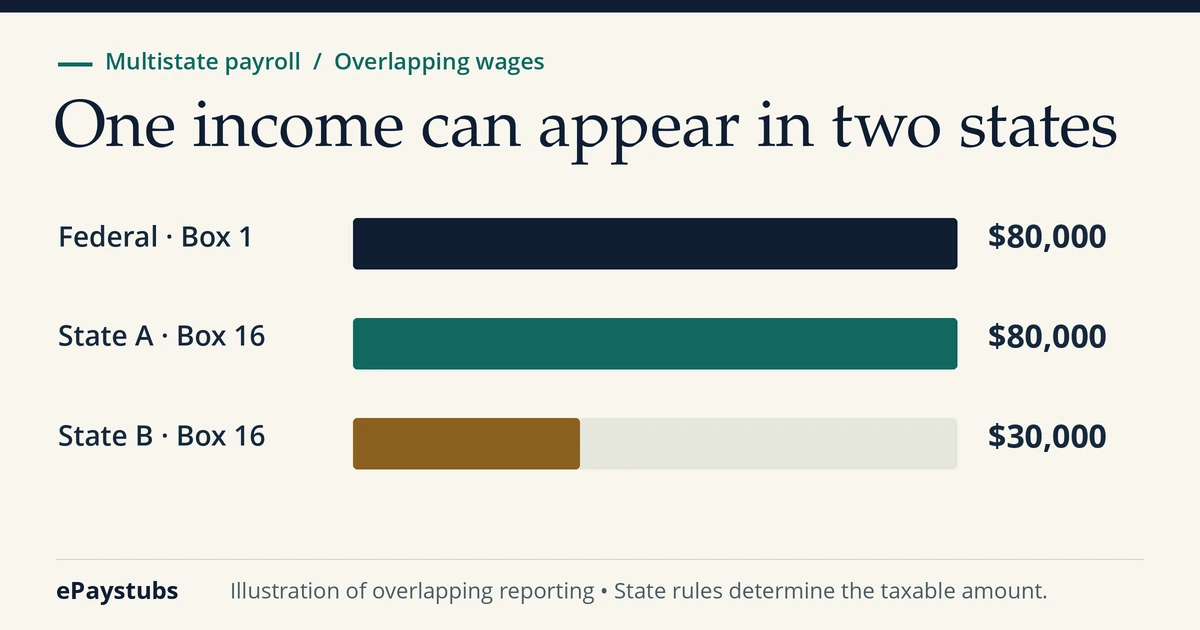
| Resident and work-state reporting | $80,000 | $80,000 | $30,000 |
These fictional scenarios are illustrative, not calculations under any particular state's law. In the second scenario, $30,000 can be part of the same income already reflected in State A's wage amount. Adding the two state entries to federal income would be wrong. The correct taxable state amount must be determined under the applicable state rules.
Which state returns might be needed?
A full-year resident return generally considers income from all sources under the state's rules. A nonresident return may be needed for income sourced to another taxing state. A part-year return may apply when you change residence during the year. Credits for tax paid to another state may reduce overlapping taxation, but they are not automatic and the availability and calculation depend on the jurisdictions.
Reciprocity is a separate issue. Where an agreement applies, employees may be able to avoid work-state wage withholding after providing the correct documentation. Do not assume all neighboring states have agreements or that every kind of income qualifies.
Steps before filing
- Keep each Box 15–17 row separate in your tax software.
- Confirm the residence and work dates used to calculate any allocation.
- Obtain current instructions from both state tax agencies.
- Investigate any unexpected state withholding with payroll; request correction if the underlying report is wrong.
- Seek professional advice if remote-work sourcing or credits are uncertain.
See our W-2 boxes guide for the fields and the incorrect W-2 guide if you suspect a reporting problem.
Frequently asked questions
Do I need to file in both states? It depends on residency, income sourcing and filing thresholds; the W-2 alone cannot determine this.
Does state withholding equal tax due? No. Withholding is a payment toward the applicable liability.
What if I work from home in another state? Check both states' remote-work sourcing and withholding rules; do not assume the office state always controls.