
Bank Statement vs Pay Stub for Rental: Which Proves Income Better?
Home › Blog › How to Get Pay Stubs
To get pay stubs online, open the employee payroll portal your employer uses, sign in, select Pay, Paychecks, Pay History, Pay Statements or a similarly named menu, choose the pay date, and download the original pay stub. If you do not know your portal, check your onboarding or pay-notification email and ask HR or payroll for the official link. With direct deposit, look in the employer's payroll system, not your bank's transaction history.
How to Get Pay Stubs Online From Your Employer in Five Steps
- Find your company's official payroll link. Use the employee intranet, onboarding email, prior pay notification or a link confirmed by HR. Your employer might have its own branded login even when it uses a well-known payroll company.
- Sign in to your employee account. Complete any required identity check or employer-issued registration. Do not enter payroll credentials into an unsolicited email or a search ad.
- Open the pay-statement area. Look for Pay, Paychecks, Pay History, Earnings, Statements or Documents. Choose your employee profile if the portal shows more than one role.
- Select the correct paycheck. Match the pay date and the pay period separately. A Friday deposit may pay for work completed in an earlier week or month.
- Open and save the employer-issued document. Choose Download PDF, View/Print or an equivalent option. Keep the original unchanged and store it securely.
A paycheck deposited on September 18 could cover work performed September 1–14. If a landlord requests your two most recent stubs, filter the payroll history by pay date first and verify the covered work periods on the actual statements. Dates here are illustrative, not a universal payroll schedule.
How to download, print and verify the original PDF
On a computer, open the pay statement first, then use its Download PDF or Print command. On a phone, open the provider's app or use the portal's mobile browser view; download the statement to a secure location rather than saving sensitive payroll details on a shared device.
- Check the correct employee name, employer, pay date and pay period.
- Confirm gross pay, itemized deductions, taxes and net pay are shown when needed; some legitimate formats omit fields such as YTD totals.
- Check whether the recipient wants one stub, two recent stubs or a specific date range. Save each requested period separately.
- If the PDF opens blank, try the provider's browser version or official app, enable downloads/pop-ups for that verified site as needed, and ask payroll for a copy if the problem persists.
How to Download Several Pay Stubs or Find Older Pay Dates
Start by checking the date range in your pay history. Some employee accounts open to only recent checks, so a missing old statement may be hidden by a filter rather than deleted. If you need a set of records for a lender or landlord, check exactly which pay dates they require before downloading.
- QuickBooks Workforce on the web: open Paychecks, set the date range and select the required checks. Intuit says the web view can display paychecks in windows of up to six months at a time; change the range for a different period. The mobile app uses Money → All Paychecks and a date filter. See Intuit's employee instructions.
- Gusto in a web browser: open your employee Pay section. Select an individual stub and Download PDF, or use Bulk download and select a year when that option is shown. Gusto's app provides Show pay history and Show paystub PDF. See Gusto's employee guide.
- Other providers: use Pay History or the available date filter, select the requested statements and download them individually when bulk export is not offered. If older paychecks remain unavailable, ask payroll whether a former provider or archive holds them.
To understand the fields on an authentic statement, use our guide to reading a pay stub.
How to Find Your Employer's Payroll Portal
If you cannot remember the provider, search old onboarding emails or pay notifications for your employer's name along with “pay statement,” “payslip,” “direct deposit advice,” “employee self-service,” or “payroll.” Check your employee handbook or intranet. If you receive a direct deposit, your bank transaction may identify the payer, but it does not reliably identify the employee login system.
Ask HR or payroll: “Which employee payroll portal holds my pay statements, what is our official sign-in link, and do I need an invitation or registration code?” This is more useful than creating new accounts with every payroll provider.
Where to Find Pay Stubs in ADP, Gusto, QuickBooks Workforce and Other Systems
Menus depend on your employer's subscription, configuration and whether you use the mobile app or browser. These are navigation starting points, not guarantees that every employer has enabled employee access.
| Provider | Where to find the statement | If you cannot get in |
|---|---|---|
| ADP | Use the ADP employee login enabled by your employer. Open Pay or Pay Statements and select the relevant pay date. ADP's employee login and registration instructions. | If you have never registered, your employer must provide the self-service registration code. If the password reset fails or access is disabled, contact your current or former employer's HR/payroll team. ADP employee account help. |
| Gusto | In your employee profile, open Pay, choose the statement, then Download PDF. In the mobile app, select a pay stub from Pay and look for Show paystub PDF. Gusto's employee instructions. | If a pay date is missing, confirm the employer processed payroll; earlier statements might be in a previous payroll system. |
| QuickBooks Workforce | Web: sign in to Workforce, choose Paychecks and the date range. App: open Money, then Latest Paycheck or All Paychecks, View details and Download. Intuit's current employee instructions. | Ask the employer to invite or re-invite you if the employee account has not been set up. |
| Paychex | Confirm which Paychex product your employer uses, then open its employee pay or check-stub section and choose the statement. Start from the official Paychex login directory. | For Paychex Flex, use the login assistant or account-recovery options on the official sign-in page. Ask the employer to confirm which product and email are associated with your payroll account. |
| Workday, UKG or Paylocity | Use your employer-specific employee portal and look for Pay, Payslips, Pay Statements, Pay History or Checks. Workday says staff should obtain their company's unique sign-in link from HR or IT. Workday sign-in guidance. | Ask your employer's HR, payroll or IT administrator to confirm the portal URL, account permissions, and where earlier statements are stored. |
Forgot Password, No Invitation, or Account Disabled: Who Can Fix It?
These problems look similar but have different remedies. Try the self-service action only when your account is already registered; ask the employer to resolve missing permissions or an unavailable invitation.
| What happened | Try first | Contact if it fails |
|---|---|---|
| You registered before but forgot your password | Use the provider's official Forgot Password or username-recovery option and complete its verification steps. | Ask HR/payroll to confirm your account email and whether employee access is active. |
| You never received an invitation or code | Search onboarding emails, including spam, for an employer-approved invitation. | Ask payroll/HR to send the invitation or registration code; do not create a random account with a different provider. |
| You left the company or your account was disabled | Check whether your former employer has a separate former-employee login. | Ask former HR/payroll to restore access if allowed, or securely send original statements for your exact pay dates. |
| Password reset works but no statements appear | Check the correct employee profile, year/date range and whether payroll moved to another system. | Ask payroll which provider holds the missing dates and whether statements have been released. |
For ADP, the employer controls initial online access and the registration code; ADP directs employees to their employer for access issues. Official ADP employee support. Do not share passwords, full Social Security numbers or bank credentials with anyone offering to retrieve pay records.
How to Get a Pay Stub When You Have Direct Deposit
Direct deposit transfers your pay to a bank account. The pay stub is the separate employer-issued record explaining the payment. Open your employer's payroll portal or app and choose the statement with the corresponding pay date. If the employer does not provide self-service access, request the statement from payroll.
Suppose an illustrative employer-issued statement records $2,000 gross earnings, $350 taxes, and $150 other deductions. The net pay is $1,500. You told payroll to deposit $900 to checking and $600 to savings.
| Statement or deposit record | Amount | Meaning |
|---|---|---|
| Gross earnings | $2,000 | Pay before employee taxes and deductions. |
| Taxes plus other deductions | −$500 | $350 plus $150 subtracted from gross pay. |
| Net pay on pay stub | $1,500 | The amount payroll says was payable after deductions. |
| Checking deposit | $900 | One destination, not the full net paycheck. |
| Savings deposit | $600 | Second destination from the same payroll payment. |
| Total bank deposits | $1,500 | $900 + $600 equals the stated net pay. |
If you see only $900 in checking, do not assume $600 is unpaid. Review all accounts or payment destinations listed in your payroll setup, then compare the total received with the net pay for the same paycheck. A bank posting date may differ from the employer's pay date. If the total still differs, ask payroll whether there was a split payment, reimbursement, reversal, correction or payment delay; use your bank to investigate an unreceived transfer.
Can your bank give you an employer-issued pay stub?
Usually not. A bank generally records the deposit amount, posting date and transaction description, not the employer's complete wage calculation, hours, tax withholding or benefit deductions. Download the full statement from payroll. If a lender or landlord will accept a bank statement instead, confirm its requirements and redact unrelated transactions only if the recipient permits it.
Our pay stub versus paycheck guide explains the difference between the payment and its supporting statement.
Pay Stub Missing? Diagnose the Actual Problem
| What you see | What to check | Next action |
|---|---|---|
| Money arrived, but no pay stub appears | Pay date, account/profile, date filter and whether the employer has posted the statement. | Ask payroll for the original pay statement for that deposit date. |
| Portal shows only recent paychecks | Year/date-range selector, former payroll provider and whether the employer migrated systems. | Request archived copies from HR/payroll for specific dates. |
| Access or registration fails | Correct employer-specific login, email on file, invitation, account role and official recovery options. | Contact HR or the payroll administrator; a provider cannot always restore employer-controlled permissions. |
| PDF will not download on mobile | App versus browser navigation, pop-up/download settings and whether the PDF opens in a new tab. | Try the official desktop portal, then request secure PDF delivery from payroll if needed. |
| The deposit and net pay differ | Split deposits, pay dates, reimbursements, adjustments and missing payments. | Ask payroll for an itemized explanation; contact your bank about a bank-posting issue. |
What if your payroll portal is locked?
Use the official Forgot Password or account recovery function. If your email or phone number changed, or the account belongs to a former employer, contact the employer's payroll or HR administrator. Ask for the original PDFs while access is being resolved. Do not keep guessing passwords or give remote access to an unsolicited caller.
How to Get Pay Stubs From a Previous Employer
Try the former-employee portal using the account you used while employed. If that account is inactive, send a written request to the previous employer's payroll or HR department with your former employee ID (if known), approximate employment dates and exact pay dates. Request secure delivery and ask what identity verification is required.
For records from several years ago, a closed employer, a missing administrator or a portal migration, see our dedicated old pay stubs from a previous employer guide. This page focuses on obtaining regular employer statements online; the separate guide covers deeper historical-record recovery.
How to get your last or year-end pay stub
In Pay History, choose the last paycheck date in the calendar year, which may not be the same as your last day worked. Read the pay period and year-to-date totals shown on that statement. A final or year-end stub is not a Form W-2; the two documents serve different purposes.
What if the company closed?
Try a successor business, previous owner, bookkeeper or payroll administrator. Ask whether a payroll provider or archived record administrator can release your documents after verifying your identity. If the original statement is unavailable, ask the organization requesting proof of income which alternative records it will accept. IRS wage and income transcripts show certain reported annual information-return data; they are not substitutes for itemized employer-issued pay stubs.
How Long Are Payroll Records Kept, and Must an Employer Provide Pay Stubs?
Under the federal Fair Labor Standards Act, covered employers generally keep payroll records for at least three years; certain wage-computation records generally have a two-year retention period. Those federal recordkeeping requirements do not guarantee that the original downloadable PDF is still in an employee portal or create a universal federal right to obtain every requested pay stub. U.S. Department of Labor: FLSA recordkeeping.
The U.S. Department of Labor also states explicitly that the federal FLSA does not require employers to provide employees with pay stubs. State wage-statement requirements may apply, so check the law of the state where you worked before asserting a particular access deadline.
What if your employer will not give you a pay stub?
Send a dated written request specifying the pay periods and asking for the company's official records-request procedure. Keep the request and response. Wage-statement and access rights vary by state and employment situation, so consult the labor department for the state where you worked about the applicable rules and complaint process. Federal record retention and employee access are separate legal questions.
What Can You Use if the Original Pay Stub Is Unavailable?
Ask the landlord, lender, agency or other requester what it accepts before substituting another record. These documents answer different questions:
| Document | What it helps show | Important limitation |
|---|---|---|
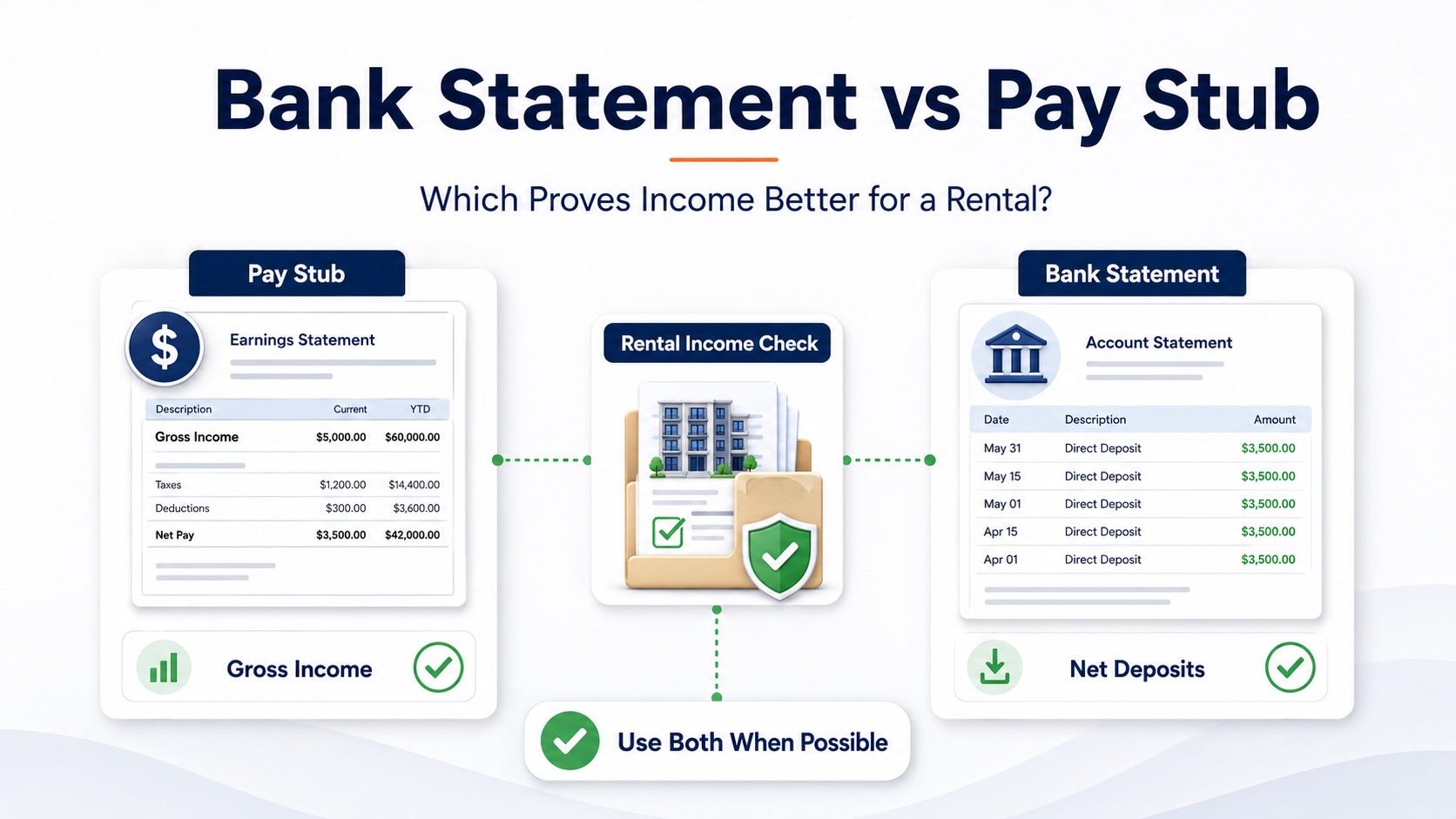
| Bank statement | Payment amount, date and payer description. | Usually does not show gross wages and itemized payroll deductions. |
| Form W-2 | Reported annual wages and tax information. | Does not itemize each pay period or necessarily prove current employment. |
| Employment verification letter | Employment status or pay information if stated by the employer. | Not the employer's period-specific payroll calculation. |
| IRS wage and income transcript | Information-return data received by the IRS, such as W-2 information. | Not an employer pay stub; reported data may be incomplete or unavailable for a recent period. |
See acceptable proof-of-income alternatives and the IRS transcript guide for document-specific guidance.
Copy-and-Paste Email to Request Your Pay Stubs
Subject: Request for employer-issued pay stubs for [pay dates]
Hello [HR or Payroll Contact],
Please provide copies of my original employer-issued pay statements for [list exact pay dates or pay periods]. My name while employed was [name], and my employee ID was [ID, if known]. I worked for [company] approximately [start date] through [end date, if applicable].
Please let me know which secure portal or identity-verification process I should use. If possible, I would appreciate the files by [deadline].
Thank you,
[Name]
[Current contact information]
Do not put a full Social Security number, password or bank account details in ordinary email. Confirm the recipient and use the employer's secure verification procedure for sensitive information.
Need a New Pay Stub for an Actual Payment?
Retrieving an existing employer-issued pay stub is different from creating a new payroll document. Employers and people documenting their own real payments can use accurate underlying pay records to prepare a new statement. Do not generate a document and present it as an original historical statement from another employer.
Explore the ePaystubs pay stub generatorFrequently Asked Questions
Can I download multiple pay stubs at once?
It depends on the payroll provider and your employer's account configuration. Gusto offers year-based bulk downloads in its web employee Pay area, while QuickBooks Workforce lets web users choose paychecks within a selected date range. If a bulk option is unavailable, download each required pay date or request the records from payroll. See provider-specific steps above.
Can I get my pay stub without an employee portal?
Yes, if your employer can provide it through another channel. Ask HR or payroll for the original statement covering the required pay date, ideally through a verified secure delivery method.
Why is my direct deposit visible before the pay stub?
The bank's posting time and the employer's statement publication time can differ. Check the pay date and payroll portal again, then contact payroll if the document remains missing. Do not assume every provider posts stubs before payday.
How many pay stubs should I download for proof of income?
Download the exact number and date range requested by the recipient. Requirements differ by lender, landlord and application, so do not assume that two stubs always suffice.
Can I make a replacement for a missing pay stub from an old job?
Do not create a new document and represent it as the old employer's original statement. Request authentic records or ask the intended recipient which legitimate alternative documents are acceptable.
- ADP employee pay statement and registration help
- Gusto: View and understand your pay stub
- QuickBooks Workforce: View/download your pay stubs
- U.S. Department of Labor: Payroll record retention
- IRS: Wage and income transcripts
- U.S. Department of Labor: Are employers required to provide pay stubs?
- ADP: Employee registration and login help
Editorial note: This guide provides general U.S. payroll-record information. Employee access, state wage-statement requirements and payroll-provider menus vary. For an authentic historical statement, use your employer's official records system.
About the author: Marcus Hale writes pay stub and payroll explanations for ePaystubs. The instructions above reflect the linked payroll-provider and government documentation; they are not a substitute for individual payroll or legal advice.