
How Many Pay Stubs Do You Need for an Apartment? 2 to 3 Is Common
By ePaystubs Editorial Team | Updated June 22, 2026
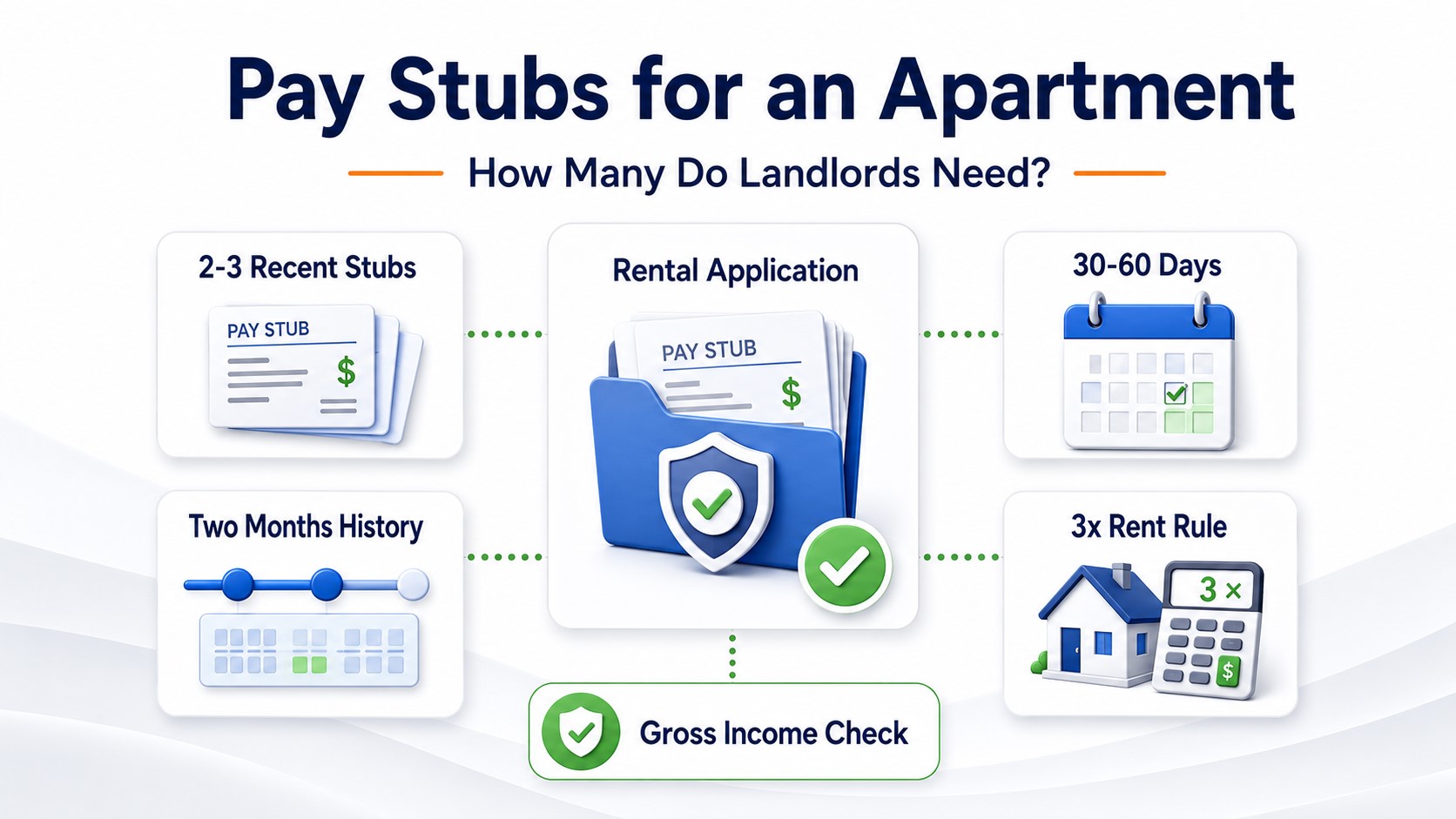
Most landlords ask for 2 to 3 recent pay stubs, dated within the last 30 to 60 days. The exact number depends on how often you're paid, since what landlords really want is about two months of income history: roughly 8 weekly stubs, 4 biweekly, or 2 to 3 monthly. Alongside the count, they apply the 3x rent rule, your gross monthly income should be at least three times the rent. This guide covers the numbers, what landlords look for, and what to do if you don't have stubs.
Finding the apartment is the fun part. Then comes the application, and the request for pay stubs, which is where a lot of renters get stuck wondering exactly how many to bring and whether their income is high enough. The good news is the standard is consistent and easy to hit once you understand what landlords are really checking for. We're a pay-stub resource, so this is a clear, practical walkthrough of the numbers landlords expect and what to do if your situation is not the standard one.
- The short answer
- By pay schedule
- How much income
- What landlords check
- No pay stubs?
- A note on honesty
The Short Answer: 2 to 3 Recent Pay Stubs
Most landlords and property managers want 2 to 3 of your most recent pay stubs. That is the near-universal standard across the country, whether you are applying to a large apartment complex or renting from an independent landlord.
The reason is simple. Your pay stubs answer three questions a landlord cares about: is your income enough to cover the rent, is it steady, and is it current. Two or three recent stubs answer all three at once, which is why it has become the default request.
It Depends on Your Pay Schedule
Here is the part that confuses people. The "2 to 3 stubs" answer is really shorthand for about two months of income history. So the actual count depends on how often you are paid.
| If you're paid… | You'll typically show… | Covering |
|---|---|---|
| Weekly | About 8 stubs | ~2 months |
| Bi-weekly (every 2 weeks) | About 4 stubs | ~2 months |
| Semi-monthly (twice a month) | About 4 stubs | ~2 months |
| Monthly | 2 to 3 stubs | 2 to 3 months |
One more thing worth knowing: electronic pay stubs are just as valid as paper ones. As long as they are accurate and you can print or share them clearly, a PDF is fine for almost any landlord.
How Much Income You Need: the 3x Rent Rule
The companion to "how many stubs" is "how much income." The benchmark almost every landlord uses is the 3x rule: your gross monthly income should be at least three times the monthly rent.
This is the flip side of a long-standing guideline that housing should take up no more than about 30% of your gross income. That 30% figure is the same threshold the U.S. Department of Housing and Urban Development uses to define a household as "cost-burdened," so the 3x rule has real grounding behind it, not just landlord preference.
What Landlords Actually Look At
Landlords are not reading every line of your stub. They scan quickly for a handful of specific things, so make sure these are clear and consistent across the stubs you submit.
- Your name matches your ID and application exactly
- Employer name is clearly listed, and consistent across stubs, which shows steady employment
- Pay period dates and pay date prove the stub is current and regular
- Gross pay is the figure they run the 3x test on
- Year-to-date (YTD) earnings prove consistency over the year, not just one good month
What If You Don't Have Pay Stubs?
Plenty of renters do not have traditional stubs, and landlords know it. Here are the common alternatives, matched to your situation.
| Your situation | What to provide instead |
|---|---|
| New job, no stubs yet | An offer letter stating your salary, plus your first stub when it arrives |
| Self-employed or freelance | Tax returns, a profit-and-loss statement, or 1099s |
| Paid in cash | Bank deposit history showing consistent income |
| Retired | A pension statement, 1099-R, or Social Security benefit letter |
| Student or no income | A guarantor or cosigner (usually a parent) who meets the income test |
If you are self-employed, our guides on proof of income when self-employed, 1099 proof of income, and proof of income when paid in cash cover what works for a rental. For the full set of options without stubs, see proving income without pay stubs, and for the complete application picture, proof of income for an apartment.
A Note on Honesty (the Fraud Question)
It is worth answering the question people actually search for: can you get an apartment with fake pay stubs? The honest answer is no, you should not, and increasingly you cannot.
The Bottom Line
Bring 2 to 3 current stubs, dated within 60 days, enough to show about two months of income, with your gross income at roughly 3x the rent. Have them ready before you apply, because in a competitive market the renter whose paperwork is already in order often gets the unit.
If you are paid by direct deposit and do not have easy access to your stubs, or your employer does not issue them, you can create a pay stub from your real income to submit with your application. The figures just need to be accurate, which they always should be.
Frequently Asked Questions
Most landlords want 2 to 3 recent pay stubs, dated within the last 30 to 60 days. The exact number depends on your pay schedule, since they're really after about two months of income history, roughly 8 weekly stubs, 4 biweekly, or 2 to 3 monthly.
Within the last 30 to 60 days in most cases. Landlords want proof you currently have income, so stubs older than 60 days are usually rejected. If you've lost a recent one, ask your employer or HR, or supplement with a bank statement showing the deposit.
The standard is the 3x rule: your gross monthly income should be at least three times the monthly rent. For $1,800 rent, that's about $5,400 per month. Competitive markets like New York or San Francisco may require 3.5x or more. With roommates, your combined income needs to meet the threshold.
They want roughly three months of income history. That's six biweekly or semi-monthly stubs, or about six weeks of weekly stubs. Landlords ask for more when they want a longer view of your income stability, common in competitive or higher-end rentals.
Yes. Electronic pay stubs are just as valid as paper ones, as long as they're accurate and you can print or share them clearly. Most landlords accept PDFs, just make sure all the details are legible.
You shouldn't, and increasingly you can't. Submitting a falsified pay stub is fraud, and landlords verify income by calling employers, checking bank statements, and using verification software. If you have real income but no stubs, document it honestly with bank statements, tax returns, or a pay stub built from your real earnings.
Landlords accept alternatives: tax returns (often 1 to 2 years), a profit-and-loss statement, 1099s, or bank statements showing consistent deposits. See our guide on proof of income when self-employed for the full set of options that work for a rental application.