
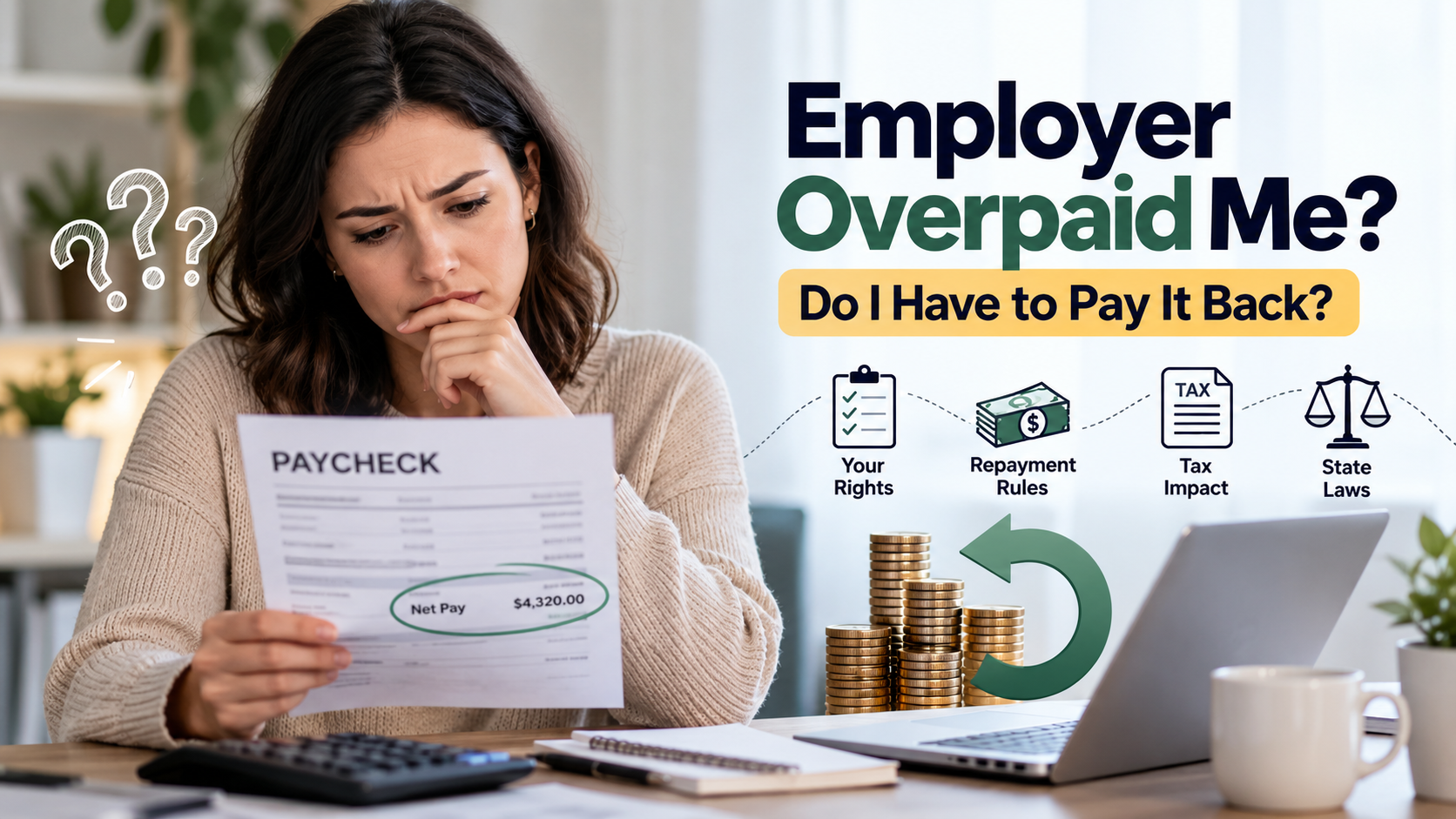
Employer Overpaid Me: Do I Have to Pay It Back? 2026 Guide
Employer Overpaid Me: Do I Have to Pay It Back? 2026 Guide
How this guide was researched: Federal payroll-tax treatment was checked against current IRS Publication 15, the 2026 General Instructions for Forms W-2 and W-3, and IRS repayment guidance. Wage-recovery sections use U.S. Department of Labor guidance and official labor-agency materials from California, New York, Oregon, and Texas. ACH reversal information is based on current Nacha guidance.
This article explains general payroll and tax rules. State law, contracts, collective bargaining agreements, public-sector rules, and individual facts can change the result. It is not a substitute for legal or tax advice.
If your employer says you were overpaid, do not begin by asking how quickly you must return the money. First determine whether a genuine payroll error occurred, how the employer calculated it, whether the employer may recover it directly from wages, and how the repayment should be reflected in payroll and tax records.
A payroll overpayment can look simple when an extra deposit appears in your account, but several different questions may be involved. The employer may have made an obvious clerical mistake, or there may be a disagreement over whether you actually earned a bonus, commission, PTO payment, holiday pay, or other compensation.
If you truly received wages you were not entitled to receive, your employer may seek repayment. That does not automatically mean it can deduct any amount it chooses from your next paycheck. State wage-deduction laws can impose notice, authorization, percentage, timing, or dispute requirements. The tax treatment also changes when repayment occurs in a different calendar year from the original wage payment.
Keep the original pay stub, direct-deposit record, time record, compensation documents, and repayment notice. A correction should be handled through the employer's payroll records. Employees should not recreate or modify employer-issued historical records to make them appear corrected.
Payroll Overpayment Decision Map
Use this sequence before deciding what the next step should be.
First Determine Whether It Is Actually an Overpayment
Not every payment an employer later questions is a simple payroll mistake.
| Type of issue | Example | What should be checked |
|---|---|---|
| Clear clerical error | A paycheck was duplicated or the wrong hourly rate was entered by mistake. | Payroll register, rate of pay, time records, and original pay stub. |
| Hours error | Payroll paid 90 hours when the employee worked 80. | Approved timecard, overtime calculation, payroll period, and rate. |
| Duplicate bonus or commission | The same incentive payment was processed twice. | Commission statement, bonus approval, compensation plan, and payroll register. |
| Compensation-entitlement dispute | The employer later says PTO, holiday pay, commission, bonus, or another earning was not actually owed. | Employment agreement, compensation policy, PTO policy, commission plan, and related written communications. |
The distinction matters. A duplicated direct deposit may be easy to prove. A dispute over whether a commission was earned can require reviewing the compensation agreement rather than simply subtracting two payroll numbers.
What Records Should You Request Before Repaying Anything?
Ask payroll or HR for enough information to reproduce the calculation yourself.
If you need help reading the underlying statement, use the ePaystubs guide on how to read a pay stub line by line.
Please provide the affected pay dates, what I should have been paid, what I was actually paid, the gross overpayment, the employee taxes and deductions included in the calculation, the total amount you are requesting back, the proposed repayment method, and how the correction will affect my current and year-to-date payroll records.
Do You Have to Repay It, and Can the Employer Deduct It From Your Paycheck?
These are related but different questions.
| Question | What it means | Main evidence |
|---|---|---|
| Was money genuinely overpaid? | Whether payroll paid wages that were not actually earned or owed. | Time records, rate, compensation plan, payroll register, and original pay stub. |
| Can the employer recover it? | Whether the employer has a valid repayment claim. | Applicable law, agreement, payroll records, and facts. |
| Can the employer deduct it directly from wages? | Whether recovery may occur through future payroll. | State wage-deduction laws, written authorization, notice, percentage limits, and dispute rights. |
| How should taxes be corrected? | Whether wages and withholding can be adjusted in payroll. | Calendar year of payment and repayment plus IRS payroll rules. |
This distinction prevents one of the most common errors in payroll-overpayment articles: assuming that because an employer has a legitimate repayment claim, it automatically has unlimited authority to take the money from the next paycheck.
Can an Overpayment Deduction Take Pay Below Minimum Wage?
The federal answer is more nuanced than a simple nationwide rule.
The Texas Workforce Commission, relying on U.S. Department of Labor opinion-letter guidance, explains that recovery of a documented genuine wage overpayment can be treated similarly to recovery of a wage advance for federal Fair Labor Standards Act purposes. In that context, recovery of the principal may potentially reduce the employee's pay below minimum wage. Texas independently requires qualifying wage deductions to be specifically authorized in writing under state law. See the Texas Workforce Commission wage-overpayment guidance.
The underlying federal opinion letter is U.S. Department of Labor Opinion Letter FLSA2004-19NA.
This does not mean every deduction is automatically lawful. State law can be more protective, and additional amounts such as interest or administrative charges can raise separate minimum-wage issues.
Do not use the FLSA treatment of a genuine wage advance or overpayment as a universal answer. California, New York, Oregon, Texas, and other states can impose different rules on the actual payroll deduction.
Payroll Overpayment Rules Can Change Dramatically by State
A useful national guide should not pretend one recovery rule applies everywhere. The following examples show how different the procedures can be.
California: Unilateral Wage Offsets Are Heavily Restricted
The California Division of Labor Standards Enforcement cites court decisions that significantly restrict an employer's ability to offset debts against wages. Its guidance specifically cites CSEA v. State of California, involving deductions from current payroll to recover salary advances paid in error, and Barnhill v. Sanders, involving an unlawful balloon deduction from final wages to recover an employee debt.
California guidance therefore makes it risky to assume that an accidental wage overpayment can simply be removed from the next paycheck or final paycheck. Certain prospective deductions supported by appropriate written arrangements can present different facts, so the exact arrangement matters.
New York: Amount, Notice, and Dispute Procedure Matter
New York permits qualifying recovery of certain wage overpayments caused by mathematical or clerical error, but the employer must follow detailed procedural requirements.
If the entire qualifying overpayment is less than or equal to the employee's net wages after other permissible deductions in the next wage payment, the rule may permit recovery of the full amount in that next payment.
If the recovery exceeds that next net paycheck, the deduction generally cannot exceed 12.5% of gross wages and cannot reduce the employee's effective hourly wage below the applicable New York minimum wage.
New York's regulation also requires advance notice. For an amount recoverable entirely from the next wage payment, notice is generally required at least three days before the deduction. Other periodic recoveries generally require at least three weeks' notice and an employee dispute procedure.
Oregon: 2026 Public-Employer Rule Is Different From the General Rule
Oregon BOLI states that employers generally may not make deductions from wages unless the deduction satisfies specific legal requirements. Its worker guidance has historically treated ordinary overpayment deductions restrictively.
Beginning January 1, 2026, Oregon created a separate rule for qualifying public employers under SB 968.
A public employer may recover an overpayment from the previous 364 days when the statutory requirements are met and the employee receives required written notice at least 10 calendar days before the deduction.
The notice must state that the deduction generally will not exceed 5% of gross pay per pay period unless the employee requests a larger amount or percentage. It must also explain that if the employee separates from employment, the public employer may recoup the remaining qualifying balance from the final paycheck.
Texas: Written Authorization Is a Key State-Law Requirement
The Texas Workforce Commission explains that wage deductions other than deductions required or specifically authorized by law generally must be lawful and specifically authorized in writing by the employee.
Its wage-overpayment guidance states that a documented genuine wage overpayment may be treated like a loan or wage advance for federal FLSA purposes, even if recovery of the principal takes the employee below minimum wage. Texas state law, however, still generally requires the wage deduction itself to be authorized in writing.
Texas Workforce Commission: Wage Overpayments and Deductions
A genuine overpayment may exist in every state, but the mechanism an employer may use to recover it can differ significantly. Always separate the underlying repayment claim from the wage-deduction procedure.
Do You Repay a Payroll Overpayment Gross or Net?
Do not determine the answer from the bank deposit alone. Gross pay and net pay measure different things.
Example: $2,000 of Extra Gross Wages
Assume payroll accidentally adds $2,000 of gross wages. For illustration, suppose $240 of federal income tax, $124 of Social Security tax, and $29 of Medicare tax were withheld from that extra amount. Ignoring state taxes and benefit deductions, approximately $1,607 of extra net pay would reach the employee.
| Illustrative payroll item | Amount | Why it matters |
|---|---|---|
| Extra gross wages | $2,000 | The underlying wage error. |
| Federal income tax withheld | $240 | Federal income-tax correction depends on whether repayment occurs in the same calendar year. |
| Social Security tax | $124 | 6.2% of $2,000 in this simplified illustration. |
| Medicare tax | $29 | 1.45% of $2,000 in this simplified illustration. |
| Illustrative extra net pay | $1,607 | The additional cash received is not automatically the legally or tax-correct repayment amount. |
The key distinction is that receiving approximately $1,607 of extra cash is not the same as having $2,000 of erroneous gross wages. Payroll must determine how the wages and each associated tax should be corrected.
Same-Year and Prior-Year Payroll Overpayments Have Different Tax Rules
This is one of the most important distinctions in the entire article.
| Timing | Federal treatment | Employee takeaway |
|---|---|---|
| Wages paid and repaid in the same calendar year | IRS Publication 15 says repayments involving wages paid during an earlier quarter of the current year can be corrected through Form 941-X to recover applicable federal income-tax withholding and Social Security and Medicare taxes. | Ask payroll how the correction changes current wages, taxes, and YTD totals. |
| Wages paid in a prior calendar year and repaid this year | Federal income-tax withholding is not corrected the same way. Social Security and Medicare wages and taxes can require W-2c and an applicable adjusted employment-tax return. | Prior-year repayment requires special tax treatment and should not be handled like a normal current-year reversal. |
See IRS Publication 15, Wage Repayments.
Prior-year repayments must be repaid gross, not net
The 2026 General Instructions for Forms W-2 and W-3 specifically state that repayments made in the current year for wages received in a prior year must be repaid in gross, not net.
The employer must generally file Form W-2c to correct applicable Social Security and Medicare wages and taxes. The instructions say not to reduce Box 1, Wages, tips, other compensation or Box 2, Federal income tax withheld on Form W-2c merely because the prior-year wages were repaid later.
IRS: 2026 General Instructions for Forms W-2 and W-3
The prior-year wage repayment is not handled by simply rewriting every box on the original W-2. IRS guidance specifically distinguishes the Social Security and Medicare correction from prior-year Box 1 and Box 2 treatment.
IRS Publication 15 also explains that wages paid in error in a prior year generally remain taxable for that prior year because the employee received and had use of the funds during that year. The employee generally does not file Form 1040-X merely to remove those wages. Possible deduction or credit treatment is considered in the repayment year instead, with a separate rule for Additional Medicare Tax.
Why the $3,000 Threshold Can Matter for a Prior-Year Repayment
The tax treatment of repaid prior-year income can become more complicated when the repayment crosses calendar years.
Current IRS Publication 525 explains that if wages or other nonbusiness income included in an earlier year's income must later be repaid, the taxpayer may have repayment-year tax treatment depending on the amount and circumstances.
| Repayment amount | General IRS issue | Practical takeaway |
|---|---|---|
| $3,000 or less | For wages and certain other nonbusiness ordinary income, current post-2017 rules can prevent a miscellaneous itemized deduction for the repayment. | Do not assume a small prior-year repayment automatically generates an income-tax deduction. |
| More than $3,000 | If the repayment qualifies under the claim-of-right rules, the taxpayer may potentially compare an allowable deduction with an IRC Section 1341 credit. | The correct treatment depends on the facts and tax calculations. Significant repayments may justify professional tax review. |
IRS Publication 525: Repayments
The claim-of-right rules have specific requirements. The threshold does not mean every employee who repays more than $3,000 automatically receives a tax credit. It identifies a tax issue that may need to be calculated under the applicable IRS rules.
Can an Employer Reverse an Overpaid Direct Deposit?
A payroll deduction and an ACH reversal are not the same thing.
A payroll deduction reduces wages in a later payroll. An ACH reversal attempts to correct an electronic payment that has already been transmitted.
Nacha's current 2026 guidance says an ACH reversal may be used only for qualifying erroneous entries, such as a duplicate payment, incorrect dollar amount, payment sent on the wrong date, or payment sent to the wrong receiver. The reversal must generally be transmitted within five banking days of the original settlement date.
Nacha: Understanding ACH Reversals, August 2026
The existence of a payroll overpayment does not create an unlimited right to pull funds from an employee's bank account. ACH reversals have defined error categories, technical requirements, and timing rules. If the ACH reversal process no longer applies, the employer generally must look to the appropriate wage-recovery or repayment process instead.
What If You Cannot Afford to Repay the Overpayment All at Once?
If the calculation is correct but immediate full repayment would create a financial problem, ask the employer whether it will agree to a written installment arrangement.
A useful repayment agreement should clearly state the verified balance, installment amount, frequency, expected completion date, how deductions will appear on pay stubs, and what happens if employment ends before the balance reaches zero.
Do not assume that every employee has a universal legal right to a particular payment plan. State law, employment status, collective bargaining agreements, public-sector rules, and the employer's willingness to negotiate can affect the available options.
I agree that the documented overpayment amount should be resolved, but I cannot repay the entire balance at once. Please provide a written installment option showing the amount per pay period, total number of payments, how each recovery will appear on my pay stub, and whether the proposed deductions comply with the rules applicable to my employment.
What If a Former Employer Says You Were Overpaid?
Leaving the job does not automatically prove that a genuine overpayment disappeared. However, recovery can become procedurally different because the employer may no longer have ordinary future payroll from which to recover the money.
A former employee should still request the same core records: affected pay dates, correct earnings, actual earnings, gross overpayment, taxes, deductions, and the employer's proposed recovery method.
The employer may seek voluntary repayment or another lawful recovery method. What it can take from a final paycheck depends heavily on applicable state law.
The underlying repayment claim and the employer's collection method are separate questions. Former-employee cases are especially sensitive to final-pay rules and state wage protections.
Can an Employer Take the Overpayment From Your Final Paycheck?
There is no reliable nationwide yes-or-no answer.
California's DLSE cites Barnhill v. Sanders, where a balloon deduction from final wages to recover an employee debt was unlawful even though the employee had previously authorized repayment. That makes California final-pay offsets particularly important to review carefully.
By contrast, Oregon's new 2026 SB 968 rule specifically states that a qualifying public employer's notice can explain that an outstanding covered balance may be recouped from final pay if the employee separates from employment.
Those two examples show why final-paycheck recovery must be checked under the specific state's rules rather than assumed from general payroll practice.
How to Check Your Pay Stub After the Overpayment Is Corrected
Do not stop after confirming that the bank deposit looks reasonable. Review the payroll statement itself.
Confirm that the erroneous wage, hours, bonus, commission, or other earnings were handled in the correct payroll period.
Do not expect net pay to change by exactly the same amount as gross wages because taxes and deductions may also change.
Check how the correction affected federal income-tax withholding.
Review FICA wages and taxes separately.
If an overpayment-recovery deduction appears, confirm the amount, label, authorization, and repayment balance.
Compare the corrected current and year-to-date figures with the original statement and written correction.
Save the original pay stub, written explanation, repayment agreement, corrected statement, proof of direct repayment, and any Form W-2c you receive. This creates a clean audit trail if questions arise later.
Employer Payroll Overpayment Correction Workflow
Employers and authorized payroll professionals should treat a payroll overpayment as a documented correction process rather than simply creating an unexplained deduction.
| Stage | Employer action | Control |
|---|---|---|
| 1. Identify | Determine exactly what created the overpayment. | Keep source payroll, time, compensation, and approval records. |
| 2. Reconstruct | Calculate what should have been paid versus what was actually paid. | Separate gross wages, employee taxes, employer taxes, benefits, deductions, and net pay. |
| 3. Check recovery law | Determine whether payroll deduction is permitted. | Review state law, notice, authorization, limits, collective bargaining terms, and dispute procedures. |
| 4. Determine tax year | Classify the error as current-year or prior-year. | Apply the correct IRS wage-repayment process. |
| 5. Communicate | Give the employee a written explanation and repayment calculation. | Use a second-person payroll or HR review for material corrections where possible. |
| 6. Recover | Use the permitted repayment method. | Document direct payment, installment deductions, or other authorized recovery. |
| 7. Reconcile | Update payroll, tax forms, and employee records consistently. | Verify current and YTD values and any required Form 941-X or Form W-2c treatment. |
| 8. Close | Confirm the repayment balance is zero. | Retain the correction calculation and final reconciliation record. |
Employers, bookkeepers, and authorized payroll preparers can use the ePaystubs W-2c Form Generator and Form 941-X Generator when those forms apply. Employees should request corrected records from the employer that issued the originals rather than recreating historical employer records themselves.
Frequently Asked Questions
If a genuine payroll error caused you to receive wages you were not entitled to receive, the employer may seek repayment. First verify the calculation. Whether the employer may recover the amount directly from later wages is a separate question governed partly by applicable state law.
Not under every state's rules. Some states require written authorization, advance notice, percentage limits, dispute procedures, or other safeguards. New York, for example, limits certain periodic overpayment recoveries to 12.5% of gross wages when the balance exceeds the next net paycheck.
The timing matters. For repayments made in the current year that relate to wages received in a prior year, the 2026 IRS W-2/W-3 instructions specifically state that the repayment must be made gross, not net. Same-year payroll corrections can be handled differently.
A qualifying erroneous ACH entry may potentially be reversed under Nacha rules, but only for permitted error types and within the applicable timing rules. Current Nacha guidance generally requires the reversal to be transmitted within five banking days of the original settlement date.
Leaving employment does not automatically eliminate a genuine overpayment claim. It can change how the employer may recover the amount because ordinary future-pay deductions may no longer be available. Final-pay rules and other state-law restrictions should be checked carefully.
Ask whether the employer will accept a written installment arrangement. The agreement should identify the verified balance, installment amount, frequency, expected completion date, and how each recovery will appear on your pay stub. Whether a particular plan is required depends on applicable law and the circumstances.
Not for the ordinary prior-year wage-repayment situation described in the IRS instructions. The 2026 W-2/W-3 instructions say the employer generally corrects applicable Social Security and Medicare wages and taxes but does not reduce Box 1 or Box 2 solely because the employee repaid the prior-year wages later.
IRS Publication 15 says wages received and used in the prior year generally remain taxable for that year, so an employee generally does not file Form 1040-X simply to remove them. Possible deduction or credit treatment may instead apply in the repayment year. Additional Medicare Tax has a separate correction rule.
Dispute the amount in writing and request the affected pay periods, correct earnings, actual earnings, taxes, deductions, compensation records, and recovery calculation. Preserve your original pay stubs and other supporting records while the issue is reviewed.
Official Sources and References
- IRS Publication 15 — Wage Repayments
- IRS General Instructions for Forms W-2 and W-3 (2026)
- IRS Publication 525 — Repayments and Claim-of-Right Treatment
- IRS Instructions for Form 941-X
- U.S. Department of Labor Opinion Letter FLSA2004-19NA
- California DLSE — Deductions From Wages
- New York Department of Labor — Wage Deduction Regulation
- Oregon BOLI — 2026 SB 968 Legislative Update
- Texas Workforce Commission — Wage Overpayments
- Nacha — Understanding ACH Reversals, August 2026