
No Tax on Overtime Isn't in Your Paycheck: the 2026 W-4 Line That Changes It
You've been working overtime all year. You heard there'd be no tax on it. Then you open your pay stub and the federal withholding line looks exactly like it always did. Nothing changed.
You're not imagining it, and payroll didn't make a mistake. The deduction is real, but it doesn't reach your paycheck on its own. There's a form that moves it there, and most people have never been told which line to use.
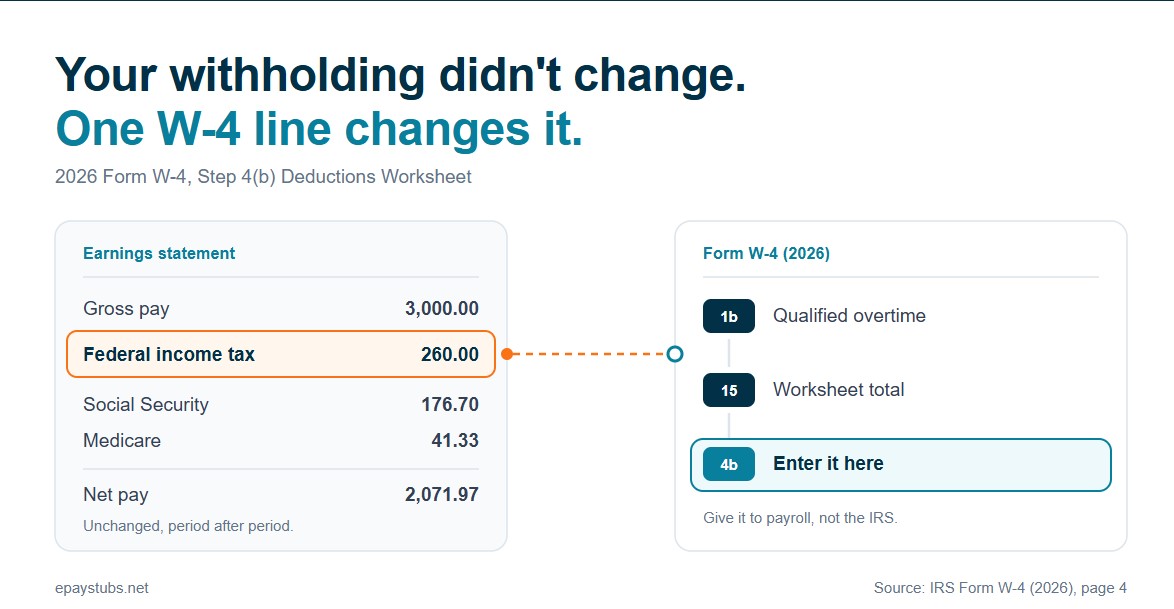
No tax on overtime doesn't lower your withholding on its own. In FS-2026-13, the IRS says employers can't reduce withholding for the deduction unless you hand them an updated Form W-4. The fix is the 2026 Deductions Worksheet: put your expected qualified overtime on line 1b, carry line 15 to Step 4(b).
Why your overtime is still fully taxed
The deduction for qualified overtime compensation was created by Public Law 119-21 and runs for tax years 2025 through 2028. It's a deduction you claim on your federal return. It isn't an exemption that makes overtime wages untaxable at the payroll level.
On August 6, 2026 the IRS published Fact Sheet FS-2026-13, which replaced its January 2026 questions and answers. Question 8 asks whether employers must reduce wages subject to income tax withholding to account for the deduction. The answer is no. Overtime compensation stays subject to federal income tax withholding, and an employer may not reduce withholding for the deduction unless you give them an updated and valid Form W-4.
So your payroll department isn't being difficult. They're following the rule. Until you hand them a new form, they're required to withhold as though the deduction doesn't exist.
There's a second reason an overtime check can look heavily taxed. IRS Publication 505 lists overtime pay among supplemental wages, and some employers withhold supplemental wages under a separate method. That can make a big overtime week look worse than a normal one even before any of this comes up. If the FIT or FWT line on your stub is what's bothering you, that's the line this article is about. If the problem is broader than one line, start with why a paycheck can look lower than expected.
What counts as qualified overtime, and what doesn't
This is where most people get the number wrong, and it's worth slowing down for. The deduction doesn't cover your overtime paycheck. It covers only the premium portion, the extra amount above your regular rate that the Fair Labor Standards Act requires.
On time-and-a-half, that's the "half," not the whole thing. Here's what that looks like with real numbers.
| Worker paid $30.00 per hour, 300 overtime hours in 2026 | Amount | Counts as qualified overtime? |
|---|---|---|
| Total overtime wages at $45.00 per hour | $13,500 | No, this is the whole payment |
| Regular-rate portion, 300 hours at $30.00 | $9,000 | No |
| Premium portion, 300 hours at $15.00 | $4,500 | Yes |
The formula is short: overtime hours multiplied by the difference between your overtime rate and your regular rate.
A few things fall outside it. Overtime that isn't required under section 7 of the FLSA doesn't qualify, so extra pay owed only under state law or a union contract needs separate treatment. Bonuses, holiday pay, shift differentials and straight-time extra shifts aren't overtime premiums at all. You can read the federal requirement itself on the Department of Labor overtime page.
Qualified tips work differently. There's no premium calculation. You estimate the cash and charged tips you expect for the year.
Turning your stubs into an annual estimate
You don't need a spreadsheet. Take your last four to six pay stubs, add up the relevant line, divide by the number of periods, then multiply by your periods per year. Twenty-six for biweekly, twenty-four for semimonthly, fifty-two for weekly.
For overtime, run that on the premium, not the payment. If six biweekly stubs from 2026 show 42 overtime hours total at a $15.00 premium, that's $630 across six periods, or $105 per period, which annualizes to about $2,730 for the year. For tips, use the reported tips figure straight from the stubs.
Then round down. If the 2026 math says $2,730, use $2,500. A conservative estimate means slightly more withholding than you needed, which shows up as a refund. An aggressive one means a bill.
Your estimate is only as good as the overtime hours on your stubs. If those hours have looked off, sort that out first using the guide on pay stub hours that don't match your timecard. A W-4 built on wrong hours produces wrong withholding.
Check you qualify before you write a number
Reducing your withholding for a deduction you can't claim is worse than doing nothing, because the shortfall comes due when you file. Four gates decide it, and three of them have nothing to do with how much you earned.
One more that catches couples. The tips deduction is capped at $25,000 per return, not per person. Two servers filing jointly with $15,000 and $14,000 of 2026 tips have $29,000 between them and a $25,000 ceiling. Combined with the rule about completing Step 4(b) on only one job's W-4, that's easy to overshoot.
The IRS summary of the tips deduction lists these conditions in one place, and the Schedule 1-A page covers the form you'll eventually claim them on.
The 2026 Deductions Worksheet, line by line
Step 4(b) on the front of the form is just a box for a total. The number that goes in it comes from the Deductions Worksheet on page 4 of the 2026 Form W-4. That worksheet runs 15 lines, and the new deductions sit right at the top.
| Worksheet line | What goes there | 2026 limits and thresholds |
|---|---|---|
| 1a Qualified tips | Estimated qualified tips for the year | Up to $25,000 per return, if total income is under $150,000 ($300,000 married filing jointly) |
| 1b Qualified overtime | Estimated premium portion only | Up to $12,500 ($25,000 married filing jointly), same income thresholds |
| 1c Vehicle loan interest | Qualified passenger vehicle loan interest | Up to $10,000, if total income is under $100,000 ($200,000 married filing jointly) |
| 2 | Add lines 1a, 1b and 1c | This total carries straight to line 15 |
| 3a and 3b, then 4 | Senior amounts for age 65 or older | $6,000 each, if total income is under $75,000 ($150,000 married filing jointly) |
| 5 | Student loan interest, deductible IRA contributions, educator expenses and similar Schedule 1 adjustments | No single cap on this line |
| 6 through 14 | The itemized deduction branch, compared against the standard deduction | 2026 standard deduction: $16,100 single or married filing separately, $32,200 married filing jointly, $24,150 head of household |
| 15 | Add lines 2, 4, 5 and 14. This is your Step 4(b) figure | Enter it on the front of the form |
Read line 15 carefully, because it settles the question people get wrong most often. Line 15 adds line 2, line 4, line 5 and line 14. The standard deduction comparison happens inside the itemized branch, at lines 11 through 14. It does not touch line 2.
That means your qualified tips and qualified overtime carry through to Step 4(b) at full value. They don't have to beat the standard deduction first, because these are deductions you can claim in addition to it.
Two filled examples
A server with tips
Single filer, expects $18,000 in qualified tips for 2026, rents, so no itemized deductions and nothing on line 5.
| Line | Entry | Why |
|---|---|---|
| 1a | $18,000 | Under the $25,000 cap and under the income threshold |
| 1b, 1c | $0 | No overtime premium, no vehicle loan |
| 2 | $18,000 | Sum of lines 1a to 1c |
| 4, 5 | $0 | Under 65, no Schedule 1 adjustments |
| 14 | $0 | No itemized deductions to compare |
| 15, to Step 4(b) | $18,000 | Lines 2 + 4 + 5 + 14 |
What that's worth depends on the bracket her income lands in. As an illustration only, at a 12% marginal rate, sheltering $18,000 works out to roughly $2,160 of federal income tax across the 2026 year, or about $83 on a biweekly check. Your own figure will differ, because actual withholding follows the procedures in IRS Publication 15-T and depends on your pay frequency, filing status and the rest of your W-4.
A warehouse worker with overtime
Single filer, $30.00 per hour, expects about 300 overtime hours in 2026. From the table earlier, the premium portion is $4,500.
| Line | Entry | Why |
|---|---|---|
| 1a | $0 | Not a tipped occupation |
| 1b | $4,500 | Premium portion only, well under the $12,500 cap |
| 2 | $4,500 | Sum of lines 1a to 1c |
| 15, to Step 4(b) | $4,500 | Nothing on lines 4, 5 or 14 |
At the same illustrative 12% rate, that's roughly $540 across 2026, or about $21 per biweekly check. Smaller than the tips example, because the premium is a smaller number than it looks like on a pay stub.
Three mistakes that cost real money
The Deductions Worksheet gates lines 1a and 1b on your total income being under $150,000 ($300,000 married filing jointly). The deduction you eventually claim on your return phases out based on modified adjusted gross income above those same figures, per FS-2026-13. They're not the same measure, so if your income is anywhere near the threshold, use the IRS estimator or talk to a tax professional before entering a large number.
What filing in September actually gets you
Here's the part almost nobody explains. Your per-paycheck savings are the same whether you file this form in January or today. What changes is how many paychecks carry it.
Withholding under Publication 15-T works off annual figures, then divides across your pay periods. So the reduction per check doesn't get bigger just because you started late. The rest of the benefit still reaches you, just as a larger refund when you file instead of as cash during the year.
There's also a lag before it starts. Publication 505 says your employer must put a revised Form W-4 into effect no later than the start of the first payroll period ending on or after the 30th day after you give it to them. Some payroll teams are faster. Plan for the slower version.
| If you submit a new W-4 | Roughly when it can take effect | Biweekly checks left in 2026 that could carry it |
|---|---|---|
| Early September 2026 | Early October 2026 | About 6 |
| Early November 2026 | Early December 2026 | About 2 |
| December 2026 | January 2027 | None for the 2026 year |
None of that changes what you're owed. A deduction you don't take through withholding still shows up when you file. It's a cash flow question, not a tax savings question.
What doesn't change, whatever you put on the W-4
Step 4(b) moves one thing: federal income tax withholding. Everything else on your stub keeps working the way it did.
- Social Security and Medicare. Overtime and tips stay subject to these taxes. The deduction is a federal income tax deduction, and it doesn't touch the FICA lines. See how FICA works on a pay stub for the rates and wage limit.
- State income tax withholding. Many states use their own withholding form and their own rules. Changing a federal W-4 doesn't automatically move your SIT or SWT line, and some states tax overtime and tips normally regardless of what federal law does.
- Your gross pay. Withholding changes what's taken out, not what you earned. Gross stays gross.
- Whether you actually qualify. The W-4 is your estimate. Eligibility gets decided on your return.
So if you file the form and only the federal line moves, that's the form working correctly, not payroll making a mistake.
How to submit it and confirm it worked
If the paper worksheet feels like guesswork, the form itself points to the IRS Tax Withholding Estimator, which accounts for what's already been withheld this year. That matters in September, when the paper worksheet can't see the first eight months of your withholding. When you check the result, the guide on reading a pay stub line by line walks through where to look.
You can complete a current-year Form W-4 with the ePaystubs W-4 form generator, preview it, and print it to hand to your payroll department. Use your own real figures, and confirm your employer's preferred submission method before you file it.
What shows up on your 2026 W-2 in January
The 2026 tax year is the first one where your employer reports these amounts separately. Two new Box 12 codes appear on the Form W-2 you'll receive in early 2027.
- Code TT reports your total qualified overtime compensation for the year.
- Code TP reports your total qualified tips.
Box 14 was also split, with Box 14b carrying a Treasury tipped occupation code where it applies. Our guide to every W-2 box and Box 12 code covers the rest of the form.
One detail worth knowing now. FS-2026-13 states that an employee isn't entitled to a qualified overtime deduction that differs from the amount reported on their Form W-2, and that a worker who believes the employer omitted or understated it should request a Form W-2c. So keep your 2026 stubs. If January's figure doesn't match your own records, those stubs are what you'll use to ask for a correction. Don't alter a statement your employer issued, and don't try to substitute your own numbers for what was reported.
Frequently Asked Questions
Because the deduction is claimed on your tax return, not applied at payroll. FS-2026-13 says overtime compensation stays subject to federal income tax withholding, and your employer can't reduce it unless you submit an updated Form W-4 accounting for the expected deduction.
No. Line 1b of the 2026 Deductions Worksheet asks for the "and-a-half" portion only, the premium above your regular rate. At $30 regular and $45 overtime, that's $15 per overtime hour, not $45. Entering the full wage overstates the deduction roughly three times over.
No, and they aren't allowed to. Per FS-2026-13 question 8, an employer may not reduce withholding for the qualified overtime deduction unless the employee furnishes an updated and valid Form W-4. Until then, payroll withholds as if the deduction doesn't exist.
No, though fewer paychecks will carry it. Publication 505 gives your employer until the first payroll period ending on or after the 30th day after you submit it. Anything you don't receive through withholding still reaches you as a larger refund when you file.
No. The deduction applies to federal income tax only. Overtime and tips remain subject to Social Security and Medicare taxes, and to state income tax where your state imposes it. Only the federal withholding line on your stub can move.
Official Sources and References
- IRS Form W-4 (2026), Employee's Withholding Certificate, including the Step 4(b) Deductions Worksheet
- IRS Fact Sheet FS-2026-13, questions and answers on the deduction for qualified overtime compensation
- IRS Publication 505 (2026), Tax Withholding and Estimated Tax
- IRS Publication 15-T (2026), Federal Income Tax Withholding Methods
- IRS, how to take advantage of no tax on tips and overtime
- IRS, what the no tax on tips deduction means for you
- IRS, Schedule 1-A, Additional Deductions
- U.S. Department of Labor, Wage and Hour Division, overtime pay