
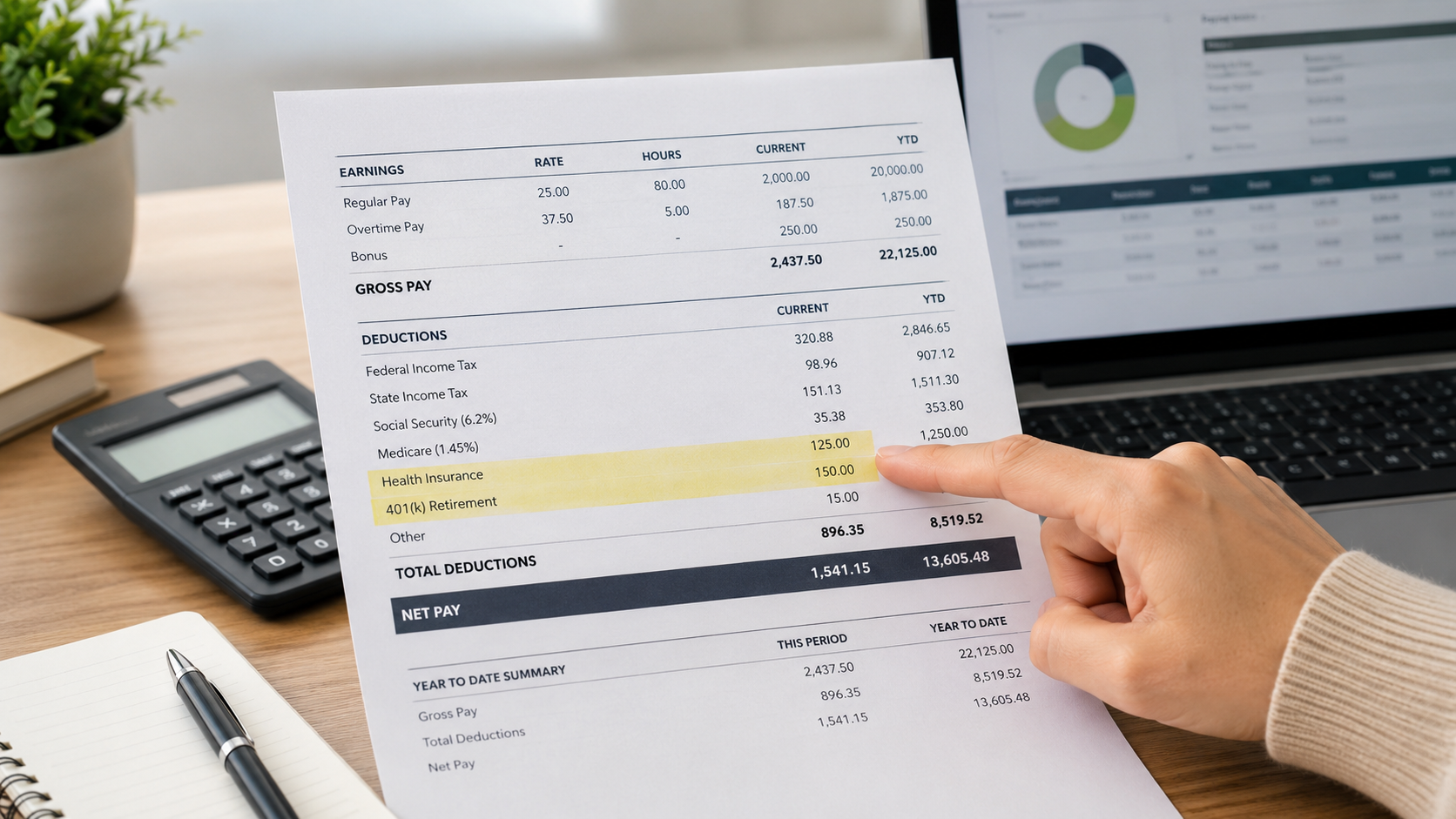
Why Is My Paycheck So Low? Taxes, Deductions, and Pay Stub Mistakes Explained
If your paycheck is lower than expected, first compare gross pay with your previous pay stub. If gross pay dropped, check hours, rate, overtime, unpaid time, bonus, commission, and pay-period dates. If gross pay stayed the same but net pay fell, compare federal withholding, Social Security, Medicare, state or local taxes, insurance, retirement contributions, and other deductions. The line that changed usually explains why your paycheck became smaller.
- Why did my paycheck go down?
- Compare two paychecks
- Gross pay vs. net pay
- Same salary, smaller paycheck
- Different every pay period
- Why are my taxes so high?
- FICA and Medicare in 2026
- Benefits and deductions
- First paycheck is small
- January paycheck is smaller
- Bonus, commission and overtime
- Possible payroll mistakes
- 5-minute paycheck audit
- FAQs
Why Did My Paycheck Go Down? Start With What Changed
If your last paycheck looked normal but the current one is smaller, put the two pay stubs next to each other. Do not begin by guessing which tax caused the difference. Compare the same lines in the same order.
| What Changed? | Likely Reason | Where to Look |
|---|---|---|
| Gross pay is lower | Fewer hours, unpaid time, missing OT, wrong rate, partial period | Hours, rate, earnings, pay dates |
| Gross same, net lower | Taxes or deductions increased | FIT/FWT, FICA, state tax, benefits |
| Federal withholding increased | W-4 information, taxable wages, extra withholding | FIT, FWT, Federal Tax |
| Benefits increased | New enrollment or premium change | Medical, dental, HSA, FSA |
| Retirement deduction increased | Contribution rate or plan election changed | 401(k), 403(b), pension, Roth |
| New deduction appeared | Benefit, garnishment, dues, advance, correction | Other/post-tax deductions |
| First paycheck is small | Partial pay period or cutoff timing | Start date, period dates, hours |
Compare Your Previous Paycheck With the Current One
A side-by-side comparison is more useful than looking only at the new deposit. Use this worksheet with the amounts printed on both pay stubs.
| Pay Stub Line | Previous Check | Current Check | Question to Ask |
|---|---|---|---|
| Gross pay | $_____ | $_____ | Did earnings change? |
| Federal withholding | $_____ | $_____ | Did FIT/FWT increase? |
| Social Security + Medicare | $_____ | $_____ | Did taxable wages change? |
| State/local tax | $_____ | $_____ | Did location or withholding change? |
| Benefits/retirement | $_____ | $_____ | Did premiums or contributions change? |
| Other deductions | $_____ | $_____ | Is there a new deduction? |
| Net pay | $_____ | $_____ | How much did take-home pay change? |
Is Your Gross Pay Lower, or Only Your Net Pay?
Gross pay is what you earned before payroll taxes and deductions. Net pay is what remains after applicable taxes, benefits, retirement contributions, and other deductions are removed.
If you expected $2,000 but received less, first make sure you are not comparing $2,000 of gross earnings with your bank deposit. Your bank deposit normally reflects net pay. See our guide to gross pay vs. net pay for the full breakdown.
A lower deposit by itself does not prove payroll made a mistake. Check the individual earnings, tax, and deduction lines first.
Why Did My Paycheck Go Down If My Salary Did Not Change?
A salary can stay exactly the same while take-home pay changes. Compare the current stub with your previous stub for these differences:
| Pay Stub Line | Previous | Current | Change |
|---|---|---|---|
| Gross pay | $2,000 | $2,000 | $0 |
| Federal withholding | $170 | $180 | +$10 deducted |
| FICA | $153 | $153 | $0 |
| Benefits | $100 | $200 | +$100 deducted |
| Take-home change | $110 lower | ||
Here, gross pay did not change. The smaller paycheck came from $10 more federal withholding plus a $100 increase in benefits.
Why Is My Paycheck Different Every Pay Period?
Hourly employees
Gross earnings can change because of regular hours, overtime, shift differential, PTO, unpaid time, tips, bonus pay, or commission.
Salaried employees
Gross salary may stay stable while net pay changes because of withholding, benefit premiums, retirement contributions, HSA/FSA elections, taxable benefits, garnishments, bonuses, or payroll adjustments.
If the dates themselves are confusing, read our guide to weekly, biweekly, semimonthly and monthly pay periods .
Why Are My Taxes So High on My Paycheck?
If gross pay is correct but the tax section increased, compare the current paycheck with your previous paycheck. Federal income tax withholding generally depends on wages and the withholding information supplied on Form W-4.
A different filing status, multiple-job information, additional withholding request, or another W-4 adjustment can change the amount withheld. See what FIT or FWT means on a pay stub , or use the IRS Tax Withholding Estimator if you need to review federal withholding.
Social Security, Medicare and FICA in 2026
Pay stubs often use FICA, OASDI, SS, MED, or Medicare for payroll taxes related to Social Security and Medicare.
| 2026 Tax | Employee Rate | Important Limit | Possible Labels |
|---|---|---|---|
| Social Security | 6.2% | Up to $184,500 of covered wages | SS, OASDI, FICA SS |
| Medicare | 1.45% | No Social Security-style wage maximum | MED, Medicare, FICA MED |
| Additional Medicare Tax | 0.9% | Employer withholding begins after more than $200,000 of Medicare wages paid to the employee during the calendar year | Addl MED, Additional Medicare |
For more detail, read what FICA means on a pay stub and what MED means on a pay stub .
Benefits and Other Deductions Can Make Your Paycheck Smaller
Some deductions are taken before certain taxes are calculated, while others are taken afterward. See our guide to pre-tax vs. post-tax deductions .
Why Is My First Paycheck So Small?
A first paycheck may be smaller because you did not work the entire pay period covered by the check. If a biweekly period began Monday and you started the following Thursday, your first check may include only the days or hours worked after your start date.
| First Paycheck Issue | Possible Reason | Check |
|---|---|---|
| Smaller than expected | Partial pay period | Start date and period dates |
| Hours missing | Timecard missed cutoff | Timesheet and approval |
| Benefits appear immediately | Coverage or retirement started | Enrollment effective date |
| No deposit yet | Employer payroll schedule | Pay date and payroll policy |
Why Did My January Paycheck Get Smaller?
A paycheck can change at the beginning of a new year because of new benefit rates, withholding changes, retirement elections, or annual payroll-tax calculations restarting.
One example affects higher earners. If an employee reached the Social Security wage maximum late in the previous year, Social Security withholding may have stopped. A new calendar year starts a new wage-base calculation, so withholding can appear again.
Why Is My Bonus, Commission or Overtime Check Smaller?
A paycheck containing bonus, commission, or overtime earnings can look different because gross wages and withholding calculations may differ from a normal paycheck. Compare the earning type, federal withholding, state withholding, Social Security, Medicare, and any deductions that changed.
For bonus-specific details, see why a bonus may appear heavily withheld .
Why are taxes still coming out of overtime pay in 2026?
The phrase “No Tax on Overtime” does not mean every payroll tax or deduction disappears from an overtime paycheck. Current federal rules provide a deduction for qualifying overtime compensation subject to eligibility rules and limits.
Read our guide on qualified overtime and tips on a pay stub or review the IRS overtime deduction guidance .
When a Low Paycheck Could Be a Payroll Mistake
| What You Notice | Possible Error? | Check First |
|---|---|---|
| Regular hours missing | Yes | Timesheet and period dates |
| Hourly rate incorrect | Yes | Rate and employment records |
| Approved overtime missing | Yes | OT hours and cutoff |
| Benefit appears twice | Possibly | Current deductions and benefits |
| Federal withholding increased | Not necessarily | W-4 and taxable wages |
| Wrong state tax | Possibly | Home/work state and payroll setup |
| Net pay does not match deposit | Needs review | Direct-deposit allocation |
If you do not recognize a code, see our guide to pay stub deduction codes .
5-Minute Paycheck Audit
- Check pay-period dates. Make sure the check covers the period you expected.
- Check gross pay. Compare it with the previous paycheck.
- Check hours and rate. Review regular hours, overtime, PTO, commission, bonus, and pay rate.
- Check taxable wages. They may differ from gross pay.
- Check federal withholding. Compare FIT/FWT.
- Check Social Security and Medicare. Look for OASDI, SS, FICA, MED, or Medicare.
- Check state and local tax. Make sure the correct location appears.
- Check benefits. Compare insurance, retirement, HSA, and FSA.
- Check other deductions. Look for garnishments, dues, repayments, or adjustments.
- Compare YTD totals. They can reveal whether a deduction is new or building over time.
- Match net pay with the deposit. Confirm the amount agrees with the payroll record.
See what YTD means on a pay stub if the year-to-date column is unclear.
What Should I Send Payroll If My Paycheck Looks Wrong?
Hi, I reviewed my pay stub for [pay date] and compared it with my previous paycheck. I noticed that [specific line] changed from [previous amount] to [current amount]. My current gross pay is [amount] and net pay is [amount]. Could you please confirm whether the change in [hours / rate / overtime / federal withholding / benefit / deduction] is correct? Thank you.
Do I Still Need a Pay Stub With Direct Deposit?
Yes. A bank deposit shows how much money reached your account, but it does not show how payroll calculated the amount. A pay stub can show gross earnings, hours and rate, taxes, benefits, other deductions, net pay, and year-to-date totals.
If you need help with each section, use our guide to reading a pay stub .
Need a Clear Pay Stub Record?
ePaystubs helps users create organized pay stub records showing earnings, taxes, deductions, and year-to-date totals.
paycheck stub makerFrequently Asked Questions
Check whether gross pay or only net pay is lower. Lower gross pay can point to hours, rate, missing earnings, unpaid time, or a partial pay period. If gross pay is correct but net pay is low, compare taxes and deductions.
Compare your current pay stub with the previous one. Look at gross pay, taxable wages, federal withholding, FICA, state or local tax, benefits, retirement contributions, and other deductions.
You may have worked fewer hours, had unpaid time, received less overtime, had a benefit or retirement change, or had different tax withholding.
Federal withholding, insurance premiums, retirement contributions, HSA/FSA deductions, state tax, garnishments, taxable benefits, or payroll adjustments can change without changing salary.
Hourly employees can have different hours, overtime, PTO, shift pay, tips, bonuses, or commissions. Salaried employees may see changes in taxes, benefits, retirement deductions, taxable benefits, or payroll adjustments.
Compare federal, state, Social Security, and Medicare withholding with your previous pay stub. Federal income tax can change because of taxable wages or W-4 information.
You may have started after the pay period began, worked only part of the period, missed a payroll cutoff, or had benefit deductions begin on the first check.
Check gross pay first. If gross pay is wrong, review hours, rate, overtime, bonus, commission, and pay-period dates. If gross pay is correct but net pay is lower, review taxes and deductions.