
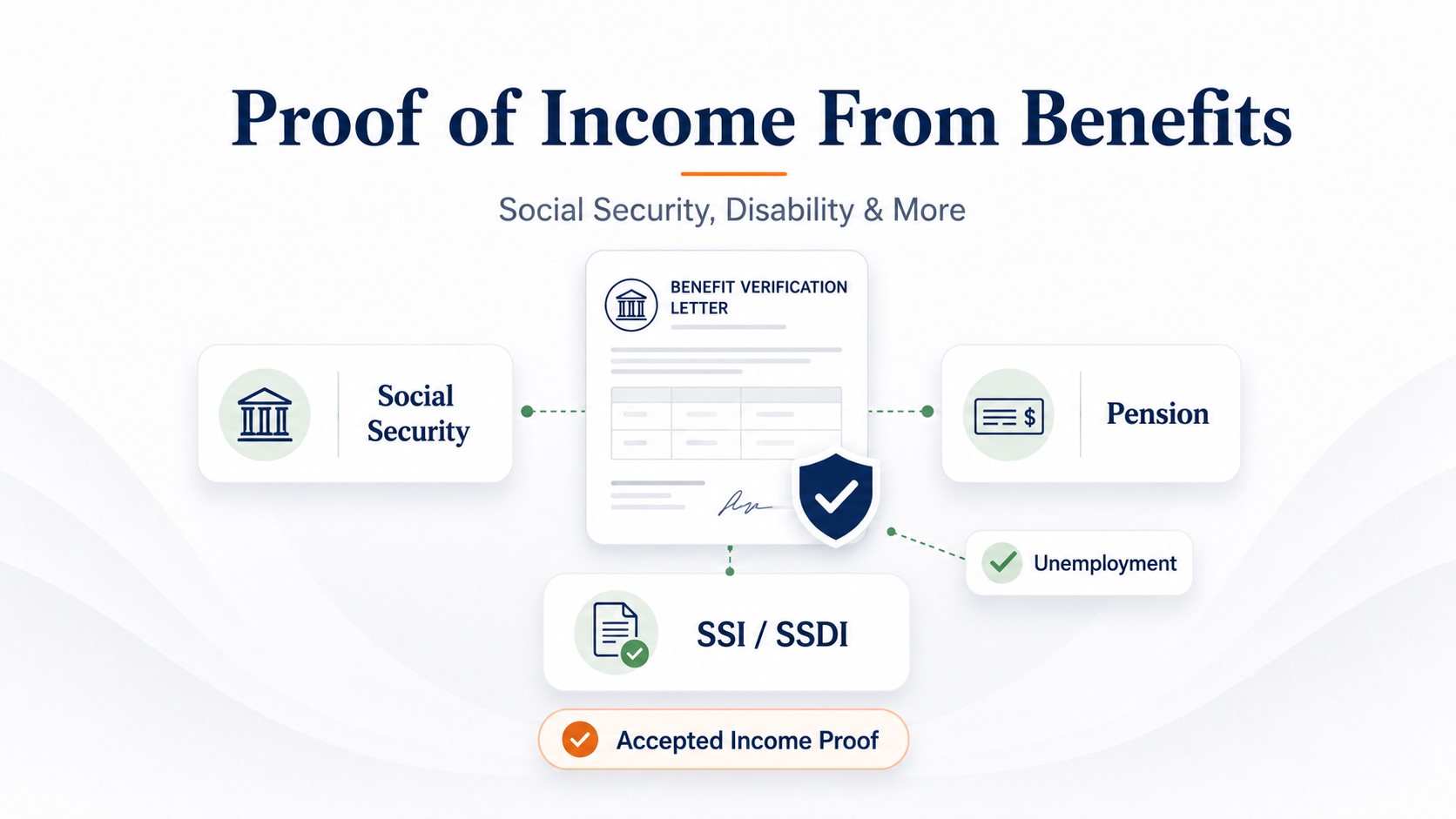
Proof of Income From Benefits: Social Security, SSI, SSDI, VA & More
If you need proof of Social Security income, the best starting document is usually a Social Security Benefit Verification Letter. Eligible users can sign in to my Social Security and download the PDF immediately. The letter can verify that you receive Social Security or Supplemental Security Income (SSI), that you have applied for benefits, or that you do not receive benefits. If an application asks for an original award notice or a prior-year tax form instead, use that specific document.
The key is to match the document to the question being asked. A Benefit Verification Letter is designed for current benefit verification. A Notice of Award documents the original approval decision. An SSA-1099 shows prior-year Social Security benefits for tax purposes. These documents are related, but they are not interchangeable in every application.
How to Get Proof of Income From Social Security
For most people who need a current Social Security or SSI income document, the fastest route is a Benefit Verification Letter from the Social Security Administration. SSA says eligible users can immediately view, print, or save the letter through a personal my Social Security account.
- Sign in to my Social Security. Use the official SSA account page and complete the normal secure sign-in process.
- Open the Benefit Verification Letter option. SSA may personalize the letter based on your Social Security, SSI, Medicare, application, or non-receipt status.
- Review the information before you send it. Make sure the document answers what the landlord, lender, agency, or other reviewer actually requested.
- Download or print the PDF. Keep the original file unchanged and provide it through the recipient's requested submission method.
If SSA mails the letter, its FAQ says the letter is mailed within about 10 business days to the address it has on file. Confirm your address before requesting mail delivery. If you receive SSI and need to change your address, SSA directs you to contact the agency rather than relying on the standard online address-change process.
What Does a Social Security Benefit Verification Letter Show?
A Benefit Verification Letter is an official SSA record used to verify benefit status. The exact information shown depends on the person's situation. SSA describes the letter as proof that someone receives Social Security benefits, SSI, or Medicare; has applied for benefits; or does not receive benefits.
SSA's current SSI guidance says an online verification letter can include details such as:
- Benefit amount and benefit type.
- Medicare information, including a start date and withholding amount when applicable.
- Age of the beneficiary.
SSA also describes the standardized verification letter as containing identifying and benefit information intended to support legitimate verification while reducing misuse. Because the letter is personalized, do not assume every copy contains every possible field.
Benefit Verification Letter vs Notice of Award vs SSA-1099
These are different records. Choosing the wrong one can delay an application, especially when a reviewer uses the word “award letter” loosely.
Benefit Verification Letter
Best for: current Social Security or SSI benefit verification.
What it answers: whether you receive benefits and the benefit information SSA currently shows for your situation.
Notice of Award
Best for: showing the original SSA decision approving a claim and the information provided when the claim was awarded.
Limitation: an older notice may not reflect later benefit increases, deductions, or other changes.
SSA-1099 / SSA-1042S
Best for: prior-year Social Security tax reporting and historical benefit evidence.
Limitation: it is not a current monthly-benefit letter. SSI payments are not reported to recipients on an SSA-1099.
Social Security Statement
Best for: reviewing your earnings record and estimated future benefits.
Limitation: it is generally not the record to use when someone asks for proof of benefits you currently receive.
Can You Get a Benefit Verification Letter for Another Person?
Not simply because you are a spouse, parent, relative, or helper. SSA says you generally cannot obtain another person's Benefit Verification Letter online unless you are an active representative payee for that beneficiary.
An active representative payee can use their own personal my Social Security account to open Representative Payee Services, select the beneficiary, and access the Benefit Verification Letter option. SSA says the representative payee can immediately view, print, or save the letter.
If online representative-payee access is not available for your situation, use SSA's official phone or service-office process rather than trying to create, edit, or recreate the beneficiary's document yourself.
Common Social Security Proof-of-Income Problems
| Problem | What to do | Why |
|---|---|---|
| The reviewer says your letter is too old. | Generate a new Benefit Verification Letter from SSA, then ask whether the reviewer has a specific freshness requirement. | A fresh letter reflects the information currently available through SSA. |
| Your bank deposit is lower than the benefit amount shown. | Check for deductions such as Medicare premiums or tax withholding and provide supporting records if the reviewer asks. | Gross benefit information and the amount deposited after deductions may differ. |
| Your amount recently changed. | Generate a new letter and keep the SSA notice explaining the change if one was issued. | Older documents can reflect a previous benefit amount. |
| You receive SSI but cannot find an SSA-1099. | Use the Benefit Verification Letter or another SSA record requested by the recipient. | SSI payments are not reported to recipients on an SSA-1099. |
| The application asks for an “award letter.” | Ask whether it wants the original Notice of Award or a current Benefit Verification Letter. | The terms can be used inconsistently outside SSA. |
| You cannot sign in online. | Use SSA's phone route or other current service options on the official benefit-letter page. | SSA provides non-online ways to request the document. |
| You need the letter for a spouse, child, or other beneficiary. | Use Representative Payee Services if you are the active representative payee, or contact SSA for the correct route. | Ordinary access to your own account does not authorize access to another person's benefit information. |
| The recipient wants both income proof and deposit history. | Provide the official benefit letter first, then the requested bank records without altering either document. | The letter verifies the agency record; the bank statement can show actual deposits. |
Can Social Security or SSI Be Used as Proof of Income for an Apartment or Loan?
Social Security and other benefit income can be documented for housing, lending, and assistance applications, but the acceptance standard belongs to the recipient or program. The fact that an SSA document verifies income does not mean every landlord, lender, or program uses the same approval formula.
For an apartment or rental application
Start with the current Benefit Verification Letter if the property manager asks for Social Security or SSI income proof. Some property managers may also request bank statements or other payment history. There is no single nationwide private-landlord rule requiring every landlord to use the same “3× rent” formula, so confirm the property's screening criteria rather than assuming one universal calculation.
For a broader document checklist, see proof of income for an apartment.
For a mortgage or other loan
Loan programs can apply more detailed documentation rules. Fannie Mae's current 2026 guidance, for example, accepts several forms of Social Security documentation depending on the benefit type and the beneficiary relationship, including an SSA Award letter, SSA-1099, tax returns or transcripts in applicable cases, and proof of current receipt.
Fannie Mae also does not impose one blanket three-year continuance rule on every Social Security benefit. For retirement or long-term disability based on the borrower's own account or work record, lenders generally do not have to verify continuance unless they have reason to believe the income may stop. Other situations can require evidence that the income is expected to continue for at least three years.
That mortgage guidance is program-specific; it should not be generalized to every personal loan, auto loan, landlord, or benefit program. For a broader comparison, see proof of income for a loan.
Gross benefit amount vs bank deposit
Do not assume one number is always the correct figure for every application. A Benefit Verification Letter may show benefit information while the amount arriving in your bank account can be lower because of deductions such as Medicare premiums or tax withholding. Give the reviewer the official letter first and follow its instructions if it also asks for deposit evidence or a specific income calculation.
Which Proof-of-Income Document Works for SSI, SSDI, VA, Pension, and Unemployment?
Once the Social Security question is answered, the same principle applies to other benefits: use the current official record from the agency or plan paying the income. Historical tax forms can support prior-year income, but they may not show what you receive today.
| Income type | Best current starting document | Useful supporting records | Important note |
|---|---|---|---|
| Social Security retirement, SSDI, survivor, or other Social Security benefits | SSA Benefit Verification Letter | Notice of Award; proof of current receipt; SSA-1099 for prior-year tax evidence | Use the document the recipient specifically requests. |
| SSI | SSA Benefit Verification Letter | Notice of Award; SSA payment or change notices if relevant | SSI recipients do not receive an SSA-1099 for SSI payments. |
| VA disability, pension, or other VA benefits | VA Benefit Summary Letter or applicable VA verification letter | VA payment history or another VA-generated record when requested | Eligible users can download benefit letters through VA.gov. |
| Pension or annuity | Current pension or annuity statement / verification letter | 1099-R; deposit records when requested | A 1099-R is a prior-year tax record and may not prove the current monthly amount. |
| Unemployment benefits | Current determination, benefit statement, or payment history from the state agency | 1099-G for prior-year tax evidence, where applicable | Portal names, document names, and verification procedures vary by state. |
If you receive more than one type of income, document each stream separately. For example, someone receiving SSDI plus part-time wages can use an SSA record for the SSDI and genuine payroll records for the wages. For the broader document hierarchy, see what counts as proof of income and how to show proof of income without pay stubs.
Use Official Benefit Documents Without Altering Them
Do not edit a benefit amount, eligibility status, payment date, agency name, or other information on an official document. If a reviewer needs a different date, a different benefit period, or another document type, obtain a new official record instead.
A pay stub is also not a substitute for a Social Security, SSI, SSDI, VA, pension, or unemployment benefit letter. If you legitimately earn wages in addition to benefits, document the wages separately with genuine employer payroll records.
Do you also earn wages? Use official agency records for benefits and payroll records only for legitimate earned income.
Create a Pay Stub for Legitimate Earned IncomeThe Bottom Line
If someone asks for Social Security proof of income, start with a current Benefit Verification Letter unless the application specifically requests something else. It is the most direct SSA record for current benefit verification and can be downloaded immediately by eligible users through my Social Security.
Use the original Notice of Award when the reviewer needs the approval decision, use an SSA-1099 for prior-year Social Security tax information, and use the corresponding current agency or plan document for VA, pension, annuity, or unemployment income. The strongest submission is not the largest stack of paperwork; it is the official document that answers the exact question the reviewer asked.
Frequently Asked Questions
For eligible users, sign in to my Social Security and download a Benefit Verification Letter. SSA says the letter can be viewed, printed, or saved immediately. If you cannot use the online option, SSA also provides phone and mail request routes.
The exact content depends on your situation. SSA says the letter can verify Social Security, SSI, or Medicare status and can also show that you applied for benefits or do not receive benefits. Current SSA SSI guidance says an online letter can include benefit amount and type, Medicare start date and withholding amount when applicable, and the beneficiary's age.
Not always. SSA sometimes uses “proof of award letter” as another name for a Benefit Verification Letter, but the original Notice of Award is the decision notice issued when a claim is approved. If a reviewer asks for an award letter, confirm which record it wants.
Yes. SSA's current SSI guidance says recipients can get a Benefit Verification Letter online instantly through a my Social Security account. SSI payments themselves are not reported to recipients on an SSA-1099.
Not simply because you are related to the person. SSA says online access to another beneficiary's letter is available when you are an active representative payee. Representative payees can use Representative Payee Services in their own my Social Security account.
SSA's official benefit-letter page says its automated phone assistance is available 24/7 at 1-800-772-1213. When the system asks how it can help, say “proof of income.”
No universal nationwide private-landlord rule requires every landlord to use the same 3× formula. Screening criteria and housing-program rules vary. Ask the property manager which income figure and supporting documents it uses.
No. Fannie Mae's current guidance varies by benefit type and whose record the benefit is based on. Retirement or long-term disability based on the borrower's own record generally does not require continuance verification unless the lender has reason to believe it may stop; other situations can require three-year continuance.
A bank statement can show deposits, but it may not establish the official benefit type, entitlement status, or benefit information in SSA's records. When current benefit verification is requested, start with the agency-issued letter and add bank records only when useful or requested.