
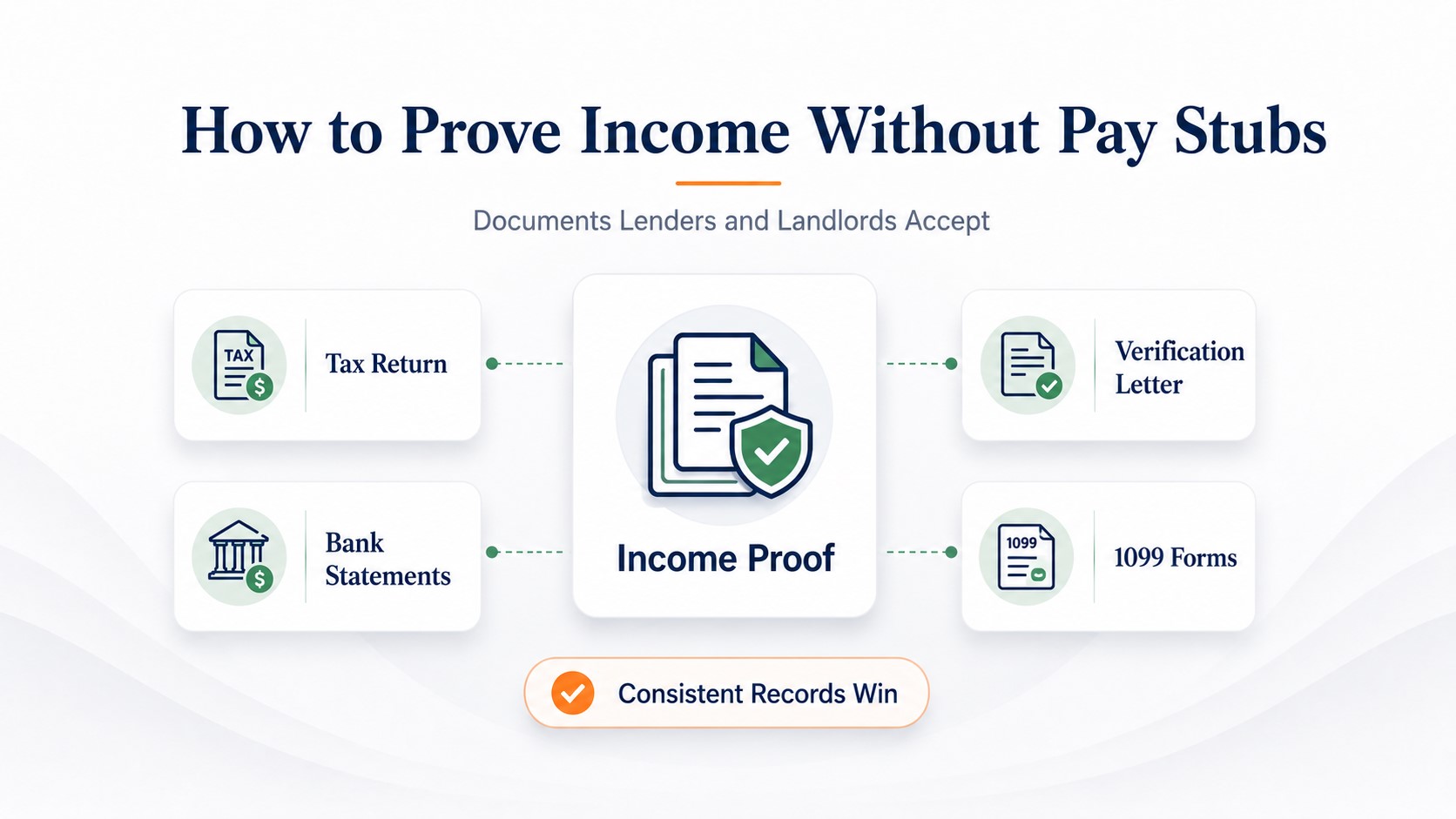
How to Prove Income Without Pay Stubs: Best Documents to Use
If you do not have pay stubs, use authentic records that show where your income comes from, how much you receive, and whether it is current. Depending on your situation, useful documents can include an employer verification letter, signed offer letter, W-2 or 1099, filed tax return or IRS transcript, bank statements, a profit-and-loss statement, paid invoices, platform earnings records, or an official benefit letter. There is no single substitute accepted everywhere, so confirm the recipient's rules before sending financial records.
Start with an employer verification letter, then add a W-2 or recent payroll deposits if requested.
Use a signed offer letter or employment agreement plus HR confirmation. Add the first wage record when it becomes available.
Combine historical tax records with current business, platform, invoice, or bank records that cover the same income source.
Use official documentation for the income you actually receive. If you have no income, ask for the recipient's zero-income procedure.
- Best documents by situation
- 10 documents that may work
- Proof of employment without a pay stub
- Bank statements as proof of income
- New job with no pay stubs
- Self-employed, freelance, or gig income
- Paid in cash
- Unemployed or no income
- Choose documents by purpose
- 3-part verification test
- Build a proof-of-income packet
- Self-prepared pay stubs
- What to do if rejected
- FAQs
Best Proof-of-Income Alternatives at a Glance
Start with the reason you do not have a pay stub. The strongest packet is usually the one that answers the recipient's actual verification question with the fewest clear, authentic records.
| Your situation | Useful starting document | Possible supporting record |
|---|---|---|
| Employee who cannot access pay stubs | Employer verification letter | Recent W-2 and bank record showing payroll deposits, if accepted |
| Recently hired | Signed offer letter or employment agreement | HR confirmation or first payment record |
| Self-employed business owner | Filed tax return or requested IRS transcript plus current P&L | Business bank statements covering the same period |
| Freelancer or contractor | 1099, client records, or platform earnings statement | Paid invoices and matching bank deposits |
| Gig worker | Official platform earnings record | Bank records showing corresponding deposits |
| Paid in cash | Tax record or employer verification, depending on employment status | Income ledger, receipts, paid invoices, and matching deposits |
| Receiving Social Security, pension, or benefits | Official benefit or award letter | Recent account record showing recurring payment, if requested |
| Unemployed but still receiving income | Official document for the income source | Bank or payment record if requested |
| No current income | Recipient's zero-income or no-income procedure | Agency form, attestation, guarantor, or asset documentation if the program allows it |
These are starting points, not universal acceptance rules. Ask what document types, date range, file format, and redaction rules apply before uploading sensitive records.
10 Documents You Can Use as Proof of Income Without Pay Stubs
What matters is not whether a document simply contains a dollar amount. A useful income record should help establish the source, amount, period, and authenticity of the income you are claiming.
| Document | What it can help show | Main limitation |
|---|---|---|
| 1. Employer verification letter | Employer identity, job status, pay rate or salary, and pay frequency | Acceptance and required wording vary; the recipient may verify it with the employer |
| 2. Signed offer letter or employment agreement | Expected pay, start date, and employment terms for a new job | May not prove that work has begun or that a payment has been received |
| 3. W-2 | Wages reported by an employer for a prior tax year | Historical; does not prove the job or pay rate is still current |
| 4. 1099 or official platform earnings record | Payments reported by a client, platform, or other payer | May show gross payments and may cover an earlier period |
| 5. Filed tax return or IRS transcript | Income reported for a completed tax year | Historical and may not reflect a recent change in earnings |
| 6. Bank statements | Deposits and cash-flow patterns | A deposit alone may be a transfer, loan, refund, or other non-income transaction |
| 7. Profit-and-loss statement | Business revenue, expenses, and net income for a stated period | A self-prepared P&L may need tax, bank, invoice, or accounting records behind it |
| 8. Paid invoices, contracts, receipts, or client records | The payer, work performed, payment terms, or payment history | An invoice or contract does not automatically prove the money was received |
| 9. Benefit, pension, or unemployment letter | Official benefit type, amount, and sometimes payment frequency | Use the issuing agency's current document and the recipient's rules |
| 10. Court order or other recurring-income record | Legal or contractual right to certain recurring payments | The recipient may also want evidence that payments are actually being received |
How to Show Proof of Employment Without a Pay Stub
Proof of employment and proof of income are related, but they are not identical. If the immediate question is where you work, start with an employer-issued record rather than trying to replace a missing stub with a self-created document.
| Employment situation | Document to ask about first | Supporting evidence |
|---|---|---|
| Currently employed but cannot access payroll records | Employer verification letter from HR or payroll | W-2 or bank record showing payroll deposits |
| Employer does not issue traditional stubs | Employer verification or official payroll record | Direct-deposit history if accepted |
| Recently hired | Signed offer letter or employment agreement | HR confirmation that employment began |
| Former employee | W-2 or other employer-issued wage record | Employment verification if available |
An employment verification letter should come from an authorized employer contact. If you need a checklist for the fields it can contain, use the income verification letter template.
Can Bank Statements Be Used as Proof of Income?
Yes, when the organization accepts them. Bank statements can show recurring deposits and current cash flow, but they do not automatically identify every deposit as income. A transfer between your own accounts, loan proceeds, refunds, gifts, or owner contributions can all appear as deposits without being earned income.
Make bank records easier to verify by pairing them with a document that identifies the payer. For example, a freelancer can connect a paid invoice or platform statement to the matching deposit. Someone receiving Social Security can pair an SSA benefit verification letter with the corresponding recurring payment if the reviewer requests deposit evidence.
How to Prove Income From a New Job Before You Have Pay Stubs
A signed offer letter or employment agreement can help document expected salary, hourly rate, start date, and employment terms before the first paycheck arrives. The receiving organization may also ask HR or payroll to confirm that you accepted the offer or actually started work.
Once the first payment is made, ask whether an employer-issued wage record or a bank record showing the payroll deposit should be added. An offer letter describes expected income; it does not by itself prove that the income has already been earned or received.
How to Show Proof of Income When Self-Employed, Freelance, or Gig Working
Self-employed applicants often need to show both historical income and current activity. A practical starting package is a filed tax return or requested IRS transcript for history, plus current business or earnings records covering the period the recipient wants reviewed.
- Business owner: tax records + current P&L + business bank statements.
- Freelancer or contractor: 1099 or client/platform records + paid invoices + matching deposits.
- Gig worker: official platform earnings records + bank deposits when requested.
- Multiple clients: use a ledger or P&L to organize income, while keeping the underlying invoices, client records, and deposits available.
For the deeper workflow, use the dedicated self-employed proof-of-income guide and 1099 proof-of-income guide.
How to Show Proof of Income If You Are Paid in Cash
Cash income becomes easier to verify when it has a consistent paper trail. The right documents depend on whether you are an employee or self-employed.
- If you are an employee, ask for employer-issued wage or employment records and keep your W-2 when available.
- If you are self-employed, keep an income ledger, receipts, paid invoices, customer records, regular deposits, and filed tax records.
- Whenever practical, make the date and amount in your ledger reconcilable to a receipt, invoice, customer record, or deposit.
Keep the same records together by date so the recipient can trace each claimed payment from source record to receipt or deposit. If you are unsure which documents are acceptable, ask the reviewer before creating a custom substitute.
How to Show Proof of Income If You Are Unemployed or Have No Income
Being unemployed does not necessarily mean you have no income. You may still receive unemployment compensation, Social Security, disability benefits, a pension, support payments, investment income, or another recurring payment. Use the official record for the income you actually receive.
The Social Security Administration provides a benefit verification letter that can document Social Security or SSI benefit status and is commonly needed for processes such as loans or housing assistance.
If you truly have no income, there is no legitimate income record to create for money that does not exist. Ask whether the organization requires a zero-income attestation, no-income form, asset review, guarantor, pending-benefit documentation, or another approved process. Government and housing programs may require their own forms.
For benefit-specific documentation, see proof of income from benefits.
The Right Evidence Depends on Why You Need It
| Purpose | What the reviewer needs to establish | Practical starting point |
|---|---|---|
| Apartment or rental | Current income and affordability under the property's policy | Employer or tax record plus current supporting evidence the property accepts |
| Personal or auto loan | Income stability and ability to repay | Employer, tax, bank, or earnings records requested by the lender |
| Mortgage | Qualifying income under the loan program and lender's underwriting rules | Follow the lender's exact documentation checklist rather than a generic substitute list |
| Government or assistance program | Eligibility under that program's income definition and review period | Use the agency's required forms and accepted-document list |
For rental-specific requirements, see proof of income for an apartment. For borrowing, use the proof of income for a loan guide.
The 3-Part Income Verification Test
Before submitting a document, ask whether it answers three basic questions. This is a more useful test than asking whether a document is “strong” in the abstract.
Can the reviewer identify the employer, client, business, platform, agency, or other payer?
Does the document clearly show how much income it represents and whether the amount is weekly, monthly, annual, gross, net, billed, or received?
Does the recipient need current income, historical income, continuity, or some combination of those?
If one document answers only one or two questions, add a second record that addresses what is missing.
What usually does not prove income well by itself?
| Record | Why it may be incomplete alone | What can strengthen it |
|---|---|---|
| Unexplained bank deposit | Does not identify whether the money is wages, a transfer, loan proceeds, refund, or business revenue | Employer, invoice, platform, benefit, or tax record |
| Invoice | Shows money billed, not necessarily money received | Receipt, platform payment record, or matching deposit |
| Earnings screenshot | May omit issuer details, date range, account identity, or verification information | Official downloaded platform statement |
| Self-written income summary | Organizes information but is not independently issued | Tax, bank, accounting, employer, client, or platform records |
| Old W-2 | Shows prior-year wages but not necessarily current employment | Current employer verification |
| Offer letter | Shows expected pay but may not prove the job began | HR confirmation or first payment record |
| Transfer between your own accounts | Moves existing money and does not identify a new income source | Evidence of the actual payer or source |
How to Build a Proof-of-Income Packet
- Ask what is accepted. Confirm the approved document types, required date range, deadline, file format, and redaction policy.
- Choose a source record. Start with a document that identifies the employer, payer, agency, business, platform, or other income source.
- Add a current record if needed. Use bank, payroll, platform, benefit, or accounting records to show what is happening now.
- Label the number correctly. Distinguish gross wages, gross business revenue, net business income, monthly income, annual income, billed income, and received income.
- Explain legitimate differences. Use a short cover note when two records cover different periods or measure different things.
- Check the packet. Names, payers, dates, totals, and periods should either match or have a clear explanation.
- Submit securely. Use the recipient's approved portal or document-delivery method for records containing financial or personal information.
Simple proof-of-income cover note
Example: summarize variable self-employment income without changing the underlying records
Suppose a freelancer is asked to summarize the same three months covered by a P&L and business bank records.
| Month | Gross business revenue | Business expenses | Net business income |
|---|---|---|---|
| January | $4,800 | $1,100 | $3,700 |
| February | $5,100 | $900 | $4,200 |
| March | $4,300 | $1,200 | $3,100 |
| Three-month total | $14,200 | $3,200 | $11,000 |
The simple monthly averages are $4,733.33 gross revenue and $3,666.67 net business income. Do not select whichever number looks more favorable. Label each measure accurately and let the recipient apply its own qualifying-income rules.
Can a Self-Prepared Pay Stub Be Used as Proof of Income?
A self-prepared pay stub is not automatically equivalent to an employer-issued or independently verified record. If an actual payroll event occurred and the recipient permits a self-generated payroll record, the figures should match the real payroll, bank, tax, and bookkeeping records.
If no payroll wages were paid, do not create a pay stub merely to make other income look like employee wages. A sole-proprietor owner draw, personal transfer, future invoice, or unreceived payment should not be presented as payroll. Use the authentic documents that describe the income source instead.
Need a pay-period record for genuine payroll?
Use accurate payroll figures and submit the document only when it truthfully represents the payment and the recipient accepts it.
Proof of Income Rejected? Find the Missing Verification
| What the reviewer says | What may be missing | Useful question or next step |
|---|---|---|
| “The document is too old.” | Current-income evidence | Ask which recent employer, bank, platform, benefit, or accounting record is acceptable |
| “We cannot verify the source.” | Payer identity | Add an employer letter, client record, benefit letter, tax record, or official platform statement |
| “The amounts do not match.” | Period or gross/net explanation | Reconcile the original figures without altering the underlying records |
| “Self-created records are not accepted.” | Independent evidence | Ask which employer, bank, tax, agency, accountant, or platform records the policy accepts |
| “Income is too variable.” | Longer history or a program-specific averaging method | Ask for the exact review period and method rather than guessing |
| “The file is incomplete.” | Pages, dates, issuer details, or required attachments | Download a fresh complete copy and resubmit the requested pages |
A useful follow-up question is: “Which part could you not verify—the source, current amount, history, or continuity—and which documents do you accept for that requirement?”
Proof-of-Income Mistakes to Avoid
- Submitting unexplained bank deposits and expecting the reviewer to identify which deposits are income.
- Confusing gross business revenue with net business income.
- Using an old W-2 or tax return as the only evidence when the reviewer needs current income.
- Sending invoices without showing whether the invoice was actually paid.
- Assuming one landlord, lender, or government program's rules apply everywhere.
- Editing, fabricating, or inflating records.
- Sharing more sensitive information than the recipient requires instead of confirming its redaction policy.
Frequently Asked Questions
Use authentic records that show the source and amount of your income. Depending on your situation, that may include an employer verification letter, offer letter, W-2 or 1099, tax return or IRS transcript, bank statements, P&L, paid invoices, platform earnings records, or an official benefit letter. Confirm what the recipient accepts.
Start with an employment verification letter from HR or payroll. A signed offer letter, employment agreement, W-2, or bank record showing payroll deposits may provide additional support if the recipient accepts it.
They can be, depending on the recipient. Bank statements show deposits and cash flow, but a deposit does not always identify the income source. Pair bank records with an employer, tax, client, platform, benefit, or invoice record when source verification matters.
An offer letter can document expected pay and a start date for a new job, but it may not prove that employment began or that wages were received. The recipient may also request HR confirmation or the first payment record.
Use official records for income you still receive, such as unemployment compensation, Social Security, disability, pension, support, or other recurring income. If you have no income, ask the organization for its zero-income or no-income procedure rather than creating income evidence.
A 1099 can help document payments reported by a payer, but it may reflect gross payments and an earlier period. For current or self-employed income, the recipient may also ask for bank statements, paid invoices, platform records, a P&L, or other documentation.
There is no universal number. The period depends on the recipient, application type, and income source. Ask for the exact date range before collecting or redacting financial records.
No. Proof of employment confirms that you work for a particular employer. Proof of income documents money you receive, which can come from employment, self-employment, benefits, pensions, support, investments, or other sources.