
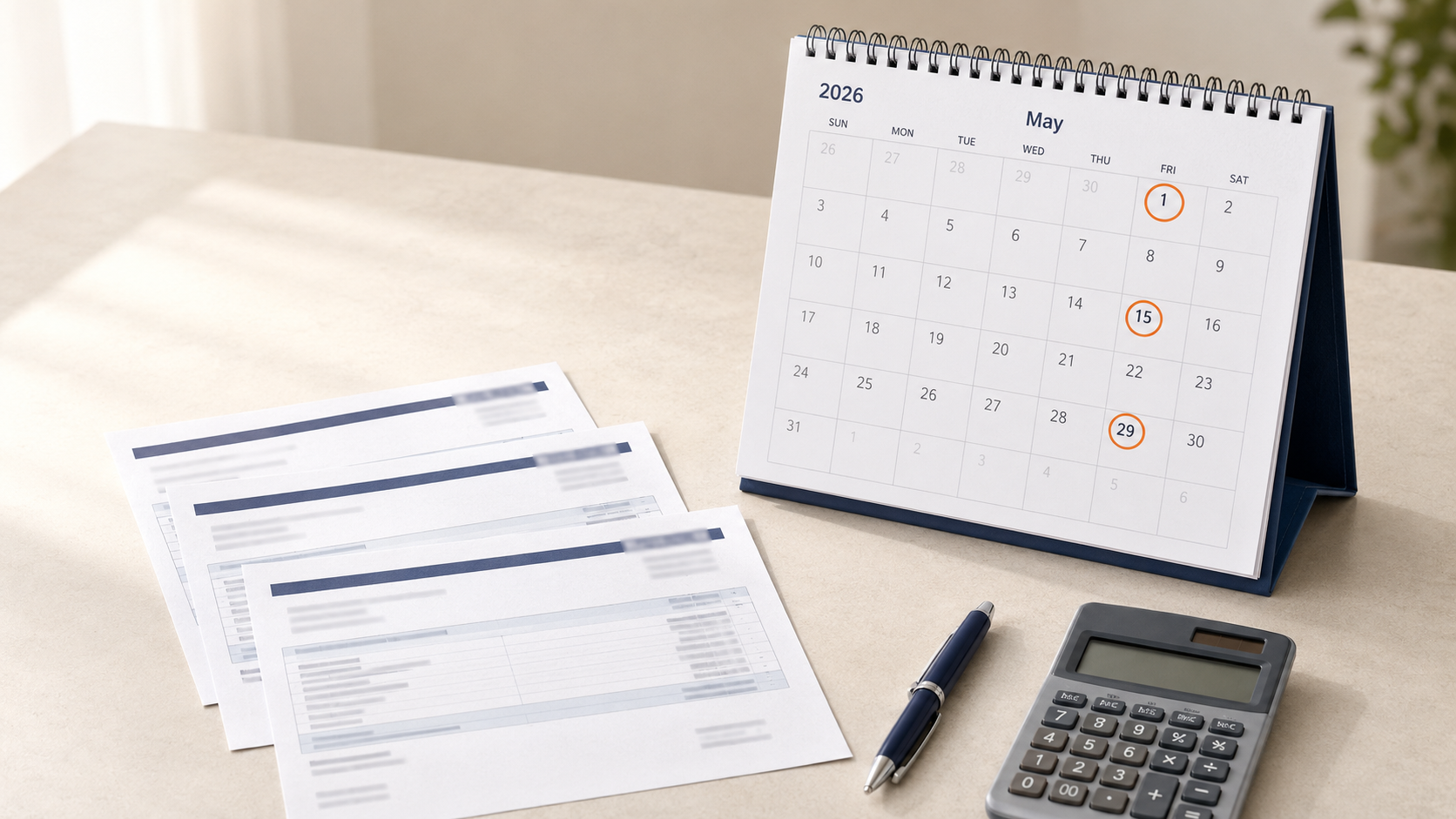
Three-Paycheck Months in 2026: Exact Dates & Calculator
Your three-paycheck months depend on your biweekly payday. For common every-other-Friday schedules, a January 2 payday gives you January and July; a January 9 payday gives you May and October. Other weekdays can produce different months. Check your normal payday below.
These are scheduled 14-day dates, before employer holiday adjustments. July 3 is a federal holiday in 2026. Check scheduled vs. official pay dates.
2026 Three-Paycheck Month Calculator
Enter any normal biweekly payday in 2026 to find your exact three-paycheck months. Avoid one-off holiday-adjusted or early bank-deposit dates.
Print, download or copy your schedule
The ⚑ symbol means that a scheduled date coincides with a listed U.S. federal holiday. It is a warning, not an automatically adjusted pay date.
This tool performs calendar math only. It flags federal holiday conflicts but does not automatically move paydays because employer, payroll-provider and banking policies differ. The 2027 result continues the same 14-day cycle you entered; it does not restart the schedule on January 1. Confirm official dates on the pay stub or employer calendar.
Planning beyond 2026? See the complete 2027 payroll calendar, holiday notes and pay-date examples.
Which Months Have Three Paychecks in 2026?
For the two common Friday biweekly cycles, the first normal Friday payday of 2026 identifies the schedule. The table shows scheduled 14-day dates before employer-specific holiday changes.
| First 2026 Friday payday | Three-paycheck months | Three scheduled pay dates |
|---|---|---|
| January 2, 2026 | January and July | Jan. 2, 16, 30 July 3, 17, 31 |
| January 9, 2026 | May and October | May 1, 15, 29 Oct. 2, 16, 30 |
No January 2026 pay stub? Use any normal 2026 biweekly payday in the calculator above. It works backward and forward to find your full schedule.
What Months in 2026 Have 3 Pay Periods?
If by “3 pay periods” you mean three biweekly pay dates landing in one calendar month, the months depend on your recurring payday. A common Friday cycle containing January 2 has three scheduled paydays in January and July. A Friday cycle containing January 9 has them in May and October.
A pay period is the span of time in which wages are earned. A payday/pay date is the date the paycheck is issued. People commonly search for “3 pay period months” when they mean months containing three biweekly paydays, so this guide shows the pay dates while keeping the payroll terms separate.
Friday, July 3, 2026 is the observed federal Independence Day holiday. An employer may use an earlier official payment or deposit date. The GSA payroll calendar, for example, lists a July 2 EFT deposit date rather than July 3 on its schedule. GSA lists separate official pay dates, which are not necessarily the EFT dates. That is why a generic calendar should never replace the employer’s published payroll calendar.
Is October 2026 a Three-Paycheck Month?
Yes—if your normal every-other-Friday schedule includes October 2, 2026. That track has scheduled paydays on October 2, October 16 and October 30. A different Friday track has only October 9 and October 23.
| If a normal recent payday was… | Your October 2026 schedule | Three checks? |
|---|---|---|
| September 18 | October 2, 16, 30 | Yes |
| September 25 | October 9, 23 | No |
If your normal payday is on another weekday, enter any confirmed 2026 payday in the calculator above. Do not use an early bank-deposit date or a one-off holiday-adjusted date as your anchor.
October 30, 2026 is the third scheduled October payday for the October 2/16/30 cycle. If October 16 was your normal payday, October 30 is the next date on that track. For the other common Friday cycle (October 9 and 23), October has only two scheduled paydays.
October is a three-paycheck month only for schedules whose 14-day cadence lands three official or scheduled pay dates in October. Coworkers on another biweekly track, semimonthly workers and employees whose official payday is shifted can have a different answer.
Scheduled Payday vs Official Pay Date
Early direct deposit can make funds appear in a bank account before the official payroll date. When deciding which month contains a paycheck for payroll records, use the employer’s official pay date or the date printed on the pay stub unless the employer formally changed it.
This distinction matters at year-end. A January 2, 2026 scheduled cycle continues every 14 days through December 18 and then reaches January 1, 2027. If an employer formally moves that January 1 holiday payday to December 31, 2026, the employer can end up recording another official 2026 pay date.
26 vs 27 Paychecks in 2026
A normal biweekly calendar has 26 paydays, but the exact anchor date can place a 27th scheduled date inside a calendar year. Holiday processing can also move a scheduled early-January payday into late December.
| Scenario | 2026 dates | Three-paycheck months |
|---|---|---|
| Jan. 9 Friday scheduled cycle | 26 | May and October |
| Jan. 2 Friday scheduled cycle No year-end date shifted into 2026 | 26 scheduled dates | January and July |
| Jan. 2 cycle Jan. 1, 2027 official payday moved to Dec. 31, 2026 | Potentially 27 official pay dates | January, July and potentially December |
| Jan. 1 Thursday scheduled cycle | 27 scheduled dates | January, July and December |
Employers should review employment agreements, salary-basis requirements, notice obligations, benefit deductions and applicable law before changing any salaried per-paycheck amount. Employees should use the employer’s published payroll treatment rather than a generic 26-or-27 divisor found online.
Three-Paycheck Months for Federal Employees in 2026
Federal employees should use the calendar published by the agency or payroll provider that serves them. The GSA 2026 payroll calendar is a useful real-world example, but it is not a universal calendar for every federal worker.
| Month | GSA EFT pay dates | What it shows |
|---|---|---|
| January | Jan. 2, 16, 30 | Three EFT dates in the month |
| July | July 2, 17, 31 | July 3 holiday shifts the first EFT date earlier |
| December | Dec. 4, 18, 31 | A year-end EFT date lands on Dec. 31 |
The GSA example illustrates why a computed 14-day calendar and an operational payroll calendar can differ. These are EFT deposit dates, not the GSA table of official pay dates; do not treat “three pay periods,” “three official pay dates,” and “three deposits” as interchangeable.
Quick 2026 Biweekly Payday Tracks
Most people do not need the full 14-row matrix. Match one normal early-2026 payday—or use the calculator—to identify the recurring 14-day track first.
Paid on another weekday? The full matrix below covers every 14-day cycle that can begin between January 1 and January 14.
2026 Biweekly First-Payday Matrix
Match the first scheduled 2026 payday in your 14-day cycle. Weekend rows are included for completeness because some payroll records can use weekend check dates even when a bank deposit is released on another day.
| First scheduled payday | Day | Scheduled 2026 paydays | Three-paycheck months |
|---|---|---|---|
| January 1 | Thursday | 27 | January, July, December |
| January 2 | Friday | 26 | January, July |
| January 3 | Saturday | 26 | January, August |
| January 4 | Sunday | 26 | March, August |
| January 5 | Monday | 26 | March, August |
| January 6 | Tuesday | 26 | March, September |
| January 7 | Wednesday | 26 | April, September |
| January 8 | Thursday | 26 | April, October |
| January 9 | Friday | 26 | May, October |
| January 10 | Saturday | 26 | May, October |
| January 11 | Sunday | 26 | May, November |
| January 12 | Monday | 26 | June, November |
| January 13 | Tuesday | 26 | June, December |
| January 14 | Wednesday | 26 | July, December |
Assumption: each row adds 14 calendar days and counts dates that remain in 2026. Holiday and employer-specific processing changes are not applied to the matrix.
Why Do Three-Paycheck Months Happen?
Biweekly means every 14 days. A normal biweekly year therefore produces 26 paydays. If each month contained only two paydays, that would account for 24 checks; the remaining two land in months that contain a third date in the employee’s rolling 14-day cycle.
The U.S. Bureau of Labor Statistics reported that biweekly was the most common pay-period length in its February 2023 private-establishment data, at 43.0%. For a broader explanation of how pay periods differ from pay dates, see What Is a Pay Period?
Biweekly vs. Semimonthly
| Schedule | Typical annual checks | Three-paycheck month? | Pattern |
|---|---|---|---|
| Biweekly | Usually 26 | Yes, usually two months | Same weekday every 14 days |
| Semimonthly | 24 | Normally no | Two planned dates each month |
| Weekly | Usually 52 | Different pattern | Some months contain five paydays |
| Monthly | 12 | No | One planned date each month |
How Much Money Is a Third Paycheck Worth?
A three-paycheck month does not necessarily mean extra annual salary or a bonus. It means a third biweekly payment lands in one calendar month instead of the usual two. To plan for it, use your actual net pay from a typical pay stub, not just your gross salary.
| Month | Paychecks | Take-home cash received |
|---|---|---|
| Typical two-paycheck month | 2 × $1,450 | $2,900 |
| Three-paycheck month | 3 × $1,450 | $4,350 |
| Difference in that month | One extra scheduled paycheck date | $1,450 |
In this example, monthly take-home receipts are $1,450 higher, but annual earnings have not automatically increased. Actual third-check net pay may differ because of benefits, withholding, overtime and other deductions. If you want to set money aside for upcoming costs, compare the third stub against your usual bills and spending before treating the entire amount as available.
Is the Third Paycheck Taxed More or Different?
No special federal tax rate applies merely because a regular paycheck is the third one received in a calendar month. Federal withholding still depends on taxable wages, pay frequency, Form W-4 information and the applicable IRS withholding method. Social Security and Medicare rules also continue to apply to covered wages.
The 2026 IRS Publication 15-T is the official federal withholding-method reference. Your third deposit can still be higher or lower than the first two if earnings, benefits, retirement contributions, garnishments, reimbursements or other payroll inputs changed.
| Pay-stub item | What may happen | What to verify |
|---|---|---|
| Gross pay | Usually follows the normal salary, hours, rate and other earnings for the period. | Hours, rate, overtime, bonus and commission lines. |
| Federal withholding | Still applies; amount can change with taxable wages or W-4 inputs. | Compare with a similar prior check. |
| Social Security / Medicare | Generally continue on covered wages, subject to their rules and annual limits. | Review OASDI/Social Security and Medicare lines. |
| Health / dental / vision | Some employers collect selected fixed benefits from 24 checks; others use every eligible payroll. | Benefit election and payroll policy. |
| 401(k) / retirement | Percentage or fixed-dollar elections can make the third check differ. | Current and YTD employee contribution. |
| YTD totals | Running totals should reflect the new payroll amounts. | Reconcile current lines with the prior stub’s YTD values. |
| Net pay | Can be higher if selected deductions are skipped, but that is not guaranteed. | Compare the stub’s net pay with the actual payment. |
A skipped pre-tax benefit does not always increase net pay by the exact amount skipped because taxable wages can also change. See Pre-Tax vs. Post-Tax Deductions for the calculation order.
Third-Paycheck Pay Stub Checklist
Use the first two checks in the same month as comparison points. A line-by-line check is more reliable than assuming every repeated amount should be identical.
For field-by-field help, use How to Read a Pay Stub. For running totals, see Current vs. YTD on a Pay Stub.
2026 Checklist for Employers
- Count the actual scheduled and official pay dates. Do not assume every biweekly 2026 calendar has the same count.
- Document holiday handling. Paydays near July 3, December 25 and January 1, 2027 can require special processing.
- Review salary treatment before changing a divisor. Check employment agreements, salary-basis requirements and applicable law.
- Review benefit deduction frequency. Identify which deductions run 24 times, 26 times, every eligible payroll or under another schedule.
- Test annual limits and YTD calculations. Review retirement, payroll-tax and other accumulating fields.
- Check state payday requirements. Pay-frequency requirements can vary by state and worker type.
- Tell employees what to expect. Explain any holiday shift, benefit-deduction change or 27-date treatment before it reaches the pay stub.
Need a Clear Payroll Record?
After verifying the real pay-period dates, earnings, taxes, deductions and YTD figures, ePaystubs can organize those details into a readable pay statement.
Create a Pay StubFrequently Asked Questions
For common Friday biweekly schedules, a January 2 cycle has scheduled three-paycheck months in January and July, while a January 9 cycle has them in May and October. Other weekday cycles differ, so use a confirmed normal payday and count every 14 days.
Yes for the common Friday schedule with paydays on October 2, October 16 and October 30. That cycle corresponds to a normal first 2026 payday of January 9. A different biweekly track can have only two October paydays.
Yes for some schedules. A Thursday cycle beginning January 1 has three scheduled December dates. A January 2 Friday cycle can also have a third official December pay date if the scheduled January 1, 2027 payday is formally moved to December 31, 2026.
No. Most biweekly schedules contain 26 scheduled 2026 dates. A 27th date depends on the exact calendar anchor and, in some cases, employer holiday handling.
No special federal tax rate applies simply because it is the third paycheck in a month. Withholding can still differ when taxable wages, W-4 information, benefits or other payroll inputs change.
Sometimes, but there is no universal rule. Some employers collect selected fixed benefits from only certain checks; others deduct them from every eligible payroll. Check the benefit plan and employer payroll policy.
It can change the date visible in your bank account, but it does not automatically change the employer’s official payroll date. For payroll records, use the pay date on the stub or published payroll calendar unless the employer formally changed it.
Official Sources & References
- U.S. General Services Administration — 2026 Payroll Calendar
- U.S. Office of Personnel Management — Federal Holidays
- U.S. Bureau of Labor Statistics — Length of Pay Periods
- Internal Revenue Service — Publication 15 (2026)
- Internal Revenue Service — Publication 15-T (2026)
- U.S. Department of Labor — State Payday Requirements