
What Is a Pay Period? Weekly, Biweekly, Semimonthly & Monthly Pay Explained
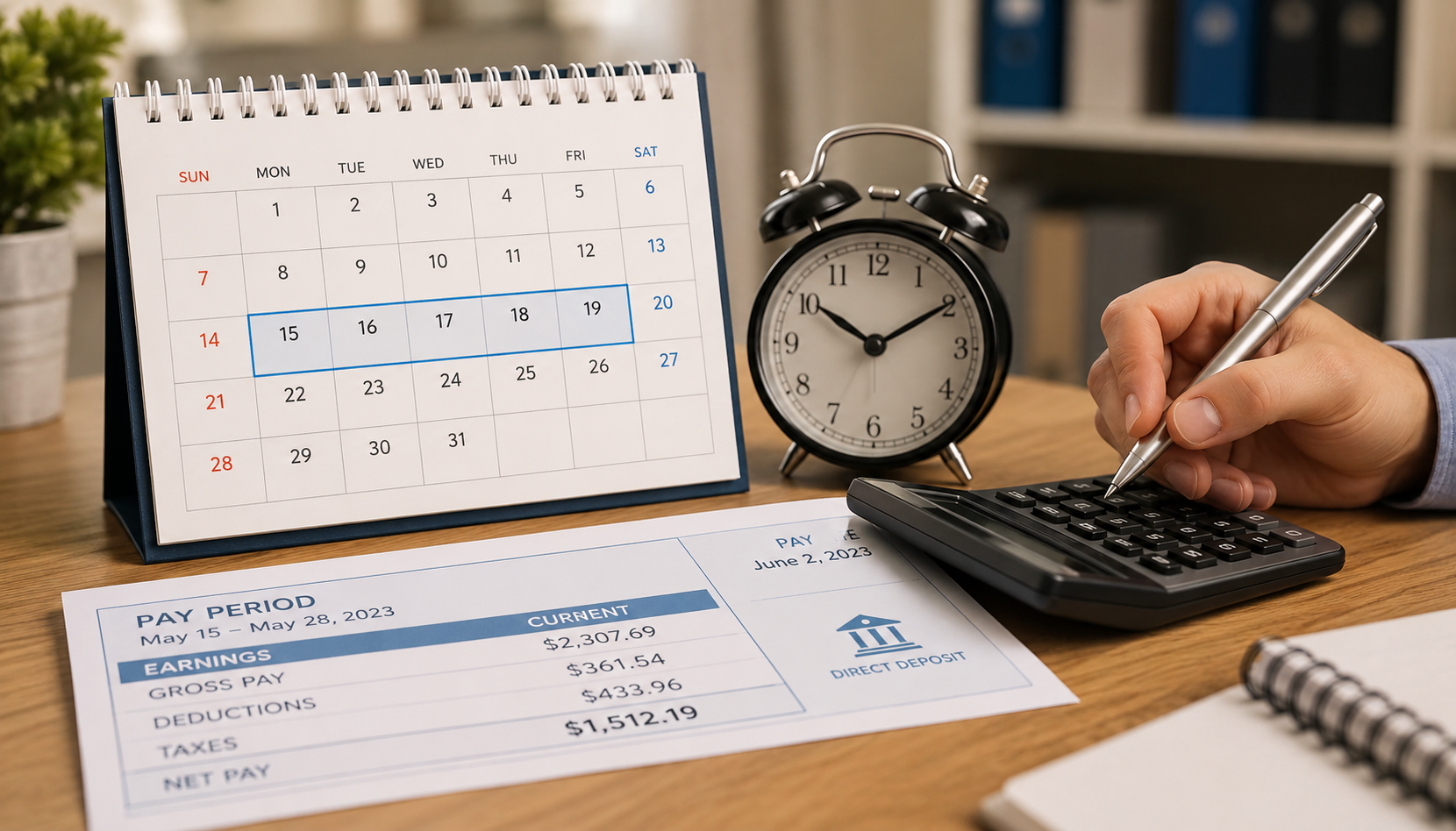
A pay period is the period of time for which an employee's wages are calculated. Weekly payroll normally creates 52 checks per year, biweekly payroll normally creates 26, semi-monthly payroll creates 24, and monthly payroll creates 12. The pay date is different: it is the day the employee actually receives the paycheck or direct deposit.
| Pay schedule | Typical period | Normal checks/year | Typical payday pattern | $60,000 salary/check |
|---|---|---|---|---|
| Weekly | 7 days | 52 | Same weekday every week | $1,153.85 |
| Biweekly | 14 days | 26, sometimes 27 | Same weekday every other week | $2,307.69 using 26 checks |
| Semi-monthly | Variable calendar periods | 24 | Two scheduled dates each month | $2,500.00 |
| Monthly | About one calendar month | 12 | One scheduled date each month | $5,000.00 |
The pay period tells you when the wages were earned. The pay date tells you when the wages were paid. A pay period may end several days before payday because payroll still has to be reviewed, calculated and processed.
What Does Pay Period Mean?
A pay period is the span of service or work used to determine the wages included in a payroll calculation. It has a specific beginning date and ending date and is separate from the later date on which the paycheck is issued.
For example, a fictional employer might use a pay period running from July 1 through July 14 and issue payment on July 18. Work completed on July 15 would normally fall into the next payroll period.
A pay stub commonly shows both the pay-period dates and the pay date. It may also show current earnings, taxes, employee deductions, employer contributions, YTD totals and net pay.
See what is included on a pay stub for a complete field-by-field explanation.
How Long Is a Pay Period?
A pay period is not automatically two weeks. Its length depends on the employer's payroll frequency.
Pay Period vs Pay Date, Pay Cycle and Workweek
| Term | Meaning | Example |
|---|---|---|
| Pay period | The dates used to group wages earned | July 1 to July 14 |
| Pay date | The date wages are issued | July 18 |
| Pay frequency | How often payroll normally pays the worker | Every two weeks |
| Payroll cycle | The repeating process of collecting time, calculating payroll and paying wages | Timecards → calculation → approval → payment |
| Workweek | A fixed seven-day period generally used for federal overtime calculations | Monday through Sunday |
| Payroll cutoff | The deadline for timecards or payroll changes | July 15 |
A biweekly payroll period can contain two separate workweeks. For covered, nonexempt workers, overtime generally cannot be erased simply by averaging hours across those two weeks.
How Common Are Weekly, Biweekly, Semi-Monthly and Monthly Pay?
U.S. Bureau of Labor Statistics data for private establishments shows that biweekly payroll is the most common of the four major schedules.
These figures describe private establishments in the BLS February 2023 pay-period distribution and should not be interpreted as a rule every employer must follow. Different industries use different payroll schedules.
What Is Weekly Pay?
A typical weekly payroll schedule produces 52 paychecks in a standard year. It is especially common in jobs where hours can change significantly from one week to the next.
$60,000 ÷ 52 = $1,153.85 gross salary per regular weekly paycheck
The gross amount is not the same as take-home pay because payroll taxes, benefits and other deductions can reduce the final deposit.
What Is Biweekly Pay and How Does It Work?
Employees on a biweekly schedule are normally paid every 14 days, often on the same weekday. A standard biweekly year normally produces 26 paychecks, although certain calendar alignments can produce a 27th payday.
Is biweekly the same as twice a month?
No. Biweekly means every 14 days. Semi-monthly means two scheduled payments during each calendar month.
That difference is why biweekly payroll normally creates 26 checks while semi-monthly payroll creates 24.
How Many Biweekly Pay Periods Are in a Year?
A year contains about 52 weeks, so paying every two weeks normally produces 26 paydays. Certain calendar alignments can create a 27th payday.
52 weeks ÷ 2 = approximately 26 biweekly payroll cycles
The exact count depends on the continuing payday cycle, not simply on the fact that an employer uses biweekly payroll.
How Many Biweekly Pay Periods Are There in 2026?
Many common 2026 biweekly payday cycles produce 26 paychecks, while certain schedules can produce 27. The result depends on the employer's actual recurring 14-day cycle and where its paydays fall within the calendar year.
| Example 2026 cycle | 2026 checks | Three-paycheck months |
|---|---|---|
| Friday cycle containing January 2 | 26 | January and July |
| Friday cycle containing January 9 | 26 | May and October |
| Certain other recurring cycles | Can reach 27 | Depends on the exact payday sequence |
| GSA 2026 federal payroll calendar | Includes Pay Period 27 | Calendar-specific |
Two employers can both pay biweekly and still have different payday dates and different three-paycheck months. Use your own employer's known payday as the anchor.
If you specifically want to identify months containing three biweekly checks, see: Three Paycheck Months in 2026 .
What Is Semi-Monthly Pay and How Does It Work?
Employees on a semi-monthly schedule normally receive 24 paychecks per year. Common patterns include the 1st and 15th, the 15th and last day of the month, or another fixed pair of monthly pay dates.
2 payments per month × 12 months = 24 semi-monthly payments
How many hours are in a semi-monthly pay period?
There is no universal number of actual work hours in every semi-monthly period because months and calendar periods vary.
For salary administration, some payroll calculations use an average based on a 2,080-hour annual schedule:
2,080 ÷ 24 = approximately 86.67 hours per semi-monthly period
That does not mean an employee literally works 86.67 hours every period. Hourly employees and overtime calculations still depend on actual hours and applicable workweeks.
Biweekly vs Semi-Monthly Pay
| Feature | Biweekly | Semi-monthly |
|---|---|---|
| Meaning | Every 14 days | Twice each month |
| Normal checks/year | 26 | 24 |
| Payday pattern | Same weekday every other week | Two planned dates per month |
| Period length | Consistent 14-day rhythm | Can vary with the calendar |
| Three-paycheck months | Normally two months in a 26-check year | No, normally exactly two checks per month |
| $60,000 salary/check | $2,307.69 using 26 checks | $2,500 |
What Is Monthly Pay?
A standard monthly payroll schedule creates 12 regular payments per year. Individual checks are larger than under weekly or biweekly payroll for the same annual salary, but employees wait longer between payments.
$60,000 ÷ 12 = $5,000 gross salary per regular monthly paycheck
Which Pay Period Is Best?
There is no single payroll schedule that is best for every employer or employee. The choice can affect employee cash flow, payroll workload, overtime administration, budgeting and compliance with state payday requirements.
| Schedule | Employee advantage | Employer advantage | Main drawback |
|---|---|---|---|
| Weekly | Frequent access to wages | Fits weekly hour tracking well | More payroll runs |
| Biweekly | Predictable every-other-week income | Common balance between frequency and administration | Extra-paycheck months can affect budgeting and deductions |
| Semi-monthly | Predictable monthly calendar dates | Only 24 regular payroll runs | Periods do not align cleanly with workweeks |
| Monthly | Larger individual paycheck | Only 12 regular payroll runs | Longer gap between checks |
Payday-frequency requirements differ by state and sometimes by employee classification. Employers should confirm the rules that apply before changing payroll frequency.
2026 Paycheck Schedule Finder
Use this tool to estimate a recurring 2026 payday schedule. For weekly and biweekly payroll, enter one payday you know is correct. For semi-monthly payroll, select the employer's normal monthly pattern.
Find Your 2026 Paydays
This finder estimates recurring payday dates. Employers may move payments because of weekends, bank holidays, payroll rules or company policy. Always confirm dates with your actual payroll calendar.
How Do You Calculate Salary Per Pay Period?
Annual salary ÷ scheduled paychecks = gross salary per regular paycheck
| Schedule | $60,000 calculation | Gross/check |
|---|---|---|
| Weekly | $60,000 ÷ 52 | $1,153.85 |
| Biweekly | $60,000 ÷ 26 | $2,307.69 |
| Semi-monthly | $60,000 ÷ 24 | $2,500.00 |
| Monthly | $60,000 ÷ 12 | $5,000.00 |
Actual payroll can differ because of partial periods, bonuses, commissions, unpaid leave and other adjustments.
How Does Pay Frequency Affect Taxes and Deductions?
Pay frequency changes the number and size of individual payroll calculations. It does not necessarily change the employee's annual salary or annual benefit cost.
Consider a fictional $3,120 annual employee health-plan contribution:
| Schedule | Calculation | Deduction/check |
|---|---|---|
| 24 semi-monthly checks | $3,120 ÷ 24 | $130 |
| 26 biweekly checks | $3,120 ÷ 26 | $120 |
Some benefit deductions are not simply divided equally over every paycheck, especially in an extra-paycheck month. Check the employer's benefit rules rather than assuming every deduction will repeat on a 27th check.
See pre-tax vs post-tax deductions for the tax-treatment distinction.
Do Pay Periods Affect Overtime?
Pay periods determine when earnings appear on a paycheck, but covered, nonexempt employees generally have federal overtime evaluated by workweek rather than by averaging an entire biweekly pay period.
| Workweek | Hours | General result |
|---|---|---|
| Week 1 | 45 | 5 potential overtime hours |
| Week 2 | 35 | No federal overtime based only on hours |
| Two-week total | 80 | The first week's overtime is not normally erased by averaging the weeks |
Employee classification, special rules and state law can affect the actual calculation.
Where Is the Pay Period on a Pay Stub?
Pay-period dates usually appear near the top of the pay stub. Common labels include:
- Pay Period Begin
- Pay Period End
- Period Start
- Period Ending
- PP Begin / PP End
- Pay Date
- Check Date
Current vs YTD
Current generally reflects the present payroll calculation, while YTD accumulates applicable amounts from the beginning of the year through the current payroll.
Learn more in the Current vs YTD guide .
How Long After a Pay Period Ends Do You Get Paid?
Payday may occur on the final day of the period or several days later depending on payroll processing, direct deposit timing, employer policy and applicable state law.
What Pay Period Are We In?
There is no universal U.S. current pay period because employers use different payroll schedules and starting dates.
To identify yours:
- Open your most recent pay stub.
- Find the pay-period start and end dates.
- Identify your frequency.
- Move forward one normal payroll cycle.
- Confirm the result with the employer's payroll calendar.
A coworker at another company can be paid biweekly and still have a completely different current pay period.
Why Is My First Paycheck Smaller Than Expected?
A common reason is a partial first pay period.
Other explanations can include normal taxes, benefits, timecard cutoffs or work falling into the following payroll period.
What Happens When a Pay Period Crosses Two Years?
A payroll period can begin in December and end in January, or the work may occur in December while the actual payment happens in January.
Tax and payroll reporting can depend importantly on when wages are actually paid or made available, so do not assume the work date alone determines the reporting year.
Can an Employer Change the Pay Period or Pay Frequency?
Employers can sometimes change payroll schedules, but applicable state payday laws, notice requirements, contracts and employee classification can affect what is permitted.
If a schedule changes, employees should confirm:
- The final payday under the old schedule
- The first period under the new schedule
- The first new payday
- How benefits and recurring deductions will be handled
- Whether any transition period creates a longer-than-usual gap between checks
How Does Pay Frequency Affect Proof of Income?
Pay frequency changes how many pay stubs may represent the same length of income history.
| Frequency | Approximate stubs covering two months |
|---|---|
| Weekly | About 8 to 9 |
| Biweekly | About 4 to 5 |
| Semi-monthly | 4 |
| Monthly | 2 |
A landlord, lender or agency can require a different document set, so always follow the recipient's stated requirements.
Frequently Asked Questions
A pay period is the date range used to group wages earned for one payroll calculation. The pay date is the date the resulting paycheck is issued.
Weekly periods are normally seven days, biweekly periods 14 days, semi-monthly periods vary with the calendar, and monthly periods cover approximately one month.
Biweekly pay means employees are normally paid every two weeks, usually creating 26 regular checks during the year.
Many common biweekly cycles produce 26 paychecks in 2026, while certain recurring cycles can produce 27. The answer depends on the employer's actual payday sequence.
Semi-monthly means two regular payments each month, normally producing 24 paychecks during the year.
No. Biweekly means every 14 days. Semi-monthly means twice during each calendar month.
Because 26 biweekly paydays have to fit into 12 calendar months, two months commonly contain three paydays. The specific months depend on the worker's actual payday cycle.
It means the amount applies to each applicable payroll cycle. A $100 deduction per pay period, for example, would normally apply to each applicable paycheck.
Employers may need time to approve work hours, calculate wages, process taxes and deductions, and schedule payment.
Yes. Biweekly describes the 14-day rhythm, not one universal U.S. calendar. Different employers can start that cycle on different dates.
Need a Pay Stub for a Specific Pay Period?
Use accurate pay-period dates, earnings, taxes, deductions and YTD information when creating a legitimate payroll record.
Create a Pay StubOfficial Sources
- IRS Publication 15, Employer's Tax Guide
- U.S. Bureau of Labor Statistics, Length of Pay Periods
- U.S. Department of Labor, State Payday Requirements
- U.S. Department of Labor, Fair Labor Standards Act guidance
- U.S. General Services Administration, 2026 Payroll Calendar