
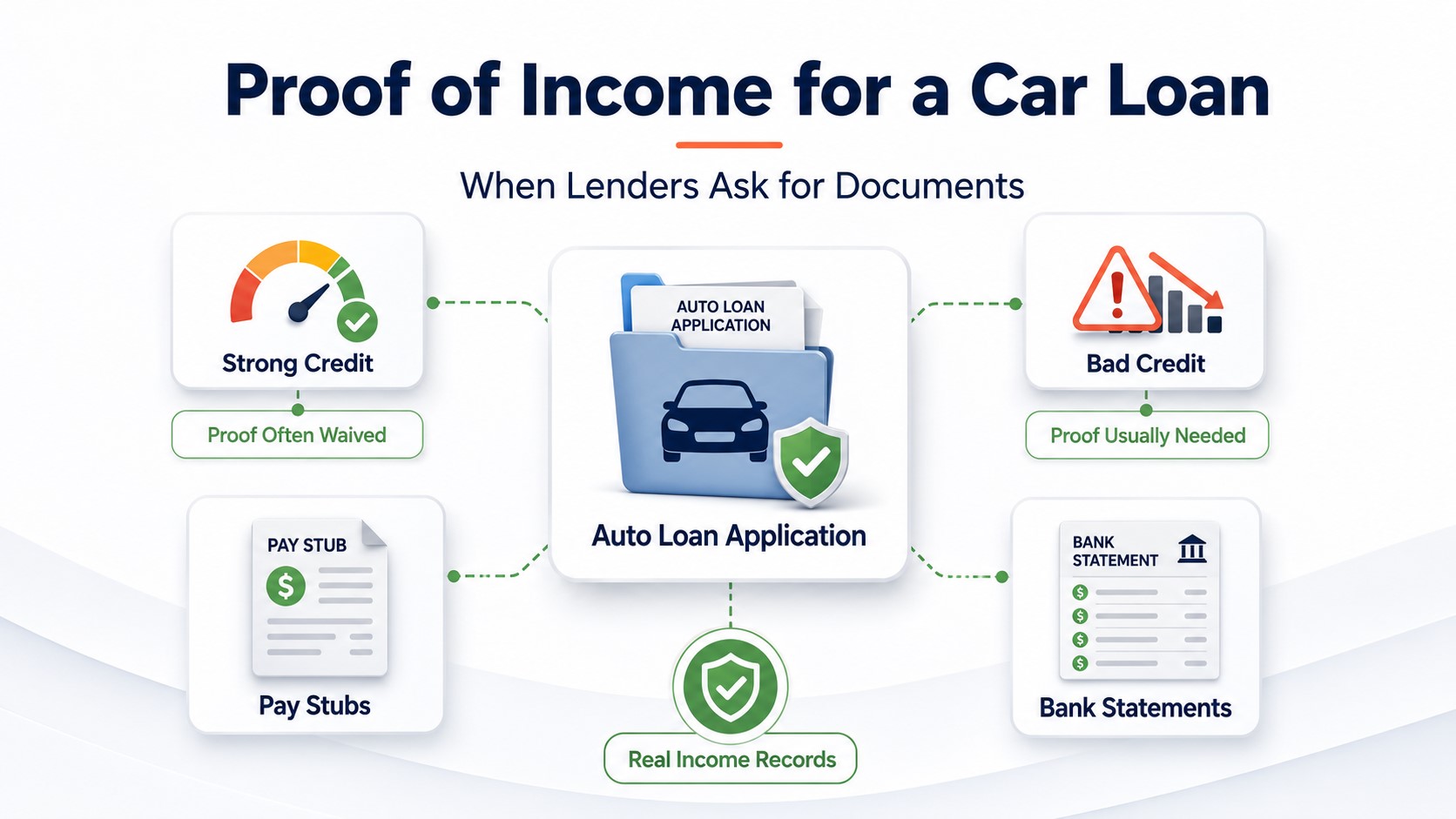
Proof of Income for a Car Loan: When You Need It and What Works
Car lenders may accept recent employer-issued pay stubs, bank statements, W-2s, 1099s, tax returns, employment offer letters, or official benefit statements as proof of income. The exact documents and date range depend on the lender and how you earn money. Ask for the lender's checklist before submitting anything, and use authentic, unaltered records that match the income stated on your application.
Not every auto lender verifies every applicant in the same way. Some can confirm income through a payroll or bank connection. Others ask for documents before making a final decision. Your credit history, current debts, employment, amount financed, down payment, income pattern and the lender's own underwriting rules can all affect the request.
W-2 employee
Start with a current employer-issued pay stub
Self-employed
Expect tax and business-income records
New job
Ask whether an offer letter is accepted
Universal rule
The lender decides the documents and period
Build your car-loan income document packet
Select the description that best matches your income. The tool creates a preparation checklist, not a lender approval decision. It does not request, upload, send or store personal financial information.
Car-loan proof-of-income packet builder
Use the result to ask the lender what it accepts. Requirements can differ even between two lenders reviewing the same applicant.
Start with
Possible supporting records
Ask the lender
Before submitting
Tool limitation: This checklist is educational. It cannot predict approval, establish which income a lender will count, or replace the lender's written requirements.
What documents can prove income for a car loan?
The strongest document is usually produced by the employer, financial institution, tax authority, benefit agency or platform that paid or recorded the income. What works best depends on the source.
| Income situation | Primary records to ask about | Possible supporting records | Important limitation |
|---|---|---|---|
| W-2 employee | Current employer-issued pay stub | W-2, bank statement showing direct deposit, employer contact information | The lender decides how recent the stub must be |
| Recently hired employee | Signed employment offer or contract, if accepted | First pay stub when available, employer verification | A stub from a previous job does not prove current pay |
| Self-employed owner | Filed tax returns and applicable Schedule C or business schedules | Business bank statements, current profit-and-loss statement, balance sheet, contracts or paid invoices | Business revenue is not automatically the same as qualifying personal income |
| 1099 contractor | 1099 forms, filed return and applicable business schedule | Bank deposits, contracts, invoices and current earnings records | The lender may want a longer history when income varies |
| Gig-platform worker | Platform-issued earnings statements or available verification records | Bank deposits, 1099 forms and filed returns | Do not identify the platform as a payroll employer if it is not one |
| Social Security or government benefit | Current benefit verification or award letter | Official statements or bank deposits if requested | The lender may evaluate the amount and likely continuation |
| Pension or retirement distribution | Pension statement, retirement award letter or 1099-R | Bank statements showing regular deposits | One-time withdrawals may be treated differently from recurring income |
| Multiple income sources | The appropriate official record for each source | A short cover sheet matching each source to its document | The lender may not rely on every source listed |
Experian's auto-loan guidance lists pay stubs, bank statements, W-2s, 1099s, recent tax returns and statements documenting other income as possible evidence. Progressive's car-loan document overview likewise notes that pay stubs are common but not the only option.
How many pay stubs do you need for a car loan?
There is no universal number. Experian says it is typical to provide the most recent pay stub or about one month's worth, but the lender may request a different period. A variable-income applicant may be asked for more history than a salaried employee with consistent pay.
Ask two questions before downloading files:
- Which pay periods should the records cover?
- Do you need the latest stub, every stub in that period, or a payroll verification connection?
What should an employer-issued pay stub show?
- employee name;
- employer name and identifying information;
- pay date and pay period;
- gross earnings for the period;
- year-to-date earnings;
- hours, rate, salary, commissions or other earnings when applicable;
- deductions and net pay; and
- figures consistent with the application and supporting deposits.
A year-to-date amount helps the reviewer compare the current stub with the income stated on the application. Use the current versus YTD guide if those columns are unclear.
Do all car loans require proof of income?
No. Some lenders may verify information electronically, use records already held by the institution, or decide that additional documents are not required for a particular application. That does not create a universal credit-score or down-payment threshold for skipping verification.
It is safest to assume you may need to support the income entered on the application. A lender is more likely to ask follow-up questions when:
- income cannot be verified through the lender's normal process;
- the application and available records do not agree;
- income is new, seasonal, commission-based or irregular;
- the applicant is self-employed or receives income from several sources;
- the proposed payment is high relative to the income and existing obligations; or
- the lender's policy requires documents for that loan program.
A “no income verification” loan usually means traditional pay stubs or tax documents may not be requested. It does not necessarily mean the lender ignores ability to repay. Alternative records, assets, bank data, a larger down payment or a cosigner may still be relevant. Terms and requirements vary, so compare the total cost carefully.
How do you prove income after starting a new job?
If your first paycheck has not arrived, ask whether the lender accepts a signed offer letter or employment agreement showing the employer, position, start date and pay. The lender may also contact the employer or require the first official pay stub before final approval.
Do not use a pay stub from a previous job as evidence of current income unless the lender specifically requests past employment history. That document shows what the prior employer paid, not what the new employer will pay.
- Signed offer or employment agreement
- Employer contact information
- Confirmed start date
- Salary or hourly rate
- First official pay stub when available
- Written confirmation of what the lender accepts
How can self-employed and 1099 workers prove income?
Self-employed applicants usually need records that show both income and business expenses. A bank deposit can show that money arrived, while a filed tax return and Schedule C can show reported revenue, expenses and net profit. A current profit-and-loss statement can help connect the most recent business activity with the older tax record.
Chase's self-employed auto-loan guide identifies tax returns, business statements, contracts, invoices and bank statements as possible supporting records. The actual package remains lender-specific.
Suggested self-employed packet
- Latest filed personal and business returns requested by the lender.
- Schedule C or the relevant business schedules.
- Current business bank statements for the requested period.
- Year-to-date profit-and-loss statement if requested.
- 1099s, paid invoices or contracts that explain important deposits.
- A short reconciliation when revenue, deposits and net profit differ substantially.
For the broader document process, use the self-employed proof-of-income guide. Contractors can also review the 1099 income-verification guide.
Gig workers
Start with records issued by the platform: earnings statements, transaction history, tax summaries or an available verification service. Match those records to bank deposits and the appropriate tax documents. A self-prepared summary may help organize the file when the lender accepts it, but it is not an employer-issued pay stub or independent verification.
Platform-specific instructions are available for Uber income records, DoorDash income records and Instacart income records.
Can benefits, pension or part-time income count?
A lender may consider documented income from Social Security, disability, pensions, retirement distributions, part-time work, investments, rental property or other sources, subject to its policy and applicable law. The record should identify the payer, amount, frequency and expected continuation where relevant.
Federal Regulation B says a creditor cannot discount or exclude income simply because it comes from part-time employment, an annuity, pension or another retirement benefit. A creditor may consider the amount and probable continuation when evaluating creditworthiness. See CFPB Regulation B, §1002.6.
For Social Security, SSI, SSDI and retirement documentation, see the proof of income from benefits guide.
Can bank statements be used as proof of income?
Possibly. Bank statements can show recurring deposits and cash flow, but they do not always explain the source, business expenses or whether the income is likely to continue. A lender may accept them alone, pair them with another record or decline them for a particular application.
Prepare bank statements carefully
- Download official statements from the bank rather than using cropped screenshots.
- Include every page requested, even when one page contains no transactions.
- Make sure the account holder and statement period are visible.
- Match deposits to pay stubs, platform statements, invoices or benefit records.
- Ask before redacting account information; an unauthorized redaction may make the document unusable.
- Use the lender's secure portal rather than ordinary email when sensitive information is involved.
Why might a lender reject an income document?
| Problem | Why it creates a question | What to do |
|---|---|---|
| Document is too old | It may not show current income or employment | Ask for the required date range and download a current record |
| Pages, dates or identifiers are cropped | The lender cannot confirm the document is complete | Submit the original complete file |
| Income differs from the application | The lender cannot reconcile the stated figure | Correct the application or provide a factual explanation and supporting records |
| Names or employers do not match | The record may belong to another person or old job | Use the correct current record and explain a documented name change if relevant |
| Business deposits are presented as personal income | Revenue does not show expenses or net earnings | Add returns, Schedule C and a P&L or other records requested by the lender |
| Figures appear edited or reconstructed | The lender cannot rely on the document's authenticity | Replace it with the original issuer-generated file |
| Large deposits have no clear source | A deposit alone does not identify recurring income | Connect the deposit to a pay, invoice, platform or benefit record |
What to do after a document is declined
- Ask which specific document, field or period did not satisfy the request.
- Ask which authentic alternative the lender accepts.
- Correct inconsistencies rather than adding more unexplained documents.
- Keep a copy of the final application and verify that the income and down payment are accurate.
- Compare other lenders if the available records do not fit one lender's policy.
The Federal Trade Commission recommends reviewing the final financing application to confirm it shows the applicant's real income, down payment and personal information. See the FTC consumer alert on falsified car-financing information.
Is there a minimum income for a car loan?
There is no single minimum income that applies to every auto lender and every loan. Approval depends on the requested payment, existing debt, credit history, amount financed, down payment, income stability, lender policy and other factors.
Two calculations may be considered:
Online percentage targets are not universal approval rules. A lender may calculate debts or qualifying income differently.
A larger down payment can reduce the amount financed, while paying down existing debt can reduce DTI. A cosigner may also affect an application, but that person becomes legally responsible for repayment if the borrower does not pay. Read the CFPB explanation of cosigner responsibility.
Prequalification, preapproval and final approval
- Prequalification: an early estimate may begin with self-reported information and a limited credit review. It is not a final loan commitment.
- Preapproval: the lender may request income, identity, residence or other documents before making a conditional offer.
- Final approval: the lender reviews the selected vehicle, loan terms and any remaining verification requirements before funding.
Do not assume a dealership delivery means financing is final. Read the documents and confirm that every term matches the deal you accepted. The CFPB auto-loan resource center provides additional information about comparing and closing an auto loan.
Do not create or alter an employer-issued pay stub
An employee applying for credit should obtain the original pay stub from the employer, payroll department or payroll portal. Do not change an existing record or create a new document that appears to have been issued by an employer.
A self-employed person may prepare an income summary when the lender expressly accepts that format, but it should be labeled accurately and supported by genuine tax, banking and business records. It does not become independent verification merely because it resembles a pay stub.
For employers and payroll preparers: use our pay stubs online to create accurate employee payroll records from real payroll information. Applicants should submit only records the lender accepts and should never misrepresent who issued a document.
Final car-loan proof-of-income checklist
- Ask for the exact document list
- Confirm the required date range
- Use original issuer-generated files
- Check name and employer consistency
- Match income to the application
- Check current and YTD pay
- Connect deposits to income sources
- Include all requested pages
- Explain legitimate inconsistencies
- Use a secure submission method
- Keep copies of the final application
- Never alter or inflate income
Frequently asked questions
Not in every case. A lender may verify income through documents, an approved electronic connection, existing account information or another process. Be prepared to support the income entered on the application.
There is no universal number. The most recent stub or roughly one month's worth may be typical, but the lender can request a different period, especially for variable income.
Some lenders accept bank statements, either alone or with another record. Use complete official statements and connect deposits to their income source.
Possibly. Ask whether the lender accepts a signed offer letter or employment agreement until the first pay stub is available. Approval and required documentation depend on the lender.
Yes. They may need filed tax returns, business schedules, bank statements, profit-and-loss statements, 1099s or other records showing income and expenses.
A lender may consider documented unemployment or other benefit income, but it can evaluate the amount and likely continuation under its policy and applicable law. Ask what benefit records it requires.
Do not create a document that appears employer-issued when it is not. Employees should use employer-generated stubs. A self-employed income summary may be supplemental only when the lender accepts it and every figure is supported by genuine records.
Not automatically. Credit can affect underwriting, but there is no universal score that guarantees a lender will skip income verification.
Authoritative and industry sources
- Experian: Do Lenders Check Income for an Auto Loan?
- Chase: Auto Loans for the Self-Employed
- Progressive: Documents Used for Car Financing
- Truliant Federal Credit Union: Auto-Loan Income Verification
- CFPB: Regulation B §1002.6
- CFPB: Auto-Loan Consumer Resources
- FTC: Check Income and Other Information on the Financing Application
Disclaimer: This article and checklist provide general educational information, not lending, legal, tax, accounting or financial advice. ePaystubs is not an auto lender, dealer or broker. Requirements, underwriting methods and accepted documents vary. Confirm every requirement directly with the lender before applying or submitting sensitive information.