
What Is Proof of Income? Documents, Examples and How to Show It
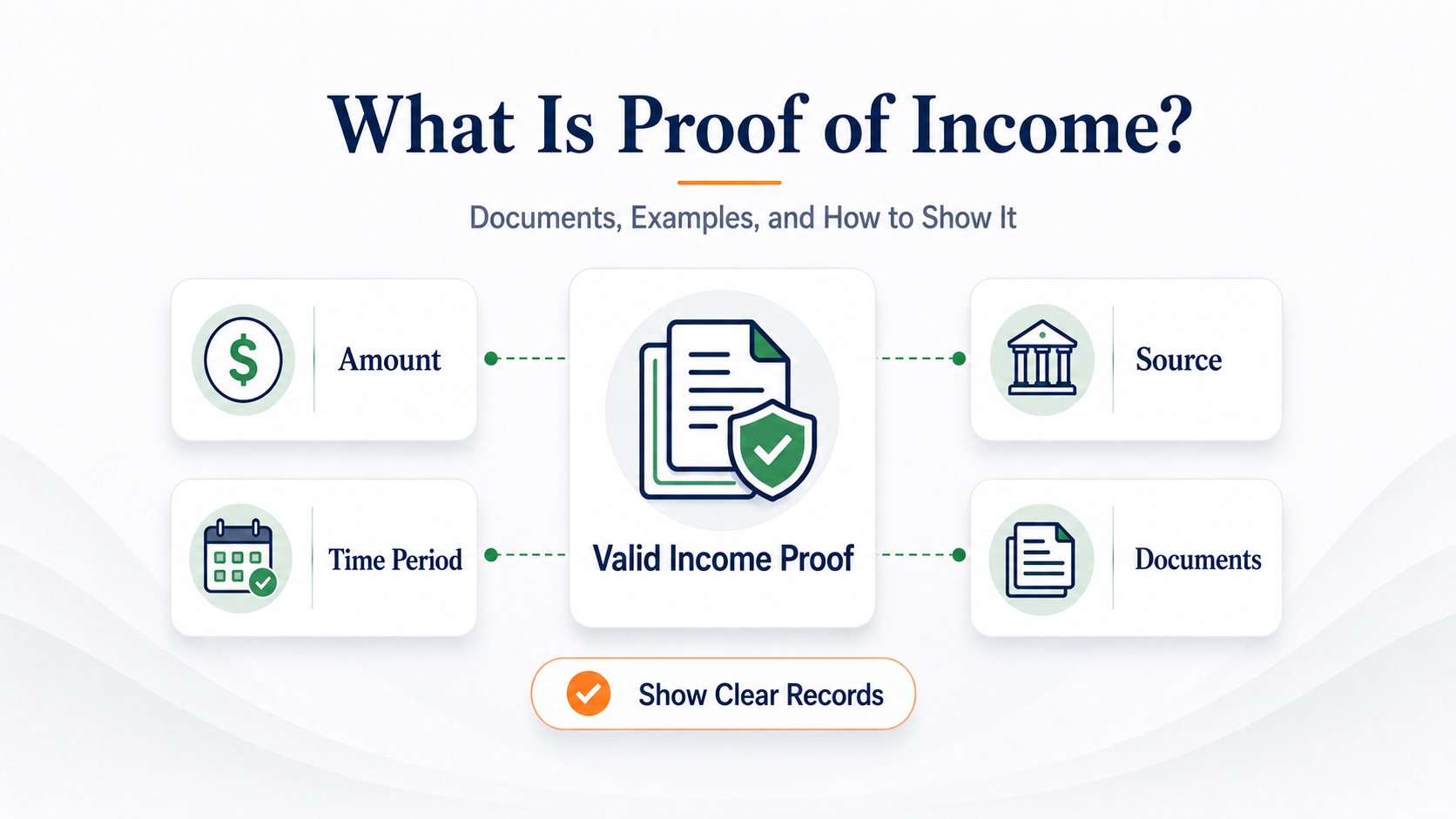
Proof of income is documentation that helps verify where your income comes from, how much you receive and the period it covers. Common proof of income documents include employer-issued pay stubs, W-2s, 1099 forms, tax returns or IRS transcripts, bank statements showing identifiable recurring deposits, employer verification letters, business records and official benefit statements.
There is no universal document that every landlord, lender, employer, court or government program must accept. Confirm the accepted records, required date range, file format and redaction rules before submitting financial information.
What Does Proof of Income Mean?
Proof of income is a record, or sometimes a combination of records, that helps another organization evaluate income you reported. A useful record normally helps answer four basic questions:
This is why a screenshot showing a dollar amount may be less useful than a complete pay stub, tax transcript or benefit letter. The reviewer needs enough context to understand the payment, not simply proof that money exists.
What Counts as Proof of Income?
A record can count as proof of income when it clearly connects you to a legitimate income source, identifies the relevant amount and period, and meets the requirements of the organization reviewing your application. Employer-issued pay stubs, tax records, W-2s, 1099s, income letters, business records and official benefit statements are common examples.
| Record | Often useful for | What it helps establish |
|---|---|---|
| Employer-issued pay stub | Employees | Current wages, pay period, gross pay, deductions, net pay and often YTD totals |
| W-2 | Employees needing annual history | Prior-year wages and certain tax information reported by an employer |
| 1099 form | Freelancers, contractors and other applicable payment types | Certain reported payments from a payer, platform or financial institution |
| Tax return or IRS transcript | Historical income review | Income reported for a prior tax year |
| Employer verification letter | Current employment or compensation | Job status, salary, hourly rate or expected compensation when supplied by the employer |
| Bank statement | Deposit corroboration | Recurring deposits and payment patterns |
| Profit-and-loss statement | Self-employed applicants | Business revenue, expenses and profit over a defined period |
| Benefit verification letter | Social Security, disability or other benefits | Benefit type, amount, status and sometimes payment frequency |
For example, U.S. Treasury income-verification guidance includes records such as pay stubs, W-2s, 1099s, tax filings, bank statements showing regular income and employer attestations in its program framework. Program-specific rules still apply, so this should not be treated as a universal acceptance list.
Proof of Income Documents: Which One Should You Use?
The strongest document depends on the question being asked. A recent pay stub may be excellent evidence of current employee wages but poor evidence of a full prior year. A W-2 may provide annual wage history but does not prove that the employee still has the same job today.
| Document | Best for | Current or historical? | Typical strength | Important limitation |
|---|---|---|---|---|
| Employer-issued pay stub | Current employee wages | Current | Strong | One stub may not show long-term income stability |
| W-2 | Prior-year employee wages | Historical | Strong | Does not prove current employment or current pay |
| 1099 | Certain contractor, platform or payment history | Historical | Strong | Does not normally show business expenses or net profit |
| Filed tax return | Annual income history | Historical | Strong | May not reflect current-year changes |
| IRS transcript | IRS-recorded historical information | Historical | Strong | Different transcript types contain different information |
| Employer income letter | Current employment and compensation | Current / projected | Strong when accepted | Recipient may require contact information, signature or specific wording |
| Bank statement | Confirming recurring deposits | Current / historical | Supporting | A deposit may be income, transfer, refund, gift or loan proceeds |
| Offer letter | New job before first paycheck | Projected | Conditional | Shows expected compensation, not income already received |
| P&L statement | Current self-employment income | Current / historical | Often needs support | May be self-prepared and require tax or bank records |
| Benefit or award letter | Social Security, disability, VA or other benefits | Current | Strong for that benefit | Only documents the named program or benefit |
| Invoices or contracts | Freelance and business activity | Current / projected | Supporting | Unpaid invoices do not prove payment was received |
| Platform earnings statement | Gig-worker income | Current / historical | Supporting | May show gross receipts before expenses |
Employers, clients, platforms and financial institutions generally issue applicable W-2 or 1099 forms and report the relevant information to the IRS. An IRS transcript is a separate IRS record.
What Usually Does Not Work as Proof of Income by Itself?
Some records show that money exists or that a payment is expected, but they may not clearly establish income without additional support.
Requirements differ. A recipient may accept one of these records when combined with another document or under its own verification process.
How Do You Get Proof of Income?
Employees can usually obtain pay stubs or wage records from their employer or payroll system. Self-employed workers generally assemble tax, accounting and banking records. Benefit recipients can request verification from the agency or plan paying the benefit.
How to Show Proof of Income
A strong proof-of-income submission is not simply a large pile of documents. It should answer the recipient's specific question with the fewest complete, relevant records.
-
Ask which documents are accepted.
Confirm the document type, date range, number of records and permitted file format. -
Match the record to how you earn.
Employees should start with wage records. Self-employed applicants may need business and tax records. Benefit recipients should use official program records. -
Use current records for current-income questions.
A prior-year W-2 may not establish what you earn today. -
Add historical records when requested.
Tax returns, transcripts, W-2s or 1099s can provide longer-term context. -
Check that all amounts are understandable.
Know whether the figure is gross pay, net pay, business revenue, net business income or a bank deposit. -
Make supporting records consistent.
If a bank deposit supports a pay stub or invoice, dates and amounts should make sense together. -
Submit records securely.
Use the recipient's secure portal where available and retain a copy of what you submitted.
Current Proof of Income vs Historical Income Records
| Question | Useful starting records | What to remember |
|---|---|---|
| What are you earning now? | Recent pay stubs, employer letter, current P&L, recent platform statements | Confirm the exact period requested |
| What did you earn last year? | W-2, 1099, filed tax return or appropriate IRS transcript | Historical records may not describe current earnings |
| Did money reach your account? | Bank statement or payment record | Connect the deposit to an identifiable income source |
| Is the income expected to continue? | Employer letter, current contract, benefit letter | Expected future income differs from income already received |
| What remains after business expenses? | P&L, Schedule C or applicable business records | Gross receipts and net business income are not interchangeable |
If your pay stub includes cumulative totals, see what YTD means on a pay stub before comparing the amount with annual tax records.
Is Proof of Income Based on Gross or Net Income?
The correct figure depends on the application. Employee pay stubs can show both gross and net pay. Business applications may distinguish gross revenue from net business income. Benefit, tax and lending programs may define income differently.
For employee wages, see gross pay vs net pay .
How Is Proof of Income Verified?
Verification methods vary by organization. A landlord, lender, agency or other reviewer may use one or more of the following checks where permitted:
- Confirm that the applicant's name matches the record.
- Identify the employer, payer, business, bank or government agency.
- Check whether the record covers the requested period.
- Compare current wages with annual or historical records.
- Compare payroll records with identifiable bank deposits.
- Check whether gross pay, net pay and YTD amounts are being interpreted correctly.
- Review whether self-employment records distinguish revenue from expenses and profit.
- Request an appropriate IRS transcript when the process calls for tax-record verification.
- Contact an employer or use an approved verification service where authorized.
- Request replacement records when pages are incomplete, altered, unreadable or inconsistent.
A document can look complete yet still fail the recipient's requirements if the information cannot be verified or does not cover the required period.
Proof of Income Documents by Income Type
Proof of Income When Self-Employed
1099 Proof of Income
Proof of Income for Gig Workers
Proof of Income When Paid in Cash
Proof of Income From Benefits
Proof of Income Without Pay Stubs
Proof of Income by Application Type
Keep this page as the general proof-of-income hub. For situation-specific rules, use the dedicated guide that matches the application.
| Situation | Useful starting documents | Detailed guide |
|---|---|---|
| Apartment or rental | Recent pay stubs, employer verification, tax/business records when applicable | Proof of Income for an Apartment |
| Personal loan | Income records requested by the lender | Proof of Income for a Loan |
| Car loan | Employment/pay records or alternative income documents requested by the lender | Proof of Income for a Car Loan |
| Mortgage | Current earnings plus broader income history depending on lender requirements | Proof of Income for a Mortgage |
| Employer income letter | Employer verification letter containing requested pay/employment details | Income Verification Letter Template |
Choose Your Proof of Income
This tool gives you a practical starting point based on how you earn and why proof is being requested. It does not guarantee that a landlord, lender or agency will accept the suggested documents.
Proof of Income Document Finder
The requesting organization remains the final authority on acceptable records, time periods and verification methods.
Examples of Proof of Income Packages
- Employer-issued pay stubs covering the requested period
- Employer verification letter if requested
- W-2 when annual history is required
- Bank statement only when deposit confirmation is requested
- Latest filed return or appropriate IRS transcript
- Current P&L
- Business bank statements
- Relevant 1099s, contracts or paid invoices
- Current SSA benefit verification letter
- Deposit record when requested
- Other pension or benefit records if applicable
- Earnings statements from each platform
- Bank statements showing matching deposits
- Applicable 1099 forms
- Tax records and P&L where expenses matter
Some applications may accept one current income record. Others may compare several documents. Submit what the recipient requests rather than every financial record you own.
How to Prepare Proof of Income Before Submitting It
- Confirm accepted document types and required date range.
- Use the original PDF or statement from the issuer where possible.
- Make sure your name or permitted identifying information is readable.
- Keep the employer, payer, business, bank or agency identifiable.
- Make pay periods, statement periods, payment dates and tax years readable.
- Identify whether figures are gross, net, annual, monthly, revenue or deposits.
- Include every page the recipient requires.
- Check that supporting documents are logically consistent.
- Explain legitimate changes such as a raise, reduced hours or new job when requested.
- Name files clearly so reviewers can understand what each record is.
Share financial records securely
Use the organization's secure upload portal when one is available. Ask before redacting information because formal applications may require fields that are unnecessary in an informal review.
If redaction is permitted, remove only information the reviewer does not need while keeping required names, income sources, amounts and dates visible. Keep a copy of the exact records you submitted.
Why Was My Proof of Income Rejected?
| Possible problem | What to do next |
|---|---|
| Document is outside the required period | Download a newer statement or request a current letter |
| Name does not match the application | Correct the application or provide permitted documentation explaining the difference |
| Pages are cropped, blurry or incomplete | Submit the complete original PDF or a clear scan |
| Income amounts appear inconsistent | Check whether each record shows gross, net, annual, monthly, revenue or deposits |
| Bank deposit has no identifiable source | Pair it with a pay stub, invoice, platform record, employer record or benefit letter |
| Record is self-prepared | Add independent supporting documents and ask whether the format is accepted |
| Income recently changed | Provide current records and an explanation if requested |
| Wrong income period was submitted | Ask whether the review requires current wages, a tax year or a longer history |
| Recipient does not accept that document type | Request its approved-document list before submitting another record |
Proof of Income vs Proof of Employment, Funds and No Income
| Type | Question it answers | Example |
|---|---|---|
| Proof of income | How much income do you receive, from where and during which period? | Pay stub, tax record, benefit letter, supported deposits |
| Proof of employment | Do you work for a particular employer and what is your work status? | Employer verification letter or permitted employment-verification record |
| Proof of funds | How much money or assets are currently available? | Bank balance or investment statement |
| Proof of no income | What does the organization require when a person reports no current income? | Program-specific zero-income process or other approved verification |
An IRS verification-of-non-filing letter indicates that the IRS has no processed tax return for the requested year. It does not independently prove that a person received absolutely no income during that period.
Can a Self-Prepared Pay Stub Be Used as Proof of Income?
A self-prepared pay stub can organize real payment information, but it is not automatically equivalent to an employer-issued or payroll-provider record. A landlord, lender or agency may reject it or request independent supporting evidence.
Do not invent an employer, hours, wages, deductions, taxes or YTD totals. Do not present a self-created document as employer-issued. If a recipient permits a self-prepared record, the information should match authentic bank, accounting, invoice, tax or payment records.
The Bottom Line
Proof of income is not one universal form. It is evidence that helps a reviewer understand the source, amount, period and nature of your income.
Employees often start with recent employer-issued pay stubs. W-2s, 1099s, tax returns and IRS transcripts can provide historical context. Bank statements can help confirm deposits but may need another document that explains where the money came from. Self-employed applicants often need several complementary records.
The safest approach is simple: first ask what the recipient accepts, choose documents that match how you earn, use records covering the requested period, and make sure the information is complete and consistent.
Frequently Asked Questions
Proof of income is documentation showing the source, amount and relevant period of income. Examples include pay stubs, W-2s, 1099s, tax records, bank statements showing identifiable recurring deposits, employer letters and official benefit statements.
A document can count when it clearly connects the applicant to a legitimate income source, shows an understandable amount and period, and meets the recipient's requirements.
Common documents include employer-issued pay stubs, W-2s, 1099s, tax returns, IRS transcripts, bank statements, employer verification letters, P&L statements, platform earnings records and benefit letters.
Obtain the record from the organization that created it. Employees can request pay records from payroll or HR, taxpayers can obtain IRS transcripts, benefit recipients can request agency verification letters, and self-employed workers can assemble tax, bank and accounting records.
Sometimes. A bank statement can show deposits and payment patterns, but deposits can also represent transfers, gifts, refunds or loan proceeds. Another record may be required to identify the income source.
A W-2 can provide strong evidence of prior-year employee wages, but it does not prove that the person still has the same job or earns the same amount today.
An authentic employer-issued pay stub is commonly used to document current employee wages because it can show the employer, pay period, gross pay, deductions, net pay and YTD totals.
It depends on the application. Some reviews use gross income, others use another defined amount. Follow the requesting organization's instructions rather than assuming gross or net.
There is no universal period. Use the exact date range requested. Current pay stubs or statements may show recent income, while tax documents usually describe a prior tax year.
The number depends on the recipient. One employer-issued record may be enough in some cases, while another review may compare current pay, annual history and deposit records.
An offer letter shows expected employment and compensation but does not prove that wages have already been earned or received. Some recipients accept it for a new job and others do not.
Ask which alternatives are accepted. Depending on your income source, options may include tax records, bank statements, employer letters, platform statements, P&Ls, invoices or benefit records.
Primary Sources
These sources illustrate official income-document and verification practices. They do not establish one universal proof-of-income standard for every application.
- U.S. Department of the Treasury: Income Verification
- IRS: Get Your Tax Records and Transcripts
- IRS: Transcript Types for Individuals
- Social Security Administration: Benefit Verification Letter
- HealthCare.gov: Self-Employment Income
- Covered California: Proof of Income Documents
- Consumer Financial Protection Bureau: Loan Application Packet